Two Poems

SINGLE 

I locked my mouth like the doors of your eyes

Globes full of museums with hollow hallways

Which pocket holds my key?

Which page can cut the deepest?

Break the backspace

Present presents with lessons wrapped in aluminum foil

How do you do it?

Scream for my silence in silence?

Shape the subject into you?

I’ll tell you how I did it

It was not on purpose

Do you feel me running down your hand

Because of how you gripped me?

Every crevice of me leaking?

There’s too much of you

No dictionary has me

Slam the book

Slam yourself inside

I’ll make room

I didn’t notice I let go

I’ve been nurtured into slippery

Cultivated into clumsy

When I said you weren’t bothering me

I didn’t mean it

Each time

And when you insinuated I was made just for you

I wished I were a rib

Replace your question marks with God

Replace your ignorance with facts

Let go of my hand to put yours on the clutch

Reverse me back to the only corner with no webs

Erase the games of tic tac toe on my skin

With your tongue

Undress me to my skeleton

Taste me then kiss me

I use your hair to clean my fingers

Because it feels good

Because I want to feel the residue of your brain under these nails

Then flick them away like the nuisance you are

I love the new haircut

I love the temple

But that is all

We’re the pink spit from brushed teeth

Is it the paste and blood

Because I brushed too hard

Or is it the paste and Koolaid

The cherry kind we breathed as kids

But now doesn’t taste the same

But now taste like required insulin

Disgusting

Won’t you discuss me one more time

Say those words we’ve all heard before

Say it like you mean it

Say it like a song

Say it like we’re single


HOME 

Home is where the sound of sirens are lullabies. Where single moms dream when they blink. Where the candles smell like the places we’ve never been. Where the grass on the other side is as green as money. Home sparkles with resilience. Home has tears that could quench thirst. Sometimes our smiles are tired from being bent but we smile anyway. Home is where neighbors offer you mangos from their trees. Where Grandma plants her own collard greens. Where aunties and uncles smoke blunts and black & milds while playing cards. Where there are t-shirts and towels dancing in the wind, waiting to be dry. Where a surplus of men roam the streets and fatherless children sleep untucked in bed. Home is where your mom approves your sleepover with your cousin just for y’all to laugh until Auntie yells for y’all to go to bed. Home is where the pastors are loud and the choirs are louder. But who one can hear us? Who will listen? Home is where the clouds slow down prayers. Where the people are darker from flying too close to the sun. Home is a whisper of water touching the seeds who can make it out. Home is a 9 to 5. A 7 to 3. An 11 to 7. A clock in and a clock out and a clock broken. Home is a bowl of dirt and glitter. Home is a rearview mirror glistening with neighbors, aunties, uncles, cousins, play-cousins, friends, classmates, moms all waving and watching your journey on the yellow brick road.


CHOYA is an adjunct professor at Adelphi University with a B.A. in Mass Communications and M.F.A. in Creative Writing. Her work has been published in Rigorous Magazine, midnight & indigo, Her Campus, The Crow’s Nest, NNB News and elsewhere. She’s a proud Floridian who lives happily on Long Island in New York.

An Insider’s Guide to Viewing the Night Sky

           If you’re going to count the stars you can’t stop without counting them all. The trouble is in losing track of what’s been counted and what still needs counting. The obvious solution is to section off parts of the sky, string boundary lines between the memorable standouts, clusters to divide, kingdoms to create, without repeating a single one.

# # #

          It took my landlord 23 weeks to evict me. She showed up at the door with an actual cop, wringing her hands and speaking slowly. I could tell she had rehearsed. For her benefit I pretended to be surprised. In a way, maybe I was. When you’ve gotten away with something for 23 weeks — avoiding windows, burning letters — you begin to think it will last forever.

# # #

          I paid the cab with money I borrowed from my dad’s wallet. I’ve never tipped anyone in my life. I took a dump and read an article ranking fifty of the season’s best hunting knives, then made a sandwich and opened a diet Pepsi before turning down the TV and greeting my father.

“Food in the fridge,” he shouted, his voice unused to a quiet TV. I never felt he was anything but happy to see me. Sometimes that thought made me cry.

“What’s on?” I nodded towards the TV.

“You need money?”

“Sure,” I said, and handed him his wallet.

          We ordered pizza and watched Death Race 2, The Shawshank Redemption, and several episodes of Lodge 49. My dad fell asleep in the recliner, his wallet empty. I took my sleeping bag into his bedroom. Memories and dreams are hard to separate, moments morphed like personal fables, but the dark particle board suffocating that room always reminded me of being a baby in a crib, running my fingers down the rough slots where the boards intersected. I imagined the walls were darker now, the carpet denser with whatever it was that age retched into the places of our past. In my mind it was all the same. I hardly looked at the undusted photographs fading in my mother’s frames. I didn’t need to.

# # #

          My father told me that rent would be chores. He seemed happy to say something like that to his full-grown son, like he’d been waiting all his life for it. I couldn’t imagine why. I had never known him to care about work.

         I rummaged through the garage and brought out the mower and a tool I assumed was for pruning, but before I could get going it started to rain. I clipped a couple branches and returned to the couch, my father’s snores reverberating from his armchair. The rain outside tapped like a beggar on the glass. I turned up the TV. 

         That afternoon I helped my dad into his jacket and drove him to the doctor. He didn’t mention the mower by the driveway, the pools of rainwater collecting in its curves.

“Nice weather,” the receptionist said. My father smiled.

        In the waiting room I thumbed through candids of actors and rock stars, lamenting how normal they looked in bathing suits or at restaurants, pushing strollers and arguing with their wives. I liked them better on the screen where they looked perfect and beautiful, impossibly smooth. To think of their success as unachievable because of their perfection, it made it easier to live a life like mine. A life like my father’s and, I guessed, his father’s before him. “One day at a time,” my father would say. “That’s all you can ask for.” Ambition, purpose, direction: they meant nothing to people like us.

         A nurse came into the waiting room and said my name. I followed her through a hallway that smelled like piss and bleach. “You can have a seat here,” she said, then left. My dad smiled at me. He was propped at the end of the exam table, naked beneath his smock. His ankles were stark white with purple and red splotches and his arms mostly matched. I noticed that someone had folded his clothes on one of the extra chairs. I took out my phone then put it away.

When the doctor arrived she shook my hand.

          “Your father’s condition is not improving,” she said. I couldn’t decide how to react. My dad and I rarely talked and when we did it was definitely not about our health. “Heart failure and stroke are now very serious concerns. Inevitable, it seems to me.”

           She proceeded to lecture about lifestyle and diet, about options for in-home care. Doctors always made me feel guilty. 

“How bad are we talking?” I asked. 

She made a sad little smile and handed me a sheet titled “End of Life Solutions.” 

“I suggest you start taking this seriously,” she said.

# # #

          We went for ice cream on the ride home. We ordered from the same window my father used to lift me up to see into, but the menu held no splendor. It was chipped and peeling. Mildew stained the sill. The server wouldn’t look us in the eye as she listed off the flavors she was out of.

          “Sorry,” my dad said. “About all this.” He waved his arm weakly. “I should have told you. Or left you out of it.”

           I tried putting myself in his place, his colorless tongue scooping rivulets off his cone. Maybe you reach an age and you stop caring. Maybe you care more and more as the reality of life sets in. Or maybe age and caring have nothing to do with it. I handed him a napkin to wipe his face.

# # #

           I made sandwiches for dinner and we watched The Fugitive, Independence Day, and MASH until my dad fell asleep in his recliner. With the TV still flickering I took my sleeping bag onto the uncut grass, feeling its wetness creep through the down and into my clothes and skin. The sky was a million miles away.

           You have to pick a place to begin. Pick a point and know that no matter what, you won’t return to it. You have to draw lines. Cut it all apart and string it together in a way you won’t forget. A way that moves you forward, only forward, so you’ll never go back and count it twice. Because if you did you’d risk every piece of progress, risk losing it all as the sky twists past, twisting so to start again would be a new task entirely. 

An entirely new sky with entirely new stars to count.


END


LUCAS LEERY is an educator at a maritime history museum in Maine. He likes noisy guitars, unhinged sentimentalities, and falling asleep on the beach. Some of his stories have appeared in Mad Scientist Journal and Sorrow: A Horror Anthology.

Americans in Paris

I’m beginning to think it’s not the French

donning funeral black, but the tourists,

temporary Hemingways. We’re the ones

sulking on park benches outside Notre Dame,

clutching notebooks, ink pens, watercolor

visions of the Seine at dusk. Paris blushes

crepe as lovers’ tongues waltz to a violin

Sinatra on Pont de Sully. We feverishly write

down the image. Finally, good material. Spectators,

we observe the city of love with no one to hold us

back at the hostel. And so we sip red wine bought

from a peddler, drunk on the idea that we must suffer

for divine inspiration. Years from now, failed novels later,

we will swear to God the gargoyles were laughing at us.


ANISSA LYNNE JOHNSON is a writer and motivational speaker from Gladstone, MI. She is currently an MA candidate at Northern Michigan University. Her work often centers on grief and healing, hope and faith, and the little moments that pave the large world we live in. Her creative work has appeared or is forthcoming in Tiny Seed Journal and Haunted Waters Press. When she isn’t traveling the world or writing, she can be found at home with her husband and eleven plant children.

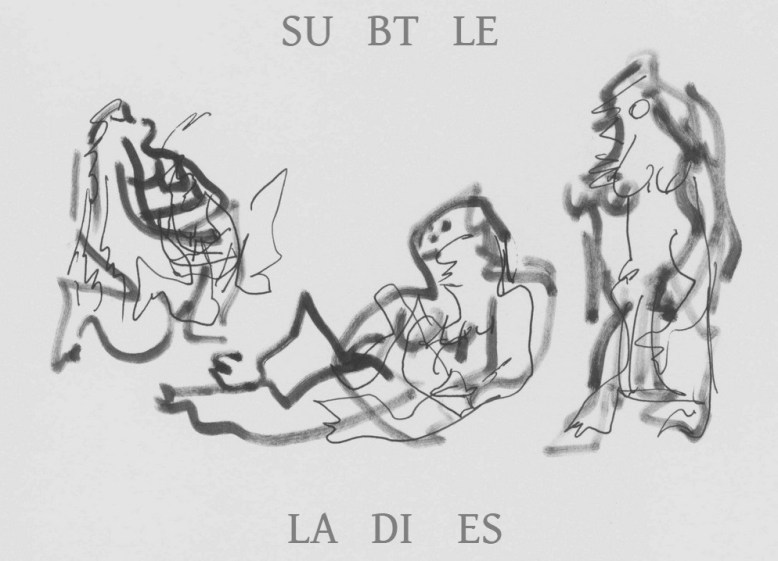
Subtle Ladies

4

‘Subtle Ladies,’ grayscale digital scan of original brush and pen and ink drawings on watercolor paper with digital text added, 2019


JOHN VIEIRA‘s visual art (digital, and in various physical media) has steadily appeared in print in small presses and in gallery and museum group shows in the U.S. and in over a dozen other countries, as well as appearing in mainstream anthologies and reference books, including The Art of Typewriting (Thames & Hudson, 2015) and A Dictionary of the Avant-Gardes, 2nd edition (New York: Schirmer Books, 2000).

The Failure of Photography


You and I spilled 

chemicals in the darkroom,

the wall gave us electric shocks.


1970’s hippie school: two

12-year-olds of opposite genders

with unsupervised lab access.


We poured stop bath into plastic tubs,

watched the images 

bloom in black and white,

their buds opened wide.


Usually we handled chemicals

like responsible adults: 

disposed of toxic waste 

down the sink drain,

washed our hands afterwards.


One day, in a hurry,

we spilled tub after tub

onto the cement floor: 


chemicals sloshed against

the dangling wires and

created a series of shocks

that reverberated through our bodies.


We did our best to clean up

before the teachers could find us

and revoke our darkroom privileges.


You and I made it back to class,

the teachers hadn’t even 

noticed we were gone.


They gave us unlimited freedom

while they sat in the corner,

chain-smoked filtered cigarettes,

and told us never to start

or we’d end up just like them.


So I hope it wasn’t you, but 

someone else with your name:

that young man on the internet


framed for murder, found 

not guilty due to insanity, 

confined to the state hospital;


exonerated 20 years later

on the basis of new evidence,

but Google doesn’t lie, and besides,


who else could it possibly be?


LEAH MUELLER is an indie writer and spoken word performer from Tacoma, Washington. She is the author of three chapbooks and five books. Her most recent book, Misguided Behavior, Tales of Poor Life Choices was published in September, 2019 by Czykmate Press. Her new chapbook, Death and Heartbreak (Weasel Press) is forthcoming in October, 2019. Leah’s work appears in Blunderbuss, The Spectacle, Outlook Springs, Atticus Review, Your Impossible Voice, and other publications. She was a featured poet at the 2015 New York Poetry Festival, and a runner-up in the 2012 Wergle Flomp humor poetry contest.

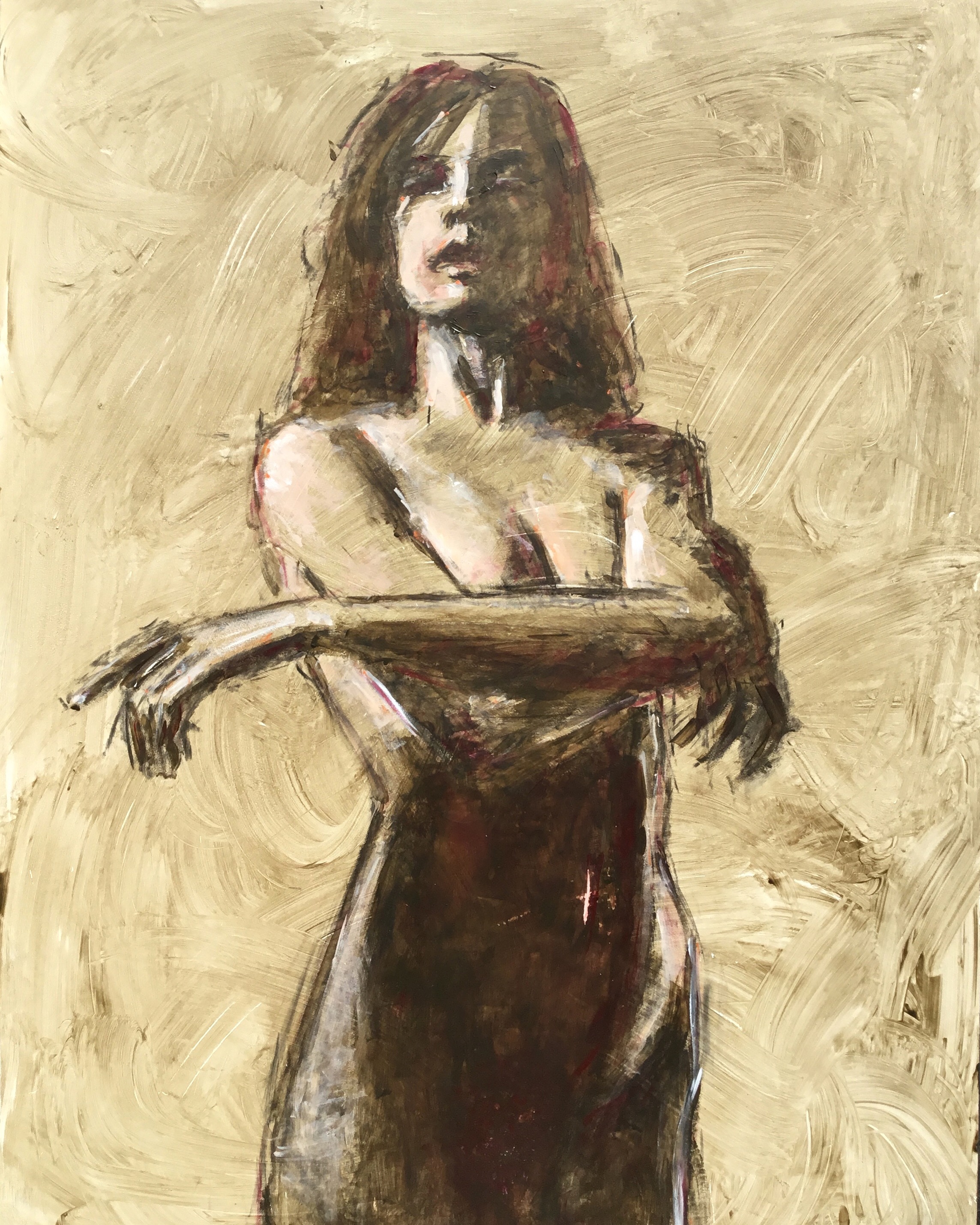
Portrait of A Lady Wicca

Artist Statement: Whatever technique I use, my goal is to catch the expression deep inside the character. For me, the portrait is the mirror of the soul of the model…of the painter too. There is a lot of me in my portraits, mixed with a lot of my models.


D36CF649-8FCD-4CD5-A286-6BBF7FF93249.jpeg

‘Portrait of A Lady Wicca,’ Acrylic on Wood, 2019


DOMINIQUE DÈVE is a french painter. His expressionist figurative style allows him to exhibit in Paris, Los Angeles, New Delhi, Sheffield. ArtMajeur Golden Award In 2018, he obtained ArtCheval Medal in 2019. « The portrait is the mirror of the soul, of the model, of the painter. »

Cooked Meat

I

She could not remember the exact moment she forgot her name, or what time it was, what she was doing, what she was thinking. But she was sure she was running, or thinking of running. In her head, she had covered a thousand miles, even though she had never known the world beyond Balambala, the small, permanent village two hundred miles northwest of Garissa, Kenya, where she had lived all her sixteen years. She was sure too she was crying, wet-crying—with tears, that is—or dry-crying, without. She must have felt fear too, fear forceful enough to wipe out the memory of herself, like a storm that ravages a city into unrecognition.

But she remembered the moment she realised she had in fact forgotten her name: two minutes ago when the woman selling khat asked her the question. She was at the Rahole bus stage, having just landed in Garissa town after a three-hour journey on the back of a speeding Land Cruiser from Balambala. She stood next to the stalls, not knowing what to do, where to go, her face red with dust, like the soil of Saka.

Uhm…my name? She hesitated to drink even though she was dying of thirst. She then took one little sip, wincing as she swallowed.

Yes.

My name is…uhm…my name is…

It’s alright dear I understand if you don’t want to tell me.

She thought she was having a momentary brain freeze that would go away immediately. Of course I know my name, she thought. I’ve known it all my life. Nobody forgets their name. It’ll come to me in a flash.

II

She walked away from the stage down the road, lest someone at the stage might recognise her. The midday azan rung out from the mosques. She walked on, even though every step she took was a step closer to getting lost. There were so many people than she had ever seen. The more she walked the more buildings she saw. Back in Balambala when you walked for two minutes in any direction you ran smack into woods. Here they had no end.

Perhaps the day she forgot her name was the day mom and dad told her about it. It was noon, and she had just come from school with her friends Najma and Ayaan. It was the last day of the school term. The girls stopped at a shop on the way home and bought candy.

They sat on a wooden bench outside.

Why are you grinning like that? Najma said.

I’m not grinning like anything, the girl said.

Is it a boy? said Ayaan. It’s a boy isn’t it? Spill the news girl. I’ll buy you an extra candy if you tell us.

It’s definitely not a boy, Najma said. She’s too shy.

Boys are too boring, the girl said.

Not to mention weird, Ayaan said.

They watched people walking to and from the market centre, crossing the open field in front of the shop.

What did you score by the way? Najma grabbed the girl’s report card. Let’s see what we have here. Wow you came number two in the whole class?

This is why she’s been grinning like a camel in a plush forest, said Ayaan.

Give it back, the girl said. It’s nothing.

It’s not nothing. It says here you are “a self-driven girl with lots of promise,” Najma said.

Masha Allah, said Ayaan. I don’t know about you but I need to be driven to do anything. I failed so miserably my report card just shrivelled up.

The girls laughed and ate their candy. They talked about the things they would do during the holiday and agreed to meet the following morning at the computer centre of the library. They then went home. When the girl reached home before she dropped her bag her parents asked her to sit down and told her.

But dad, mum I can’t do that.

You are a grown woman, stop behaving like a child!

But I’m not ready for that.

At fourteen you should be a grandmother.

Please.

Do you want blessings or a curse?

Blessings.

Allah says in the Qur’an fear your God and obey your parents if you want to go to heaven. You want to go to heaven don’t you?

Of course.

Then you’ll do as we ask.

She had never known all her life what it means to be torn or helpless until that moment. But what had she known anyway, other than to go to school, play with her friends and help her mother with household chores? What anguish had she known other than worry why some of her friends had nicer dira dress than she did? For this she was not prepared. She could not bring herself to doing what they wanted her to do. Yet she loved her parents and she did not want to disobey them. Could she even? Wouldn’t she go to hell if she did?

III

She wandered through the streets, covering her face with the edge of her hijab to keep off the dust raised by rickshaws and motorbikes. Once a man with a hennaed beard came into her field of vision. She bolted down the road. She only stopped when she could no longer run. When she looked back no one was running after her.

She sat in front of a building to rest.

She considered another possible instance when she might have forgotten her name. It was exactly a month after her parents told her about it. A camel was slain. People flocked to their compound. They ate to their full. Najma and Ayaan walked by on their way home from school. They stood on the edge of the fence and watched. The women dressed her in new clothes, sprayed her with perfume, tattooed her arms and feet and wrapped her head in a black scarf. It was her wedding day, and she was terrified. At the new house on the edge of town the old man waited. The bridal party marched towards the house, the path lit by a glorious moonlight. They beat drums and blew horns and ululated. When they arrived the women circled the men and sang burambur. The men danced saar, clapping, leaping, grunting with ecstasy. They placed glittering corsages on her neck, and sang her praises. As they left, she clung to her sister and mother.

Don’t leave me.

You’ll be fine. Just do as we told you.

I’m afraid.

Just do as he asks.

Perhaps it was when she looked at herself in the mirror and failed to recognise the person looking back at her that she forgot her name. Or it could be the moment he shed her clothes off and she stood naked for the first time in the presence of a man, overcome with the urge to cover herself, though unsure whether it was because she lost her clothes or her name. Perhaps it was when he pushed himself inside her, his hennaed beard shining in the low light, her fragile form body crushed under his weight, her hands pinned down, unable to move, the insides of her thighs burning with pain, the bed sheet clenched between her teeth unable to muffle her gasps and cries, the water from her eyes filling her ears, watching the flickering lamp, the shadows on the mud wall, the lone lizard running along a wooden plank, listening to the sound of men grunting and women singing in the distance.

Or maybe it was when, soon after, all she did was chores all day and got beat at night, even after her stomach started swelling like the bruises on her face and a darkness overcame her and she had to drag herself get out of bed and she would forget what she was doing, half-present, her movements slowed, holding a spoon in mid motion while mixing a soup, forgetting wiping the table, staring into nothing, dry-crying, at night biting the bed sheet, so hard it had more holes than the veil she wore to her wedding, watching the shadows dancing, the lizard gaping, thinking of running.

IV

She came upon a big fork on the road. On the right side was a tarmacked road and on the left a dusty footpath full of holes. She stood there thinking which road to take, even though she didn’t know where neither led to. She felt a strange sensation she had never felt before. A thrill. For the first time in her life, she could choose to do something on her own. She could for instance choose to turn right or left, and no one would tell her otherwise. She could decide to take neither and turn back. All her life she had never done anything she wanted to do. Yet she felt guilty, naughty even, though she did not know why. It was the way she felt when she stole money from her mother or when she allowed her friend to copy an answer from her sheet during an exam.

Looking at both roads her first instinct was to take the dusty footpath because the tarmac road looked like something too clean, too big, something men and boys should take, something she was not worthy of. She felt the same guilt at the thought of picking a new name for herself, and her head still spun at her plan of finding some sort of work to do in this town. At home girls always ate from the bottom of the pot and slept on the older mattresses. They sacrificed their comfort for others and were forbidden to do many things. Having to choose for herself made her feel like she was doing something wrong because she did not know there was a difference between ‘forbidden’ and ‘wrong.’

V

After sunset—lost and tired—she emerged into a busy highway. It was so dark but you could see the dust on her feet, white as flour. On this side where she was were lines of shops and outdoor cafes where men chewed khat. In the distance where trees drooped were the silhouettes of mechanics repairing trucks. She found a makeshift shack that looked like a daytime tea shop made of used blankets and curtains. She was glad to stop walking, and she was glad to find a mat on the ground, though tattered and prickly. The water the woman had given her earlier was still untouched.

Fear filled every crevice of her being like the night filled everything. She had never found herself out at night, alone. Even in Balambala safety was synonymous with ‘home’ and ‘company’ ‘daylight.’ Mother would never let her walk to the edge of the village any time past six in the evening to fetch milk from their camels, even though her six-year-old brother could.

Mother, commenting on the delicate nature of women and predatory nature of men, had explained, A female is cooked meat, don’t you know?

She peeped outside to read all the names she could see written around her on the buildings and the shops. She could recall all the names of the people she knew. Like her baby’s name, Udgoon. She missed it, the baby they took from her the last time she ran away, and could hardly think of anything else since she had left home. At only seven months old she worried whether they might give him the wrong food or ants might enter her cot. She almost died giving birth to it and had passed out from the pain several times, or maybe it was the bleeding that wouldn’t stop. Or perhaps both. As she lay down and used her arms as a pillow she missed how it smiled and cooed—her baby—unaware of all the darkness that engulfed her mother. She felt dejected for bringing another little girl into a world cruel to little girls, another cooked meat into one supremely gifted at devouring, another little light at one that extinguishes so well.

She could not remember her name.

Yet she had not forgotten the names of her mother, father, brothers, sisters, cousins, friends, teachers, villagers. She could remember people from when she was a toddler. She could even remember the names of people she met only once. Gedi, for instance, a man who once sold charcoal to her mother when she was three. Haibo, a distant relative who spent one night at their house when she was five. Yet she could not remember her own name. She tried recalling all the female names she knew, certain she would recognise hers once she heard it. Fatuma. Naima. Khadija. Hawa. Malyun. Zainab. Ambiya. Batula. Rukiya. Ifrah. Quresha… None sounded like the name she would know to be hers. Sometimes she would get this flash across her mind and she knew she had finally remembered her name, but it would turn out to be an incomplete thought, gone faster than the mind could process it, and all that would remain would be a memory of the memory, like an aftertaste whose origin one can’t recall.

She gave up trying to remember it.

VI

The night grew calm. The only sounds she could hear were the faint music coming from the khat shacks, her groaning stomach and her drumming heart when a lone walker shuffled by. She missed her old friends. She missed Najma’s stubbornness and Ayaan’s humour, and wondered what they were doing, whether they would suffer the same fate she did. Then it came to her: the exact moment she had forgotten her name. It was four days ago. She had run again, her baby strapped onto her back. She crossed the river into Hasaaqo on a boat.

Early next morning as she tried to board a car to Garissa, someone pulled her back down. The hennaed beard was the first thing she saw. On the way back, when they crossed the river, he grabbed her by the neck and took her back into the river. He dipped her head into the water. He held her steady, her arms flailing in the air, as the water drowned her lungs and her brain was starved of oxygen. She thought she was going to die. Perhaps she did. Because when he let her back up she could not remember her name.


mohamed aress is a writer, photographer and lawyer from Garissa, Northeastern Kenya. In his free time, he enjoys doing nothing, but when feeling particularly productive, he likes imagining the pleasures of watching camels make out. He binges on Key and Peele with the hope of bringing comic relief to his worryingly morbid fiction, though this has never worked. He currently works as a defender of the rights of refugees and asylum seekers at the Dadaab refugee camp in Kenya.