Where My Mother Put Her Faith

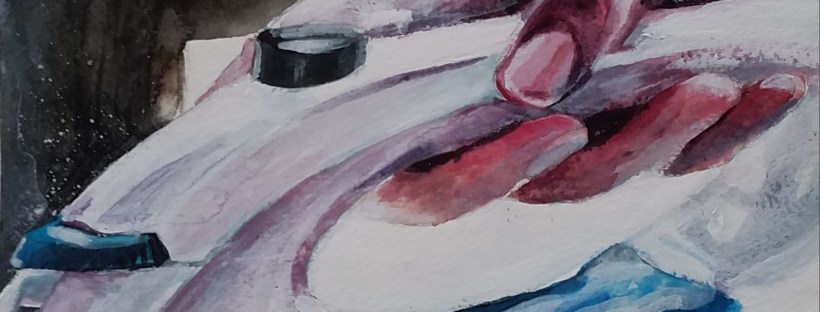
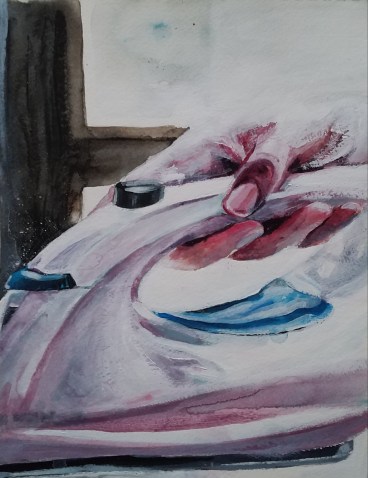
LHL illustration 2.jpg

Illustration by Ashlyn Metcalf

When I was fourteen,

she’d spend her days in front

of the ironing board to keep

my father’s pockets tucked

with the crisp, white

handkerchiefs she’d press;

hours of devotion

in front of General Hospital.


The spike of her cigarette

burned flower stems of smoke

from the wide glass ashtray

stationed at the end of her board—


the glossy shift of sunlight

diffused through the half-drawn

drapes of the unwashed

living room window, an early twilight

and the hiss of hot iron

scorching the starched cotton flat—


the corners halved, pressed,

halved, pressed again

with the clean formality

of the iron’s sibilation,

the litany of:

fold hiss fold hiss fold hiss.

Lord have mercy.


LORRAINE HENRIE LINS is a Pennsylvania Poet Laureate in Bucks County and serves as the Director of New and Emerging Poets with Tekpoet. She is the author of a full-length book of poetry entitled, All the Stars Blown to One Side of The Sky (VAC Poetry) and two chapbooks. Her work appears in journals, anthologies and magazines both in print and online. Born and raised in the suburbs of Central New Jersey, this Jersey Girl now resides outside of Philadelphia with her family and several dogs, where she has learned to pump her own gas.

ASHLYN METCALF is an introvert, painter, creative writing nut, and artist. She studied art education at Northeastern State University and worked in education for 4 years. Moving towards painting full time felt natural although ‘a task difficult as hell’. Metcalf lives and paints in Tulsa, Oklahoma where the cicadas hum on summer nights.

Two Pieces

Artist Statement: “My art is inspired by Lithuanian archeologist Marija Gimbutas and her controversial “Goddess Theory”. I produce feminist art, honoring the matriarchal societies from the Neolithic period.”


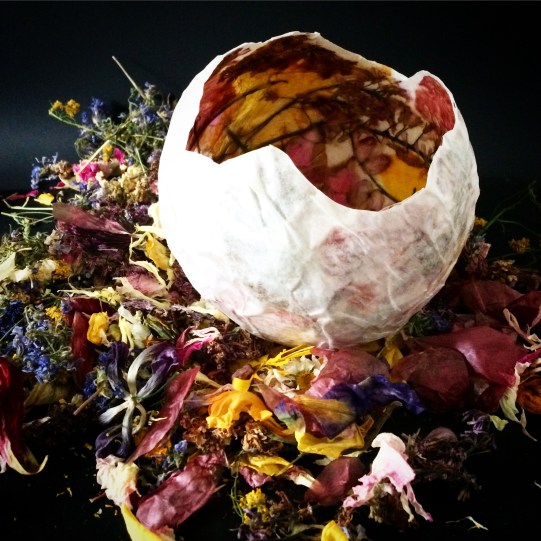
1.JPG

‘Primordial Egg,’ Dried flowers and paper, 2016

2

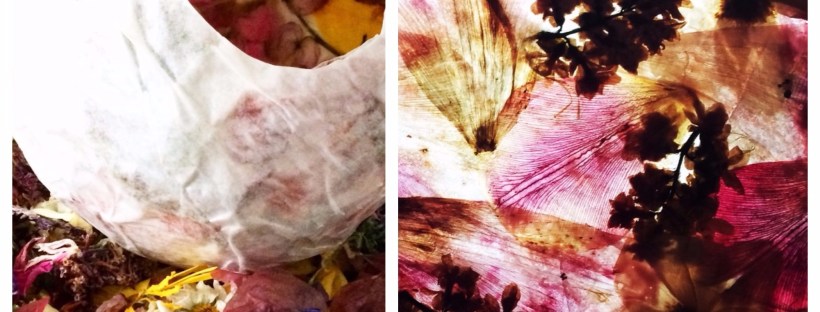
‘Inside,’ Dried flowers and paper, 2016


ANDRÉA ACKER is a visual artivist from Rio de Janeiro, Brazil. She studied art at the Maharishi University of Management, where Transcendental Meditation is part of the curriculum. For her, making art is a spiritual practice. With her art, Andréa honors the Matriarchal Societies and inspires the viewer with a Neolithic Goddess centered worldview; with the intention of creating a more peaceful and compassionate world.  For more of her work: andreaacker.com

AA

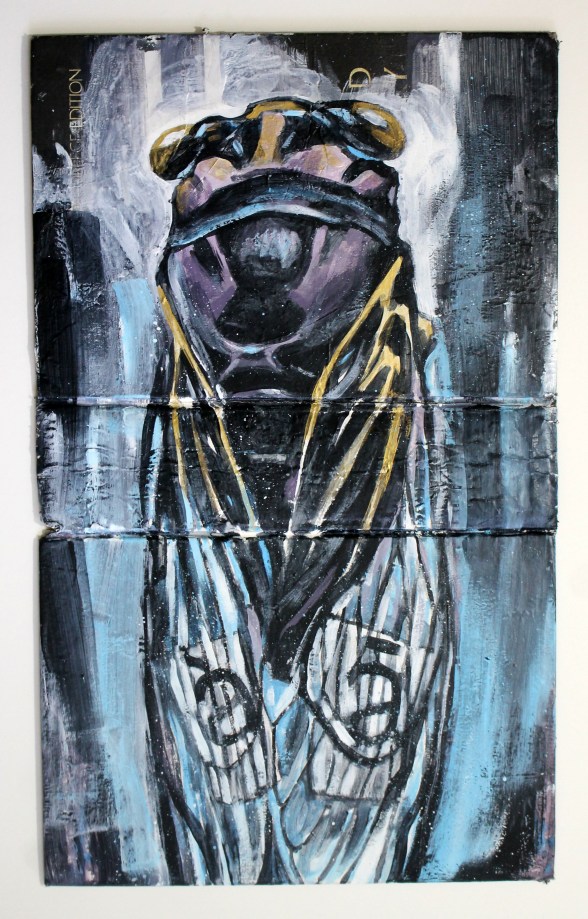
Artist Statement: “I paint on discarded library books, paper, and wood panels. I began painting on discarded library books in college. It resonated with me on many levels. Exploring libraries, garage sales, resale shops, and forgotten places to search for books was a tangible (and enjoyable) task between inspirations. And this process has developed organically into my practice today. The ideas I receive from between discarded pages always lead me to interesting places.
For this series a narrative had began to form. One in which skeletons were vestiges of gods, talking to cicadas, breathing into them ideas, dreams, visions. At dusk in my studio, Oklahoma cicadas would hum. I tuned into their chanting, their meditation, and it felt like tuning into a collective consciousness of ideas. Cicadas would become my eyes and I could see stories, words, and letters fall into place.”


AA.jpg

‘AA,’ Acrylic on Paper with Paperback Book, 2016


ASHLYN METCALF is an introvert, painter, creative writing nut, and artist. She studied art education at Northeastern State University and worked in education for 4 years. Moving towards painting full time felt natural although ‘a task difficult as hell’. Metcalf lives and paints in Tulsa, Oklahoma, where the cicadas hum on summer nights.

Two Photographs

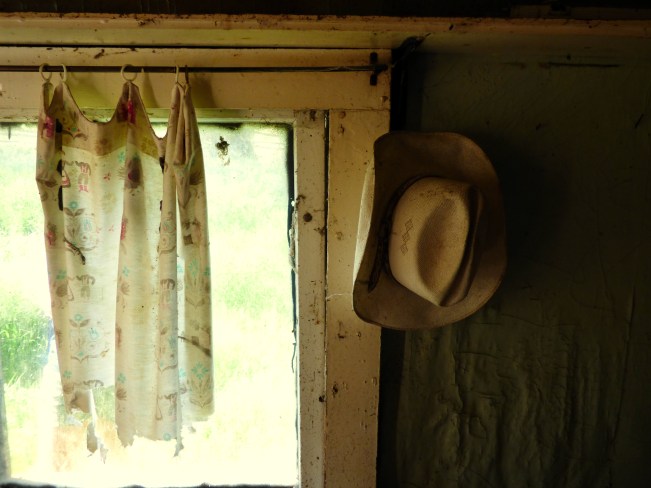
American Porch-2

‘American Porch,’ Photography, 2016

Got Home

‘Got Home,’ Photography, 2016


BRAD has shown his drawings, photographs, mixed media and paintings since 1997, in the Portland and Lake Oswego, Oregon area. His art and photographs have made it onto the front covers of Vine Leaves 2014 Anthology and N Magazine, and in Gravel Magazine, Cargo Literary, Jokes Literary, The Tishman Review, Shuf Poetry, Meat for Tea, Mud Season Review, Third Wednesday, Foliate Oak and many other literary publications.

Editor’s Note

Dear readers, contributors, and friends of Inklette,

We are thrilled to bring to you the fifth issue of Inklette magazine, themed on ‘Home.’ Home has come to mean so many different things for me over the course of these past few months. Here I am, living in the unstoppable city of New York, thousands of miles away from my hometown of Bhopal, India. As a stranger and a foreigner here, I have been trying to comprehend what home means and what it makes us learn, or forget.

I used to think homes are permanent. But the more I have grown and travelled, the more I have come to realize that sometimes our homes are not symbolic of who we are or where we come from, but what we choose to leave behind. Like most things, they are perhaps best experienced only in their absence.

I feel compelled to bring up the brutality of our homes. They can be politicized or discriminative entities, they can inflict pain or disappointment. But this summer, in Iceland, and now, in New York, I have found a home to believe in. I have found homes in the bodies we inhabit, the friends we make. I look for things that don’t change. I enjoy the color of water, and the tears that poetry brings. And that’s when I know I am nowhere but at home.

Our stellar staff members have worked incredibly hard to put this together. Without their passion and creativity, I am uncertain if I would have the kind of hope and love I am learning to take in. We received an overwhelming number of submissions from this issue and chose, with great care, the ones included in this issue to show to you. We hope you like this issue. We hope it allows you to look around, and love.

Sincerely,

Devanshi Khetarpal

Editor-in-Chief

Red Bricks Yellow Shoes

IMG_1783.JPG

‘Red Bricks Yellow Shoes,’ Photography, 2017


J. ALAN NELSON is a photographer, writer, actor, filmmaker and lawyer. He published essays, stories, poems and photographs previously in Illya’s Honey, Fulcrum, Wisconsin Review, South Carolina Review, Illya’s Honey, Red River Review, Adirondack Review, Red Cedar Review, Identity Theory, Hawai’i Review, Kennesaw Review, Driftwood Review, Ken*Again, Haggard and Halloo, Review Americana , The Wittenburg Door, South Carolina Review, Pegasus Review, Wisconsin Review, Hawai’i Review, Red Cedar Review, Fulcrum, Connecticut River Review, Blue Fifth Review, and Ship of Fools. His filmmaking and acting career is accessible here.

City Strolls

She walks in the dusk, collecting images through windows. The late fall air nips at her cheeks as she steps in and out of the light that tumbles from houses and blankets the sidewalk in yellow. She mourned the stars when she first moved to the city but now she sees they were never lost, merely fallen to the ground. They pepper the jagged panorama, clustering around downtown and freckling the eastern hills. She worships the silent movements of families settling into the day’s end. There’s clinking silverware and lazy conversation muted by windowpanes. She remembers the warmth of those crowded tables, prefers the memories—the looking in, the seeing and not being seen.

These walks are meant as an escape, a way to be a part of something and separate from it. There’s an intimacy to passing a person in twilight. It’s different than touch, but no less electrifying. She smiles at them, one shadow to another. And how lovely they seem now, wandering like her.

In daylight she has a job, prepares meals, gets irritated at careless drivers. The daylight is frenzied, unforgiving. It’s there, under unfiltered light, that the faces she passes have flickers of familiarity—a nose with a similar curvature to hers, eyes the same blue as her mother’s. In those moments of imagined recognition, she brings her hand to her own face, which is too exposed, and she thinks of the one she left behind. The one whose face she never had time to learn.

In the night, details are difficult to make out and time is slower, easier to control. In the night it’s those families, safe behind the glass, that seem so vivid. Children bound from sofa cushion to the floor in footed pajamas, hair wet. Televisions blaze. Grateful for closed doors, she shakes away the smell of fruity-scented bubble baths and the calm of socked feet tangled together atop a coffee table. How easy it seems looking in.

It isn’t. It wasn’t.

Up a hill, her muscles flex and she’s reminded of the horses she drew in grade school. She’d never ridden one, still hasn’t. She loved them for their gallop, how their muscles rippled through their bodies. Their strength was visible, undeniable. The boy who sat next to her in homeroom—the one with the mole on his neck—used to make fun of her drawings. He said horses were for old hags, cat ladies. He thought those were threats and wanted her to hide her horses in shame. Instead, she swallowed her anger and tucked her best drawing behind the transparent film of her binder.

Now, looking back, it seems that at eleven she was her most self-assured. She used to stay awake at night, the glow from her nightlight fanning against her wall and the laugh track from her parents’ television show spilling under the crack in her bedroom door. She preferred the cricket chirps outside, the inky expanse of night. It was the unknown of the moon-stained darkness that drew her to her window’s edge, her back to canned laughter and neatly wrapped endings.

But as she got older—exposed to the underbelly of the unknown, the threats that came from exposing her desire—that those neat, happy endings became more alluring. She stopped staring down those who told her how to be. First she just ignored, pretended she didn’t hear what other people said. But in a way, silence was a form of acquiescence and her resolve softened.

Then she fell in love. She gave herself fully to the hope of another and her muscles atrophied.

It wasn’t until she found herself in that certain kind of life that she remembered it was something she’d never wanted. In those months spent in unwashed sheets, her husband at work, she looked out their double pane windows at the still, tree-lined streets and began to remember. With her colicky infant in arms, the vacant feeling of small pink lips latched to aching nipple, she pieced together the truth, which was that some people weren’t meant to be stuck behind glass. This kind of life would lead to her decay and only by leaving could she work her way back to the quiet confidence of her eleven-year-old self.

Now her muscles take her up this steep city hill. Her heartbeat quickens and she feels her vitality as small pricks against the surface of her skin. With deep breathes she lets in the fog, which crawls through her and curls into her lungs. The smell of damp leaves, sound of forgotten conversations. She swallows the dim yellow streetlights, the cool wind, and the darkness of carless roads.

These curtain-less windows give her a view into a life she was meant to want. The life she turned her back on. Standing on the dark side of the pane, amongst the scent of night jasmine, she pushes down those stabs of guilt until they return to that familiar, persistent ache. She waves away the memory of that small face, full of need. Her absence was a gift—the only form of love she knew how to give. Because someone so hell-bent on freedom could never love without condition.

Before descending, returning to her quiet apartment, she looks up, taking in the steep facades of the houses, which are pushed together like a line of toy soldiers. The house above her gives off a dim light. An empty room, she thinks at first, but as she turns there’s a glint. Light reflects off of a pair of glasses and she sees an old woman sitting next to a table lamp. Her cushioned chair faces the view and her hand rests on top of a cane. Out she looks, the interior of her room still, her eyes on the younger woman standing on the street below. Neither moves or smiles. They merely regard each other until one of them—though it’s hard to tell which one first—looks away, back toward their dark, winking city.


ELENA MURPHY was a finalist for The Best Small Fictions 2017 anthology and won first place in Writer Advice’s 2016 Flash Fiction Contest. Her work has appeared in Calamus Journal and an anthology by 2Leaf Press. She lives in Sacramento and the San Francisco Bay Area.