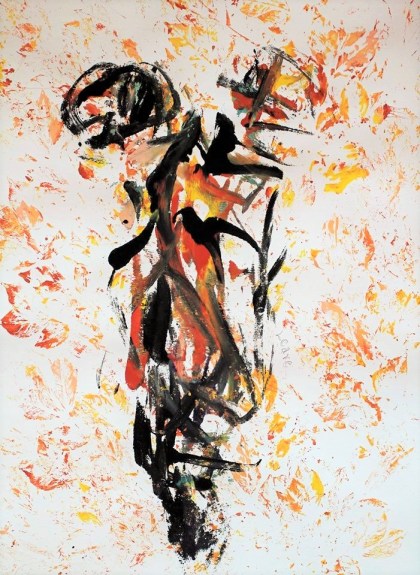
Mudbelly

deskins_mudbelly

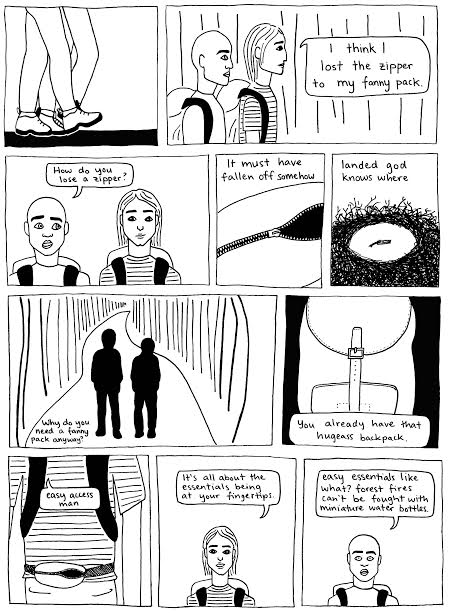
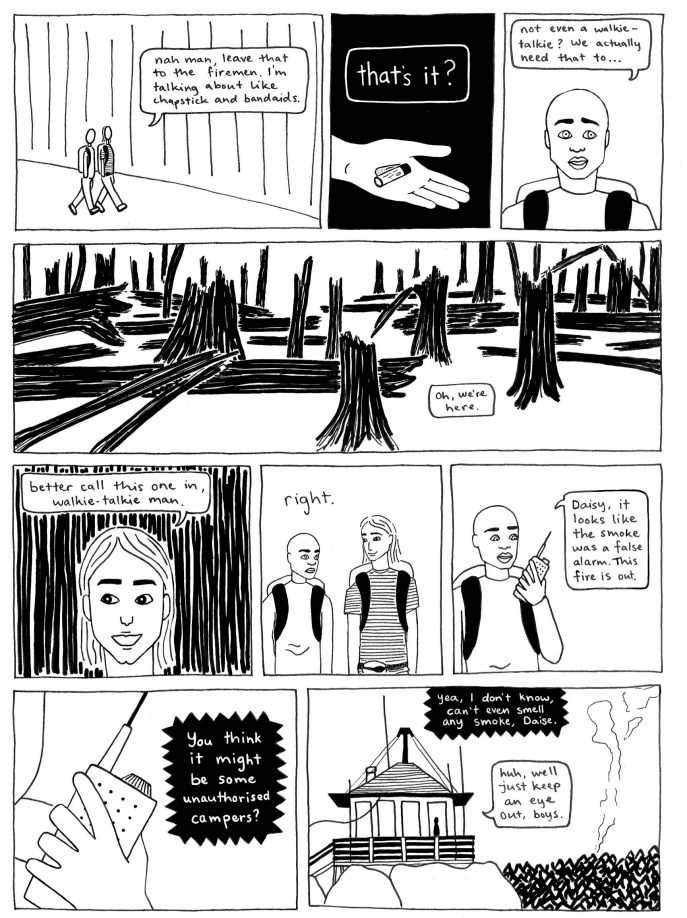
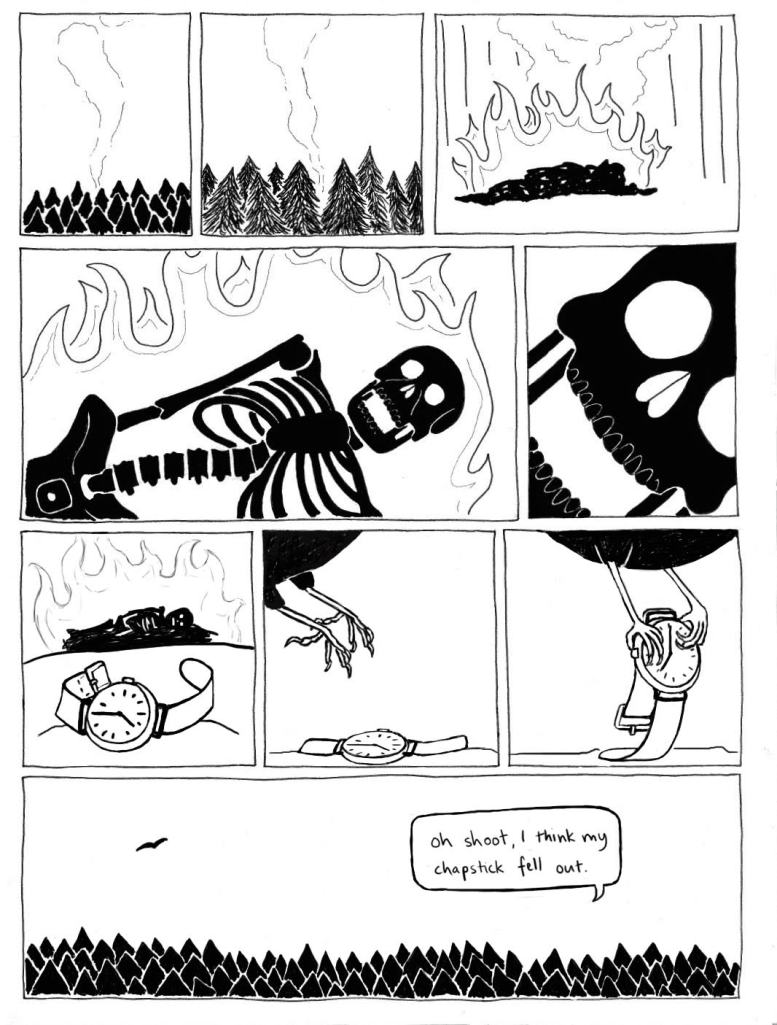
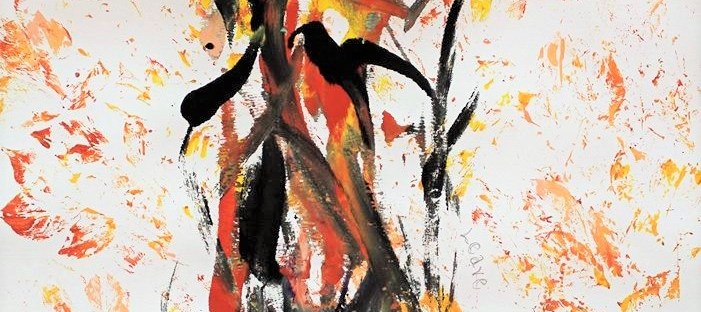
Illustration by Sally Deskins

In those days when the town was still young, a river cut between gray-green mountains and lazied along a postal road, murmuring fool’s-gold secrets. At the water’s edge on a cul-de-sac, a sturdy ranch house materialized, built by the pub’s new manager, who was married to an aspiring preschool teacher. The newlyweds carpeted the rooms in a medium beige and papered the walls in sunflowers.

That summer Layna arrived amid screams. Her mother was glad to have another presence in the house, a bright focal point, a baby-cheeked distraction. She breathed easier and carried her daughter like a breastplate or an amulet. Layna’s father doted on his only child. As she grew older, he often had her sit with him on the sofa and watch the television on his days off and at night when he couldn’t sleep. On those nights, Layna watched the fan blades blur, blinking round baby eyes.

*

She liked to laugh. Bugs made her laugh, the watching part—the teasing part. She would push them with the edge of her finger in tiny fits, especially the biting ones, too quickly for them to hurt her. Her mother told her it was wrong to squish bugs, but Layna would giggle away at even the sound of the word. “Squish, squish!” she would shriek out, and dissolve into giggles. Her mother tried to teach her other words for when a bug went splat, but Layna would shake her head. “Not crush. No kill!” Her mother made fists with her hands and turned away, easier to turn than to press the issue.

Layna did not like to kill bugs, only to squish them. For her, this was an important distinction. It made her angry when her mother insisted there was no distinction at all.

*

Layna laughed when she and her father played in the autumn leaves. Mountains of red and gold, and when you jumped in one pile the rest went up like feathers or like impossible raindrops floating back into the sky. When her father joined her, rolled with her, he squashed all the leaves. Squish, squish. Once, when she was feeling rebellious, she told him not to roll with her. He took her into his lap, nuzzled her, asked her why. She wiggled to free herself, but he held on tight.

“You squish them,” she said. “Leaves don’t like to be squished.”

He held her tighter and promised to be more careful.

*

Layna laughed at tickles. Her mother tickled her feet to get her out of bed on school mornings. If she giggled too long, her mother would tickle harder or swat her feet and toes. Then Layna would laugh even when it hurt because she knew if she cried it would hurt more. Her father tickled her belly with his mustache. Layna found his mustache immensely funny. She would pull on it when he bent over her belly, his arms coming down like tree trunks on either side of her head. He’d throw a leg over hers to prevent her moving. He’d bite if she pulled, so she made a game of pulling only when she felt his leg go soft enough; then she’d pull and wiggle out from beneath him and let loose a series of high-pitched squeals as she fled behind the sofa, peaking to make sure he was not angry.

Sometimes he was. And though she tried, she could never laugh when he was angry.

*

Today Layna’s father was angry. She knew it because of the way he closed the front door. Not the usual thump when he kicked it shut with his foot on the way in, and not the slam after a long day at work. Today was the slow slip of a creak at the joints and the mush between rubber and pith and wooden frame. The sound Layna had learned meant running.

She was in her room putting her dolls safely away when she heard that small, deliberate sound. Her muscles bunched tight like a caterpillar encountering a fingernail. She heard his footsteps and the sound of her mother turning. A glass broke. Their voices together were the voices of two things that weren’t meant to sound at the same time.

She knew why they were fighting. Her mother had been out last night long past teaching hours. Layna had barely been able to keep her eyes open by the time her mother came home. She dared not fall asleep while she and her father sat on the sofa watching the late-night shows: she’d been startled awake once by his mustache, and had learned to count fan blades as others counted sheep.

Another glass.

When they fought, Layna had learned to slip out and dart for the woods. Today, though, her bedroom window wouldn’t give. She pulled and pulled as their voices rose. It was unlocked, wasn’t it? Yes. But still, it wouldn’t come. She considered breaking it but knew that would only make it worse for her by the time she returned.

Finally, she decided to sneak out through the bathroom window. It would require getting out of her room without being seen. Without being heard. She must be only a tremble down the hallway where beyond there was yelling and hurling and bodies blooming with bruises in places only the walls ever witnessed. She tightened the laces on her shoes. She opened her bedroom door. Its spine groaned.

Don’t breathe.

Their shadows crawled on the back wall of the living room, monsters with claw hands and snarling mouths. Creep down the hall, now into the bathroom. The door was ajar. She went through, soundless. The bathroom window opened too swiftly, thumped at the top. She bit her lip, heart in throat, pushed out the screen, dropped to ground, heels hitting, and ran.

*

Who knew if it was rain or dusk? The sky was overcast, and weeds were sandpaper on her bare calves. Her stomach growled, but she hushed it. No supper to miss. Mama would be in her bedroom with a liquor glass, smoky stuff yellow as piss in the toilet bowl. And him. He would be sitting on the sofa calling, calling for Layna.

These were the parts she had to run from: her mother’s chalky hands after the glass was emptied two or three times, and her father’s hands when he called for her. His gentle hands all over her. He would tell her to laugh; and since the anger had simmered out of him, she could laugh easily, loudly even. She didn’t understand why gentle hands made her more afraid than rough ones, why they made her laughter louder.

*

Layna found the path without trouble. In winter, she knew, it would be harder to follow, but now, in summer, she traced the smooth river stones and chunks of sparkling fools’ gold with ease, uphill through the forest, zigzagging above the town, hiking, hiking, as the sun sank and the stars muttered in the low sky.

She found the place. Near a short cliff face, she’d posted three sturdy sticks as thick around as her thighs and balanced a large sheet of corrugated metal on top for a roof. Last time, she’d put a blanket in a banker’s box and put a rock on top of the box to keep it from blowing out from under the metal.

Good, there was the rock surrounded by leaves; and underneath, the box; and inside, the blanket.

She climbed into her shelter, huddled, chilled, and squished the first bug that came by. A fat black beetle. She couldn’t figure out why squishing, when she was up here, never made her laugh.

*

She woke and uncurled. Woke stiff and cold all the way down to her toes, stuffed sockless in ragged shoes. She could hear the town below. A vague almost-quiet. It had not rained. That was a blessing. She knew from other times that her hideout roof would keep out the downpour but not the slush and seep of rainwater. The understated gray sky was nearing sunrise. Her back and shoulders ached.

She rolled up the blanket and returned it to its box, which she sealed with a rock and covered with leaves. Standing slowly, she let the pain from sleeping outdoors settle into her spine and thighs and hips. That was good, too, that settling. That pain of being alive, being here, now; not floating somewhere just outside the curled shell of her sleeping self, heaped in blankets on a too-large bed beside a too-large body. It was good, instead, to be here.

The trip back was slow. She didn’t run. She crossed the river and skipped a stone over it. Watched it sink, blink back at her from the mudbelly bottom of the riverbed. By the time the sun broke over the eastern mountains, she was just descending her trail to the point where she could no longer hear the river. The town was a machine, humming.

*

When she finally approached her house, lights glowed in her parents’ bedroom. The television flashed through the sliding patio door. Among the sweet, musty morning smells was that of her mother’s cooking leaked through thin walls. Bacon on the air, and coffee.

She wound back to the bathroom window, reached up to crawl through.

But the screen was back in its place. Beyond the screen, the glass was closed and locked from the inside.

For a moment, she stood looking dumbly at the window. Then, she went round to her bedroom window—

—and found the obstruction that had prevented her from opening it last night: a wedge of wood stuck firmly between the top fixed half and the bottom sliding half. Only a pair of gentle hands could have secured it there. Her throat and chest tightened. No. Do not be afraid.

She tested each window, walking slowly around the house, sweat sticking her short red-orange hair to her neck. They were all locked. All the windows and doors.

Finally, she walked up the steps to the front. Locked. She stood frozen. Her core contracted, closed in on her. She was a block of wood wedged between unmovable forces, not a little girl.

She knocked. No one could hear her. Thump, thump this time, to the rhythm of her heart. She waited, glanced right, left, back at the door. She thought suddenly with a gasp so deep it pounded in her head: the car! The new red car that sat sleek and animal-like in the driveway. She could have curled up in the back, small as a beetle, and waited until her mother drove into town to work. Unseen, Layna could have waited a few more minutes until her mother had gone inside the building. Then, she might have popped out of the trunk and slinked to her classroom and sat at her desk with its fire-engine nametag, stomach don’t you growl, armpits don’t you stink, face, oh, please don’t be dirty.

But the front door opened, toweringly full of Layna’s mother, whose clothes were freshly laundered and whose face was powdered and pretty; you almost couldn’t see the sleepless circles or the cut at the edge of her smile. She bent down and hugged Layna hard and said she was sorry about the windows but Daddy wouldn’t let her leave them open. And now, Angelface, there was breakfast on the table. Then off to the bath before school. And better be lickety-split, or they’d be late.

So, Layna went inside.


Post-MFA in Tucson, LORA RIVERA worked as a literary agent, children’s biographer, and crepe maker. Today, she develops online trainings for child welfare professionals. In her spare time, she serves as Vice President of a climbing advocacy nonprofit where she is the senior editor of Stories from the Drylands: A Southern Arizona Climbing Anthology. She’s Asian-Indian, queer, and happily partnered. Her creative work is forthcoming from Reckoning and Ink in Thirds, and has recently appeared in Gravel, The Voices Project, Speculative 66, FLAPPERHOUSE, The Chattahoochee Review, and Eastern Iowa Review.  Learn more at www.lorarivera.com

SALLY DESKINS is an artist, writer and curator. All of her work focuses on women, feminism and curating issues in art. Her artwork has been exhibited nationwide and published in Masque and Spectacle and Extract(s) among others. Her 2014 illustrated book, Intimates and Fools, with poetry by Laura Madeline Wiseman, won the Nebraska Book Award for illustration and Design. She also created art for Leaves of Absence (2016). She is founding curator of Les Femmes Folles, an organization for women in art.
Words From The Front

A mouth in the mountain.

Grey rucksack stuck with sand.

Mother’s letter on light-colored paper folded

end over end

pinned inside my sleeve.


Innocent beard, cared for like soft moss,

grips the wind. Glow ember, harrows

rutted pitched thick in spikes

holding our tent flaps.


A grey bird two days ago making water

noises.

Roads appearing under closed eyes off

in a different valley. Skin feels ashed,

turns to coal.


I make a drawing of a castle in the sand.

Imagine walking through each corridor, key to every

hall.

I can carry more weight than any man.

My face reflected black in the rock-side of a castle

wall.


CHARLES KELL is a PhD student at The University of Rhode Island and editor of The Ocean State Review. His poetry and fiction have appeared or are forthcoming in The New Orleans Review, The Saint Ann’s Review, floor_plan_journal, The Manhattanville Review, and elsewhere. He teaches in Rhode Island and Connecticut.

Hand

Davis painting.JPG

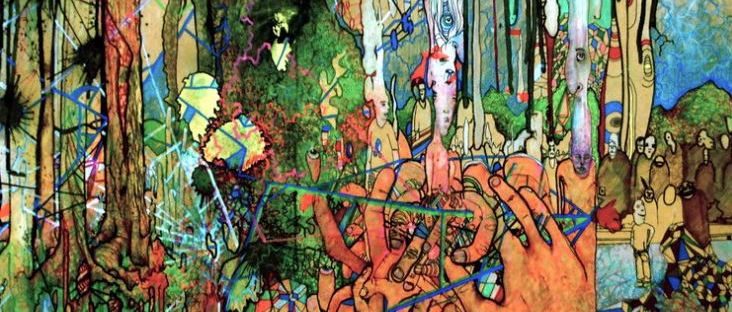
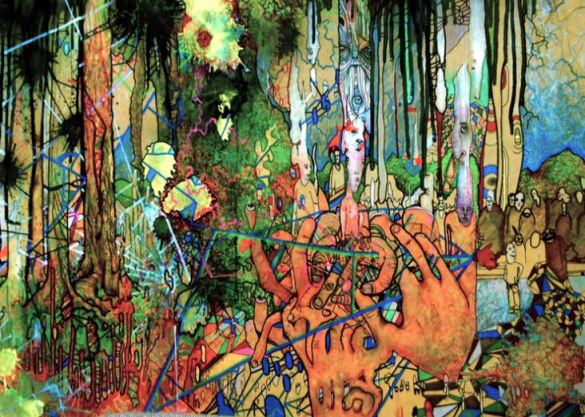
‘Trees and Fingers’ by Christopher Noble Davis


The old man held my left hand, briefly, then set it palm-down on a worn piece of plastic the size and shape of a fist and a shade of blue-green associated with futurism forty years ago. Underneath the plastic fist was a metal tray.

In the man’s hand appeared a small tool with a plastic handle the same blue-green and a circular blade with tiny teeth. Holding the tool with his right hand and resting his left hand on my wrist, the man pressed the blade on the ring, hard enough to make the ring dig into my finger, and began to run the blade carefully back and forth on the narrow surface.

He worked for a minute or two. He said, The blade is dull. I am sorry.

He had a strong Polish accent and a wonderfully full head of white hair, like the actor John Marley.

An older woman—the man’s wife, I assumed—attended to a customer nearby.

He worked steadily. I thought I saw a tiny groove forming, but I may have been imagining that. He pressed harder, making my finger hurt.

I am sorry, he said. The blade is dull. I must sharpen it.

Time passed in the way that time passes when responsibility has shifted from your hands to the hands of a professional. There is a sense of loss, but also a peace and lightness that come from being temporarily relieved of options, of the need to make decisions. A tiny amount of gold dust began to form on the ring. It slid onto the tray without touching my finger. The man removed his hand from my wrist, and I missed it immediately.

I said, I saw on the internet about using dental floss, slipping it under the ring and twisting it around your finger. Your finger turns purple, but then you pull on the dental floss and the ring comes off. I saw a video. I tried it, and my finger turned purple, but the ring stayed on.

The man paused and looked up. Oh, no, he said. Your finger should not be purple.

His correctness was instantly apparent. What had seemed so logical on the internet now seemed ludicrous when confronted with the firmness of his reason.

He returned to sawing. He asked if it hurt. Although it did hurt, I told him no, recognizing that no matter what I replied, I had no options.

The blade looked very old.

The amount of dust grew, but only slightly. I could not see a groove, but it might have been obscured by the dust. The ring was very narrow.

I felt I had to speak, but did not know what to say. I heard myself say this: Thirty-five years.

He stopped working and looked up at me suspiciously. His left hand returned to my wrist. He asked, How old are you?

I told him.

No, he said. He called to his wife. How old do you think he is?

She looked away from her customer and studied me grimly. After a moment, she stated my age accurately.

No, he said, not in disagreement, but in surprise.

She said, I look at the skin, the neck.

She returned to her customer.

He continued to saw, digging the ring harder into my finger. His wife spoke to the customer, a young man in a black suit.

In one motion, the man stopped sawing, released his pressure, and removed the ring. I was not aware of the actual removal; the ring was on and then it was off.

He set the ring on a scale that I had not noticed previously. My lack of awareness of my surroundings has been a subject of good-natured kidding in my workplaces over the years. Once I inherited an office with a huge, tacky, and rather ominous poster of a lion on the wall behind me. Why do you keep that poster? a co-worker asked. I said that I didn’t like it, but didn’t notice it and didn’t want to go to the trouble of figuring out what to do with it. My co-worker pulled the poster from the wall, pulling off some paint, and carried it out of the room. At my next job, a coworker hung on my bare office walls a picture of Uncle Sam, finger extended, with the caption, I want YOU to decorate your office. But two years later, the walls were still bare, except for her sign.

The man removed the ring from the scale, wrote on a small piece of paper, punched the keys of a well-worn calculator, and said, Fifty.

I nodded, and he dropped the ring through a slot into a square metal box that I also had not noticed previously.

With my thumb, I rubbed the underside of my finger on the spot where the ring had been. On the top of my finger, I could feel the ache of where he had pressed down on the ring. I did not rub this spot, not wanting the man to know he had hurt me.

The man stood, pulled a roll of bills from his pocket, counted off two from the outer portion and one from within, and handed them to me.

I thanked him, turned, and thanked his wife.

I wanted to shake the man’s hand, but somehow we weren’t positioned correctly.

Light pushed in from the windows that surrounded us. As I turned to leave, I could feel the business of the store resuming, no longer involving me.


ROBERT FROMBERG‘s fiction has appeared in Indiana Review, Bellingham Review, Tennessee Quarterly, and other magazines, and a short book, Blue Skies, was issued by Floating Island Publications. He taught writing at Northwestern University. This story is the second written after a 20-year break. He edits a website called Imperfect Fiction.

CHRISTOPHER DAVIS is a visual artist who grew up in Oak Park, Illinois. As a Sophomore in high school, he began to paint and draw every day.  His math teacher referred to him as “Crayon Boy.” The painting “Trees and Fingers” was produced in high school. He was admitted into the Maryland Institute College of Art with the highest awards offered, including MICA’s Presidential Scholarship. While in college, he majored in painting, minored in general fine arts, and experimented with many different art disciplines. He now lives in Chicago. He states: “I have a fascination with functional art. With painting, I tend to focus on color, composition, perspective, iconic imagery, and emotion like ecstasy and joy, and fear and greed. I am obsessed with the freedom of abstract expressionism. While I was in high school, my art was very psychedelic, and throughout college I was interested in the unconscious, or what the darkness beneath the surface might be portrayed as–possibly looking like intuitive biomorphic images, faces and patterns and subliminal imagery. In 2015, I made a series of paintings that seemed blocky, like a juxtaposition of rectangular colors. This year I made a series of paintings focusing on exterior images of Frank Lloyd Wright architecture.”

Interview with Kazim Ali

“If one has to look into Kazim Ali’s work, what is most evident in his poetry is the feeling of homeliness and how answers arise out of the most mundane of situations. There’s a beauty echoing in the simple verse, the way the words come together to dance and quiver on the page. This search for homes gives us poetry which is diverse and rich, both in terms of language and the cultural experiences it seeks to pull together for the reader – and how all of this comes together to define Kazim Ali as a writer singularly unique for his time. Given the fact that Kazim Ali grew up in UK, to Muslim parents of Indian descent, these themes of his writing are not surprising. Equipped with this legacy, his work brims with a raw urgency that calls to readers belonging to all ages, time and place, and feeds the fire in all of us.”

Smriti Verma, Poetry Editor


How did you seek to assimilate your diverse heritage, and the experiences it provided you, in your work? What kind of effect did it have on your writing?

KA: My writing has always been driven by twin notions of sense and sound and the way they treat and overlap and diverge from one another. These come deeply from my twin South Asian lineage of Islam and Yoga. The devotions and scriptures of the Kasmiri Shaivites have been as important to me as the Islamic philosophy and art of my South Indian family. It’s a family that has since been scattered– to Hyderabad, Telangana, to Karachi, to England, Canada and America. Very few of my family remain behind in our ancestral homes (in Vellore and Chennai) yet India feels an inextricable part of my life and my writing.

The forms I choose, the way abstraction interacts with the concrete, the roles that vowels and sound play in my poems– all these come from devotional music of India and Islamic concepts of art and architecture. I also studied sacred chanting and nada-yoga as part of my yoga training. PUT_CHARACTERS_HERE

What are the fundamental differences between prose and poetry, according to you? If there are any, what different approaches due you adopt to writing each?

PUT_CHARACTERS_HERE
KA: Prose and poetry both follow the rhythm of language, breath and the body. In prose you rely more on syntactical and grammatical rules of the language you are working in but even these can be bent or transformed or done away with. The sentence is usually meant as a complete thought but can com in a fragment too. I do not always know the difference between an essay or a poem as it begins. Not until the thought starts to spin our does a form present itself. And sometimes (like in my books, Bright Felon and Wind Instrument) the text actually quivers between poetry and prose and does not choose. PUT_CHARACTERS_HERE

Since our theme for this issue is ‘Growing Up,’ we’d like to know what influenced you the most growing up.

PUT_CHARACTERS_HERE
KA: I grew up in a lot of different places. I was born in the UK where my parents had migrated, but I spent a lot of my early childhood in Vellore. Then I was raised in Canada and finally the United States. So I don’t really feel like I have a single origin or “home.” Or more accurately I have had many different homes and I can’t always choose between them. This maybe gave me access to multiplicity as a broader context in which to live my life. Different languages, different cultural experiences– I don’t feel defined by a single culture or language. This is an “American” experience but it is also an “Indian” experience. I am sad beyond measure that in both America and India there are political forces who are seeking to define in singular (and narrow) terms what it means to be “American” or “Hindustani” for example. PUT_CHARACTERS_HERE

You’ve said previously that ‘everyone knows how much easier it is to write a poem in form and meter’. Would you still stand by it?

PUT_CHARACTERS_HERE

KA: I believe this because form and meter give you rules to work with. They also make the music of a poem much easier to achieve and make it easier to construct an architecture and a mood. But having said that, I do not necessary believe that one starts out with an intention to work in a particular form. I think the relationship to form in a poem has to be organic, meaning it is uncovered during the writing process. One reason to read a lot of poetry in form is that you then learn the patterns of sound and thought and the emotional valences of (for example) a pantoum vs a sestina vs a sonnet vs a ghazal. Once, when I was a young writer I took one specific episode from Islamic history (the attempted arrest of Imam Zayn by the troops of Yazid immediately following the battle of Karbala) and wrote a poem about it in 22 different forms and meters. I wanted to know what the forms itself brought to the episode and what various forms and metrical patterns would bring out of the episode itself.

PUT_CHARACTERS_HERE

You’ve experimented with the couplet very often, in many ways. How does it, as a style, manifest in your thinking process?

PUT_CHARACTERS_HERE
KA: I’ve tried and tried to get away from it, with limited success! My newest book, which is coming out at the beginning of 2018, has a greater variety of stanzaic patterns. But the couplet has a deep attraction, in terms of a “call and response” but not necessarily between a writer and his audience but a writer and himself. A thought answers a thought and not always logically or completely. Often the response contradicts or redefines the original thought. This is an attractive pattern for me, who is a restless thinker.

There is an explosion of poets of colour, especially, writing in blank verse. Does a lack of structure lend to a certain democratisation of poetry?

KA: I think it is a wonderful thing to have a broader range of people from differing educational, economic and social backgrounds writing and creating poetry. Poetry is meant to communicate human experience, all of it. There are a number of registers and ways to approach a poem that do not always involved the received and historic forms. But I do believe that thinking about language, its qualities, the sound of a poem, the way it resonates and echoes–these all build and make beautiful the utterance of the poem. Rhyming meter, blank verse, free verse, and even chaotic outburst– all these can make a powerful and incisive poetry. But as a writer I think it was good for me to practice and explore as wide a range of poetries as I could in order to find my own path in language and literature.


cassisprofileKAZIM ALI is a poet, essayist, fiction writer and translator.
His books include several volumes of poetry, including Sky Ward, winner of the Ohioana Book Award in Poetry; The Far Mosque, winner of Alice James Books’ New England/New York Award; The Fortieth DayAll One’s Blue; and the cross-genre text Bright Felon: Autobiography and Cities. He has also published a translation of Abahn Sabana David by Marguerite Duras, Water’s Footfall by Sohrab Sepehri, Oasis of Now: Selected Poems by Sohrab Sepehri, and (with Libby Murphy) L’amour by Marguerite Duras. His novels include Quinn’s Passage, named one of “The Best Books of 2005” by Chronogram magazine,and The Disappearance of Seth. His books of essays include Orange Alert: Essays on Poetry, Art and the Architecture of Silence and Fasting for Ramadan. In addition to co-editing Jean Valentine: This-World Company, he is a contributing editor forAWP Writers Chronicle and associate editor of the literary magazine FIELD and founding editor of the small press Nightboat Books. He is the series co-editor for both Poets on Poetry and Under Discussion, from the University of Michigan Press.

Ali’s forthcoming titles include: Uncle Sharif’s Life in Music, a collection of short stories; The Secret Room: A String Quartet, a novel; and Anais Nin: An Unprofessional Study, a new book of essays.  Ali is an associate professor of Creative Writing and Comparative Literature at Oberlin College.

Marilyn’s Pose

Marilyn's Pose- Illustration by Chuka Susan Chesney.jpg

Illustration by Chuka Susan Chesney

I haven’t heard back from you yet,

though I’ve carved your eye into paper fifty times.


If you had been born in 1959 and lived up the street,

we could have been friends.

I know you better than I did

before I dampened your eye, smudging it into nothingness

next to your flash of hair.

Your mother came over and swam in our pool.

She had pubic hair that grew

next to her bathing suit. She taught me how to swim.

The lips, now that’s something.

Lips that curve up into a saucer at one end, but at the other

spill into darkness and a cup of caved-in hand.

One time I saw you getting changed in the dressing room.

I saw how big your breasts were, and I didn’t want to be your friend.

I am sorry I felt that way.

Now that we’re headed down your body,

let’s talk about that quiet, purple world next to your arm,

next to the most vulnerable lines, fragile lines.


Is it a lie,

or are you just as human

as any woman with your big wooden elbow that works

its way into the shadowed bed sheet?

We put naked Barbies in a bucket and said it was a hot tub;

I played with Stacy and you played with P.J.

Did he spray the room with Chanel #5 to get it ready for you?

X beauty out with something beautiful, something red.

Now X is gone, and all we have left is this piece of paper.


A graduate of Art Center College of Design, CHUKA SUSAN CHESNEY is an emerging artist who lives in Los Angeles. Her drawings and paintings have been exhibited throughout the United States. Recently, she collaborated with Laura Madeline Wiseman, a poet, on a book called People Like Cats. In secret, often very late at night, Chesney has been writing poems. She often uses her own art as inspiration for her poetry.

Quartz Hunting

For years we kept the quartz stones you found,

placed them in rows upon the window sills 

of your room like teeth along a weathered jaw.

After a spring rain in the garden,

past the wood chips at the playground’s edge,

at the gravel inlet of our driveway,


you’d rush to seize each alabaster knot,

as if it might sink back under the soil–

the bedrock rippling with that milky droplet.


Obvious and common, its hold on you

was charming, although I was the one

to ferry your finds, happy to bear

the clattering pull of full pockets.


Our last good hunt before the snow,

we walked the bank of a late fall stream–

two bundled figures floating above

the cobbles like frozen smoke, our bodies

nearly translucent in the clear autumn air.


KEVIN CASEY is the author of And Waking… (Bottom Dog Press, 2016), and the chapbooks The wind considers everything (Flutter Press) and For the Sake of the Sun (Red Dashboard). His poems have appeared recently or are forthcoming in Rust+Moth, Valparaiso Poetry Review, Chiron Review, and Ted Kooser’s syndicated column ‘American Life in Poetry.’

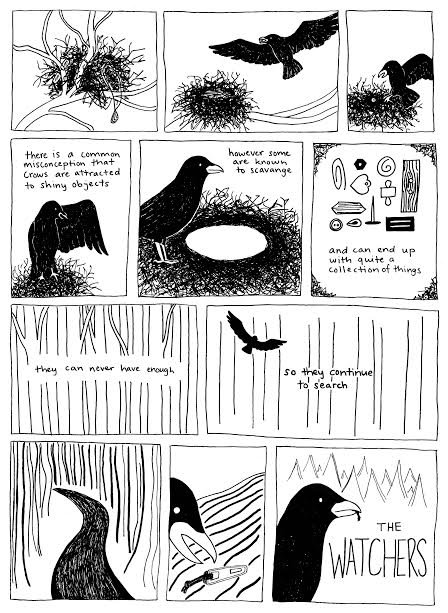
The Watchers

unnamed

unnamed-1

unnamed-2

unnamed-3


MICHELLE WOSINSKI is an alumnus of the University of Virginia Young Writers Workshop. She was a member of the program’s first class of Graphic Fiction and Nonfiction, which was also the first workshop of its kind in the country. Though german screamo music from the streets of Luxembourg can be heard at all hours through her bathroom window, which is as distracting as it sounds, she continues to work on her comics and art.