Loadshedding

The loadshedding was unexpected and, in most ways, unwelcome, especially at this part of the day. It was not uncommon for the locality to collapse into darkness, of course, and the darkness had been becoming something of a regular, unwanted house guest over the last year. Yet surrounded by the placental darkness that dropped as abruptly over this South Kolkata locality as a tangled mess of cobwebs at Phutka’s tea shop could come loose at the slightest hint of carelessness, somehow the shadows seemed longer, and the silence, desperate for air.

“Are we out of candles?”

“I think we might have some left. But I’ll have to look for them. Don’t you have a flashlight lying around somewhere?”

There was a sound of feet shuffling away towards the other end of the room. A few books were moved. Something fell out, and the perpetrator could be heard bending over to pick it up, the folds of a starched shirt crackled slightly into wrinkles. A drawer opened with a loud creak, and after moving around a few of its inhabitants, the candle was withdrawn.

“I found one. Where do you keep the matchsticks?”

“On the shelf above the cabinet. Towards the edge.”

A frantic hand felt blindly along the shelf. Then a matchstick flared up with its characteristic crisp crackle, dim and yellow light slowly spreading over the room like a winter fever.

“At least there’s some light now.”

“How long do you think this’ll last?”

The other voice waited, measuring the seconds, as if not sure what context the question followed, or exactly how precise the answer should be.

Then, as if it had made up its mind, the voice coughed a little.

“Maybe an hour. Maybe two. Who knows?”

That seemed to the speaker a perfect sentence, deliberate and slow, offering no promises, no hopes, but soothing all the same. The deniability of knowledge had always been a saviour of such conversations.

But the one who had asked the question seemed to grow even more restless at this prospect.

“I wonder why they keep doing this to us?

“Imagine how hard it’ll be on everyone, to be sitting in this absolute darkness, with the hoards of summer mosquitoes from the South Kolkata drains hungry for our blood.”

As if in punctuation, a loud resounding slap on one’s thigh notified of the forgotten fact that the mosquitoes were a true menace, and more so in this godforsaken darkness.

“I was just talking to Mr. Choudhury in the morning, and he says his son recently went to the electric department office to submit an application. And the clerk there told him these power cuts will only get worse as the summer advances. Mrs. Choudhury was worried about it too. Her daughter is appearing for her boards this year, and she told me that it’s impossible to study with these power cuts.”

The other person seemed to have not heard the story, or maybe heard, but found it easier to ignore.

Instead, a strange worry suddenly wriggled uneasily through the whole conversation.

“Mr. Choudhury talked to you today morning? Did he ask anything about us?”

“No, he didn’t. Too busy talking about this postgraduate course his son is doing.” The voice sounded comforting. “And even if he does, everyone in this locality knows we are colleagues. That is enough for their curiosity.”

The other person let out an audible sigh.

“I wish we didn’t have to do this.”

“Me too. But we don’t have a lot of options. And nothing else matters, besides this house and us living together under its roof.”

“Talking about living together, did you catch the news today? I think I heard someone mentioning us somewhere. In passing, of course.”

“They always do. I’m tired of hearing it over and over again. I guess we have to learn to just live with it now.”

With that, their voices trailed into silence again. The humming mosquitoes kept getting louder. The candle flickered at times, and there was a slight crackling when the flame encountered molten wax that had solidified on the body of the candle itself.

The candle had almost burnt till midway when the voices started talking again.

“You know, I met Professor Sen on the way to work today. Wedged in between two pudgy ladies, sweating profusely as always. Brought back memories of our college days.”

The other person smiled and, in the flickering light, the smile looked tinged with sadness.

“College life was good. Especially after I met you. Remember our first meeting, the waiter had served you my coffee, and you had already drunk half of it when he realized his mistake and pointed it out to a furious me.”

Silence again.

This time heavier. And almost foreboding.

“Back then, we never would’ve thought we’d end up like this.”

“Oh, but I did. The moment I saw you walk over to my table and apologize, I knew we’d end up this way somehow.”

The other voice sounded cautious now.

“Do you think we are doing something wrong? Our parents don’t talk to us anymore, you know. And your brother, who used to fight with people who bullied you, doesn’t even ask if you’re doing okay. Sometimes, it scares me. The enormity of our situation.”

The end seemed abrupt. As if dipped into silence by the repercussions of the words that had just escaped the lips.

“I love you,” the first voice said.

As if all answers to their fears, their forbiddance lies in those three words.

Like Jesus Christ, walking over the water, while his disciples in a rudimentary fishing boat stare with awe at the myth being born right in front of their eyes.

Was it hope?

Or was it desperation?

Was Jesus their saviour, or the physical representation of their collective voices, promising them salvation, but more than that, the choice of freedom?

Were these three words, clinging to each other, breathless, caught in the darkness of an old Kolkata apartment like a baby deer gets caught in front of the fast approaching circle of lights from the headlights of a rickety car, all they had hoped for, to save them from their fears and inhibitions and the warring society at large?

Both voices seemed strangely uninformed.

“I love you too. Yes. That’s all that matters.” The replying voice had finality to it.

In the floor below, Mr. Choudhury warily wiped off sweat from his neck and balding head as he talked to his wife.

“You know I met that fellow who lives upstairs today. Nice guy. Gave me a few tips about our daughter’s career choices as well.

“Dev, isn’t that his name? And the other one is Boddhi. Such a pair of handsome guys. I wonder if we’ll get invited to their wedding though. Two feasts, eh?”

And with that, he laughed, as the electricity finally came back on, and the television set crackled to life.


NILESH MONDAL, 22, is an undergraduate in engineering by choice, and a poet and writer by chance. His works have been published in magazines and ejournals like In Plainspeak, Cafe Dissensus, Textploit, ArtRefurbish, Fiction Magazine, The Hans India, etc. He works at Terribly Tiny Tales, an online storytelling platform.
Marie, a novitiate of the Ursuline Order, hears jazz while running errands for the Mother (New Orleans, Louisiana 1956)

Cold glass bottle clasped in hand, she hurries to her cloister, never before out to hear the sounds of an emerging city. Never before hearing the whine of a saxophone. She stops. She faces the neon flickering radiation, The Blue Nile, above the door holding the belly of Sound. Curiosity pulls the handle to her.

Bare feet float down the stairs; shins shiver with each wooden creak. Body follows, hip bones thrust through white woven cotton, pulled by Sound. His thumping thumb pressing above her pelvis, his brushing fingers running up her spine. She carries the heady smells of a southern summer (magnolia and wet pavement at dusk) behind her, pausing to taste this new front at the convergence on the last stair: cigarettes, brass, and gin. She cannot speak this olfactory language ahead of and below her (only that behind); her vocabulary fails, so she swallows, stepping down and in to understand, and the olfactory fronts pant around her, licking and crawling inside, until the door swings shut behind and the two are one, she in the middle of a dimly lit room, unknowingly made new.

No man’s head turns from the bar to look at her bright moon face, gasping in ecstasy overcome from her wimpled folds, yet the air and mood has shifted.  Genteel drawls cease, and the band reigns.

Yes, yes, yes, whispered, yes.

Yes wet on the tongues of many, wet on her tongue. The bass man’s fingers fly over deep strings and chords. Body scoops its mahogany curves, building the yes in jerks and folds.

Aahn squeezes out as a long hot release, from the lips of the man or the bowels of the bass? He builds again.

What is this feeling inside, between the legs, running along the surface of the thigh? Is there a word for this? It is not the music; it is made by the music. Warm and unsatisfied, liquid dripping, she feels a resonance within her hips.

The drummer’s brushes sweep a rattle; fingernail slides the cymbal’s razor rim for a ring that hits her ear, muddling her mind with mad sounds travelling down.

After sixteen years of uncertainty, God’s throbbing language is at last loud.  She’ll tell the Mother, triumphant, milk in hand!

And the saxophone pulls her forward, floating blur of swaying white mass and milk held tight, into the light.  Fingers pressing keys and body swung around neck, he dances and she dances. Satisfaction wails on high.


SYLVIA ROBINSON is a recent graduate of the Hotchkiss School and plans to attend Kenyon College in the fall. She is from Summerville, South Carolina, the birthplace of sweet tea, though she’ll take hers unsweetened.

Breath by Breath

Image

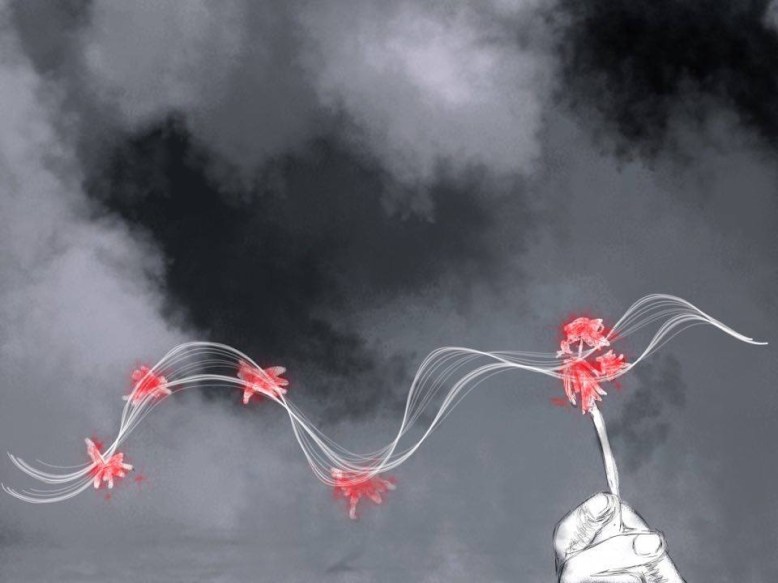
Illustration by Ashwin Pandya

I


Knock gently on this oak door. The wood is defined

by rupture, breath by breath.

Breaking down from the pressure of unsolicited sex

engraved in the floorboards and text of this mansion

I built with fiber forged out of fading candle light.


Knock gently on this oak door. It’s a very old world,

and I’m knitting the dust of my skin into a maid.

I have not cleaned these halls in years.

The paintings have rusted. Even my spiders are disgusted.

The splinters filter through fresh air.


II


Tobacco’s only been around for a hundred years.
It would be easier to account for our sins

if we didn’t burn them in our hands. Hell hath no fury

like the colonized. They bide their time until the fire starts

and the masters dance their histories blind.


HAZEM FAHMY is a poet and critic from Cairo. He is currently pursuing a degree in Humanities and Film Studies from Wesleyan University. His poetry has appeared, or is forthcoming in Mizna, COG and Random Sample. In his spare time, he writes about the Middle East and tries to come up with creative ways to mock Classicism. He makes videos occasionally.

ASHWIN PANDYA is a sketch-artist and illustrator, whose work has graced many book-covers. Acknowledged for his digital art as well as musical compositions, Ashwin Pandya can sketch given any situation, description or character. You can visit his website here.

Autumn Alleluia

the spine of your umbrella
trickled sodden yellow dew
on the blind white of your
skin, harassing the lengths
between blue-rimmed veins
and pulsating fingertips–


leaning into the taut spirals
of an early dusk harvesting
your warmth, you prepared
for a nearing winter, mouth
shored up chorus of autumn
alleluia which impaled your

heart like a sword–


A Pushcart nominee, LANA BELLA is an author of two chapbooks, Under My Dark (Crisis Chronicles Press, 2016) and Adagio (Finishing Line Press, forthcoming), has had poetry and fiction featured with over 250 journals, like California Quarterly, Chiron ReviewColumbia Journal, Poetry Salzburg Review, Plainsongs, San Pedro River Review, The Writing Disorder, Third Wednesday, and elsewhere. She resides in the US and the coastal town of Nha Trang, Vietnam, where she is a mom of two far-too-clever-frolicsome imps. You can visit her Facebook here.

What It Means to Be An Editor

BY TRIVARNA HARIHARAN

Up until I joined Inklette, I was alien to the idea of editorship. I hardly understood what went behind creating literary magazines or how crucial an editorial team was to the process preceding it.

After an year of serving as the Co-Editor-in-Chief at a vibrant community of young artists, I have realised that taking on an editorial position has been one of the best decisions I’ve made.

It has opened my eyes up to not just the technical side of operating a magazine, but also to various kinds of art whose existences I was previously oblivious to.

It has changed the way that I gauge the importance of an editorial process. I no longer belittle or undermine the relevance of one, for I know what goes into it. I no longer look at it as a position of “excessive privilege or power”, for it is certainly not one.

While it is true that editors are entrusted with the responsibility of selecting pieces for publication (and in the process filtering out some), this by no means empowers them to do as they wish. It is a job, after all. Editors work within frameworks and paradigms fenced by rules which are adhered to. This disallows them from being biased or coloured by factors other than the ones assigned to the working of the magazine.

Of course there may be instances of other factors playing in, but those are very few in number. Eventually, pieces will find themselves in places where they truly belong.

An editorial process is an extensive one – and needless to say, it’s a demanding job. But being an editor has its own perks – the opportunity to learn being the most prominent of them.

Editorship allows one the space to explore a plethora of arts, each different from each other in its texture, tonality and narrative. It allows one to discover an eclectic range of pieces, and exposes one to varied perspectives, contexts and stories.

It helps understand different kinds of art, and what goes behind making them. It gives one a place to belong to.  “It made a group of strangers a family”, as my friend, the Founder and Co-Editor-in-Chief, Devanshi Khetarpal rightly puts it. It made us realise the necessity of understanding each other’s strengths and weaknesses, opening us up to varied ways of working on similar pieces. It facilitated an exchange of perspectives – culturally, socially, and intellectually.

It nurtured us into better artists and human beings and made us more receptive to art. It has been a huge lesson in patience, co-operation and perseverance, and what it means to work in unison.

An editorial job may be intricate, time consuming, and extensive, but it is most definitely worth it.


title951409746

TRIVARNA HARIHARAN is an ardent lover of poetry, prose, film, music and everything artistic. She often wonders what the world would have been like without Gabriel Garcia Marquez, J.M. Coetzee and Ruskin Bond. Besides reading and writing, she loves to play the keyboard, and listen to tunes that sound like “neighbours from another world.”

In Response to ‘The Sacred Androgen: The Transgender Debate’ by Daniel Harris

BY HALEY ZILBERBERG


This blog is in response to the article, ‘The Sacred Androgen: The Transgender Debate’ by Daniel Harris published in The Antioch Review here. 


There is no debate. There is no right or wrong in gender or gender expression. Transgender people are not “TGs” or “transgenders” or any other term that takes away the humanity from a group of people who are people before they are anything else. Cisgender people are in a position of power and have privileges that transgender people do not. Writers have the wonderful and beautiful tool of language and the ability to employ rhetoric to make readers see things differently. In the case of Daniel Harris’s “The Transgender Debate,” his writing was not that of beauty, but of destruction.

Transgender people are people. There is no delusion. There is no grand sacrifice. There is no repression. I find it hard to believe, let alone ponder, the idea that people would make their lives so much harder in order to go through a painful experience of transitioning, both emotionally and physically. I cannot conceive that anyone would ever want to go through that hardship on top of the bigotry and lethal actions provided by society. Even someone who is part of a group of people who faces hardships has served a neatly packaged essay with vicious accusations by Daniel Harris. We, at Inklette, will not stand for the unkind words and discrimination towards people with varying gender identities and expressions. We will not let voices of hatred overpower the voices of those who struggle.

There are people, like Daniel Harris, who may struggle with trying to understand that people should not be condemned for simply being themselves. We are growing and evolving as a society every day, and there is room to continuously improve and adapt the views we have towards cultures, peoples, and practices that we do not understand. There is no shame in not knowing everything immediately, but there is shame in belittling minority groups for wanting to be happy. This push against Equal Rights is counterintuitive. When we repress those who strive to live benign and gentle lives being who they are, we are asking these people who are trying to climb the ladder of success to prove they are able to get to the top while throwing boulders on them so they keep falling down.

No institution or organization should use its power on the basis of “freedom of expression” to further oppress people. If you are going to start a war on something wrong with the world, stop targeting people who do nothing destructive and start fighting against the destruction being caused. Being notable in the public eye as a person or an organization makes your words and messages amplified to mass amounts of people. This kind of power should be used to create positive change. There is absolutely nothing constructive about Daniel Harris’s words claiming himself as a ‘supporter’ of Transgender Rights and then tearing down the transgender population. If that is support, I do not want to know what hate is.

People who are transgender are everywhere, and a lot of times, we might not even notice. And that’s how it should be. Society should not be on a hunt to try to pinpoint and pick apart everything about transgender people. There is no room for criticism and scrutiny over things that are personal to others, that are challenging enough without the idiocy of condemning people for wanting to be happy and wanting to be themselves. There is no Transgender Debate that needs to be looked at. There is only the need for people who cannot wrap their heads around something that they do not experience and understand to resolve their own cognitive dissonance. Being transgender does not and will not ever make someone less of a person, but hatred can.


145688373036873 (1)

HALEY ZILBERBERG is pursuing a Bachelor’s in Social Work with a Creative Writing minor. She writes about many topics, often surrounding disabilities and social justice. Haley has been published in Inklette and Loud Zoo (Issue 5).

Boogie Board


One dollar. Jeez, the cool one was just one dollar more, Evan thought. That’s all, just a stupid dollar, but no, we can’t spend one more stupid dollar to get the damn boogie board with the red flames on it. Stupid mom. Stupid money. Stupid boogie board. What kind of stupid dork rides a boogie board anyway? Stupid beach. Stupid fucking vacation. This is going to suck. Totally suck.

Thunk. The boy slammed the door to the old Ford Fairlane. What an ugly dumb old car. Why don’t we have a decent ride like regular people, he thought, before he heard the screaming.

Jesus, what’s that sound, he thought, covering his ears as the desperate noise grew louder. It was like no sound he’d ever heard before. What the hell is going on? He swung his 13-year-old body, all legs and shoulder blades, around back to the Ford Fairlane, back to the back door of the back seat where his knees had ached moments before as he’d tried to sleep, pretzeled in between the dinged up ice chest and the discounted flowered boogie boards his mom insisted were good enough for one round at the beach, never mind how juvenile they made him look, like some kind of teeny bopper, girly girl, and why couldn’t he have a real surfboard anyway like normal kids, like the cool dudes really doing it, really riding the waves, not just boogie boarding with his dumb old mom, he thought, as the howl grew louder and stranger and louder and stranger until it surrounded him.

“Mom,” he started to call, but then he saw her there in front of him, with this horrible sound coming out of her. “Mom!” he shouted, scared now that his mom, was suddenly screaming bloody murder like some woman in a horror film. “Mom!” he screamed himself.

“The key,” she screamed, “Get the key out of my bag! Unlock the door, Evan, unlock the fucking car door!”

What the fuck, he thought, and then he saw it, his mom who never stopped moving, never stopped taking care of business was frozen to the side of the Ford Fairlaine, the little finger on her left hand pinned in the door jamb of the car’s back door he’d just slammed shut.

She was yelping “nnn…nnn…nnn,” like a wounded dog.

He looked around. Where the hell was her bag, this thing that was like a part of her, like some black hump that grew on her side? Where? And then he saw it, sitting peacefully on the hood of the car, out of her reach.

And finally, with the quickness honed from hundreds of wipe outs on his long board, he lunged for the bag, dug his hand into its bottomless unknown and pulled out the keys with the keychain of the wooden cheetah he’d carved for her out of a tree branch at summer camp four years before. He found the car key, unlocked the driver’s side door and, in one motion, unlocked the back door and swung it open.

His mother slumped to the ground beside the car, whimpering, her body folded over her hand like the corner kids lighting their cigarettes on a windy day.

He slumped down beside her and put his arm around her and rocked her back and forth the way she had done to him, jeez, like a million times before.

“God, I’m sorry, Mom,” he said. “I’m so sorry,” and suddenly they were both crying, stupid laugh crying, and rocking back and forth together there on the asphalt in the parking lot at the end of the beach while streaks of grey sand blew across it.

“Here,” he said, and he reached for his mother’s injured hand, limp and helpless as it was. One by one he gently rubbed the other fingers, her ring finger that still wore her wedding ring even though his dad had been dead, what, five years now, and the middle finger he saw her raise only once when a road racer nearly ran them down on their way to his first baseball game, and the index finger and thumb that were always busy chopping or folding or typing something.

“Coach Wells taught me this after I jammed my finger in practice once. You remember, it swelled up like a boiled hot dog you said. Thanks a lot by the way,” Evan said. “Took me a year before I could eat a hotdog again.

“Anyway, it confuses your nerve endings, Coach said. They’re so busy sending massage messages from the other fingers that there’s not enough juice left for the pain messages. Cool, huh?” Evan glanced over at his mom.

“Yeah, cool,” his mom said, her voice quiet and shaky.

“Is it working?” he asked.

“Uh huh,” she nodded and closed her eyes.

“I’m sorry I made a fuss about the boogie board, mom,” he said, rubbing her ring finger with both his hands. “It’s just a dumb boogie board; it doesn’t matter. I just want you to be alright.”

“Yeah, I’m sorry I was such a tightwad about the extra dollar, buddy,” she said, opening her eyes. “All I ever really want in life is for you to be happy and for me not to worry any more. That’s worth so much more than a dumb dollar.”

“Yeah, I know,” he said, pressing more gently on each of her fingers. “I’m already happy, mom. I just want your pain to stop.”

His mother laughed suddenly and ruffled his shaggy hair with her other hand. “That’s the sweetest thing a boy can ever say to his mama. You keep saying that until you’re 35, OK?”

“OK, mom,” he said. “OK. I promise I’ll say it all the time.”


ELIZABETH BRUCE is a native Texan writer and theatre artist based in DC. Her debut novel, And Silent Left the Place, won Washington Writers’ Publishing House Fiction Award and distinctions from Texas Institute of Letters and ForeWord Magazine. She’s published in Gargoyle, Bare Back Magazine, Lines & Stars, Paycock Press’ Gravity Dancers, Long Short Story, and Washington Post, and received grants from DC Commission on the Arts & Humanities, Poets & Writers, and the McCarthey Dressman Educational Foundation. Bruce co-founded Sanctuary Theatre with Michael Oliver and Jill Navarre. Her work has won Carpetbag Theatre’s Lucas Award & has been produced at Capital Fringe Festival, Adventure Theatre and Sanctuary Theatre.