Dogtags

Outside, it sounds like the whole world is exploding. There are people laughing, people cheering. Everyone is happy because the war is over. The ceasefire was announced on the public broadcast channel an hour ago, and already bottles of beer and wine are appearing as if by magic. Families are spilling into their yards, carrying boxes of fireworks pulled from sheds and cellars, setting them off in the middle of the street in vibrant shocks that set the sky ablaze in blues and reds, yellows and greens. I must admit it looks beautiful.

I sit curled up in the window seat of the loft, my legs drawn up to my chest. There is a photograph in my hands, one I’ve looked at many times. In the bursts of colored light, I look down at my boyfriend’s face and smile. He is a little younger in this picture; it was taken two years ago, when we were both stationed in London during the war. Shortly after that picture was taken, a rifle blast to the thigh ended my military career. His continued.

Dangling over the corner of the frame are his dog tags, which have been cleaned and given to me. I wear his spare one, the one that came with his enlistment papers. It hangs on a long silver chain beside my own, from when I was Fleet Commander. When you serve, even if you’re discharged, you never feel right without them on. I never take mine off. The chain bears these well-worn tags, and my engagement ring.

Another burst outside the window momentarily pulls my attention away. He loved fireworks, because they hadn’t set them off where he came from. It was part and parcel of another culture, and the idea of things blowing up in the sky, naturally, appealed to a military man.

I can still hear him saying, “Look honey! Aren’t they beautiful? They look like burning flowers.” He was right. I still think so, even if the sight of them causes a sudden, painful jerk within my chest. It feels like every beat is a stab wound. Eventually, this pain should have been enough to kill me. But miraculously, I’m still here. I’m still waiting, stupid me, for him to walk through that door. Drop his duffel bag on the floor. Run to hold me in his arms. But he doesn’t.

I look at the heavy black steel door on the other end of the room, and I wait. I wonder. I hope. But all I hear are the sounds of merrymaking outside. The shrieks of happy children playing in the streets. Tomorrow, their family will be whole again. Everyone will be together. I hear glasses clinking in the hallway, the sound of running feet. Knocking on doors and calls of, “Ceasefire! They’ve called a ceasefire!” But there is no way for me to lay down my arms and surrender. I survived.


SIERRA NITSCHKE graduated from Northern Kentucky University with a Bachelor of Arts in English Literature. She also earned the 2012 Japanese Student Award. She has has been an avid reader of fiction and poetry since she was very young, and draws much of her inspiration from Arthur Conan Doyle, her favorite author. She is hard at work on several writing projects, including a novel, and her first poetry chapbook. She lives in Northern Kentucky with her boyfriend, and their two spoiled cats. Sierra‘s unpublished works and thoughts can be read on her Tumblr Blog here.
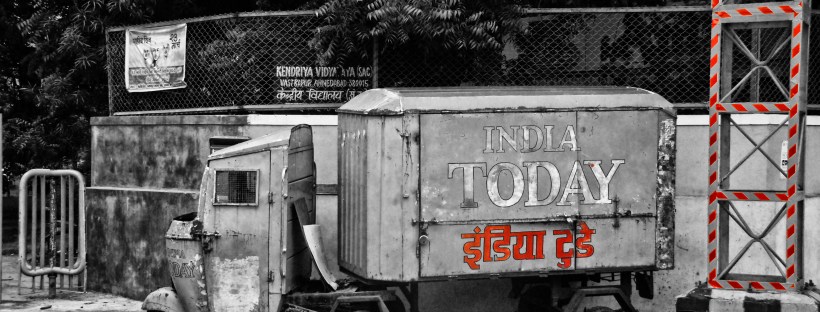
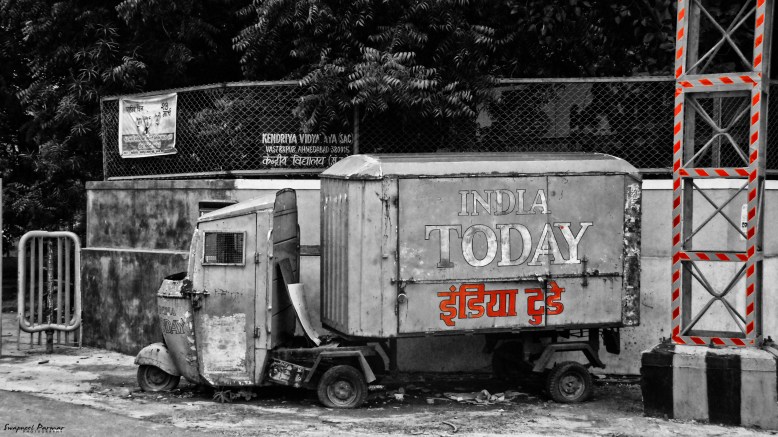
India Today

Artist Statement: “This photograph was taken in 2014. However, the place where it was taken no longer exists. I firmly believe that this photograph has a story to tell and I am more than happy to share it.” 

Swapneel_Parmar-India_Today

India Today by Swapneel Parmar
Photography Ι 3775 X 2123 Ι 2014

SWAPNEEL PARMAR, 22, is an Ahmedabad-based photographer who inherited a passion for photography from his father. When he moved to Ahmedabad for higher education, he was exposed to several youth and cultural festivals as well as local competitions where his photography was exhibited, awarded and appreciated. Since then, he has been involved in photography as well as cinematography in the Gujarat region.

Lovers Haunt

All my lovers haunt me, especially my father’s. They loom in the scents of strangers walking by: a passing male with strong body odor, another who uses the same cologne. Even the moist smell that warns rain brings me back to first kisses and the flail of my naive heart.

Their images burn behind my retinas as certain songs- our songs-play on the radio.  Teen-aged boys in Summer; careless youth, soft skinned faces and bright eyes looking out for the prettiest girl tanning. The Winter evenings turning early morning in bars, alcohol lacing an ugly scene.  The worst though, the place they came without disguise was through my dreams. In there they prodded, pleaded and flirted, hounding me, all the while I knew better, yet nothing had changed. They remained fancy thorns, puckering towards my innocence. I still had no control.

I’m older now. I’ve been seasoned within the subject of boys and men. I no longer flirt to float nor return a gaze to later falter.

Like most women, I have my line of firsts, the ones who set the bar, and the others who I wished I’d never let go, and the ones who stained me, changed me, made me question myself.

There was Thom one night in my college dorm alone: “Don’t make me rape you,” he whispered as seductively as if he’d just revealed his love to me.  I didn’t let him rape me.  Instead I turned it into my own idea and learned to play the seductress. I hate myself for this.

The boy with one eye. Vaughn.  He who pushed me into a bathroom stall as the music in the bar blared so loud, I knew no one would hear me anyway.  He wanted to keep flirting after that, but I was too far gone, hiding within a crowd who believed I was something I was not.

My first love turned crazy, landing himself in a mental institution. He didn’t know how safe he was as I tried to make my way down streets in a small town that whispered condemnatory phrases in my direction.  “Witch,” or was it bitch?

To be cheated, lied to or treated wrongly should have only happened once. Too many of these beguiling lovers embedded themselves quite close to my heart. They lay grinning under this category.  I blame my father for this.

Before I’d grown breasts, noticed the opposite sex or even felt the tug of attraction, he came knocking on my bedroom door. My mother did dishes. Folded laundry. She went out with her girlfriends for appetizers and bubbly drinks that glazed her pretty eyes and made her laugh in a way that was faraway.  In the meantime, her husband taught me how to roll over and numb myself dead.  His lessons became my blueprint for how I’d feel for someone, especially a man.

This morning I spoke to a girl almost two decades younger than I. She hadn’t birthed, survived nor racked up her experiences just yet to a ripe time of contemplation. She had years to go before she would come to understand tight smiles, resting frowns or the consequences of decisions, seemingly meaningless in their moment.  She said to me, “I write down all these things so that I don’t screw something up.  My boyfriend thinks it’s weird.”

I remembered doing much the same, yet it hadn’t prepared me for shit.

She had chosen me for whatever reason and I tried my best to pick my words to precisely convey a truth I had learned.  A truth I struggled within.  First I smiled, hoping it came off as kind.  Then I looked out into the distance of my past.

“You gotta feel good about you and follow what your heart feels it wants to find home in.  Then it’s near impossible to screw up.”

She started to cry. I asked her why. She only shook her head, leaving the space between us, one woman and one girl; a convoluted mix of knowing and naivety up for debate. I spoke again, maybe a poor decision, yet how can there be a filter when tears have already surfaced?  “Every decision I’ve made has stemmed into what I feel.” I looked down to her boots, studying their small silver clasps, and at the same time not really seeing them at all.  “If I could go back, I would have done everything I wanted to: education, lovers, friends, my relationship with myself. No one can tell you what’s right for you. They don’t know or feel what your experience is from your perspective.”

We parted some time after. I saw her twice more. She said she’d been writing about me and wanted to know how I spell my name. I drove away each time, wondering how I could hold so much wisdom for another, yet none for myself. My sweet husband was home and I failed to see what he saw of me. All my lovers crowded my sight and I found myself fearing a man my heart loved.  After so many situations, adorning roles to make the scene less depleting, I no longer trusted who I was.

I wish to rest my lovers, slay my father’s being. Sometimes more than I want to live contently.

The girl, two decades years younger, ceased to exist.  My words to her were just words to myself.  Similar to looking back through old photographs, being able to recognize the beautiful elements of that time to realize they were over. I sit up.  My hands stop shaking and begin to grasp a tangible reality. I close the ghosts of my past, tired versions of myself as well, the bodies I folded myself into, between covers of an old story I’m finished reading.


S. WINTERS, pulled by the motion still symbols evoke, can usually be found among the old growth giants of Vancouver Island working on her novel. Her work can be found in The Portal, Vancouver Island University’s literary magazine.

Stillborn

My daughter was understood.

She wasn’t a flower or a bee

or tropical storm or anything

else you can name and study

as a science. She had anatomy

but it wasn’t textbook like they

want you to believe. There wasn’t

a season for her. A chart to track her.

A price for the color of her hair.

She wasn’t a gift.

I couldn’t plant her in the soft soil,

give her roots or extract from her

all the sweet that pleased me.

Nor could I break apart the trees

or build a shelter to protect myself

from the violent adoration she spun

in my chest the moment I conceived her.

There is no wood strong enough.

No house pretty enough.

My daughter was understood

but not because numbers named her.

They only measured the length

of her soft, padded feet, her cherub legs,

how tall she could have grown.


MEGHAN BLISS is a freelance writer from Coastal NC. Her poetry and nonfiction have been published in Rust+Moth, Naugatuck River Review, A Poetry Congeries, and Mary Jane’s Farm, among others. Her chapbook, The Little Universe, was published in 2015 by dancing girl press. She is currently at work on her first novel. You can find more of her writing here.

Unconventional Warfare


When the wooden horse rolled in

and its side fell open, you braced,

stiffenening your muscles, but

no assault, only darkness

with a promise of surprise—

so you waited. Sometimes

you climbed up its flank and neck

looking into its eye’s cavern

and held your breath. It followed

on its ancient casters with creaky

warnings at the commissary,

the family readiness meeting,

the ring of your land line.

It followed you to the officers’ BBQ

and its wooden jaws cracked open.

She’s no moto wife. She doesn’t

even run. Her dog is just a tiny little thing.

She doesn’t plan to join the softball team,

and you saw the other wives

cordoned off inside the beast’s belly,

and your husband ate ribs and laughed.


LISA STICE received a BA in English literature from Mesa State College (now Colorado Mesa University) and an MFA in Creative Writing and Literary Arts from the University of Alaska- Anchorage. She taught high school for ten years and is now a military wife who lives in North Carolina with her husband, daughter and dog. Her full-length poetry collection, Uniform, is forthcoming with Aldrich Press. You can find out more about her and her publications on her blog and Facebook page.


Petrichor

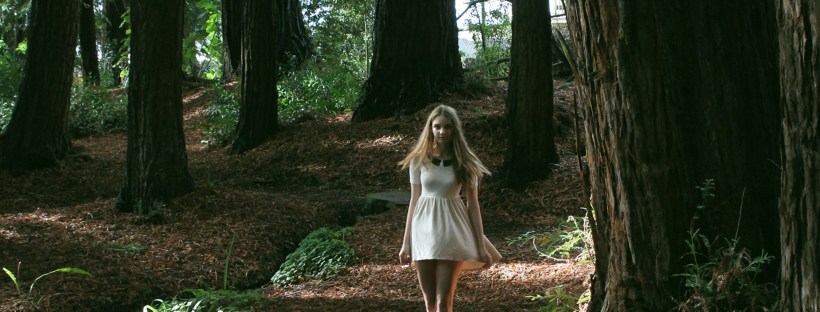
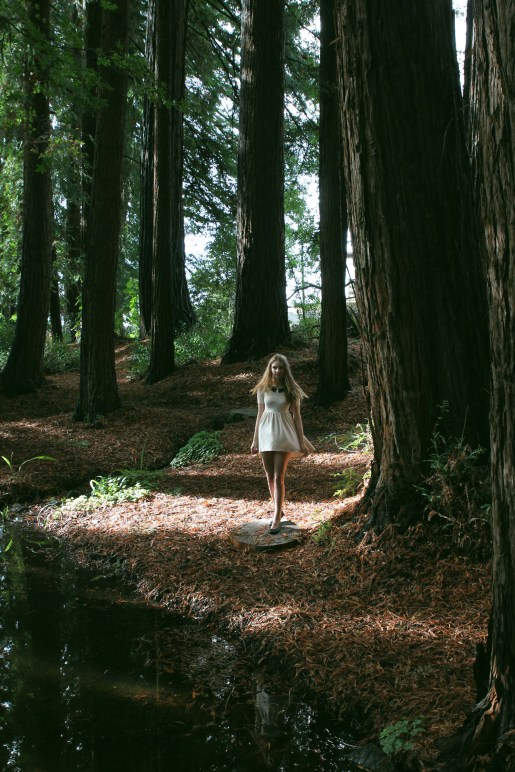
Artist Statement: “This work is part of a series titled, Petrichor, which means the fragrance of the earth after it rains. The model is the beautiful Emily.”

belle_carlson-BCarlson

Petrichor by Belle Carlson
Photography Ι 12″ X 18″ Ι 2013

BELLE CARLSON is a Californian artist pursuing the study of psycho-sociology and fine art at the University of Pennsylvania in Philadelphia. Her passion for photography bloomed from her desire to explore the vast landscape and beauty of the human experience through her camera lens. In the past, her work has been recognized through international publications, exhibitions, and a 2015 Young Arts Award. You can find her here.

Kinematics in One Dimension

i. v=v0+at

we carve alphabets onto glass tabletops.

acidic veins. bunsen burner hearts.

physics coating our fingernails like nail polish:

a burgundy glitter. how glass chips

cling to our palms like moist sand.

how, when marker squeaks against whiteboard,

we pause, look up. molten glass dribbling

from our wrists to the linoleum floor.

speed, we remind ourselves. not velocity.

that is to say: directionless.


ii. x=v0t+½at²

that is to say: we have not rusted.

minivans under a forest canopy, windows splintered.

the fraying metal of playground swings whistling.

a shudder of oxygen. that is to say: dissembled

by time and all its squares. or maybe it’s distance.

walk the stretch between here and sunrise and maybe

you’ll understand. come sundown, count the threaded calluses

on the soles of your feet, rivers eroded from the grit of gravel.

see how your fate line cracks your foot in half

like vertebrae. watch the calluses break off into deltas

at the curl of your toes. possibilities, fault lines,

etched into aching flesh. lessons of the difference

between distance and displacement.


iii. x=½(v0+v)t

learn how to piece together torn fabric.

patchwork, sewn from the fragments

of acceleration: not stagnant,

but not exactly changing either.

a rearrangement of variables, equivalence

wrought from the firm-mouthed lines

of stitches. learn how to halve time

as you would cotton sheets,

the kind hotels wash once, then never again.

much like your own purged distance:

sunblock-stained time, margarita-washed velocity.

rice-paper thinness, porcelain fragility.

somewhere that is not here, there is a room

with glass tables and whiteboard markers.


iv. v² =v0²+2ax

you make mirrors out of glass tables,

out of foggy windows: an infinite display

of delicate things. one day

not so far from today, you’ll go and rub out

your reflection, leaving only

smeared charcoal thumbprints. like how time

was eventually scrubbed from your equations,

velocity expanding to fill its place.

you think of how stars are glued to the canvas of sky,

some you suspect are mistakes, splotches of yellow

dripping from the painter’s sleeve.

no cat’s cradle of a constellation knotted between them.

no andromedas pressed around the corners

like daises suspended between the pages of photo albums.

one day not so far from today, you know

you’ll be wandering back, kinematics stitched

onto the lining of your sleeves.


LILY ZHOU is a high school sophomore from the San Francisco Bay Area, where it is never quite cold enough to snow. Her writing has been recognized by Scholastic Art & Writing, has appeared in Phosphene Literary Journal and Textploit, and is forthcoming in Glass Kite Anthology. When not writing, she can be found drinking bubble milk tea, solving a sudoku puzzle, or playing the flute.