Sawgrass Angel

Grey morning churned fog

along my eyes’ edges, a soupy slough

of muddy memories; our gazes met like Florida’s horizon,

mine: brown Everglades water,

his: blue Everglades sky.

The heat stroke shed details like discarded feathers,

sucked deep by swamp.


At Shark Valley, we biked 15 miles

and ran out of water halfway.  Ethan

laid me, delirious, by the side of the trail,

his sawgrass hair spreading cloudy tendrils into the air.

I closed my eyes, smelled mud and musk,

saw red tracks behind my eyelids,

heard ibises taking flight.


I woke surrounded by the white walls

of Heaven’s gift shop, clutching a tiny bell:

the clay bead clinked against the ceramic dome,

cool in my flushed hands.

At the ring, Ethan kneeled, eye-to-eye, mud-to-sky,

and promised I’d recover.

White ibis wings sprouted from his back.


Grey afternoon churned fog

along my eyes’ edges; my swamp spirit

with the glance of Everglades sky

trembled on lanky, just-hatched legs

as we piggy-backed across the doorframe

towards the car, my final

rest.


CASSIE HOTTENSTEIN graduated from the University of North Florida with a bachelor’s in English and a minor in creative writing and writing studies. Her other work has appeared in PULP, Perversion Magazine, The Talon Review, Exothorpe, and The Tampa Review Online. She now lives in the Boulder, Colorado area with her husband and two pet rats.

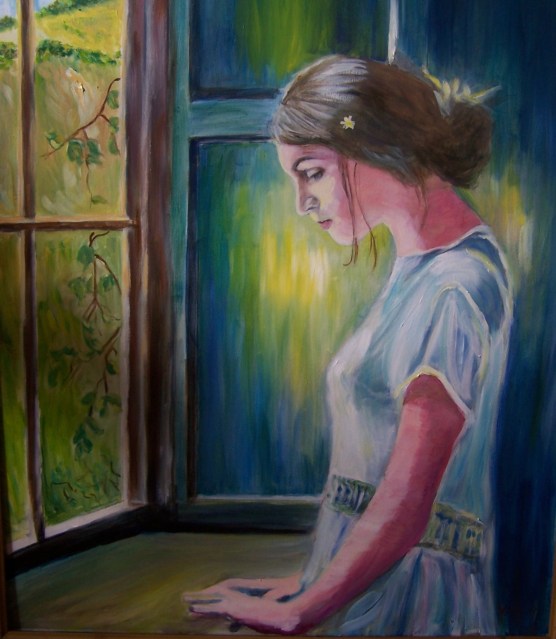
Elba At The Window

Artist Statement: “At first, I was going to throw the painting away until I added some yellow highlights that brought the picture to life.  I changed the window scenery at least four times to complement the portrait.”


clinton_inman-259

Elba At The Window by Clinton Inman
Oil on Canvas  Ι   24″ x 32″  Ι  2015

CLINTON INMAN was born in England and graduated from San Diego State University with a degree in Philosophy.  He is a retired high school teacher living in Florida with his wife, Elba. He paints realistic art in the Romanticist tradition. 

Songbird

Sage sat there, very still except for the light tapping of her hands, waiting to hear the knock on the door. She had already echolocated everything in the room – the chair, the table, even the small statue in the corner – so many times that she had memorized their locations without meaning to. Not for the first time, she felt the starchy material of her shirt and wished she could blend into the smooth, cool hardness of the walls like a cold, dead goddess.

Soon enough, there were three delicate, precise knocks on the door. Clearly, this was someone who had mastered echolocation more than most in their society of people with blind, useless eyes.

“Sage, they’re ready for you,” the organizer called. “Are you prepared for the concert?”

“Yes,” Sage replied simply. She stood up, trying to calm herself by breathing deeply. After all, she should be the one feeling the most confident about her upcoming performance.

As the two walked down the long hallway that led to the acoustically perfect hall, Sage could feel her heart beating rapidly. What comforted her was the steadiness of her clicks and the organizer’s as they walked. Click. It was such a simple sound, but it was soothing. Click. The organizer slightly adjusted his path toward the door. Click. Click. Click.

As they neared the door, Sage could feel her heartbeats relaxing into a comfortable rhythm. What more was there to do? She had rehearsed the haunting melody until it sang itself in her sleep. And, nowadays, the only mistakes that she made were imperceptible to the average ear. She was almost perfect.

*          *          *

            After the concert, Sage was surrounded by her adoring fans, who flowed around her as if she were a leaf floating in the middle of their stream. Listening to their chatter, she almost felt as if she were stuck in a slightly alternate dimension, one in which she was not meant to truly fit in as one of their own.

One elderly couple stepped forward to express their love and admiration. “We’ve listened to all of your concerts since you were five years old,” they breathed almost in unison. “That was a truly excellent performance. You made us cry. In a good way, of course.”

As the couple clasped her hands in theirs, Sage couldn’t help but marvel at the ever-surprising wonder of human touch. Sound could convey the emotions, but hands told the truth. She could feel every line, every wrinkle, every scar, and she desperately hoped that, one day, her hands could be like theirs.

A loud throat-clearing erupted behind Sage. It was her voice teacher, who was waiting with warmth and pride. “Well done, Sage. Truly, well done. I see your dedication and your improvement. I just want you to know how proud I am of you.”

Sage smiled and blushed from the acknowledgement and the warmth of having been able to leave an emotional impact on her world. Feeling the need to be alone, she did her best to excuse herself from the crowd. Walking out of the room, she directed herself toward a window near The Edge, where she could feel a slight breeze. Somehow, Sage had always felt calmer whenever she got close to The Edge and its characteristic soft caress of wind. No one knew what was past the free, open air of The Edge, but she couldn’t help but feel that it was full of possibilities.

*          *          *

            The scientist sat and stared at the screen, lab coat wrinkling under her weight. She stared at Sage and at the giant metal cage around her society, too fine for them to detect with their echolocation.

Her colleague peered over. “Oh, you’re watching the Songbird again. Do I need to remind you that we have a problem with Experiment 58C again? Ever since we gave them eyes, it’s been amazing how many rebellions we’ve had to put down.”

She chuckled wryly under her breath. “Don’t you mean Experiment 99B? You’re the only one around here who regularly talks about that girl as a songbird. I could also mention what a disaster Experiment 36A was. Perfect species? More like perfect annihilation.”

They watched as Sage held the last note of the song, obvious joy emanating from her very posture. He shrugged. “I don’t understand why 58Cs are so rebellious. The only difference between them and 99Bs is the number of functioning eyes. But they seem happier, somehow. More free,” he shrugged again, gesturing toward the screen.

She sighed. “I suppose you’re right about our little songbird. Now let’s get back to work.”


ASHLEY LAW is currently a senior in the wintry state of Minnesota, where the four seasons are pre-winter, winter, post-winter and construction. Despite having a long history with the STEM fields, especially math, maybe this time she’ll be a convert to the land of the humanities. This is Ashley‘s first publication.

Two Sketches

Artist Statement: “The first version of Siddhartha was made in 1984, as a gift to my elder brother who had renounced the world. Originally inspired from a sculpture of The Buddha, this piece aims to capture the peace and inner radiance of enlightenment. It was redone in 2010.

Although redone in 2010, Return and Rest was first made in 1995, when my sister had left Mumbai for a small town with plenty of earth, trees, sun and fresh air.”


This slideshow requires JavaScript.


ASHWIN PANDYA is a sketch-artist and illustrator, whose work has graced many book-covers. Acknowledged for his digital art as well as musical compositions, Ashwin Pandya can sketch given any situation, description or character. You can visit his website here.

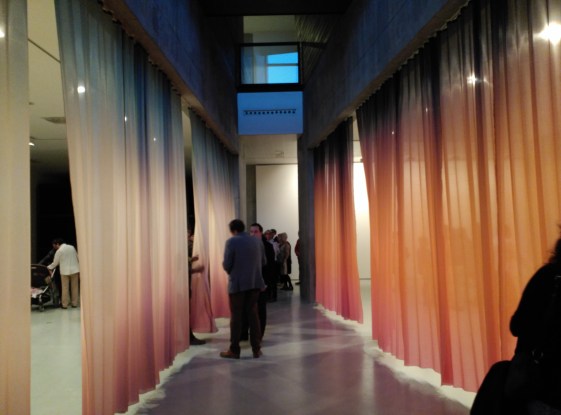
Curtains

Daniel_de_Culla-IMG_20151008_194954

Curtains by Daniel De Culla
Photography Ι 5.8″ X 8.2″ Ι  2015

DANIEL DE CULLA is a writer, poet and photographer. He is also a member of the Spanish Writers Association, Earthly Writers International Caucus, Poets of the World, and others. Director of Gallo Tricolor Review, and Robespierre Review, he has participated in poetry festivals and book-theatre in Madrid, Burgos, Berlin, Minden, Hannover, and Genève. His work has been exhibited in many galleries in Madrid, Burgos, London, and Amsterdam. He divides his time between Los Angeles, Madrid and Burgos. He has published more than seventy books.

Trespass

Even though there are signs saying KEEP OUT and BEWARE OF DOGS, Gordy says he’s going in.

“But what about the dogs?” I ask.

“He don’t have any dog.  It’s a ruse.”

I have no idea what a ruse is, and the word is either something Gordy’s made up or recently overheard.

I watch him clip metal strands from the fence with wire cutters.

“You’re going to get into a buttload of trouble,” I say.

“Been there before,” Gordy says, which is true.  Gordy’s been expelled from school four times.

He’s been caught shoplifting and he set fire to Wally Goff’s tree fort three summers ago, about a month after his dad made off with the redheaded receptionist at the used car lot where they both worked.

Gordy, like everyone else in our school, has heard the stories about old man Miller’s place, how he keeps kids caged in the barn beside his house.  I’ve told Gordy that’s nonsense.  If it were true, the sheriff would have swept in long ago.  Gordy says the authorities in our town are dimwits, some of the dumbest people on the planet.

When he’s cut a space wide enough, Gordy climbs through it and I take a deep breath, waiting for lightning to strike, even though it’s a clear, starlit evening.

“Come on.” Gordy waves me in.

“No way.”

“Chickenshit.”

“I’m not an idiot like you.”

“Fine.  Wait here then.  I’ll just check out the barn and be right back.”

“Gordy, don’t—“

But he’s dashed off, hunched over, moving bowlegged as if he’s some dwarf commando.

The house and barn are set back quite a ways from the fence and I lose sight of Gordy in less than a minute.  All I can really see is the outline of buildings and the porch light bleeding yellow streaks.

I listen for barking dogs but only hear crickets bleating and the eerie rustle of tree branches swaying in the breeze.  I wait an hour, shivering as the temperature drops.  I wait a half an hour more, my teeth chattering from the cold and for fear that something bad has happened to Gordy.  I know I should probably go after him, but Gordy was right: I’m a chicken.

An hour later, he still hasn’t shown, so I hightail it home, sprinting as fast as I can, picturing Gordy locked in a cage, stripped to his underwear, on his knees with several other captives.  Guilt and fright clash inside me.  I’ve always been the wary one, the lucky one, with a normal family and parents that are still married.  I can’t even think of the worst thing that’s ever happened to me, or any situation where I’ve been daring.

Running towards home with tears streaking my cheeks, I tell myself they’re because of the wind, nothing else.  I plan on calling the cops as soon as I’m home, but once I reach the house, Gordy’s there, sitting on the porch.

“What the hell?” I gasp, out of breath.

“You were just going to leave me there?”

“You said you’d be right back.”

“Nice friend.”

“How’d you get here?” I say, flustered, trying to change the subject.  “You didn’t come back the way you went in.”

Gordy stands.  His face is contorted, a mash-up of wrath and disillusionment.  “Asshole.” He slugs me in the chest.

“Hey!”

As he walks away, a flurry of thoughts clash in my head—that I should jump him and punch him back, that I should apologize, or lie and tell Gordy I went looking for him but he was nowhere to be found.  Instead I call out, “What’d did you see?  In the barn, was there anything inside?”

Gordy flips me the bird without looking back and keeps walking.

I watch him go, his body eventually swallowed up by darkness.

I slink inside the house and go to my room, undress and get beneath the bed covers.  I think about courage and cowardice, friendship and choices.  I picture the man I want to be someday versus what I am now.  I stare at the full moon listing outside my window and promise it that I’ll be stupid from now on, reckless and daring, anything, no matter what it takes to be brave.  I close my eyes and watch myself slip through a fence.


LEN KUNTZ is a writer from Washington State and an editor at the online magazine Literary Orphans. His story collection, The Dark Sunshine (Connotation Press), debuted in 2014. You can also find him here.

Top Hat

They were showing Top Hat on TV when he got home from work. When had he seen it in the theater? 1935? Yes, it had been 1935, when he was 20. Had 40 years really passed? He took a few gulps of his cold Bud and tried to remember who he saw it with.

Wasn’t it that girl his aunt set him up with? What was her name? Ellen? No, that was the theater where they saw it. The Ellenay. He noticed once again how Ginger was playing so hard to get. Did she play hard to get? No, not really, she just sat there on the bus and just nodded when he tried to think up something to say.

“How did you like it?” he remembered asking as they walked out with the crowd. But he still couldn’t remember her name.

Here was the part where Dale Tremont says, “That sounds like Gertrude Stein.”

That got him curious about Gertrude Stein and he tried to find something she wrote at the bookstore near his grandparents. The girl at the counter had never heard of Gertrude Stein.

Who was that girl? Suddenly her first name came to him. Her last followed slowly just like his tagalong sister. She wanted to go with them to Top Hat. He should have let her.

Would her name be in the phone book? She had an unusual name. If it was he’d know it was her. But surely she would have married in the forty years since he took her to Top Hat for their one and only date.

He had to see and went to the phone book on the table by the phone. He opened it and found her name, just as he remembered it. Could it really be her? It had to be. Who else had such an unusual name? But he couldn’t bring himself to dial.

He sat down and got back to Top Hat. Was he liking it as much as he did forty years before? How did Fred and Ginger hold up in the 1970s? Who could be watching it now but him… and maybe her?

The phone rang. Who could that be? No one called him, especially not now at dinnertime, even though he never had a dinner that could interrupted.

Maybe it was her. Maybe she was watching and she remembered going on the date with him to see it in 1935, forty years before, and she remembered his name. He let it ring three times. It couldn’t be her. But then stranger things had happened. He rushed to the phone.

“Is Ed there?”

It was a young man’s voice, the young voice of a man born long after 1935, a young man who was not watching Top Hat and if he did could not have appreciated the beautiful footwork of Fred and Ginger.

“You have the wrong number, son.”

“Okay, sorry.”

He sat back down and found that he couldn’t watch Fred and Ginger anymore. He turned it to Walter Cronkite.


JOHN MacAYEAL has a Master’s in English from the University of Texas at El Paso and now works at the IT help desk for a major North American retailer. He has had a few short stories published in small publications. One of his short stories was included in an anthology about the US-Mexico border.