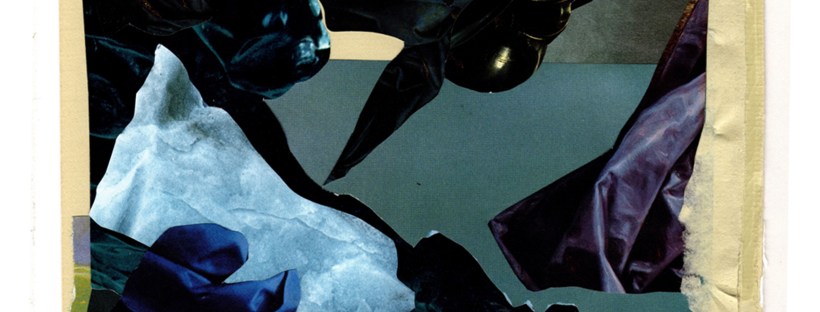
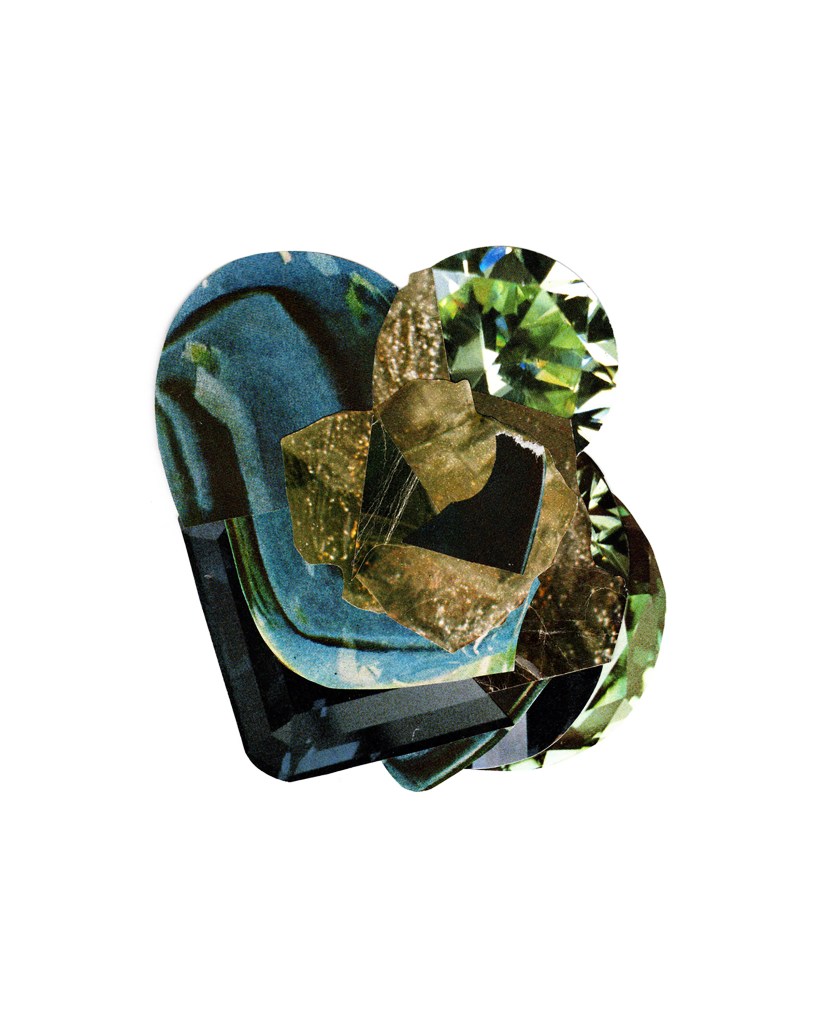
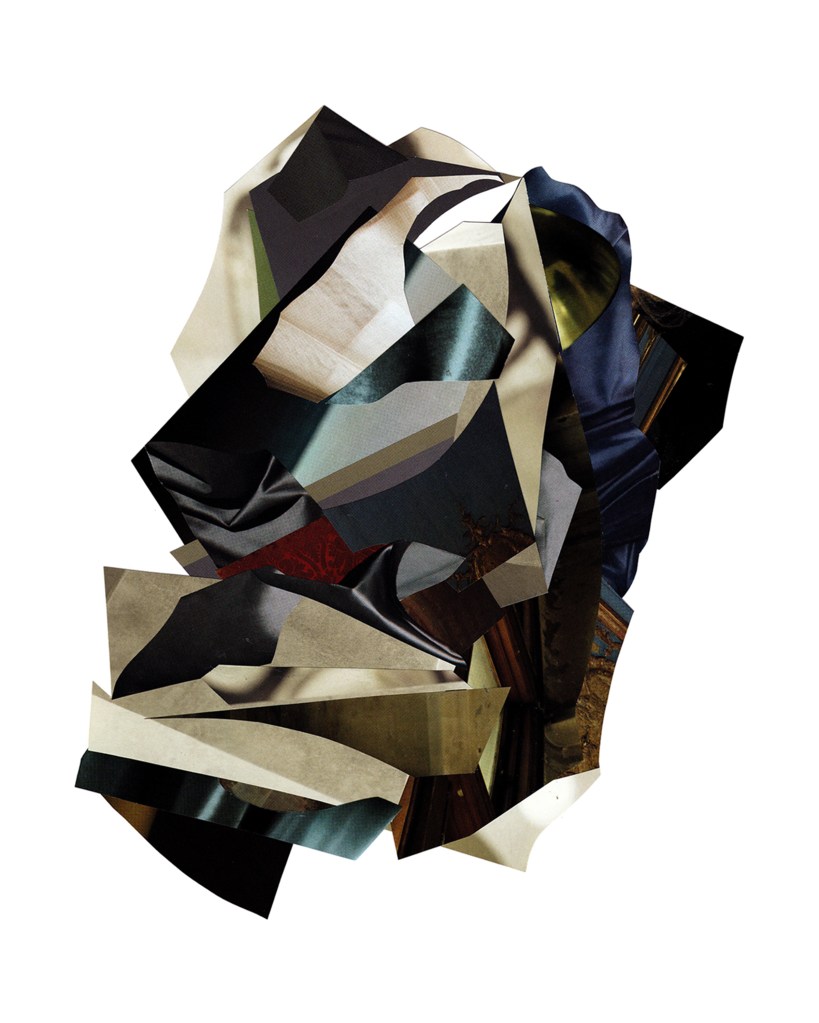
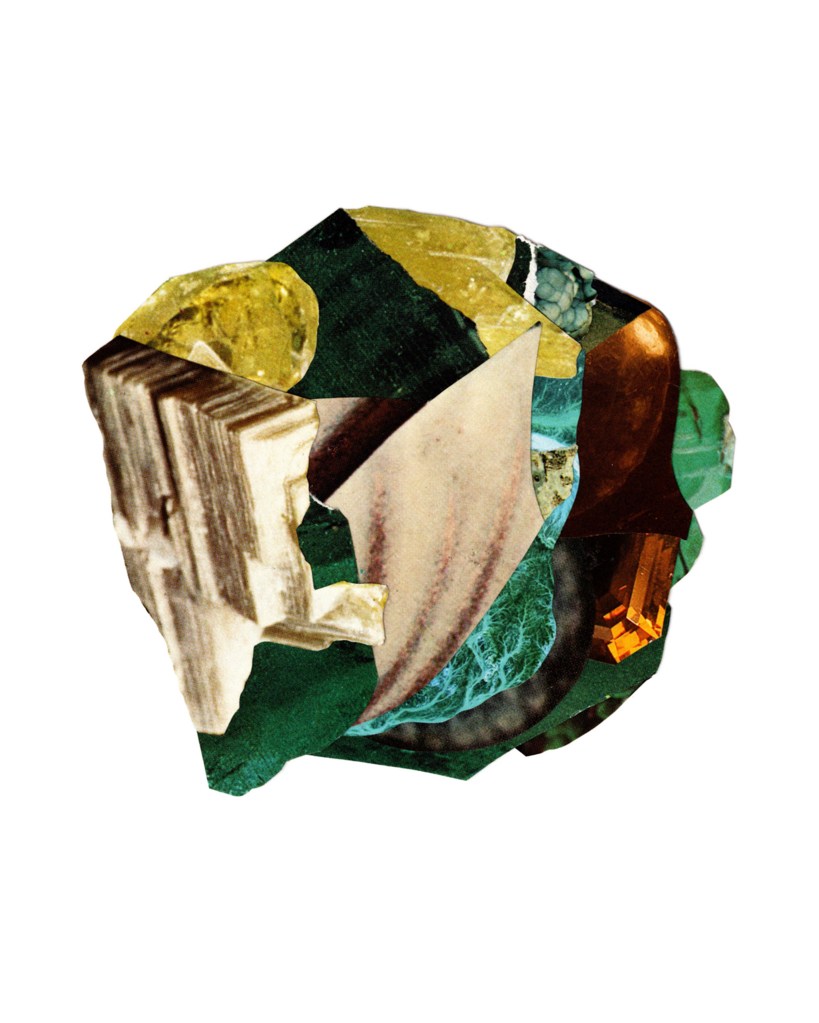
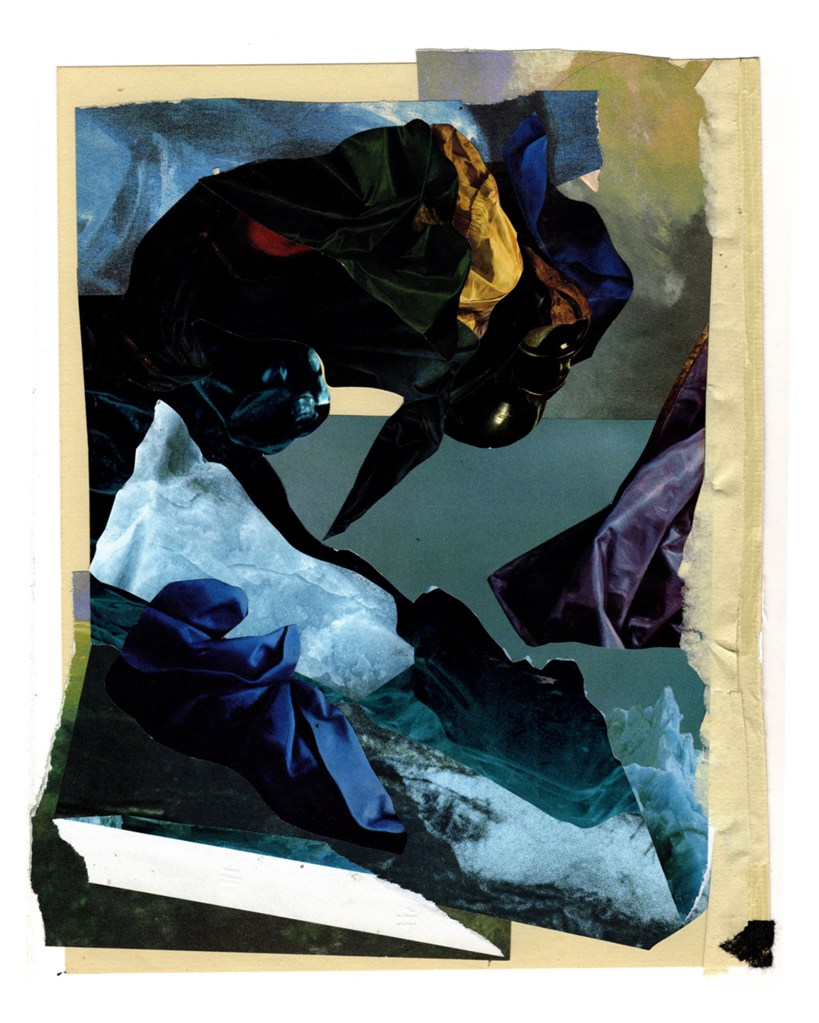
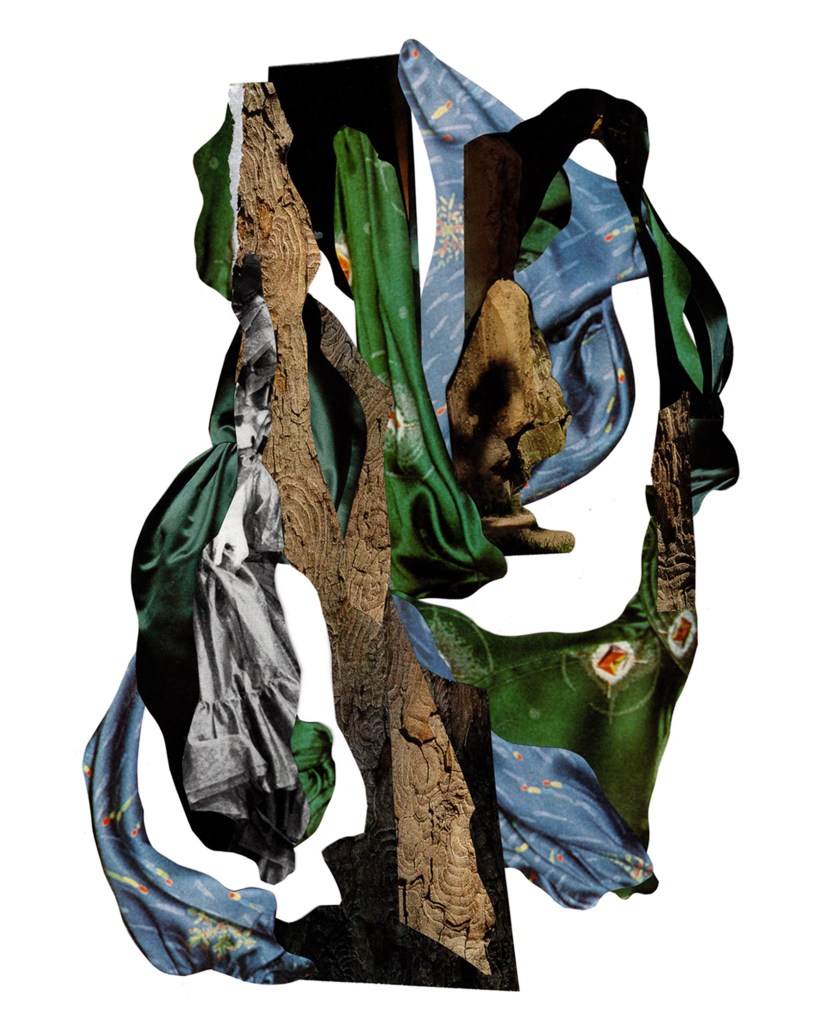
allison anne is a multidisciplinary artist based in Minneapolis, Minnesota, USA (unceded Očhéthi Šakówiŋ land), working in collage, zinemaking, mail art and mixed media. The core of their practice is handcut paper collage— a constantly evolving exploration of experience and emotion through the reconstitution and rearranging of various printed media and ephemera. By recontexualizing images and materials, allison creates complex textural, intuitive abstractions and configurations which prioritize that which is found, discarded and left behind, exploring the intersections and interactions between context, materiality and creativity.
allison is a founding member of Twin Cities Collage Collective, a member of the International Union of Mail-Artists and the collaborative projects Morphic Rooms, NONMACHINABLE and Scissor Prism Orchestra. Their work has been shown and published around the world and is in the collections of the Scandinavian Collage Museum and the Minnesota Museum of American Art as part of the MPLSART 2020 Sketchbook Project.
fimbria pulling the delicate pearl into my cistern,
my red sinew.
I can see the Tor from here! I shout,
climbing mound after mound of the Green Mother’s body.
The Earth is fertile. And I have my poppy seed.
It is symphonic and delightful.
Eat the water, my pearl, my shining descendant,
I say to star in my belly,
eat it with your hands.
This egg tells me that ova need more than water,
that they desire fruit like their other mother.
I am an orchard woman now.
Blastocyst, zygote,
cells dividing in their miniature geometry.
In a library of embryos, this one would shine
and sing upon me–
unfolding like lace made of light and new flesh.
She is the animal, burrowing, and I am the dirt,
and I am already full of her;
her scent, her texture.
She looks at me in the dark,
and I think, there is no country, no volcano
wide enough to hold this child.
I call out anyway:
Come to me now, in these startling millennia,
and show me your first, truest form–
scarlet, sharp, and female.
ALORAH WELTI is a nineteen-year-old Minnesota-born feminist, synesthete, and emerging poet and artist. Her work has been featured in the anthology Re-membering with Goddess: Healing the Patriarchal Perpetuation of Trauma (Girl God Books, 2022) and is upcoming in Allium, A Journal of Poetry & Prose. She currently lives on stolen Mohican and Wabanaki land, now called Berkshire County, Massachusetts, with her family.
ALIYAH WARWICK is a student in Maharishi International University’s MFA in Creative Writing program. She enjoys dabbling in dance, puppetry, Dungeons & Dragons, and languages like Italian and Swedish. You can find an essay she wrote about her experience learning Italian in Zenith Literary Magazine. Her poetry was published in Lothlorien Poetry Journal and will be featured in the forthcoming anthology, Conestoga Zen, Issue 2.
You sprouted these Orange King Alstroemeria from seeds twenty-five years ago. Gently you placed them between strata of moist paper towels, and when shoots appeared you poked them one by one into the soil. They bloomed only once, and afterwards— nothing.
Now, after two successive springs fluent in rain, they’ve suddenly ripvanwinkled. Many blossoms pop up from the ivy ground cover eager as fledglings greeting a parent bird bearing morsels.
I’m so glad that alstroemeria know how to alchemize leaden skies into golden petals without any help from us because we’re far from nature’s most dependable friend, and long after we’re gone, flowers will rise up toward brightness and starlight and the muck of puddles.
ZACK ROGOW is the author, editor, or translator of more than twenty books or plays. His ninth book of poems, Irreverent Litanies, was published by Regal House. He is also writing a series of plays about authors. The most recent of these, Colette Uncensored, had its first staged reading at the Kennedy Center in Washington DC, and ran in London, Barcelona, San Francisco, and Portland. His blog, Advice for Writers, features more than 250 posts on topics of interest to writers. He serves as a contributing editor of Catamaran Literary Reader. www.zackrogow.com
I wrote my first short story only a few months ago. It concerns the truth of someone I know. It was told to my mother in confidence, but she decided to spill it to me anyway as most innocent mothers do. I wasn’t shocked by the truth when I first heard it, but it has stayed with me and assumed its own shape and form in my mind over the past few years. It is strange to say this, but I can almost feel it constantly shifting and being punctured in my mind and body in ways that have perhaps made that truth mine now. When I decided it was time to write it down and give it some form, I realized I couldn’t do it through poetry. It had to be done through prose; I had to write a short story. It needed a different body. But I felt odd being nearly paralyzed by the idea of writing something down as a poem. I had never written a short story. Where should I begin? How? How do I get my mind to think in sentences without line breaks? How much should I meditate on language and isolate words? How do I write with a poet’s mind? I never thought there was something I couldn’t say through poetry, but this instance felt different as though the real challenge was not the story itself, but the way to tell it. And so I finished writing the short story and wrote one after the next, and soon enough, I realized I had embarked on a novel. I haven’t written any poetry since and decided sometime in April that I wanted to attend a fiction workshop in the summer.
I came across the Yale Writers’ Workshop and spent a week with other writers on the beautiful Yale campus trying to find ways to write and revise our stories. There, I was struck by something that Sergio Troncoso, one of the faculty members, said at the faculty reading. He pointed out that it’s the challenges related to craft that he wants to explore in his writing now, as opposed to challenging themes or subjects alone. I thought he had spoken to what I’d recently experienced: the truth of the story didn’t challenge me as much as the idea of writing in a short story form did. So I decided to get in touch with Sergio and talk to him more about this idea.
We decided to meet one afternoon at a French-style cafe on the Upper West Side. I like going to a different neighborhood than mine, or meeting people in theirs. Each neighborhood carries a different personhood and conversations in different areas, too, perhaps are imbued with the identity of that place. I composed myself before meeting Sergio. I always feel like I am entering a different world, a different dimension when I exit the subway and it takes a while for me to reorient myself. Sergio was waiting for a couple of minutes. We decided to sit inside because we thought it would be too noisy outside. We ordered coffee and our conversation, of course, began with talking about New York. If I could have it my way, every conversation of mine would begin with the city.
Sergio thought I look acclimated to New York. “For better or for worse,” he added. And he went on to tell me how he misses Texas, where he was born and raised in the city of El Paso. He misses connecting with people the most. “They can be rude and rough in New York,” he said. But he went on to add that the diversity of the city is unmatched, that one can meet fascinating people from various backgrounds doing all kinds of creative, interesting stuff. And then we got down to it. Sergio asked me to shoot my questions and I told him, then, that I was interested in talking to him about the idea of being challenged by some aspect of craft. He immediately said that he knew how to tell a good story, but that he wants to feel constantly challenged as a writer. He wants to do something difficult or something he wants to learn more about. I liked that approach. Sergio was stepping into the territory I like asking writers the most about: What do you not know about writing yet? What continues to scare or challenge you about writing?
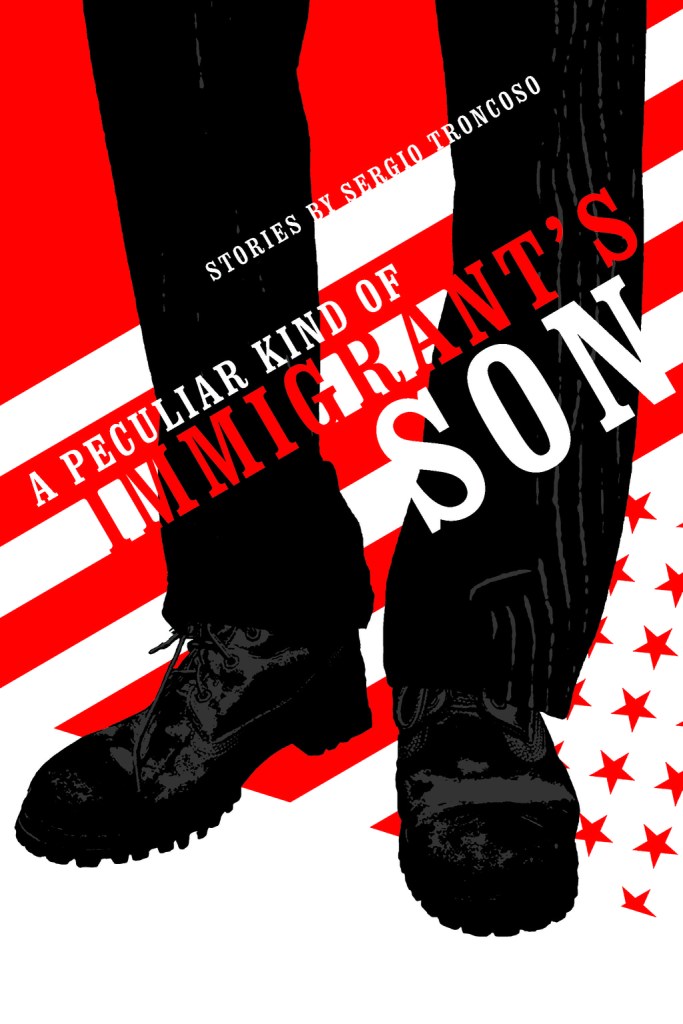
And Sergio’s new novel, Nobody’s Pilgrims, is what he had in mind as his “adventure novel.” It’s his attempt at something new, something he hasn’t done before. He wanted to write something suspenseful, but also something about immigration, poverty and the working class. His other books, such as A Peculiar Kind of Immigrant’s Son(Lee and Low, 2019) and From This Wicked Patch of Dust(University of Arizona Press, 2011) deal with similar themes, albeit in different ways. Nobody’s Pilgrims, however, is interestingly described as “a cross between The Adventures of Huckleberry Finn and No Country for Old Men.” Sergio wanted to write about people who don’t belong, and his novel follows three runaway teenagers— Turi, Molly and Arnulfo— racing across the country in a stolen truck. “One of the things writers are supposed to do,” he said, “is entertain readers.” He laughed and added, as if suddenly conscious of what he had said, “I know it sounds ‘sucky,’ but it is true.”
But one of Troncoso’s main challenges related to craft in Nobody’s Pilgrims was to write short, fast-paced chapters and a novel in which all the protagonists are teenagers. The book, unlike his other works, was not what he calls “pre-arranged.” His other novels were laid out and he mostly stuck to the maps he had drawn. He said, “I wouldn’t call it an outline. It was more like a map of a lot of paragraphs… and I sort of followed it with a few adjustments.” But with Nobody’s Pilgrims, he only knew where to start and where to go, but he wanted to allow a chance of discovery.
I went on to ask him at that point, whether he ever conceptualized his book a YA novel even though it is adult fiction. His publisher, Lee and Low, after all, mostly publishes children’s books although they have started to make forays into the adult fiction and nonfiction markets. Troncoso stated that the presence of three teenage protagonists doesn’t necessarily make it a young adult fiction. I agreed with Sergio and he asked for my opinion as a reader. I told him how I was reminded of reading Salman Rushdie’s books, Luka and the Fire of Life and Haroun and the Sea of Stories. I read those titles only a few years ago as an undergraduate, and my experience of reading them was not from the perspective of children’s literature or YA fiction. The same, I believe, is the case for Elena Ferrante’s books, I told Sergio. Her latest fiction, The Lying Life of Adults, is told from the perspective of a teenager and although the narrator of her Neapolitan novel, Lenù narrates her childhood and adolescence in retrospect maintaining a touch of her childhood and adolescent voice, they are not books for children or teenagers alone.
But what also interested me about Sergio’s new novel was his attempt to explore the psychology of teenage characters in the present and insert his own self into them. In his new novel, he goes through just a few weeks in their life as opposed to a long stretch of time. One of his characters, Arnulfo, is like a version of himself, he said. And Molly is the kind of character Sergio knew while he was teaching in Independence, Missouri. Most Mollys, he said, were from white, working-class families who are “poor, blonde and blue-eyed,” but who perhaps saw Sergio as an elite, Ivy-league educated man— he graduated from Harvard before receiving two degrees in international relations and philosophy from Yale, and was a Fulbright scholar. And Turi, on the other hand, is as an orphan who doesn’t have a family to fall back on and is trying to escape the border from a bad family. “The more you educate yourself and spend time away from your family or origin, the more you can’t explain to them where you are and what you’re doing. And I have felt that acutely.” The reason Sergio started to write was because he felt he couldn’t talk to anybody, not about the works of Plato and Aristotle, or about what he had managed to do with his life.
But Sergio maintains that growing up in poverty never really leaves one and there’s always an imposter’s voice inside him that speaks at times. “I’ve always felt a sense of fear. Maybe I haven’t done enough, maybe I don’t understand enough. Maybe Yale and Harvard made a mistake.” And it is these apprehensions that he tries to write into his characters. Sergio started learning the craft on the fly. He learnt it on his own, he says, and he admits that it’s a lonelier path to take, but the payoff, he thinks, is that it has made his voice all the more unique.
But Sergio is always working on something new. He was working on research for another historical novel set in Juárez about a young, seventeen-year old woman who led a protest during the Mexican revolution, but has largely disappeared from history. Based on his research, he has reason to believe that she was probably killed but the more he dug into her life, he realized he would have to create her end to make her life meaningful. He wrote a little bit about her in his linked short story collection, but he said the fervor is gone now, he said. “The Yale Writers’ Workshop and a few other things,” he said, “interrupted it.” He did a lot of research, but he’s just not so sure of continuing with it. Sergio often advises his students to write something that really excites them, even if they don’t know everything about it. “If you’re not excited, you should put it aside and do something else,” Sergio declared, ” and that’s the other thing about craft. You should enjoy it.” Sergio is very serious about writing but he emphasizes on having fun with it, not a purposeless kind of fun, not a fun that isn’t ambitious. But the kind of fun that makes you feel more engaged with the task at hand. Craft is time-consuming and any lack of energy, Sergio believes, is reason enough to drop it and switch to something else.
He said to me, “You are your best experience. You dig deep into yourselves, you see many different selves and many different versions of people in you. I always see myself as an experiment, a vehicle.” And Sergio is always experimenting with versions of himself. But as he were talking, I was interested in his idea of discovery— it is something I think of as a translator. You’re not just translating words from one language to another, you’re also aiming to translate their discovery and suprises and how you replicate your discoveries as a reader, that delicious suspenseful feeling before the discovery, is crucial to your task.
But Sergio cared about it being a conversation, and asked me a few questions about my own writing project and obsession with Ferrante. I told him how the novel I am working on is an auto-fiction and before I could pick his brain about inserting oneself into one’s story, Sergio immediately acknowledged that creating a fiction of yourself and putting yourself in a story is also about “putting yourself through a lot.” When he was writing Nobody’s Pilgrims, it was a departure from From This Wicked Patch of Dust, which was about a loving, poor family who could get to the United States primarily because of the love that existed among them in the midst of their poverty. But Nobody’s Pilgrims is different and focuses more on the idea of violence haunting innocence. It was born out of focusing on the reversal of some ideals, out of Troncoso’s own inability to speak to everyone. I was certain many writers can connect to that— so many of us write when we fail to speak. It sounds ironic, but it’s true.
“I feel like a turtle. My home is on my back, it’s wherever I am,” he said. Sergio is accustomed now to working by himself, to the loneliness of a writer’s life that only occasionally crosses paths with others. But he is a firm believer in the freedom that loneliness affords, the one to follow one’s mind and delve deeper into oneself that emerges within its sad but liberating confines. One of Troncoso’s early stories, he recounted, was about a twenty-year old man, Victor, who goes out with a Mexican woman he met in El Paso who is a decade older to him. That relationship made his character wonder about whether he’s Mexican or American. The very first scenes describe them in a moment of passion and Troncoso’s father, upon reading the story, said, “Sergio, what are you doing? Are you writing pornography?” We laughed and Sergio talked briefly about not censoring oneself, or not writing because of the fear of people around us. There’s often a pull to write the “right characters,” he said, but Sergio tries to resist linear or perfectly moral characters, not the “right” kind of immigrants or women for instance.
“A deep freedom of consciousness,” Sergio says, “is what writing is about.” “Damn even yourself,” he says and advises writers not to fall for their own proclivities, judgements and tendencies. He wants to ask the toughest questions of himself, as much as he asks them of others around them and that’s why he loves writing. He said, “Let me be blunt. I don’t even think I know myself.” It’s a huge admission to come from a writer, and it is difficult to do what Sergio wants writers to do: to turn the lens onto our own selves as we do towards others. In many ways, my first short story felt like a test of my ethics, I told him. I wrote that story because I was uncomfortable harboring the truth. It wasn’t a lens turned towards that person’s secret, but a lens turned towards my own self. Should I tell the story that belongs to someone else and how? How do I capture the ways in which their truth is as difficult for me to harbor as it is for them? How do I write a secret and still keep it?
But I asked Sergio about teaching writing which is, in my eyes, a difficult terrain that forces one to test one’s ethics and morality. And, of course, since I know him through the Yale Writers’ Workshop Sergio laughed and asked me to talk to his students. He calls himself a “tough” teacher. He pushes them a lot, he gives them exercises each day. He has his students doing exercises three weeks before the start of the workshop. “I believe if you work hard, you should enjoy yourself.” He wants to help his students realize their vision instead of forcing his own on them. His workshop, he says, operates like a group effort in service of writing before anything else.
And I wondered if he had other advice for writers. “You should be reading three books a week as a writer,” he said. “That’s normal pace for a writer, and frankly, you should be reading a lot more than that.” I think of the beautiful Urdu word, riyaaz. For writers, one of the most important forms of riyaaz is reading, and to make it less solitary, one should perhaps espouse Sergio’s definition of teaching: an effort to create a community. He tries to run the kind of workshop he wish he could have been part of. At Yale, he mentions how he meets students over breakfast and dinner and talks shop. His workshop outside the workshop too, and while it exists for the sake of creating beautiful work and working on each individual’s weak spots, he is also equally motivated to helping his students get a contract, get published in the best literary journals and prepare a serious piece of work to be shared with the world, .
When I asked him if there’s anything else he’s working on, or what’s going on in general in his reading and writing life, he revealed to me that he works a lot with his dreams and frequently dreams about his characters. At the moment, he’s thinking of a short story based on this one character who appeared in his dream, but he also wants to work on some essays. An editor, he told me, has requested a sequel to Nobody’s Pilgrims and around the time we met, he was reading Gogol’s Dead Souls and Chekhov’s short stories as a way of “replenishing” himself while “getting lost.” He loves writing by some Russian and German writers, and feels very connected to them and the time they lived in. He thinks of American literature as something “flimsy.” He thinks of George Saunders, for instance, as a great writer, but very few American writers, he believes, can stand the test of time. He mentioned Elena Ferrante as a truly great writer (which obviously brought a smile to my face) and he struck a nerve when he mentioned how he had to leave everything he learnt about academic writing behind as a creative writer. The mechanics of the two are rather different and it requires one to switch one’s brain, he mentioned.
Finally, towards the end of our conversation, he said “writers don’t talk about money, but they should.” Despite growing up poor, Troncoso told me he is adept at managing money. And writers, according to him, should learn how to manage money in ways that helps them build a life in which they can write and explore freely. “Writing a story needs a great deal of meandering until one gets it right,” he said, and money is an entity through which one can afford that luxury so the writing doesn’t suffer. In the last recorded sentence of our conversation, Troncoso said, “You don’t have to be lonely.” It is a reassuring thing to hear from another writer, particularly when, as Michele Filgate writers, writers are the loneliest artists of all. As we got up to leave, I told Sergio I could walk down a few blocks with him to the 79th Street subway station. People, I saw suddenly with Sergio’s words still on my mind, were everywhere. There were people coming out or walking into the subway, going into the stores that lined the streets. Nobody was truly alone, nobody had to be.
SERGIO TRONCOSO is the author of eight books: Nobody’s Pilgrims, A Peculiar Kind of Immigrant’s Son, The Last Tortilla and Other Stories, Crossing Borders: Personal Essays, The Nature of Truth and From This Wicked Patch of Dust; and as editor, Nepantla Familias: An Anthology of Mexican American Literature on Families in between Worlds and Our Lost Border: Essays on Life amid the Narco-Violence.
Troncoso teaches fiction and nonfiction at the Yale Writers’ Workshop in New Haven, Connecticut. A past president of the Texas Institute of Letters, he has also served as a judge for the PEN/Faulkner Award for Fiction and the New Letters Literary Awards in the Essay category. His recent work has appeared in the Texas Highways, Houston Chronicle, CNN Opinion, New Letters, Yale Review, Michigan Quarterly Review, and Texas Monthly Magazine.
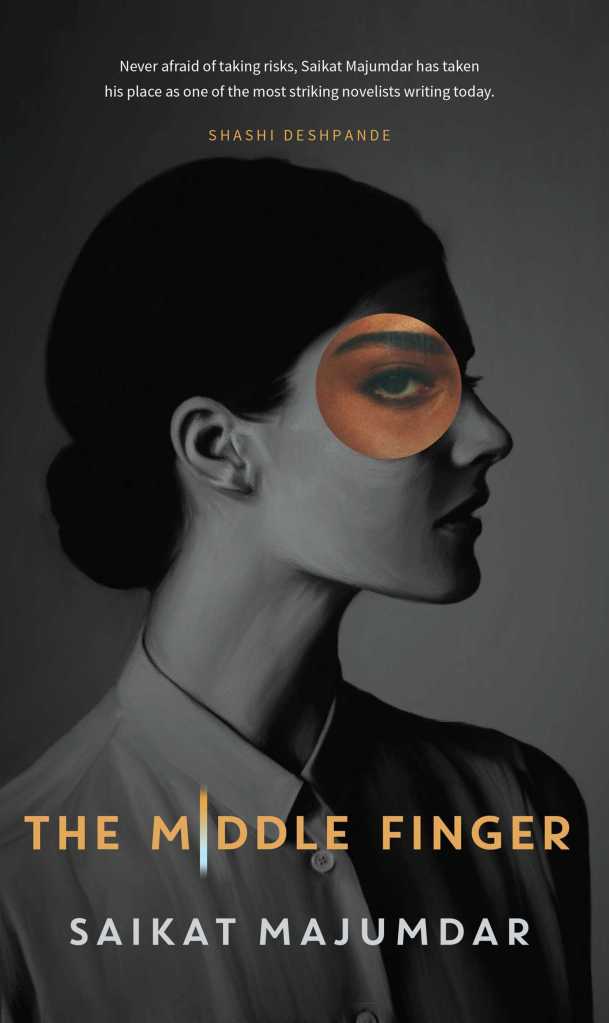
The Middle Finger by Saikat Majumdar (S&S India, 2022)
Saikat Majumdar’s fourth novel, The Middle Finger, seeks to explore the ethical boundaries of friendship and familiarity between a teacher and their student. It follows academic and poet, Megha Mansukhani who might have been teaching at Rutgers at the start of the book but she was writing her dissertation in Princeton, comes from a moneyed family, and moves in social circles filled with fellow Ivy League grads. Her stalled PhD degree hampers her prospects in the States, but her contacts land her a job in India. It might seem ludicrous but it simply demonstrates the nepotistic close-knit upper-class upper-caste circles. Harappa University is a fictionalized Ashoka University where Majumdar heads the Creative Writing Department. Both these names reference a distant, presumably glorious pre-modern ur-India not tainted by Muslim presence.
While it provides Megha a break from the corporatized neoliberal universities in the US, Harappa also highlights the growing inaccessibility of education in India where “quality” institutions become playgrounds of the elite. We are supposed to be shocked at the display of wealth and entitlement alongside Megha whose blinkered vision has apparently hidden the fact of her own privilege from her. She exists in a bubble isolated from the harsher realities of life that mark the trio—Mr. Ajmal, the driver; Reynold, the procurer, and Poonam, a young woman who looks up to her—who help her acclimatize in India. Megha is the determining subject not only because she is the main protagonist and the story is focalized through her, but also because of her specific socio-cultural position which keeps in check any personal reflection or self-examination.
Hence, a distorted worldview surfaces in her indecisive but vaguely dismissive interaction with people. Her poems showcase exoticized and problematic caricatures of the “other.” Race relations turn into bestial clashes with racialized lizards and geckos: “Horns and tails and scales, the forked tongue.” In another chapter, Megha is at the New Brunswick train station and her observations of her fellow passengers develop into questionable verse that ultimately make it into her final book: “There were poems about body odours on the subway. Odours of different races and how they felt in the noses of differently coloured flesh.” Unsurprisingly, her similarly privileged audience, both in India and abroad, laps it up ecstatically without any qualms. After all, this rendering of painful events and systemic problems into blithe metaphor is not new to them.
A little ahead in this section, Megha goes on to describe these clashing ‘odours’: “Black flesh felt like sugar and cinnamon on brown nostrils. Spanish skin smelt like sour cream on yellow nostrils. Brown flesh was hot and sweaty, like moist chilli peppers, on black nostrils. Yellow skin smelt fibrous, sharp, and vinegary on Chicano noses.” Are we to suppose, then, that “Indian flesh” will smell like spicy curry? So she evinces a certain kind of gaze: sweeping, patronising, diminishing. Kaitlin Ruiz talks about “the kind of writer, nurtured by good schooling and upper-middle-class sensibility, who truly believes they are giving utterance to those without speech—and expects the objects of their curiosity to be grateful for this ventriloquism.” Megha definitely fits the bill. If the novel intends to expose her as such it succeeds and with enough dramatic irony.
Poonam is her protégé but only in the sense you could call Ekalavya a student of Drona. Megha refuses to take on Poonam despite her repeated insistence firmly stating many times that she needs to focus on her students at Harappa so she borrows books from her library and teaches herself without her help. Megha is overwhelmed by her proficiency but neither does she take undue credit for it nor does she ask for any “tuition.” When her students ask her, disillusioned after listening to Poonam’s sermon, whether something like that can be taught, she replies: “No, you can’t. It’s not for people like us. It’s power you can’t create.” While this is written as a profound moment, there are clear undertones of the noble savage trope, leaving a bad taste in the mouth.
The Arjuna figure in the novel, appropriately named Jishnu, is a teenage fan of Megha and her poetry. He comes from money and political power, the son of mutual friends. Instead of going abroad, he decides to join Harappa to be taught by Megha who runs Writing to Think, “an intimate seminar where people could be bruised naked.” A whole lot of obscenely self-absorbed hot air so completely characteristic of Megha, the university, and her students. He is perhaps the most visibly impressed student after the previously mentioned sermon. Jishnu thinks of Poonam as a rival but soon realizes he will never match up: “It’s pointless no matter how I try.” Moreover, there are signs that he feels betrayed by what he feels is Megha’s greater allegiance to Poonam. Thankfully, Majumdar does not recreate the Drona-Ekalavya dynamic from the Mahabharat.
Later, it is Poonam who points out the dehumanizing nature of Megha’s poetry: “… [T]hen the scales and the horns and the tails of the lizards and the geckos started to come alive because this is how you think of us, don’t you, people from the forests and mountains, people with horns and scales and tails on their skin?” As expected, Megha’s immediate reaction is denial. She claims that she has been misrepresented, that this is not how she thinks of her. The argument flares out as quickly as it had begun, leading to an unearned tender moment. This is their last meeting and at the end of the book Megha finds Poonam in Calcutta, setting up a domestic space with her. It is a watershed where differences are washed away and a new-found shared intimacy is established.
Unfortunately, it weakens the moment of truth and dulls Megha’s encounter with her privilege and figurative blindness. Poonam’s “rebellion” is subsumed within the larger narrative, a lovers’ spat in retrospect, glossed over and quickly resolved rather than a reckoning with class disparities. Megha comes off on the other side no better or worse for it and Poonam returns to being submissive. So it is regrettable that the novel’s central premise, the trap of intimacy within pedagogy, is also its least intriguing aspect. It crops up late in the narrative, remains underdeveloped and opaque, and is ultimately given a shaky resolution. It does not help that Megha and Poonam never share a proper teacher-student relationship, even informally. Majumdar also says that #metoo was a concern but it does not cast a shadow over the text, considering how it ends.
Poonam is limited by Megha’s gaze. Always inscrutably smiling, she has no ontological agency. In fact, ‘smiled’ is one of the most used dialogue tags in the book. It fits in the social circles where Megha moves: perfunctory and fake, a mask over jealousy and self-centeredness. In Poonam’s case, it pushes a character who is already significantly marginalized within the narrative further into the periphery. She is enigmatic and elusive, rendered an unknowable cipher, effaced even when she is present. She is the only other character to get viewpoint chapters but she never quite comes into her own. She is reduced to her job at the church and her brother’s death due to alcoholism.
Moreover, her deep regard for Megha is written as an obsessive infatuation. The narrative does not question the troubling perception of Megha as she repeatedly brings up Poonam’s “smell” or references her “dark body”. There is a scene where she mentions “the male odour [floating] all over her house” as Mr. Ajmal and Reynold set up furniture, calling it “a lazy, disagreeable smell”. It brings to mind the Parks in Parasite, scrunching up their noses at a mere whiff of the subaltern on coming in proximity with their servants. Her subway odour poems also uncritically reproduce the racial imaginary and Majumdar never really repudiates it. The reader knows there is something distinctly off-putting of course but nothing critically astute survives beyond the subtle black hole of Megha’s pendulum-turns between artificial self-doubt and natural self-assurance.
Coming to the prose itself, he seemingly aims for a sparse unaffected style but the careful construction of naturality and attempts at subtle lyricism backfire resulting in an uninspired carelessness. The Middle Finger showcases a language of banal observations and strange formulations, full of awkward and unsteady turns of phrase that highlight an unquestioned fetishtistic gaze. It is especially foregrounded in scenes where Megha is thinking of her poetry—the poems themselves as well as commentary around them are characterized by messy similes, clichés wriggling like worms. Truncated sentences, jerky dialogue, ineffectual images—it is an eccentric, hackneyed minimalism that fails to land. Whatever Majumdar’s intentions, they fail to come across clearly in the writing and the laboured style compounds the problems with the narrative and plot, drawing attention to their numerous deficiencies. In the end, the book is all a muddle.
While it is unable to cogently explore “the connection between the artistic, the intellectual, and the erotic”, which Majumdar identifies as the heart of the novel, I will not deny that it generates interesting epiphanies about artistic creation and compromise, appropriation and authority, meritocracy and capital, privilege and performativity. One cannot deny that the idea itself is quite intriguing but its execution as a narrative is less than decent and leaves much to be desired. The novel starts off well enough but quickly loses steam by the middle. It can also get very insufferable to read at times. The focus on exploring so-called transgressive sexualities is half-baked and goes nowhere. The novel’s claims of being disruptive and subversive are ultimately just empty claims in the end, without demonstrable proof. The reader is left frustrated and disappointed.
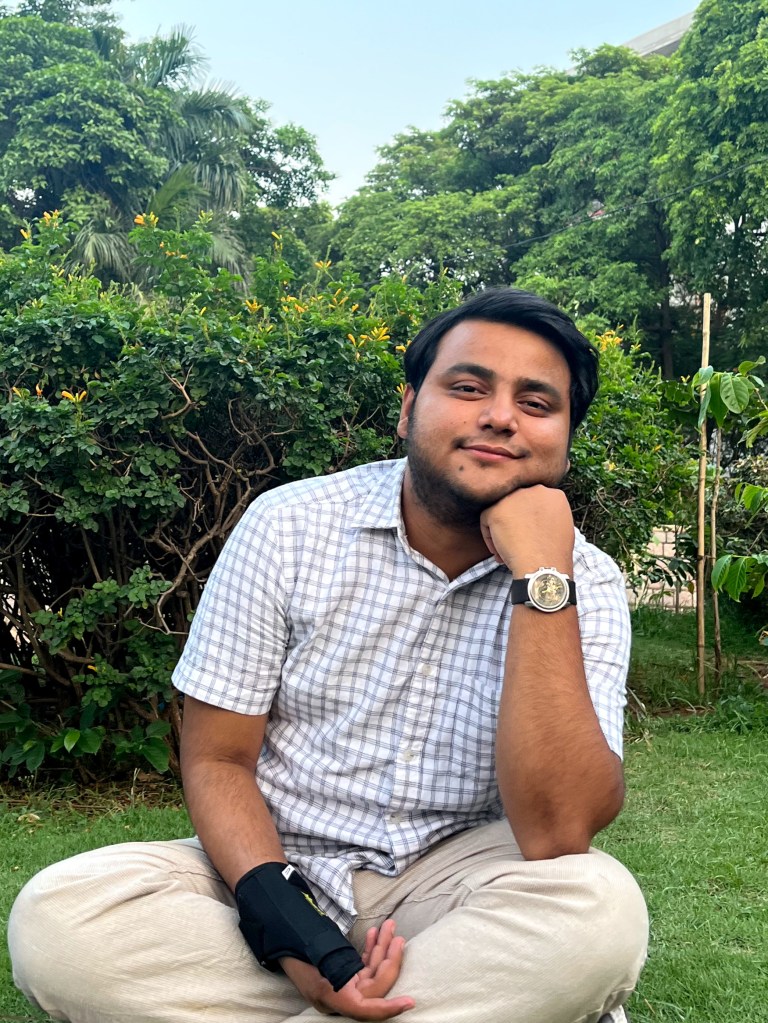
Just finished with a Master’s in English from the University of Hyderabad, AREEB AHMAD (he/him) likes to write about the intersections of gender and sexuality in literature. He also enjoys exploring how the personal and the political, form and content, interact in art. He remains certain that the author is never truly dead. Most of his regular writing can be found on his bookstagram. Areeb’s work—long-form reviews, bookish articles, and critical essays—has been featured in Mountain Ink, The Book Slut, SheReads, and is forthcoming in Gaysi, The Chakkar.
While all writers struggle to find inspiration from time to time, grappling with bouts of writers’ block can seriously shake your confidence as a writer. Many writers tend to think of their craft as an aspect of their identity, so facing writers’ block for an extended period of time can easily seep into other facets of life, causing self-doubt or artistic insecurity.
Gathered based on experience and other writers’ recommendations, these 15 techniques include suggestions for how to make authentic progress in your creative process and ultimately overcome writers’ block. While no individual writing approach or activity offers a universal remedy, these methods offer a variety of options to address possible root causes of writers’ block and foster inspiration.
Use the “Cut-Up Technique”
Popularized by William S. Borroughs and subsequently used by artists like David Bowie, this technique can provide writers with a hands-on, creative approach to finding inspiration. By cutting up an existing piece of writing and rearranging words and phrases to create something new, you may be able to spark unique and unorthodox ideas to use in your writing. The physical elements of practicing this technique can also enable your mind to naturally wander, further aiding the creative process.
Try a Guided Writing Journal
Guided journals can be useful to ensure that you dedicate some time to your craft each day, but they can also contribute to ideas for larger projects or creative endeavors. Trying a guided journal that focuses on your home genre or different genres that you want to experiment with can bring some form and structure into the writing process, helping you find a sense of direction as you explore new artistic territory. Another writer recommended Noor Unnahar’s Find Your Voice: A Guided Poetry Journal for Your Heart and Your Art, and it has been a simple, valuable resource to try new approaches in my writing.
Visit a New Place that Stimulates Your Senses
Traveling to new places, even within your local area, can be an incredibly valuable source of inspiration. Encountering new environments provides opportunities for descriptive writing involving all of the senses, and experiencing a place for the first time brings your mind into a greater awareness of your surroundings.
Change Your Daily Routine
Try changing your routine in the morning or evening and see how these shifts impact your mindset throughout the day. If you have a morning commute, consider changing your route or method of transportation for a day and see how this difference in your movement might differently inform your awareness of spaces around you.
Change Your Writing Routine or Environment
Having a consistent, familiar process and environment for writing can feel comfortable and reassuring, especially when embarking on a new creative project. But when you find yourself struggling with writers’ block or grasping for new sources of inspiration, writing in the same environment each day can seem to make your creative mentality stagnate as well. Writing in a coffee shop, outside in a park, or even in your backyard or balcony might open your mind to different ways of thinking and writing. Trying to write at a different time of day than you usually do could also trigger a rewarding shift in your artistic mindset.
Create Blackout Poetry
Similar to the cut-up method, erasure techniques allow you to seek external inspiration in other writers’ words. Blackout poetry can stand alone as an art form, but the process of creating erasure poetry can also be a source of inspiration for other genres of writing or art. In particular, if you don’t consider yourself to be a writer of poetry, this technique can showcase your own capacity to create in a new genre or provide you with distinctive phrases to carry into your other work.
Read Part of a Book You Wouldn’t Normally Choose
Visit a library or bookstore and choose a book off of the shelf that you have little or no interest in. Reading a chapter or even just a few pages could pique your interest, teach you something new, or introduce you to a topic or subculture that you had never considered exploring previously.
Write an Ekphrastic Poem or Narrative
Visual art can hold a powerful capacity to awaken latent creativity by engaging writers’ senses and imaginations. Writing a piece based on a work of visual art could provide you with a new way of approaching your work or introduce you to ideas to explore further in longform writing. Writing based on abstract art in particular can pose a unique challenge to open your mind to idiosyncratic ideas and unconventional ways of thinking.
Write to a Rhythm (Or Don’t)
Songwriters and poets who prefer to write in form often approach their writing with an acute awareness of prosody and the rhythm of language. But being attentive to rhythm in prose can also valuably alter the way writers engage with their work on the sentence level, offering an opportunity to uniquely engage the reader, sharpen dialogue, or diversify your writing style. As Truman Capote explained, “the greatest pleasure of writing is not what it’s about, but the music the words make.”
Conversely, if you frequently write using rhythm as a formal device, consider subverting your usual rhythmic techniques to write freely or bring greater acoustic complexity into your writing.
Force Yourself (Allow Yourself) to Free Write
Being a common exercise in workshops and classroom settings, free writing may be intimidating or uncomfortable for some writers. But seeking to write in an uninhibited way can directly demonstrate the power of vulnerability in your writing. Writing down your fleeting thoughts and ideas can enable you to more clearly see both their rawness and their value, allowing you to more effectively assess what ideas you want to expand and explore moving forward. If you already find yourself actively working on a project but feel stuck, free writing could enable you to get “words on the page” to revise and refine later.
Create Visual Art (Even if You’re the Only One Who Ever Sees It)
If you write and create visual art as well, these two artistic processes can overlap or naturally contribute to each other. But if you consider writing to be your exclusive creative pursuit, trying your hand at drawing or painting could serve as a source of inspiration that enables you to approach your writing from a different perspective.
Change Writing Formats or Mediums
Similar to creating in a brand new visual medium, experimenting with a new genre or format of writing could engage your creative mind in different ways. You could try writing descriptive poetry to incorporate into your fiction, or experiment with writing prose to later refine into poetry. If you write fiction that includes dialogue, try formatting conversations in a script or screenplay style to shift your perspective of the interplay between your characters’ voices.
Make a Collage
Collaging can be a relaxing method to open your mind to visual sources or inspiration—and an affordable way to create distinctive, personalized decor. Being attentive to the colors, textures, and words or phrases that speak to you can provide you with a greater awareness of your mental landscape or state of mind. Creating a collage can also be a useful way to create a hands-on representation of physical settings or emotional undertones that you want your writing to convey.
Seek out the Stories of Your Family and Friends
Talking to relatives and friends often opens new possibilities for both nonfiction and fiction writing. Older relatives in particular may have valuable stories to share about their past experiences, and these can provide you with inspiration while also offering an opportunity to document family history. Giving your friends an opportunity to share their stories or talk about their interests or goals can provide them with a platform for their voice and allow you to get to know each other better. If you plan to use these discussions to inform your writing in a direct way, it is always vital to be upfront about how you would like to utilize the content of your conversations.
Give Yourself (and Your Writing) Some Space
If you find yourself feeling uninspired or feel especially depleted in your writing, taking a break from writing for a few days could be what you really need to get back on track. While giving yourself some space from writing may feel unproductive, it could actually be what your mind needs to come up with new ideas in an organic, unforced way. You may return to your writing feeling renewed and naturally inspired, or you could be able to approach a different technique with greater mental openness. Either way, providing yourself with an opportunity to decompress creatively can jumpstart your artistic process in the long run and allow your writing to flow more freely.
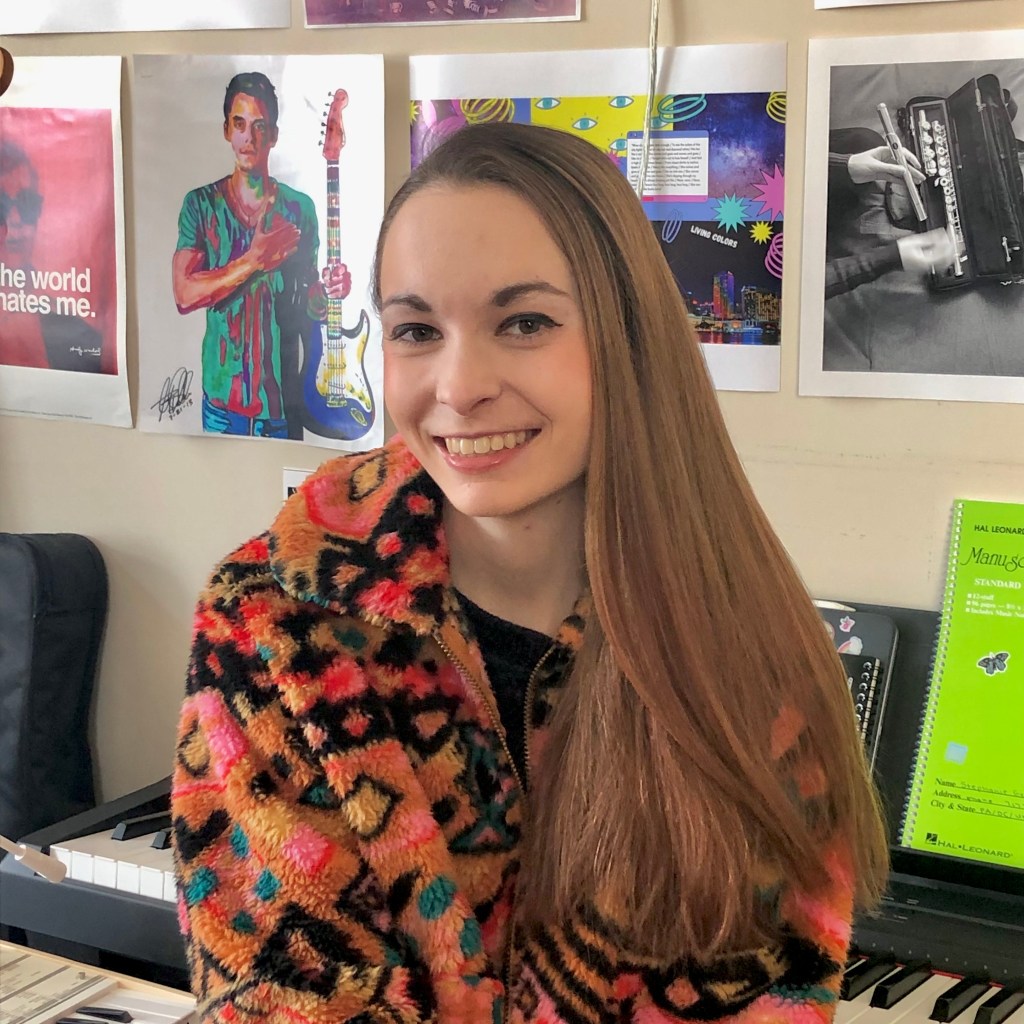
STEPHANIE GEMMELL is a writer and composer currently living in Pennsylvania. Her writing has been featured in Just Place Chapbook, Capitol Letters, The Ekphrastic Review, The Rival GW, and in the poetry anthology Falling Leaves published by Day Eight. She also attended the 2021 Glen Workshop as a poetry and songwriting fellow. She recently graduated summa cum laude from George Washington University with a BA in Religious Studies and minors in Journalism and Psychology. Her work is motivated by the unique power of art to ask meaningful questions and inspire authenticity.


 Inklette Magazine