“If one has to look into Kazim Ali’s work, what is most evident in his poetry is the feeling of homeliness and how answers arise out of the most mundane of situations. There’s a beauty echoing in the simple verse, the way the words come together to dance and quiver on the page. This search for homes gives us poetry which is diverse and rich, both in terms of language and the cultural experiences it seeks to pull together for the reader – and how all of this comes together to define Kazim Ali as a writer singularly unique for his time. Given the fact that Kazim Ali grew up in UK, to Muslim parents of Indian descent, these themes of his writing are not surprising. Equipped with this legacy, his work brims with a raw urgency that calls to readers belonging to all ages, time and place, and feeds the fire in all of us.”
–Smriti Verma, Poetry Editor
How did you seek to assimilate your diverse heritage, and the experiences it provided you, in your work? What kind of effect did it have on your writing?
KA: My writing has always been driven by twin notions of sense and sound and the way they treat and overlap and diverge from one another. These come deeply from my twin South Asian lineage of Islam and Yoga. The devotions and scriptures of the Kasmiri Shaivites have been as important to me as the Islamic philosophy and art of my South Indian family. It’s a family that has since been scattered– to Hyderabad, Telangana, to Karachi, to England, Canada and America. Very few of my family remain behind in our ancestral homes (in Vellore and Chennai) yet India feels an inextricable part of my life and my writing.
The forms I choose, the way abstraction interacts with the concrete, the roles that vowels and sound play in my poems– all these come from devotional music of India and Islamic concepts of art and architecture. I also studied sacred chanting and nada-yoga as part of my yoga training. PUT_CHARACTERS_HERE
What are the fundamental differences between prose and poetry, according to you? If there are any, what different approaches due you adopt to writing each?
PUT_CHARACTERS_HERE
KA: Prose and poetry both follow the rhythm of language, breath and the body. In prose you rely more on syntactical and grammatical rules of the language you are working in but even these can be bent or transformed or done away with. The sentence is usually meant as a complete thought but can com in a fragment too. I do not always know the difference between an essay or a poem as it begins. Not until the thought starts to spin our does a form present itself. And sometimes (like in my books, Bright Felon and Wind Instrument) the text actually quivers between poetry and prose and does not choose. PUT_CHARACTERS_HERE
Since our theme for this issue is ‘Growing Up,’ we’d like to know what influenced you the most growing up.
PUT_CHARACTERS_HERE
KA: I grew up in a lot of different places. I was born in the UK where my parents had migrated, but I spent a lot of my early childhood in Vellore. Then I was raised in Canada and finally the United States. So I don’t really feel like I have a single origin or “home.” Or more accurately I have had many different homes and I can’t always choose between them. This maybe gave me access to multiplicity as a broader context in which to live my life. Different languages, different cultural experiences– I don’t feel defined by a single culture or language. This is an “American” experience but it is also an “Indian” experience. I am sad beyond measure that in both America and India there are political forces who are seeking to define in singular (and narrow) terms what it means to be “American” or “Hindustani” for example. PUT_CHARACTERS_HERE
You’ve said previously that ‘everyone knows how much easier it is to write a poem in form and meter’. Would you still stand by it?
PUT_CHARACTERS_HERE
KA: I believe this because form and meter give you rules to work with. They also make the music of a poem much easier to achieve and make it easier to construct an architecture and a mood. But having said that, I do not necessary believe that one starts out with an intention to work in a particular form. I think the relationship to form in a poem has to be organic, meaning it is uncovered during the writing process. One reason to read a lot of poetry in form is that you then learn the patterns of sound and thought and the emotional valences of (for example) a pantoum vs a sestina vs a sonnet vs a ghazal. Once, when I was a young writer I took one specific episode from Islamic history (the attempted arrest of Imam Zayn by the troops of Yazid immediately following the battle of Karbala) and wrote a poem about it in 22 different forms and meters. I wanted to know what the forms itself brought to the episode and what various forms and metrical patterns would bring out of the episode itself.
PUT_CHARACTERS_HERE
You’ve experimented with the couplet very often, in many ways. How does it, as a style, manifest in your thinking process?
PUT_CHARACTERS_HERE
KA: I’ve tried and tried to get away from it, with limited success! My newest book, which is coming out at the beginning of 2018, has a greater variety of stanzaic patterns. But the couplet has a deep attraction, in terms of a “call and response” but not necessarily between a writer and his audience but a writer and himself. A thought answers a thought and not always logically or completely. Often the response contradicts or redefines the original thought. This is an attractive pattern for me, who is a restless thinker.
There is an explosion of poets of colour, especially, writing in blank verse. Does a lack of structure lend to a certain democratisation of poetry?
KA: I think it is a wonderful thing to have a broader range of people from differing educational, economic and social backgrounds writing and creating poetry. Poetry is meant to communicate human experience, all of it. There are a number of registers and ways to approach a poem that do not always involved the received and historic forms. But I do believe that thinking about language, its qualities, the sound of a poem, the way it resonates and echoes–these all build and make beautiful the utterance of the poem. Rhyming meter, blank verse, free verse, and even chaotic outburst– all these can make a powerful and incisive poetry. But as a writer I think it was good for me to practice and explore as wide a range of poetries as I could in order to find my own path in language and literature.
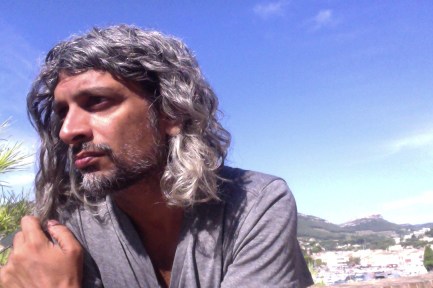 KAZIM ALI is a poet, essayist, fiction writer and translator.
His books include several volumes of poetry, including Sky Ward, winner of the Ohioana Book Award in Poetry; The Far Mosque, winner of Alice James Books’ New England/New York Award; The Fortieth Day; All One’s Blue; and the cross-genre text Bright Felon: Autobiography and Cities. He has also published a translation of Abahn Sabana David by Marguerite Duras, Water’s Footfall by Sohrab Sepehri, Oasis of Now: Selected Poems by Sohrab Sepehri, and (with Libby Murphy) L’amour by Marguerite Duras. His novels include Quinn’s Passage, named one of “The Best Books of 2005” by Chronogram magazine,and The Disappearance of Seth. His books of essays include Orange Alert: Essays on Poetry, Art and the Architecture of Silence and Fasting for Ramadan. In addition to co-editing Jean Valentine: This-World Company, he is a contributing editor forAWP Writers Chronicle and associate editor of the literary magazine FIELD and founding editor of the small press Nightboat Books. He is the series co-editor for both Poets on Poetry and Under Discussion, from the University of Michigan Press.
Ali’s forthcoming titles include: Uncle Sharif’s Life in Music, a collection of short stories; The Secret Room: A String Quartet, a novel; and Anais Nin: An Unprofessional Study, a new book of essays. Ali is an associate professor of Creative Writing and Comparative Literature at Oberlin College.




 Inklette Magazine