In the event we get stranded

My mouth is an anchor that never learned

to save the ship, a slow descent into a darkness

I never loved, but always knew how to flirt with.

I’ve left more poetry strewn on inner thighs than

have made it on paper, some of my best lines

will always rub against jeans I’ve never seen

strewn on my bedroom floor.


I hope you taste my name every time you bite your lip.


One day we’ll get drunk, and reminisce about the way

our bodies fell apart against cold blankets, the sting

of heaving chests, familiar, just to keep us warm.


Kristen Kane is a Pittsburgh native whose poetry has been featured in Backroads, the University of Pittsburgh at Johnstown’s literary magazine. 

Varicose Veins

My thoughts, they bulge

from the surface of my

skin, swelling and twisting,

oblong blue branches stemming

across gaping valleys of hushed pores.

Suits with crescent scowls

point knives at me, threatening to

slice me open and let the dense

air swallow me whole.


I hide in a music box that plays

off-key carnival tunes, letting my blood

thicken to a viscous concentrate.

With a gentle touch, I squeeze blood

onto page, after page, soaking them

until they drip, saturated. Once


I emerge


from the box, I wring out

the pages over the suits—

their bodies wither

into an ashy heap, and I hear

that same off-key carnival music

on the radio for the first time.


Evan Goetz is an enigma wrapped in chocolate filigree. He is a graduate of the University of South Florida with a B.A. in creative writing. His work can be found in Damfino Press and Digital Papercut among other journals. When he is not writing, he spends his time performing with an improv troupe making a fool of himself.

On the Point

When I saw you

crouching along water’s edge

gazing just over the water

tips of your sight, like pelican wings,

I thought of the deer

swimming across the lake,

perhaps to escape a wolf,

perhaps to enjoy life,

and I resisted

the urge to know

what made you appear

like a small stone

to be skipped,

a number of lives to be counted.


Brad Garber writes, paints, draws, photographs, hunts for mushrooms and snakes, and runs around naked in the Great Northwest. He has published poetry, essays and weird stuff in such publications as Embodied Effigies, Clementine Poetry Journal, Sugar Mule, Barrow Street, Ray’s Road Review and others. He was nominated for a Pushcart Prize in 2013. 

Urb Ex-Jungle

Another artifact of the Skraelings’

implacable xenophobia the wall

crosses the ocean on decadent runes


and ends in a concrete outlet pipe

under chain-link bent in as if giants

used it for football practice or dump trucks


took a wrong turn off this stretch of pot holes

while the guard hid underneath a smart phone

studying repetitive pornography


and bolt cutters timed to incoming trains

announced a new freedom, access for all

to relics of industrial majesty


broken and paintless as the Parthenon,

but here, now, with a few retired workers

to sing sad songs of our own Golden Age.


M. A. Schaffner has had poems published in Shenandoah, Prairie Schooner, Agni, Poetry Ireland, Poetry Wales, and elsewhere. Other writings include the poetry collection, The Good Opinion of Squirrels, and the novel, War Boys. Schaffner spends most days in Arlington, Virginia or the 19th century.

Ghost Story

The objects we live in and with and around have as vibrant an internal life and a language more complex than ours. This is a first attempt at trying to talk it out with the other half. 


for Anna 

 It was when you said something

about the tombstones behind Quarry Chapel

looking like animals standing still in the dark

that I thought of the man in Kansas

who used a trinity of flashlights

to speak with the ghosts of his parents.

He didn’t know the phantom  effect

was a fluke of science, the incantatory

breath of a metal contact beneath the bulb

rising and falling and rising again.

He didn’t know sister light

had unlocked his heart like an old car

and sewn the leather of hope inside,

that his mother and father were in fact

gone from the farmhouse where he grew up.

Walking in the dark near midnight,

it’s easiest to get the sense

this sort of thing is happening to us

all the time. We are not the only mad

masters of ourselves. No object

can survive void of entropy. Like we give

the knife its blade we give each grave a name,

until these endless white houses lining

the road are nothing but wooden ghosts, until

there’s barely room enough left to live.


Ian Burnette graduated from the South Carolina Governor’s School for the Arts and Humanities with a certificate in Creative Writing. He is an associate at The Kenyon Review, a contributing writer for the college section of The Huffington Post and a student in Kenyon College where he studies economics. His poems have been published or are forthcoming in Best New Poets 2015, The Adroit Journal, plain china: Best Undergraduate Writing 2014 and Kenyon Review. He is a winner of the Adroit Prize in Poetry, Propper Prize in Poetry, Bennington Young Writers Award, Leonard L. Milberg Prize, Patricia Grodd Poetry Prize and the Foyle Young Poets Award. 

Two Poems

An exquisite corpse is a parlor game for group writing. Invented by French surrealists, each participant writes a line of poetry in response to a line that came before. Before passing the “corpse” to the next person in line, the writer folds the paper so that only the newest  line is visible. In this way, a poem is built. At the end of the game, the paper is unfurled, and the new work is revealed. This past August over an enormous plate of nachos, Katie and Anya wrote the following poems. With two papers passed back and forth, the poems were written simultaneously, each poet responsible for alternate lines, a lyrical do-si-do, a poetic kind of play.


Wanted

In a ziploc bag behind his fishbowl

on top of a pile of housekeeping magazines

beneath a framed class photo, a dusty cobweb

frames the aquatic world of Leonardo.

The seahorse discards his pie pan halo and snorts

throwing the laundry around. What’s

a dirty sock compared to all the tent cities?

If he wants to shoot someone, he must invent

the weapon. And if he wants to conquer, he must

conjure more. So Leonardo studies day and night.

Cotton-brained, leering, famished, and laughing,

he imitates the posture of a pastry chef,

the dough flattens beneath the weight

of his uniform. Time to hire an intern.

Someone to yell at would be fine. Someone

organized, an eye for detail, who makes his own ink.


On the Elevator Between 4th and 5th Floors or Icarus Tries Again

When turtles pull back their heads, do their

brains compress? Do their dreams leak

or lock? No one ever craves a sack lunch.

Her socks crimp and crumple beneath schoolgirl knees

and she slouches like she’s been spooked.

Her plastic spork slips from her grip

and the world beyond her checked blanket

dissolves into a black puddle. A cat blinks.

The biscuits, damp, cannot be picked up

until after the barista consults with his

hose. Everything boils down to process.

He portions his day into teaspoons, TV shows,

balanced meals, drafts of the manifesto, several baths,

but still there are mornings he cannot

remember and still his gums bleed.


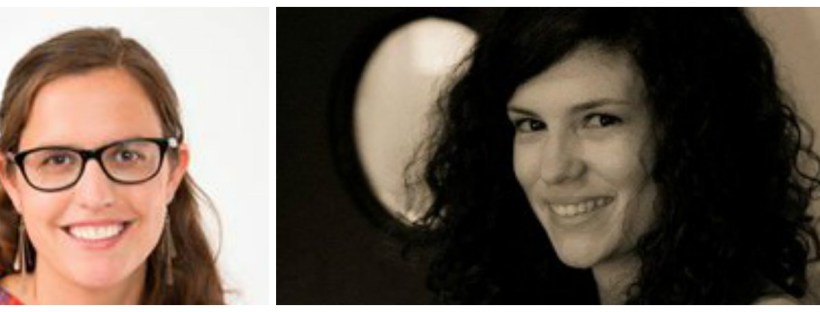
Anya Groner’s essays, stories and poems can be read in journals including Guernica, Ninth Letter, The Oxford American, The Rumpus, and The Atlantic. She received her MFA from the University of Mississippi where she was a John and Renee Grisham Fellow. Currently, she’s finishing a novel about teenage girls and eco-terrorism, set in the Blue Ridge Mountains of Virginia. Her first chapbook of poems, a collaborative project with the book artist Sara White, titled So Our Ghosts Can Find Us, will be released later this month. A resident of New Orleans, Groner teaches writing at Loyola University New Orleans. She edits fiction for Terrain.Org and book reviews for The New Orleans Review.  You can view her website here.

Katharine Ogle is a poet. She studied English literature and was a member of the Area Program in Poetry Writing at the University of Virginia, where she earned a Bachelor of Arts with distinction. She attended the University of Washington for a Master of Fine Arts degree in Poetry and was the writer-in-residence at a local high school during that time. She currently teaches literature and creative writing in Seattle and is Associate Editor of Poetry Northwest. Her work has been published in Quarterly West, Pleiades, and Mare Nostrum, among others. Currently, she is at work on a manuscript of poems titled The Smallest Gun I Could Find, which follows a conversation between a speaker and her newly-discovered homunculus: the little man who lives inside her head, protesting her moment-to-moment decisions.

The Santa Clause: Don’t Lie to Your Children

It’s nearly midnight,

and I just wrote “From Santa”

in red Sharpie


on the present under the ornament

my son stuck together

with felt and Popsicle sticks.


There was a time not long ago

I swore I would never

lie to my children like this,


never invoke the hoary, corpulent

somethinggenerian whenever

they misbehaved,


never sit at the kitchen table

with them hammering out

lists of superfluous toys,


never try to explain

how the big guy makes it around

the world overnight in a sleigh,


or how he finagles

his gelatinous frame into

our house without a fireplace.


Eventually they’ll become

little forensic handwriting analysts

and figure out why Santa’s penmanship


so closely resembles

their mother’s, stop

rising at dawn like chickens,


and sign quote marks in the air

when reading “From Santa”

in red Sharpie


as I train the video camera

on their morphing adolescence.

Maybe they’ll mean it


when they vow never to lie

to their children,

leaving only shredded wrapping paper

in their wakes.


Ted Millar teaches English at Mahopac High School in Mahopac, New York, and creative writing and poetry at Marist College in Poughkeepsie, New York.  His poetry has appeared in Cactus HeartThe Grief Diaries, Chronogram, Brickplight, The Artistic Museand Inkwell.  He lives in Marlborough, New York, the heart of the Hudson Valley’s apple and wine country, with his wife and two children.