I watch light slice through pale flesh with the softest crunch
sharp as steel
pips scatter carelessly
out of character
she’ll swipe them off the tabletop once she’d finished
sticky sweetness washed off calloused fingers
but for now there’s hope in each of them
shiny brown and full of hidden life that’ll never blossom
I smile to the child in our rented kitchen
letting little moons slip from my hands
for her to run away with
for me to never leave
MON MALANOVICH-GALLAGHER (they/them) is a non-binary queer poet, inclusion speaker and mental health activist. Their work appeared in a variety of chapbooks, anthologies and magazines including Queer Writing for the Brave New World, Beyond Words, Aurora and is forthcoming in a number of other publications, both online and in print. You can connect with Mon on Instagram: @mxmongmg
JESSICA HERON’s work appears or is forthcoming in The Horror Zine, Hole In the Head Review, Angel Rust Magazine, Anti-Heroin Chic, and others. She is a poetry reader for Catatonic Daughters. You can find out more about her including a full list of publications at jessicaheronpoetry.com.
ai Lon died two years ago, four years after the month we lived together, rose early, drank coffee, drained beerlao in the hotel’s shiny lobby, hauled plastic bags of mangosteen and longan to temples. we hadn’t talked in a while, and then he was gone. i don’t know how to be funny when my friends die. not yet, at least. i remember my uncle joked about the corpse of my grandmother as we carried her casket to the altar. i laughed, because what else?
iv. what is terrible is easy to endure
when i left laos, i cried every day.
i cried over the same two poems.
i looked at pictures and cried.
i stood in walmart and cried.
i rented an apartment, got a nice job,
reunited with a woman i loved, and cried.
autumn descended, a season missed
like a lost appendage, and i cried.
winter was a brick through the window:
cried. cried in phoenix, new york,
new haven, minneapolis, cried on pizza
and into beer, good beer, beer i’d craved!
one june day, i drove up to maine
in my cousin’s car. ate lobster rolls,
bowled, laughed. peeped lighthouses
hammered into the jagged stone coast.
took a candid photo on the beach, sand whipped
my winterwhite face pink. gulls squealed
sharp into a preposterous distance.
BRENDAN WALSH has lived and taught in South Korea, Laos, and South Florida. His work has appeared in Rattle, Glass Poetry, American Literary Review, Maine Review, The American Journal of Poetry, and other journals. He is the author of 6 collections, including Buddha vs. Bonobo (Sutra Press) and fort lauderdale (Grey Book Press). His latest collection,concussion fragment, winner of the 2020 elsewhere chapbook contest, was released in February 2022. He is co-host of theFat Guy, Jacked Guy podcast with Stef Rubino.
DAISY BASSEN is a poet and community child psychiatrist who graduated from Princeton University’s Creative Writing Program and completed her medical training at The University of Rochester and Brown. Her work has been published in Salamander, McSweeney’s, Smartish Pace, and [PANK] among other journals. She was the winner of the So to Speak 2019 Poetry Contest, the 2019 ILDS White Mice Contest, the 2020 Beullah Rose Poetry Prize, and the 2021 Erskine J Poetry Prize. She lives in Rhode Island with her family.
NOTE: This poem is based on the Hindu/ Indian tradition of Pitrapaksha, in which we pray for departed elders, preparing a vegetarian feast in their name and then offering portions of it to crows and cows, in sacred consonance with them being symbols of the soul, of the mortal world.
PRITHVIJEET SINHA is from Lucknow, India. He holds an MPhil from the University of Lucknow, having launched his prolific writing career by self publishing on the worldwide community Wattpad since 2015 and on his WordPress blog An Awadh Boy’s Panorama. Besides that, his works have been published in several publications such as Hudson Valley Writers Guild,Piker Press Online, the anthology Pixie Dust and All Things Magical (Authors Press, January 2022), Cafe Dissensus, The Medley, Screen Queens, Confluence- South Asian Perspectives, Reader’s Digest, Borderless Journal, Lothlorien Poetry, LiveWire, Rhetorica Quarterly, Ekphrastic Review, The Quiver Review, Dreich Magazine, Visual Verse and in the children’s anthology Nursery Rhymes and Children’s Poems From Around The World (AuthorsPress, February 2021), among others. His life force resides in writing.
GREGORY McGREEVY lives and writes poetry in Baltimore, Maryland. His work has previously been featured in West Trade Review, The Finger Literary Journal, Bourgeon Online, and The Northern Virginia Review, among others.
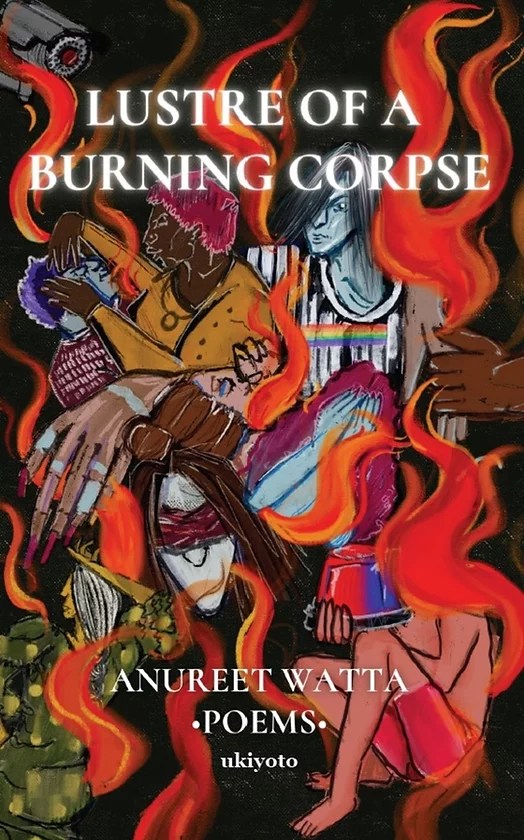
Queerness is a lesson in knowing that survival is both an act of violence and a form of self-love. In Sexualness by akshay khanna queer lives are described as “bare life of bodies” where they emphasize the untranslabitlity of being human and its fragile condition. Anureet Watta’s debut poetry collection The Lustre of a Burning Corpse, examines these bare lives of bodies that are subjected to the violence of existing, carrying grief and hope simultaneously.
Audre Lorde, in her seminal essay, “Eye to Eye: Black Women, Hatred and Anger,” distinguishes suffering from pain. Suffering is unscrutinized pain that festers like a wound. Pain is recognizing the festering wound of suffering and providing it with language. In the poem, “Where do you put down the scream?” Watta names pain as “holy agony” and asks, “What would/I be when I do not have this holy/agony to keep me company?” because “It keeps me company, the way a pebble/in a shoe, an itch you cannot reach/does.” There is an intimacy with the “holy agony” of knowing pain and carrying it like a scream. Pain often looks like anger, like a scream. After all, it is much easier to be angry than to be hurting.
The agony further stems from violence that is both personal and political. Watta writes, in “The Government has it Under Control”: “the postcard I write to my lover,/the prime minister licks the stamps for me,/the home minister checks for grammar”. These lines keenly emphasize the discomfort of being aware of the voyeuristic gaze of the state. The power vested in it is so deep that its presence is felt in the innermost sanctum of our love and the language we use to communicate. They further write, “Who wore it better, lets find out:/The prime minister’s sherwani/threaded with blood,/or the home minister’s boot,/caked with graveyard mud?” in the ironically titled, “Country of Non-Violence.” Watta’s poetry stems from the acute awareness of autocratic power and the violence it wields. The imagery presented is vivid, driving home a brutal point about the relationship of despotic power with bloodshed.
The collection is a roadmap of violence in its various grotesque and benign forms. There is the unending violence of the state masquerading as security, obsessed with safeguarding honour and mitigating shame. There is the violence of constantly finding oneself erased and invisibilized. How do we then survive, live, and bear witness to our lived experiences? In “We Swallow the Sun to keep from Stuttering” Watta writes,
“You have never longed to be understood
just acknowledged,
under kinder skies and with undoubtful eyes
but until then,
I’m here, and I’m not really a hug person,
but I think we can both use one.”
There is also a quiet form of violence that queer people reserve for themselves, like an arsenal for emergency use, in case they momentarily forget the normalized threshold of violence that constitutes their lives. It is discernible in the lines, “You have never longed to be understood/ just acknowledged.” To be understood and acknowledged is to belong so here is an attempt to belong in the face of the intrinsic violence of erasure.
Poetry carries the crucial burden of witnessing. It carries the weight of testimony. The act of witnessing is fraught with the power dynamics of the one who suffers and the one who witnesses. This act is exploitative at its core when suffering is performed for the benefit of the observer. It becomes sacred when there is surrender and the binary of the witness and the witnessed collapses. As Watta says, “We are, after all,/ the truest reporters of ourselves.” The self they behold is always on the verge of being consumed and at the brink of this annihilation is the voice of their poetry.
Watta stands witness to the lives they have lived as a queer person as well as the lives they couldn’t live or weren’t allowed to, holding themselves, all their selves, with tenderness and mercy. In “Poet as a Tragedy,” Watta pens one of the most powerful lines in this collection, “I learn the necessity of consuming yourself,/in exchange for an allegory.” They further say, “Mostly, I write, in fleeting moments of power I do not kill/myself/Mostly, I self-sabotage and wait for the poem./This must be how it works.” Poetry has always remained the domain of cis-het white men who are still taught in classrooms as canons. Poetry is fraught with romanticisation of tragedy, usually accompanied by the image of a brooding poet, taking long walks. This element of tragedy is rarely a lived experience. “Poet as a Tragedy” is a masterful subversion of this imagery where tragedy is not a convenient trope but rather varying shades of lived experience guised as a poem. Poetry then is a barter with life, which arrives in moments of self-sabotage, an attempt to live where moments of power are rare and fleeting.
Watta’s poetry brings to us the redemptive power of language. In “Body Without a Border,” Watta writes, “To commit something to memory is to protect it from the/filth of touch.” The private shrine of memory is sacred. Watta tests language to measure queerness and mocks its inadequacy to map the terrains of desire and intimacy etched in memory and shrouded in silence. “Our imaginations are so revolutionary,/I refuse to sell then to authenticity,” they write in “Cinematic Imagination.” Language as a tool belongs to the powerful who determine the narrative that dominates public imagination. Queer lives, in this power structure, are written about as subjects of interrogation and curiosity. Our lived experiences constitute educational awareness material meant to convince people of our existence. Watta supplants this usage of language from a patriarchal, heteronomative gaze which showcases “realities.” Dry witted, they write, “No, I do not want to know about the part where/the lesbian commits suicide,/I was there when she did it.” They directly challenge the gaze that curates queer realities for an audience where valorisation of death is the only option. The narrative where queer lives are reduced to a shadow, and eventually a dead body, is an old misguided, even malicious, trope that long lost its charm. Instead, Watta draws our attention to queer joy and the horizons of imagination that contain possibilities of revolution. Carmen Maria Machado in In the Dream House writes, “When the historian of queer experience attempts to document a queer past, there is often a gatekeeper, representing a straight present.” In Watta’s poetry I meet that historian who is documenting a queer past, living a queer present, and imagining queer futures. This documentation is unlike the history of victories and conquests. It is a meticulous collection of intimacies, with one’s self as well as with lovers and beloveds. I often witness the gatekeeper and the straight present, it lingers in this collection too, but Watta grazes against it in anger and humour. The voice of a poet drives poetry. It is what remains like a resounding echo long after the words have been read. After the last page is turned, Watta’s voice lingers in all its anger and tenderness.
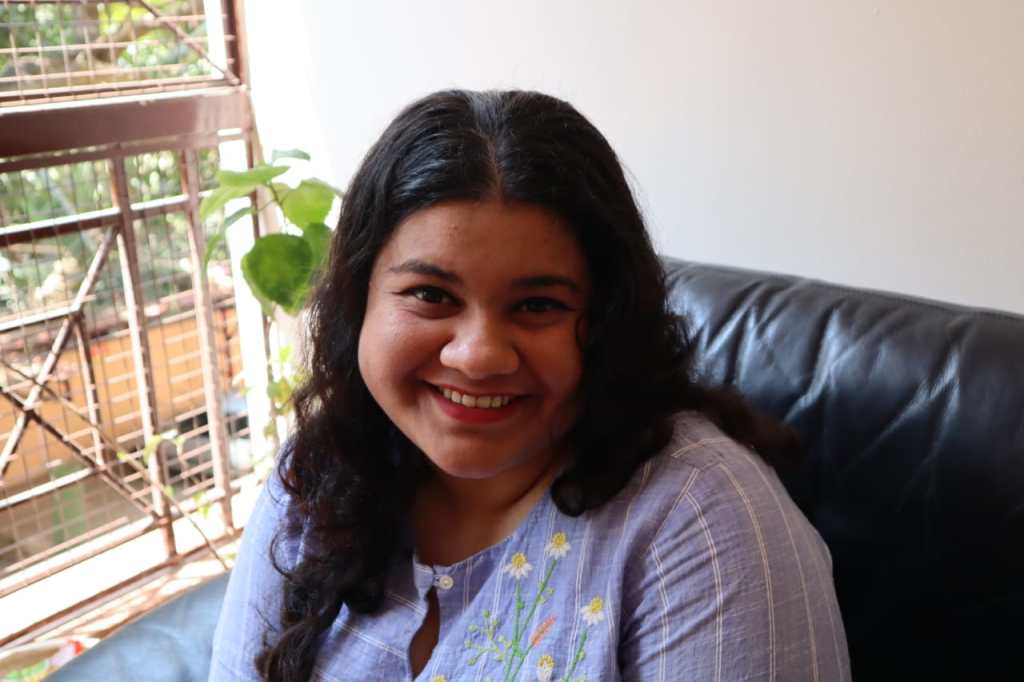
PRIYANKA CHAKRABARTY is a neuroqueer person and law student based in Bangalore. She aspires to be a human rights lawyer and is an avid reader of fiction, non-fiction, and poetry. She has been writing in the genre of creative non-fiction and is a literary contributor with TheChakkar. Her works have been published with Phosphene Magazine, Inklette Magazine and The Chakkar. She is a bookstgrammer and regularly documents her reading journey on Instagram: @exisitingquietly.