The COVID-19 Series: The Quarantine Train

BY DEVANSHI KHETARPAL

When one of my favourite poets, Arjun Rajendran, posted on Facebook that he’s starting a virtual poetry workshop, I immediately signed up to be part of it. Soon enough, the workshop group became a community and movement we now call The Quarantine Train.

I am used to loneliness, but I am also used to cities. After I was forced to leave New York, I wondered how I would write: I am used to writing and reading in my journal on the subway, in parks and cafes. I always like to be among people. I love writing about the city’s smells, its sights, absurdities, its skins and bodies which brush into and past each other. I still wonder what will happen to all the strangers and crowds I love being a part of as a body among other bodies.

But finding this community, being able to interact with poets and readers from across India and the world, is a rare gift during this moment or, as a matter of fact, any other. After I left New York, three friends were diagnosed with COVID-19. I wondered if I could write something– a letter, a poem, a story– that would help. I wondered what the purpose of writing is during a pandemic– when words cannot heal, when millions of migrants have to walk back home on foot, when cases of sexual violence are on the rise, when Dalit and Muslim and Kashmiri and migrant and black and poor and minority and Rohingya and trans and genderqueer and indigenous lives are at threat in the most violent ways, when refrigerated trailers are serving as makeshift morgues. What’s the use of writing anymore? Why should we still be writers?Can writing ever save or serve a life besides one’s own?

I was told that I have to leave New York, move out of my apartment within 48 hours (on my birthday) and I didn’t have anyone to turn to immediately or anywhere to go. Some friends and professors offered to store my belongings– and it is strange to think of one’s things as objects living isolated in cartons in places that are not one’s own, in places where those objects have never found themselves before. On the way back home, I wondered if I would ever have places to go to again. As a writer, I felt like a banal object– suddenly in an imaginative and sensuous void, a shelf where I didn’t belong. There are situations that are far worse at the moment, of course, but in all of them, I think the numbness of un-belonging somewhere at some time is present.

When I think of the the writers I have met through The Quarantine Train and the cities where they live, I start to wonder if, in fact, I do have places to visit and friends to meet. New places, new friends. For now, these places and people are sealed off, but I find my peace in this knowledge. I still continue to ask myself if writing can save or serve a life besides one’s own. But, if anything, with The Quarantine Train I have realised that at the very least, my writing can open me up. Writing can allow me to offer space and love to strangers. Writing can allow me to have others inhabit the deepest corners of my self. Writing can build a home out of loss. That being said, dear reader, here are a few friends, a few cities, some places to visit , some living within me:


Anesce Dremen

I had just left my career in international education and had embarked on a journey as a traveling writer (blogger, poet, aspiring novelist) when the COVID-19 pandemic was first reported within China. Having lived in China for several years, I followed the updates quite religiously, as I was concerned with the rising anti-Chinese and global surge in xenophobia against East Asians. I had been traveling in India for three months when lockdown struck here during late March; I remained within a backpacker’s hostel and dedicated myself to my writing. While I had a goal of completing the first draft of my novel within a year, the lockdown gave me additional space to dedicate myself to my novel. 

On a personal level, I was enduring difficulties I hadn’t foreseen (cancellation of my international flight back home, losing my apartment in the US, postponement of a fellowship by a year, extending a visa in a country, spraining my ankle); these private affairs have certainly influenced my writing. By being isolated in a country I was visiting for the first time, I was able to introspect and reflect on a deeper level than if I had been able to return to the U.S. as scheduled. I completed the first draft of my memoir by April and have since edited 300+ pages of the book.

Joining TQT has been the light at the end of a tunnel. My health was in decline when I received the invitation; despite an inconsistent WiFi connection, I was utmost grateful for the return to the classroom, albeit a virtual one. I found great company and solidarity in listening to analysis of published poets hailing from various countries to participating in workshops to constructively criticize fellow members’ submitted poetry. The discussions, prompts, and reflections have inspired a surge in my own creative writing processes. 

Throughout my international experiences (studying and working in China, traveling in India), I often observe first before speaking or submitting inquiries. For the first two months of joining TQT, I remained silent — even typing out and deleting responses — as I was concerned about taking up space as a white cis-woman from the U.S. However, at the encouragement of a couple of TQT members, I began to speak up in the group chat and during sessions. While I still maintain that listening is a crucial first step, this was a reminder that I cannot remain silent within my own privilege. I must continue to learn, to unlearn, and to understand the complexities of societal inequities wherever I am; posing questions and comments is instrumental to this journey.  

I am particularly thankful to have learned much from the Dalit and Miyah poetry workshops. From explaining the etymological and cultural connotations of groups I had never heard about to contextualizing the composition of how literary theory can enable a mutual understanding among people, TQT has provided insight into the complexity of caste and linguistic politics domestically within India as well as in reflection of global societal issues, such as Black Lives Matter, gender studies, #MeToo, and the role of (imaginary) translation. The Quarantine Train offers solace among the seemingly stationary setting within our confined (privileged) spaces within the structure of lockdown; the stations forthcoming will shake and settle each and every member’s creativity and relationship to the written and spoken word. What a ride to embark upon!
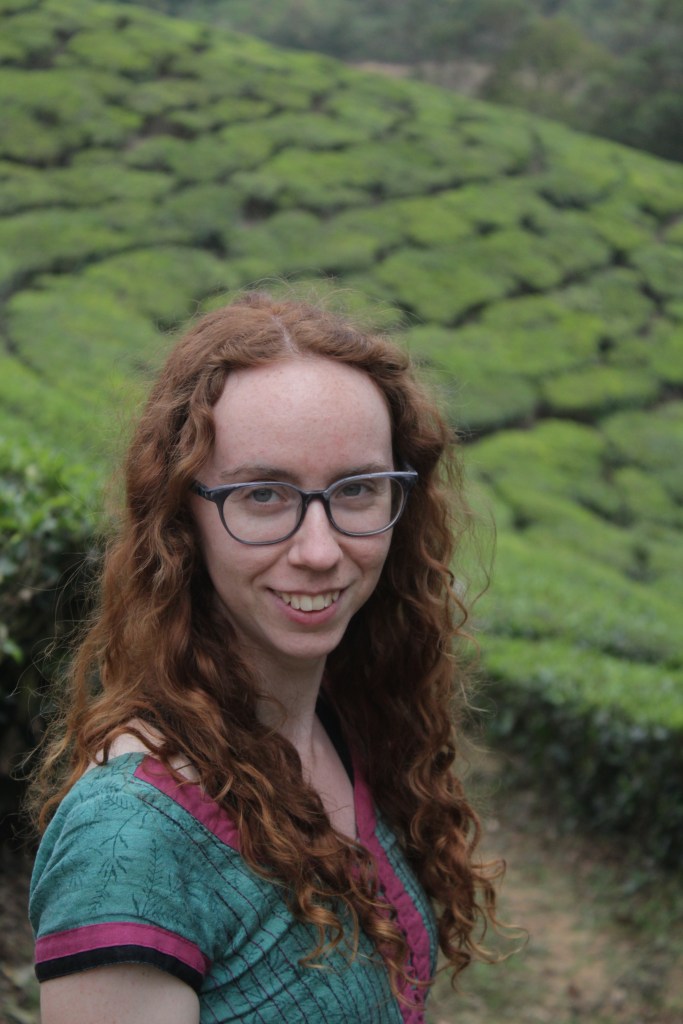

ANESCE DREMEN is a first generation college student who studied in four cities in China (Xi’an, Beijing, Chengdu, and Suzhou) with the support of the Critical Language Scholarship and the Benjamin A. Gilman Scholarship. She graduated from Carthage College with degrees in Chinese and English literature. Her bilingual work has been featured in the Midwest Journal of Undergraduate Research, Carthage Vanguard, Xi’an Daily, and Shanghai Poetry Labs. Anesce is often found with a tea cup in hand, traveling between the U.S., China, and India.


Ankush Banerjee

At the outset, I’d say that this has been a very unique workshop, and not least because of the circumstances in which it is being conducted. Certainly, the lockdown has ensured that online medium is put to good use, which has enabled more participation, as compared to an ‘in-person’ endeavour. Moreover, the TQT has brought together participants from diverse fields and disciplines – corporate, government, educators, film industry, doctors, students – the list as long and eclectic as the discussions that ensue are interesting.  

As a practicing poet, the best thing I found about this workshop is that it makes the process of meaning-making in poetry a collaborative, collective process. Unlike other art forms, writing (and reading) poems is a solitary activity. However, after attending this workshop, I realised that reading poems and engaging with them, interpreting them, uncovering the fundamental truths of human emotions tucked in the mystery of language – is best accomplished in the sort of workshop that is TQT. There is something that needs to be said about the range and diversity of genres and milieus curated. Ranging from quaint Italian poets (conducted by Devanshi Khetarpal), to highly relevant poetry movements around the country such as Miya poetry (conducted by Shalim M. Hussain) and Dalit poetry (conducted by Chandramohan S)– the curators at TQT have ensured a sumptuous fare. The next few sessions are being curated around ‘Imaginary Translations’ and Danish poetry. There is so much variation in the choice of poems read and poets covered during the sessions, that one is bound to be coached in-toto in the intricacies of sound, the nuances of alliteration, and the finesse of a poetic line. As Arjun, the chief curator, is known for remarking, “it is not a sentence, it is a line!” Or as another participant remarked, “TQT is like a Poetry Fellowship!” – which wouldn’t be inaccurate.    

Something also needs to be specifically said about the choice of poems/poets. Unlike the traditional English literature classroom reserved only for canonical works, TQT makes a point of selecting, reading, interpreting and discussing really good poems (and poets) that are important and contemporary without necessarily belonging to the canon. Usually such works are found in prominent literary journals and magazines. In my limited understanding, I can vouch that such journals are frequented by a niche group of individuals. However, by including these poems in the workshop readings, TQT demystifies (the journals and) the poems. Also, by having a collaborative method to interpreting and understanding a poem, what happens is that the group, facilitated by its curator, finds first an approach, and then an inroad into a poem, slowly unpeeling it, turning its various strands under the light of the many conversations that are struck, until we are all standing at the heart of the poem, marvelling at what wonder lay hidden amidst those lines. Another important facet of the TQT is that it serves as a space for poets, emerging and old, amateur and established, to come together, share their work and elicit feedback from others. This is an especially engaging and fruitful aspect, as feedback about one’s work is one of the most vital things that a writer looks for (and most often, doesn’t get!) – does that metaphor work, is this line alright, what is the title communication, does that troupe border on cliché – such are the questions that are raised during the ‘critique’ sessions which really push the writer to think hard and deep, and engage with their own work in new light. It is my estimate that this year, some of the best poetry in the country (maybe even outside it) will be published by members of the TQT because the discussions around each and every poem somehow adds to the collective and individual knowledge about the technical and emotive range of the craft.    

At a time when the prolonged isolation, the anxiety wrought by a globally uncontainable pandemic and the ‘new normal’ have compelled many of us to confront various aspects of our own mental health, poetry in specific, and art in general, provides hope for a better tomorrow, and a soothing, almost embalming after-effect. What TQT does is to effectively administer that far-from-perfect panacea in appropriate doses on a bi-weekly basis.   

ANKUSH BANERJEE is a mental health professional, poet and Research Fellow at IIM, Rohtak. His maiden volume of poetry, An Essence of Eternity  was published by Sahitya Akademi, New Delhi in 2016. His poem, Righteous Among the Nations won the third prize at the 2019 All India Poetry Competition. His work has appeared in Indian LiteratureThe Bombay Literary Magazine, Vayavya, Eclectica, Cha, and elsewhere. He blogs here, and can be found at Cats Who Read, reimagining his favourite novels with his two cats (obviously!) playing his favourite characters.


Aswin Vijayan

The Quarantine Train has been a valuable connection in the face of a global disconnect. Personally, as a poet writing in English and living in a small town in the South Indian state of Kerala, this disconnect is larger than the current pandemic. I believe that art thrives in community and an absence of such a community has been bothering me for the past two years. The lockdown gave rise to a flurry of activity in the poetic community online and I was fortunate enough to be connected to it through TQT.

I have always found reading poems collectively as a highly enriching act and TQT is a platform that has made this possible on a regular basis and for a stretch of time. Considering my process as a writer, I entered the workshops at a point when I was finding myself coming up short in terms of what I want to do through my poetry. In the past few months, I feel I have had a clearer sense of direction and that has propelled me forward in my quest to becoming the kind of poet I want to be.
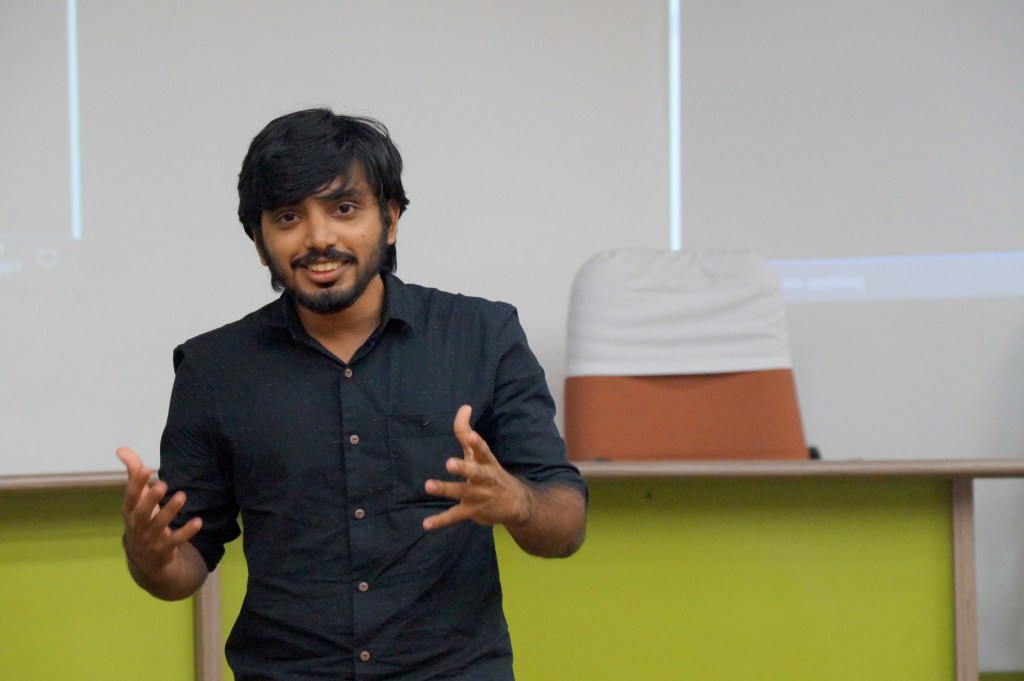

ASWIN is a poet from Kerala, India. He has an MA in Poetry from the Seamus Heaney Centre for Poetry, Queen’s University Belfast. His poems have been published or are forthcoming in a few magazines in India and the UK including The Bombay Literary Magazine, Verse of Silence, The Tangerine, The Madras Courier, and Coldnoon. He is 26.


KINJAL SETHIA

Not the pandemic only, but every crisis situation makes me wonder of my role as a writer. Unlike other professional services from medicine to law to government or civil society or even the businessmen who contribute to the society more directly and explicitly, writing does not guarantee a direct facilitative role. Hence, the pandemic really seeded the introspective strain again. But joining TQT, seeing so many established names continuing to work towards their craft with ardour rekindled hope, makes me think that perhaps mine is not a futile quest. 


I am a freelance feature writer and am trying to write short fiction. And believe that poetry will really help me hone my craft. The sessions have exposed me to newer ideas, concepts and thrown me into a pluriverse of literary possibility. If that itself were not enough, the uncertain times have also shifted my gaze alternatively to macro issues of mankind, nature’s vengeance and recuperation to basic concerns of a person-identity, ethnicity, expression, language of psychological and sociological distinctiveness also, even if the emotions are drawn from the same source universe. TQT has not helped to resolve any questions raised in my mind by the pandemic, but it has better equipped me to tackle them without getting lost. 


KINJAL SETHIA is a freelance feature writer working on themes of culture and creativity. A post-graduate in Psychology from Pune University, she presently writes features for Pune Mirror, Times Of India


KAUSIK KSK

Having a full-time corporate job doesn’t really allow one to pursue their artistic ambitions as much as one would want to. In that sense, this lockdown has proved to be a blessing in disguise for me. Suddenly, I found myself with some spare time after work, letting me focus more on my literary interests. It was just then that I saw a Facebook post by Arjun about starting a poetry group to meet and share a mutual love for this art form. I contacted him at once and I have been a part of this wonderful journey of The Quarantine Train since then.

Although I have always been passionate about reading and writing poetry on a regular basis, the structure of the workshop and the discussions opened new doors of perception in me.  Besides all the exciting and scintillating conversations by the members of the group, the workshop broadly has three categories of sessions- appreciation, critiquing and guest workshops amongst so many other activities. Coming from a background without any sort of inclination towards writing academically, the poems chosen, discussed, deconstructed and analysed, with different interpretations from people with different backgrounds from all across the globe, made my experience of reading and appreciating poetry richer and more rewarding. It always feels like a poetry class I wish I was a part of much earlier in life. The poetry writing exercises are interesting and challenging in that they forced me to look at myself much more closely and pushed me into writing territories I never imagined I would see myself charting. The critiquing from the members in the group is constructive and extremely beneficial for anyone willing to hone their craft better. TQT drove me to not just work towards bettering my craft and appreciating poetry but also towards questioning my ideas and beliefs on varied subjects and I think such reflection upon one’s own philosophies is essential for an aspiring writer especially during trying times like these.

The pandemic has changed a lot of things for me not just in terms of what ideas I should be exploring more as an aspiring writer/ poet but also in viewing and understanding the world around differently; we cannot take things for granted anymore, the machinations of a world dominated by capitalism have become more apparent, revolutions started brewing around the world, the oppressed societies have started to see through their problems amidst rising exploits of fascist forces, massive layoffs of employees in corporations exposed the commodification of the working class and the ruthlessness of a system driven by profits rather than labour relations. Amidst all of this, I think the role of an artist becomes increasingly indispensable. Trying to voice your struggle in ways you can best imagine and showing solidarity with the oppressed, the marginalized and the ones at the lower side of advantage is the need of the hour and personally, I see poetry and writing doing this for me.
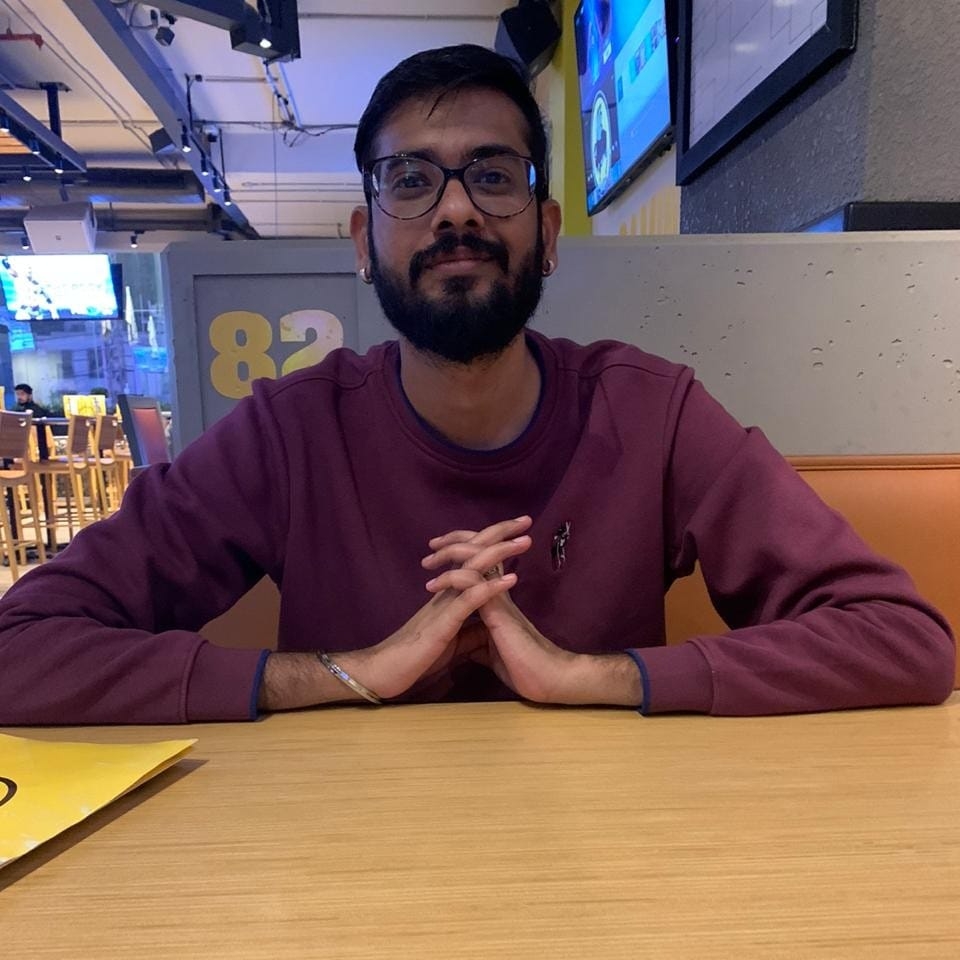

KAUSIK KSK is a Hyderabad based writer who works as a Business Analyst for a living. He takes a keen interest in all things literature and cinema. He got a few of his haiku published in journals and magazines like Modern Haiku, Frogpond (Haiku Society of America), The Asahi Shimbun, Under the Basho, Acorn and Failed Haiku.


PRASHANT PARVATANENI

A journalist friend of mine, who was doing a story around poetry and the COVID-19 outbreak asked me if poetry is helping me cope with the demands of quarantined lockdowns. Honestly, I hadn’t thought about it at all. For I do not start or stop reading poetry according to the moods of the times. Engagement with poetry, or literature, cinema, and art is a constant process and I am unsure if it can be reduced to a form of therapy or immediate utility. What poetry does for me, is to shape my perceptions and sensibilities. A closer attention to its forms and experiences, moulds a form of thinking, a way of looking at self and surroundings. So whatever be the state of the world and society, poetry influences my sense-making at a more fundamental rather than topical level. This is not to suggest that poetry cannot be therapeutic, or useful or beneficial – just that its effects are never time bound. They are all pervasive.

What the lockdown did give me, was time – an anxious, uncertain time, but time nonetheless. I was happy to find in this period, a poetry workshop like The Quarantine Train led by Arjun Rajendran. The most delightful aspect of this workshop is its refusal to take the burden of topicality and instead discuss the art, craft, and politics of poetry as a rigorous method of thinking and sense-making. I am grateful for the amount of emphasis that is placed on craft in this workshop. Far from being some kind of apolitical aestheticism, a critical understanding of form and style (and not just themes and intentions), is crucial to understand the effects of language and discourse and the place of art in the political matrix of society. So this workshop, while born in the context of the pandemic, will create, I believe more fundamental shifts in our practice and outlook.

Like all practices, poetry requires a community that works towards raising new questions, and deliberating on possible answers to keep the process relevant and alive. The nature of this community is important. Often, forms of community building mistake uncritical celebration for compassion. Instead, I am glad that active and detailed critique of each other’s works, liberty to suggest changes and point out problems – and the openness shown by the writers in inviting such criticism, is the cornerstone of TQT. This, for me, suggests honesty, openness to change and progress, and the spirit of experimentation and transformation: ideas that are essential to both creative and political practices. If we can come out of this process with a greater sense of accepting our own flaws, and rethinking our outlook towards writing, while also inculcating the art of compassionate critique which enables rather than debilitates creative expression, it would be a step towards making better sense of our worlds.
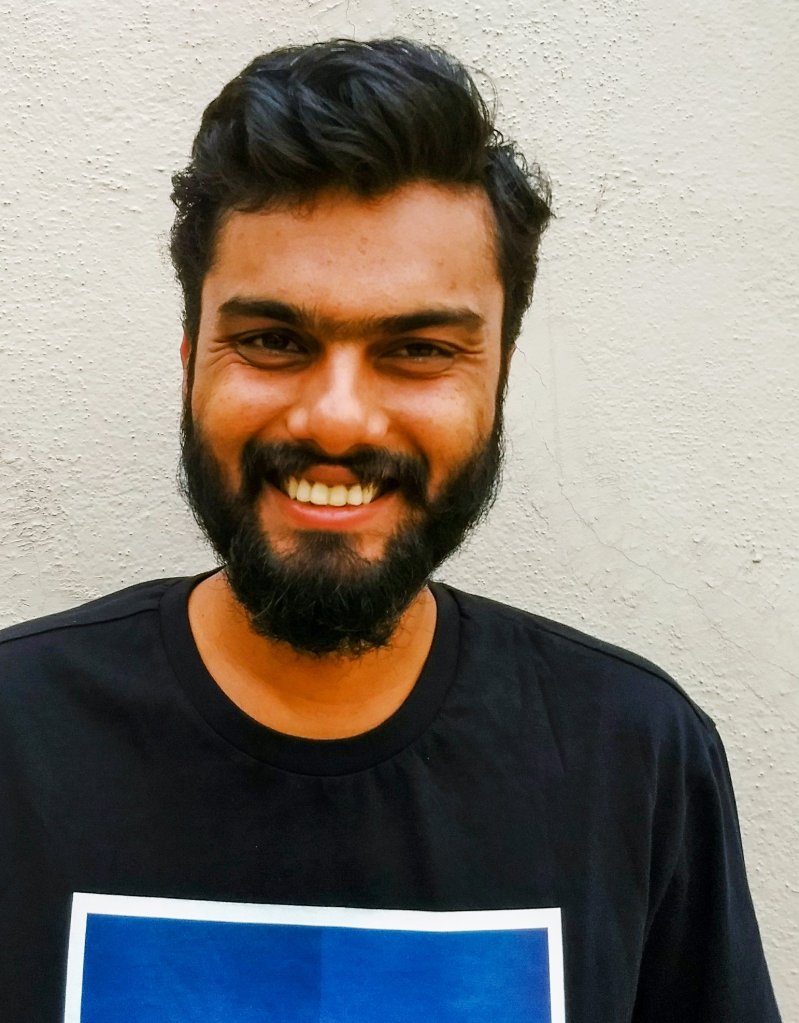

PRASHANT is an independent writer from Bangalore, who also teaches courses on cinema and literature. He won the Srinivas Rayaprol Poetry Prize for 2019. His creative and critical writing has appeared in Seminar, The Bangalore Review, and Deep Focus Cinema among others. Prashant works with the Kabir Project and is part of an arts collective called brown-study works.


Arathy Asok

Writing is a lonely road.

But the journey by itself is not alone.

Everything goes into the making of the form and the content. For some time now I have been pondering on what the process of this writing is. Getting into The Quarantine Train has somehow begun to put these questions into perspective. Not that I have arrived at answers. But that the questions have more focus now.


More than the personal, it has been the social and the political that has moved me during the pandemic. As a writer, the TQT is slowly helping me to process language, to let it mature into what it should be.
It has given me a jolt. Into the different roads that are there.
The journey has a direction now.
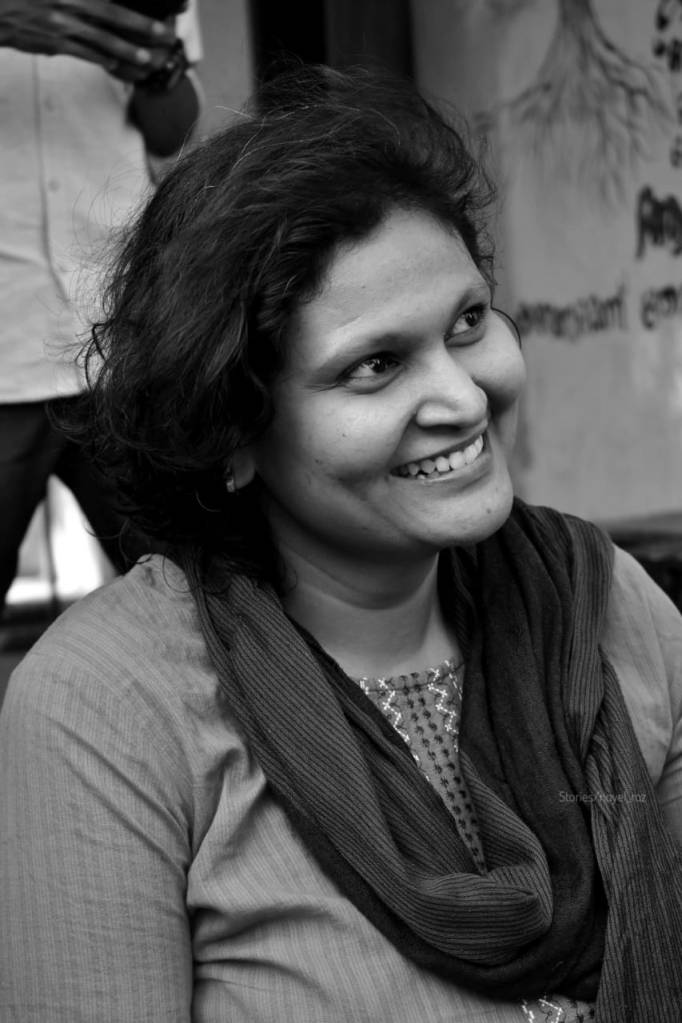

ARATHY ASOK is the author of Lady Jesus and Other Poems. She is a bilingual writer whose works are described as “resistance poetry with a sharp edge” (Journal of Commonwealth Literature). She has published in both national and international journals and her works have been translated to Malayalam.


To learn more about The Quarantine Train, kindly visit its Facebook page here or view its brochure here.
Two Poems

i want to tell her dead girls don’t get into harvard

sometimes i feel like every door in the world could be locked and i wouldn’t know the difference. like how many sides does a window really have. why are there so many tree trunks in my front yard. / mom, did we buy a hatchet? a liar is always a mouth but a mouth is not always a boy.

actually, i’m sitting in a bathtub and and some woman is getting paid to tell me water doesn’t exist.

teenage girls love to say hometown like we didn’t watch it burn. your guidance counselor loves to say suspension like you started the fire. sometimes, all it takes is an afterparty. the balloons deflate and you are on a boat in the middle of his basement. administration tucks you in her file cabinet. someone will “look into it”. the men flip our stories like an hourglass.

how many of us will leave screaming before the door slams?

somewhere in a small town, there is a girl who can’t say her own name. in july she will say what she should’ve said in january.

i want to tell her graduation and a house in the city

what is left here but a nickname you wish they’d stop calling you. a prom you never attended but remember so well. there is a summer break hung in each of our closets.

sometimes, all you have to lose is your own hands.


things the kids [didn’t know]

when it snows in nevada [when grandmas body has begun to freeze]

she crosses the stateline with a hammer in her bag. [she doesn’t carry a knife anymore, lost it somewhere in her last marriage]

when she shows up at our door, the oven is buzzing and the dogs are barking and my mom is yelling about the pipes and [my grandfather is telling my mother that we will only ever be women] and the news is reminding us that a body is [temporary], i never know how much i will miss this noise. until i do.

when it snows in nevada, grandma writes her [will] in front of our fireplace “it’s really just that pair of earrings and my bible” and “i hope rod will give the knife back so that you girls can [protect yourself] when im gone”. she chuckles as the hospice nurse changes her dressing. i want this to be a metaphor. but grandma is gone, a year this spring. she asked me to build her a house. and now, i write her into every story i tell. look how honestly we can live [beneath my fingertips].

when it snows in nevada, when grandma [and her care team] are moved into my room, we begin hanging her life from the walls. old scrapbook pages and [clothes she grew out of and then back into]. she wants to say goodbye but she doesn’t want a funeral.

[when the pain started spilling from under the welcome mat. when her stomach was filled with fists. when none of us left the house. the women gather around her like we are a pack of sorry animals. in our living room, my mother speaks with certainty. it is the first time in months that the birds leave her chest. my grandfather still doesn’t know].

i am only a child for as long as i can hold my breath. i only know what is whispered into my door-hinge. i only know what the police report says. i only know-

[loss like this].


MYA RIGOLI is an eighteen year old poet. She loves iced coffee, reading with her dogs, and true crime. Her work has been featured by Button Poetry, the California Endowment, and Get Lit Words Ignite. She has competed in the international youth slam Brave New Voices, as well as winning the Classic Slam. She is pursuing a veterinary degree.

Five Pieces


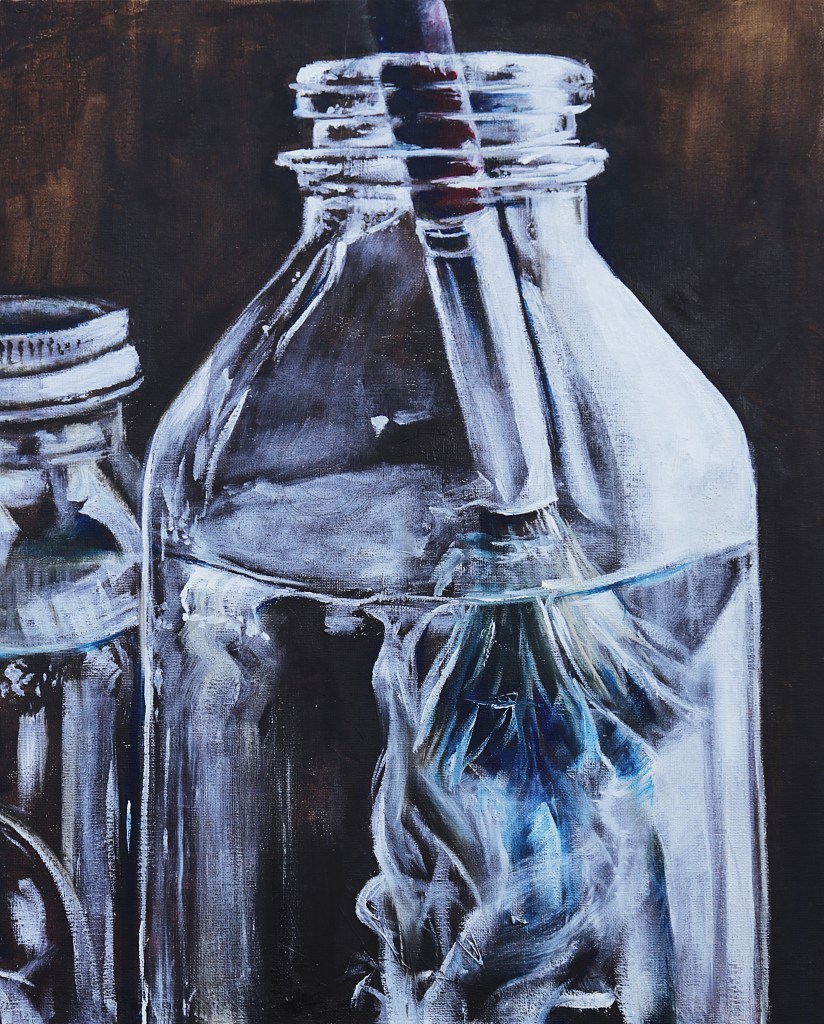
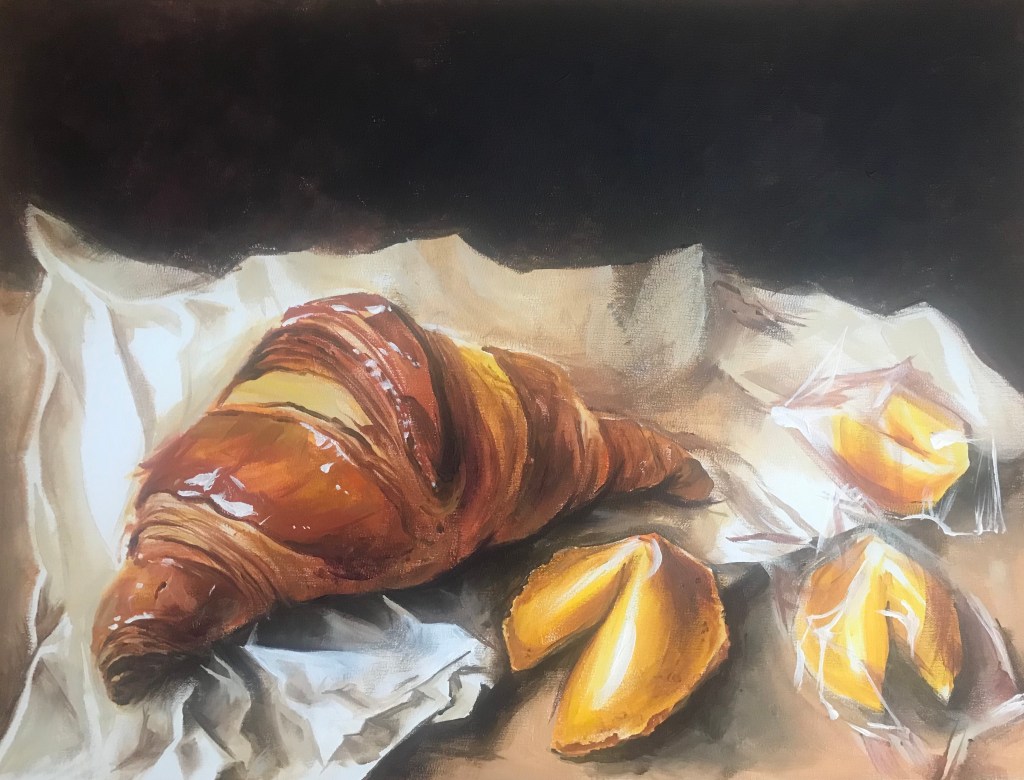
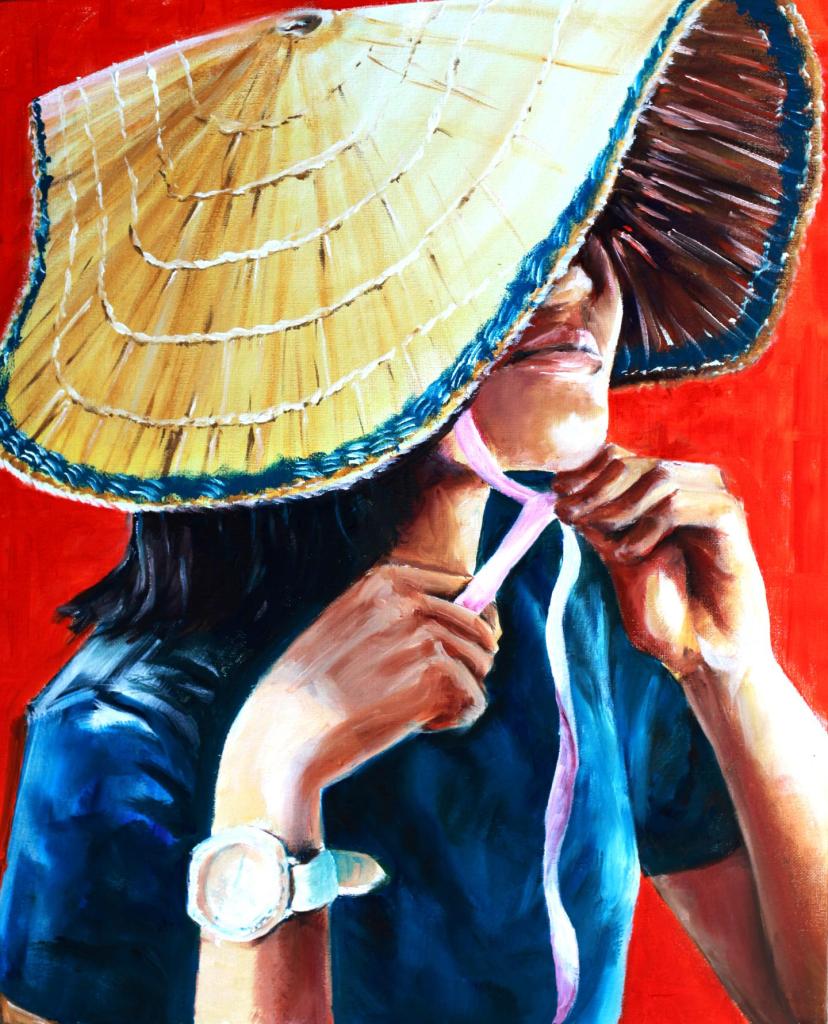
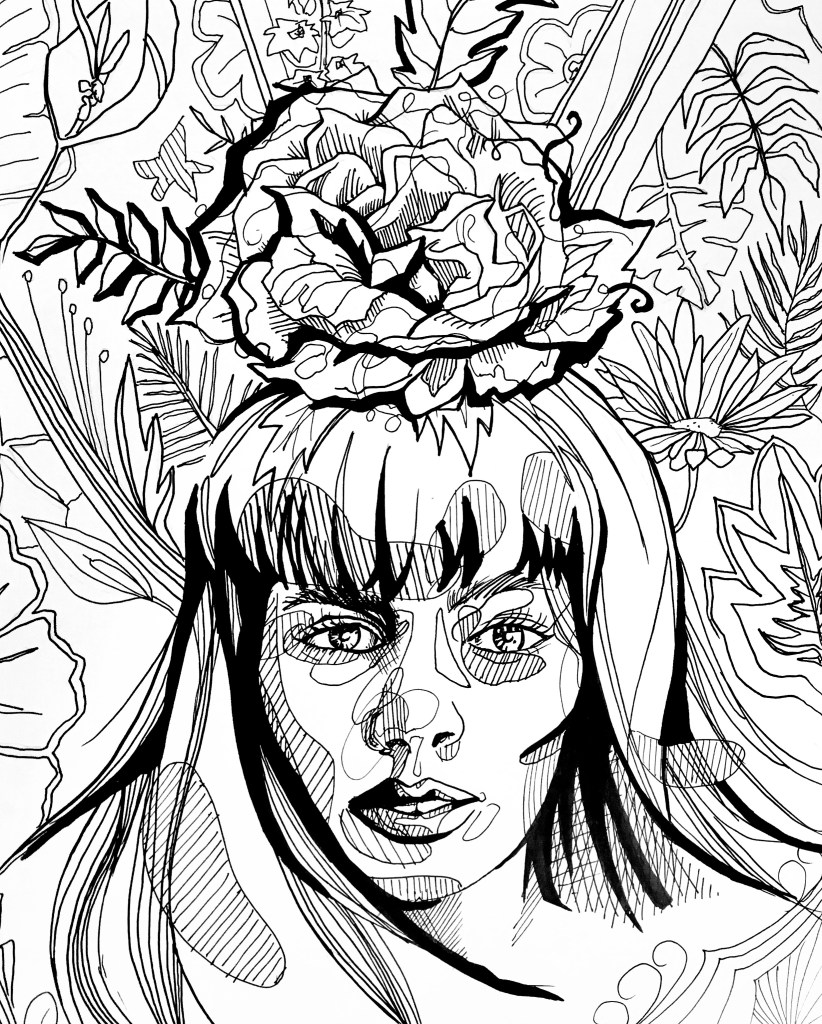
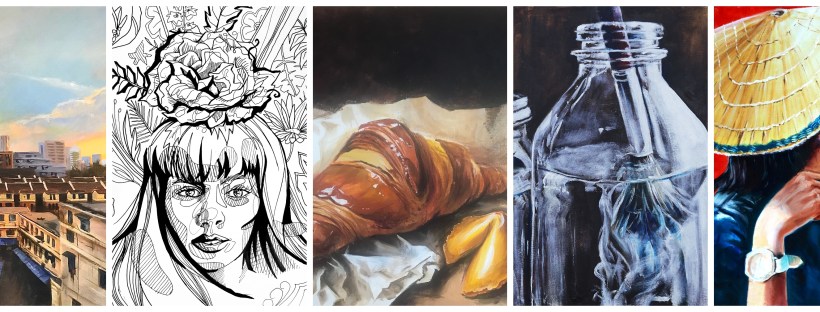
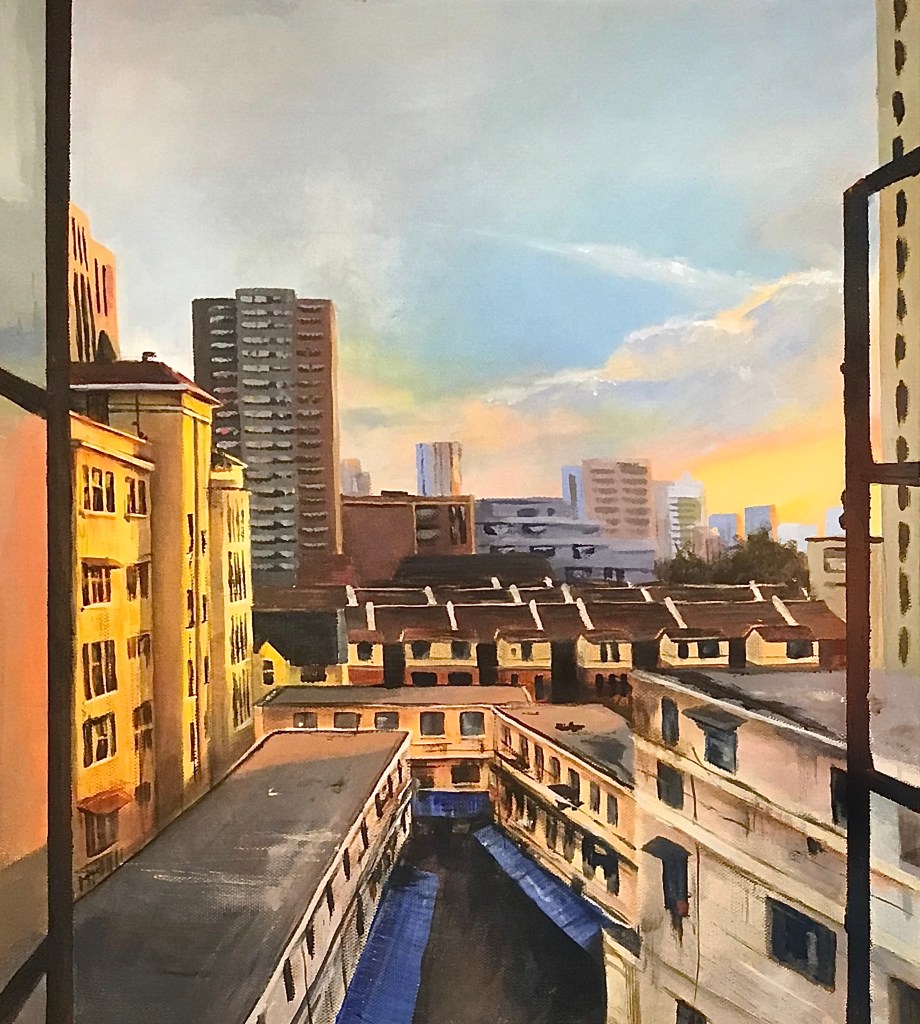
CINDY QIANG has been painting and sketching since the sixth grade. She mostly uses acrylic paints and pen for her portfolio works. Cindy has won several Gold Key Scholastics Awards in Art and continues to pursue her passion through an art minor at New York University. In addition to art, she is also studying dentistry at NYU and likes to run and play the piano for fun.

Lunar Phrases

A METAPHORICAL ILLUSTRATION OF ONE WOMAN’S BIPOLAR CYCLE THROUGH THE USAGE OF THE LUNAR PHASES

FULL MOON:

She is beautiful and glorious. I talk about the goddess in hushed tones—she, not I, because I have been consumed by her and her capacity for everything. I love her, I admire her, I worry for her, I cannot compete with her. I want her to stay, I want her to go. I can’t handle her, but I love the way she handles herself. No longer tossed around and spun about, she’s not someone that things just happen to. Instead she happens to other people, lawless and incalculable, the hazy jolt of realization as the sun comes up after you watched it set those endless hours ago—the sun! The sun! Oh, it’s time to sleep, isn’t it?

She doesn’t sleep. She is fire, fire, fire.

If I had to pick a word to describe her in those times, only one suffices. The word fits her like couture, tailored and made to measurement. Violence. Her heart threatens to burst like a ripe clementine in the fist of a 7-year-old, forcefully, carelessly, delightfully. She’s all Shakespearian tragedy in her limbs, the way she plummets dramatically onto the floor, all too aware the way her hair scatters in the silence. Then she peels one eye open and grins, her friends all laughing at her antics. And though the violence wears a pretty face, she still has bruised knees from the fall and a mark behind her hip and one just under her lip and another one another one another one—

But Sappho said, “all can be endured, for even a pauper…” 

All can be endured for the way they look at her, mirth in their eyes. She is the unspoken word at the end of a poem lost to time. She feels loved and her desire swallows it so whole there isn’t even a tiny bit left for the rest of her. It’s never enough.

She is fire, fire, fire. And she burns through it all.

She is her own narcissism and everything that entails. People search for purpose. She has found hers: devoted worshipper at her own altar, she is her own lighthouse and her own nightlight and her own god and her own savior and her own villain and her own hero and she is her very own purpose. I exist for her. She exists because it is her right. I am at her whims, her beautiful caprices, and if she were real I’d be hopelessly, endlessly in love with her. I mean, I think she’s real. I suppose I am in love with her, but it’s just so hard to know, when she comes and goes, when I have to stop loving her all over again.

She always longed to be exquisite, and only recently realized that she can never be marble features set in stone, carved to perfection. She exists in movement, soft to the touch, sunlight dapples skin and skin gives way to red and cheeks and fingers and touch her, touch her. She’s begging to be experienced. Don’t take a fucking picture, it’s a travesty. You can only see that she’s beautiful when she moves and smiles and follows you round like those summer thunderstorms that always seem like a dream.

You’ll love her, I swear. I swear it by all the cattails on the riverbank, counting down the days till you see her again. Oh, the way you’ll love her, it’ll be violent, it will. And you’ll love that too.

WANING/WAXING GIBBOUS:

I am nobody and I want it
I think of her as somebody and it makes too much sense
lines sharpened to a blade’s edge
somebody means I may have to say her name and summon her into existence
think of the madness she harbors
when she makes her appearance
she hates to cry in front of the masses
but she’s stumbling into your arms now
is this the face of a woman insane?

her cries echo the sounds of destruction
singing violins and the shattering of vases
he says “I could never hate you”
could she say the same?
how she tries, but there she goes again
already in the throes of hatred
falling out of her like a compulsion
threaded by the needle of habit
blood trickling down her arm
how she despises the worst of it,
but this is all she knows

she dances around her room
emulating a clumsy ballerina
so the spiral downwards
looks a little like a plié
the yellow leaves stained on the ground by the rain
are her only treasure
and she’s back to embers 

HALF MOON:

Honestly, I think this is the best you get when it comes to me. She’s got enough energy to fulfill her responsibilities. She gets 8 hours of sleep. She remembers to call her boyfriend. She remembers to eat. She’s so normal it hurts, repeat, repeat, repeat. She’s a sentence with perfect grammar and dated notes on her laptop. She’s blinking the correct number of times per minute. She’s ceased fiddling with her hands. She’s telling jokes that are sweet and innocent and funny nonetheless. She can listen to Tchaikovsky and whatever’s on the radio. She wants to be better, but she’s grateful she’s not worse. She feels loved, for the most part. Sure, sometimes she cries a little when she feels ugly, but that’s normal. That is normal. Is that normal? Well, it’s not for her to know. And this is the only time she’s okay with that. I think…she’s okay with that.

The rest of it belongs with falling stars and nightingales, and palaces shrouded in mist
gold specks in her eyes
a little sunflower dying
mascara in free fall
it’s me and I’m small again
I always come back to her
face painted like a butterfly
struggling to tell her that I’ve failed
“you still don’t love me?” she asks, her voice trembling through the mirror
I want to, I do, I touch a fragile wing

now she’s screaming again
fury and rage her only protectors

I AM A WHOLE PERSON
I EXIST OUTSIDE OF YOU
YOU ARE NOT EVERYTHING
I AM EVERYTHING
THE THINGS I LOVE ARE EVERYTHING
THE THINGS I WANT ARE EVERYTHING
THE STARS AND THE SKY AND THE OCEAN
AND THE TREES, THEY SPEAK
THEY SAY THEY LOVE ME

I guess it ended up being a dream, anyways. She changes by the goddamn minute, sly bastard that she is. She’s supposed to be prose but her baser instincts fall into wretched, shitty poetry. It smells like smoke in the air after the candle’s been blown out.

WANING/WAXING CRESCENT:

He said, you seem a bit sad today. I smile, a little sadly. He’s only known me for two weeks, and I’m not sure if it’s untrue to say I’ve been lying all this time. Those two weeks of mania obscure the truth of what I am. Thus far I look like someone people write love letters to. I look like I’d read them and scoff and throw them in a pile along with all my other forgotten fancies. But the truth is, I’m the only one writing love letters and they all come back, stamped over, RETURN TO SENDER I DON’T LOVE YOU ANYMORE LEAVE ME THE FUCK ALONE. And of course I pretend it doesn’t hurt. And of course it does.

We’re speaking French and I don’t seem to have the words, fuck, I barely have them in the languages I do know. I slide out words like triste and fatiguée and hope he doesn’t trip right over them. I don’t want him to think I’m a sad person, even if it’s a little bit true. He asks if there’s anything he can do for me. He says, pour les semaines sans sourires.

I close my eyes. It sounds about right. There’s no dread when I know what’s coming. There’s only resignation. Sans sourires. It sounds so lovably pathetic, but the truth is it’s what I know. The smile-less weeks and the colorless summers and the merciless winters, they don’t ever change. I just keep on feeling sorry for myself, like always. I just keep on constructing who I think I’m meant to be, asking others what they think. I’ve built myself up through the opinions of others, which is why I’m so easy to defeat. One bad patch spreads like the plague, like a group project soured by a non-cooperative partner. Is it just a fantasy to believe I exist outside what others perceive me to be? Is it ludicrous to hope that someday I won’t need anybody?

I don’t need anything, I tell him. One wobbly baby step after the next. Until the fall.

NEW MOON:

I run out of words. I lay in bed. 2 hours. 6 hours. 14 hours. The world disappears. 3 days. 5 days. 9 days. I think I cry. I think I dream. I think he says, mi amor, are you okay? I think he worries. I think they all do. But I can’t know for sure. I think I lived a million lives before I woke up. I think the world goes on, but I don’t. I think my love and fear and anxiety and euphoria and hopes and dreams and desires and intricacies are all buried in a place no one will go looking. But I can’t know for sure. 20 hours. 14 days.

And then I see the sun. 

And she sees me.

And we go around and around again.

TIDES:

You ever had your heart broken? You ever went through one of those gut-wrenching, think-about-it-every-second-every-day breakups? You ever see something and your heart just drops straight out your stomach and you can’t breathe? You ever cry so hard it just sounds like gasps falling one after the other, a domino effect? Gulps and hiccups competing with brute force? It’s not pretty, is it?

That’s how it feels, every time she leaves me. Come morning the goddess turns to a mortal and it never hurts less. And every time she comes back it’s a knife in the scar, resentment and anger and unfettered lust, open wounds carelessly smeared. I want her like something fierce. But I cannot forgive her for abandoning me, over and over and over again.

I am soft and lovely and ice and deadly. I am red mouth kisses and slaps on the thigh and cold cold feet and shades of navy. I am sweet baby roses and lush orange leaves and bitter envy and burning guilt. I am trying my best yet scared of what I could be. I am sunshine smiles and turning to snow. The moon calls out to the tides but the ocean is still yet to be known.

I am fed by starlight and I starve in the depths.


MICHELLE CAO is a soon-to-be senior at New York University studying Politics, Rights and Development. She hails from the foothills of Virginia, where she developed a love for language and the dreamy romanticism of the forests. She has had a passion for writing since her early days and uses it as a medium to express her complicated relationship with her ever-growing neuroses.

Editor’s Note

Dear readers and contributors,

The Inklette team is happy to bring to you our tenth issue featuring, incidentally, ten stellar pieces of visual art, prose and poetry. Our submissions period was a difficult month for many, with the ongoing COVID-19 pandemic and the many faultlines, insecurities and disparities it exposed across and within countries, fields and systems. Still, we received hundreds of submissions and had to make the difficult yet creatively satisfying decisions of choosing the most compelling things to share with you all.

It does feel strange, however, to be releasing this issue at the moment. No one shares good news during a funeral. Here, in India, it feels like a second partition has occurred. It feels like a crisis of empathy, compassion, sensitivity, democracy, ethics. It feels like our government is a genocide-machine. Everyday I wake up thinking, reading or watching the news about the migrant crisis, mob lynchings of Dalits and religious minorities, arrests of students and activists, increasing violence against women and children, Islamophobic incidents, whispers from Kashmir, the curbing of dissent and public discourses. How will history remember us? As the people who moved on without mourning? As the people who stood silent and ignorant in the face of violence? I hope not.

Black people in the United States made the choice to come out on the streets once again to riot, to protest. They said ‘Black Lives Matter’ and we sing it after them. This is the anger that needs voice. This is the anger and the hope that I wish my country would come together to echo. I wish we rise up together to say: Dalit Lives Matter. Muslim Lives Matter. Women’s Lives Matter. Queer Lives Matter. Migrant lives matter. They always have. This moment is not more important now more than ever. To believe that is to anchor the voice of the oppressor, the privileged, the silent. I repeat: Black lives, Dalit lives, Muslim lives, Women’s lives, Migrant lives, Queer lives have all always mattered. I don’t believe that art, writing or education is devoid of the violence and oppression we notice around us. If anything, it may have a huge role to play in the creation and spread of it across ages. But today, it’s important for us to ask again: How will history remember us? How do we want it to remember us?

Aamir Aziz, a young Indian poet, wrote a Hindi poem titled ‘सब कुछ याद रखा जाएगा‘ which translates to ‘Everything will be remembered.’ And it will be. Today, Inklette Magazine releases quietly as we sit and act with reflection. We will be learning from our mistakes, taking a moment to mourn and hope, taking a moment to listen so we can proceed in ways that give rise to freedom, equity, equality and voice. The map is yet to be charted, and we are open to being corrected and critiqued. Everything will be remembered.

Sending love and care your way,

Devanshi Khetarpal

Editor-in-Chief

Inklette Magazine

Nothing ethical has a barcode

#1 

Nothing ethical has a

barcode. 


Bruised fruits beg

empathy under ripe fruits

beg inquiry. 


My consumption = ignorance

of 


the drought that never touched

me the fire that never

swallowed me the smog that

never choked me. 


No excuses; no exemptions.

Nothing ethical has a

barcode.


When you start

thinking in

ecology you

forget how to

speak bullshit. 


and even if

you never

watch the

news 


you can still

notice that the

goldenrod

blooms earlier

each year. 


and even if you don’t

reuse your ziplocks 


you can still wonder

everyday: “Does the Earth

forgive me?” 


and even if you

didn’t vote

green 


you can still ask the wild

grasses what is their wealth?

and why don’t you seem to

have it? 


and even if

you take

baths ride

planes eat

pork and wear

plastic 


you can still

explore the

possibility of

leaving the world

more nourished

than you found it 


because

even if 

you belong to a

system you didn’t

create 


you can still be

seduced by an affair

with spontaneity. 


and even if you profit from

your place on a ladder

that you were forced to

climb you can still

remember what it is to be

a part of everything and a

master of nothing.


MARY LOEHR is an undergraduate student living in Colorado. Her greatest passions are creative writing, nature-based education, and local food systems. She finds the deepest happiness in life to be walking in the forest with her dog. She has been published in The Social Justice Review and several local zine publications.

Writing in The New Year

2020 began four days ago, and folks around the world are already eagerly fulfilling their New Year’s Resolutions. The Inklette team came up with three questions to jumpstart thinking about their writing lives in 2020. Take a look through our answers, and come up with your own!


What single piece of work are you most proud of having completed in the last ten years?

Between 2018 and 2019 I finished an Afrofuturist short story in which I explore my own experience as a Black mixed-race woman through the lens of a dark-skinned woman who learns she can swap her skin color with other peoples’. This was an emotionally challenging story to write, but it was also incredibly cathartic.

– Naomi Day, Blog Editor


Small Talk, my most recent poetry collection that came out in 2019 and was published by Writers Workshop India, Kolkata, is the work I am proudest of. It is an intimate poetry collection and, at least for me, a radical labour of self-love and self-care, actually. This is the kind of poetry collection I wanted to write and get published as a child, at the start of the decade I believe. And I have now managed it. It feels beautiful. 

-Devanshi Khetarpal, Editor-in-Chief


In 2019 I published Survive July, my first fiction chapbook. The collection of flash, mini plays, search histories, and text messages addresses a young woman’s experiences grappling with mental health, sexuality, and relationships. In addition to working with these complex themes, ensuring each piece in the collection was both self-contained and cohesive with the work as a whole was incredibly challenging and rewarding.

-Sophie Panzer, Prose Editor


I’m most proud of my first poetry collection, Uniform published by Aldrich Press in 2016, because I at first thought I didn’t have the courage to write it. Once the first poem was put to paper, the others gushed out of the dark places they’d been hiding. Since its publication, I’ve made meaningful and lasting relationships with other writers and have found a niche of friends in the military writing community. If Uniform would have never come about, I know the poems of my second collection, Permanent Change of Station published by Middle West Press in 2018, would have never found the page. Uniform has given me the confidence that poetry can come out of the times that seemed that most vacant.

-Lisa Stice, Poetry Editor

What projects do you anticipate starting or finishing in 2020?

I’m currently working on a series of short stories set in a fictional world whose timeline parallels our own. In this world, society runs on creativity. Those who don’t have creative abilities spend their lives trying to awaken it, and those who do have the power to shape the course of their world. I’m exploring different gender rules, familial structures, and styles of discrimination in this space. I’d love to complete rough drafts of at least seven more short stories over the course of the year.

– Naomi Day, Blog Editor


I am not quite sure. I want to finish my translation of Pasolini’s text on India, but I also want to write a series of short stories or a collection of essays on trauma, being an Indian woman in the complexities New York while belonging from a small town, and on running. I don’t know what I will complete this year, but one of them, at the very least, I hope I can get close to finishing. 

-Devanshi Khetarpal, Editor-in-Chief


My goal for 2020 is to write more queer fairy tales. My second poetry chapbook, Bone Church, is also pending release with dancing girl press. 

-Sophie Panzer, Prose Editor 


I have couple manuscripts that I’m continuing to edit and submit and one brand new project that might be a finished (except for more editing) manuscript soon.

-Lisa Stice, Poetry Editor

What is one new thing you are challenging yourself to learn in 2020?

Novel structure! I wrote two full novels when I was a teenager, with no awareness of the pace or framework of my narratives. I want to study what is captivating for readers, what is most often used by “alternative” writers, and what the novels of folks writing from the margins look like from a writers perspective. I plan to do this by reading a lot more books intentionally, looking for the structure and the ways the author stitches their narrative together (rather than just reading for the powerful story!). I’d also love to find some classes that do this.

Also, dialog! I’ve been stepping slowly into it with my short stories, but I tend to avoid it because dialog is hard! Written dialog is not the same as spoken dialog, which makes it even harder. This is a challenge I don’t really know where to start with, so this should be fun.

– Naomi Day, Blog Editor


Dialogues and movie/television scripts, I’d say. I love film and television now, thanks to my boyfriend plus Netflix plus iconic New York city cinemas. I am very much interested in cinema as a visual language, as a language with a unique albeit occasionally unsettling syntax of sound, images and movements. And I always wonder what a film in my vision would be. As a writer, a script for a short or feature film, or even a few television episodes, seems appealing. I would love to write a drama largely between middle-class, urban Indian women in the spaces designated to them even as they are continuously disowned and disregarded by them and in them, or are not fully and equally included in them. 

-Devanshi Khetarpal, Editor-in-Chief


I would really like to further develop my humor writing in whatever mediums I can find, including prose, satire, scripts, or stand-up.

-Sophie Panzer, Prose Editor


For 2020, I’m challenging myself to learn crocheting and accordion, and to get my dog and I both out doing scent detection again. I find that challenging myself to do something totally different than anything I’ve ever done before helps me approach familiar tasks with a more open mind. My daughter and I both took a couple crochet classes at a local yarn store while she’s been on winter holiday, and I’ve started a project of making my mom a scarf. My daughter has played button accordion for three years. Over that years, I’ve watched each of her lessons and thought, “Heck, I think I’m going to give it a try.” It’s been really fun (yet difficult). My terrier and I have been missing working as a scent detection team, so I have committed for us to regularly work together in 2020.

-Lisa Stice, Poetry Editor

To learn more about our staff members, please visit our Masthead page here.