Shelter Number Twelve

We walked together. We travelled back and forth in time. Two madwomen just like each other. We laughed like little kids. We wore each other’s clothes. We exchanged our sandals. We cooked and visited each other’s dreams. We were chips drowned in jelly, we were the sound of turning pages and floating words, we were the crushed ice and colours, we were the salt on slugs, we were crooning bugs in the dark. We discovered a prehistoric cave full of rock shelters. The rock shelter number five had paintings in red ochre. It was vivid. Battle scenes, sticky figures, leaf-like sword and ribs, a hunter, a bull with bow and arrow, a dancing peacock, soldiers riding on horseback. The animals were sketched with greater details while human figures pinched merely in outlines.

In shelter number twelve, We discovered in the dark a three-metre-long bull ready to attack. We froze. You told me about the person who would have chiselled the rock, the bull, while others might have gone hunting or tied with babies, collected mushrooms, hauled meat back to camp. Your voice reverberated within the rocks and silence, and I couldn’t see your half face in the dark. You were slowly vanishing. You were saying something like “ We are yet to discover ourselves. We needed to come out of these daily hums, listen to ourselves, and sit like that person chiselling.” You stopped speaking and suddenly moved back. I tried to touch you but you disappeared, I started to look for you, and couldn’t find you.


OMI ANISH is a writer based in Ahmedabad, India. She is a reader at The Maine Review and an ELT trainer. A lover of all things surreal and abstract, Omi is increasingly drawn to the art of brevity while writing and intricate patterns while crocheting.

Leylah’s Pomegranate

I started peeling off my skin and laying it carefully on the table in front of the mirror. Just like how you peel a fruit, I started doing the same to my face. Picking it up from right below my eyes to the ear on the other end of my face, I tore apart the skin and it came off so easily as if it was patiently waiting for this day from a long time. Then, I started from my left cheek and took a quick turn over my nose to reach the deformed forehead.

Red juices started coming out from my face. I looked like a battered pomegranate. My face appeared as if someone had chewed on the fruit aggressively and threw the remains on the ground after it became unbearable to gulp it down. I felt its juices all over my face.

My face, the fruit, looked like a human brain, which has been beaten again and again to take a shape, which is not natural but depicts a violent submission. It was mocking me, reflecting me, and daring me to wipe the juices off my face. I raised my hands to my face and started crushing it further with my hands, feeling its seeds fighting against the skin of my palm and fingers. I wanted it to be shapeless, formless, and unidentifiable. I wanted people to look at it and feel nothing because its shape would be unknown to them. It was my rebellion against nature’s cruelty to give us a living form that’s incompatible with our desires.

I laid the peeled-off skin on the table and stared at my new fresh face for a solid minute. I had seen this face somewhere. I had seen someone peeling off their skin in the broad daylight. I had witnessed it right before my eyes and all I could feel was jealousy, pure unadulterated jealousy.

Her name was Leylah. I remember her name because it was a big deal to her. It was Persian. She used to give references to songs, movies, and legends to me so that I can understand the depth of her name better. All I ever wanted to tell her was that her name was the least of my concerns and it was painful to hear her ramblings all day. One day, she came up to me and gave me a half-hour lecture on the meaning of my name. I couldn’t care less but it was her face that made me keep my mouth closed. She was a beautiful woman, too beautiful. Sometimes, I just wanted to touch her skin to see if it was real. She used to do it all day to my face but I couldn’t bring myself to do it to hers. I would ruin it; I knew it. I don’t know why but I knew it. It came to me naturally, an instinct to not act on my foolish desires.

She also never kept her hair long. Again, I couldn’t care less but it was weird. She always wished for long hair but the day her hair used to get longer by a mere inch, she used to cut it, with her own hands. Then, she would bawl her eyes out in front of me and wish for long hair again. I used to laugh and every day, whenever I remember her, I laugh.

She was one weird little woman but aren’t all of us – women, I mean— weird and sad.

Leylah was not too religious but she wasn’t godless like me either. She had a ridiculous obsession with tying holy threads around my wrist and neck, the same places one would chain a person. I loved the way she tied them around my wrists and neck, knowing that the second she goes away, I would tear them as if my skin was on fire. It didn’t burn my skin but I felt like puking my guts out every time I looked at those hideous colorful threads around my fragile pale wrists. It was anomalous. It didn’t belong there.

Today, I remembered her after a long time. I don’t forget things easily but I tend to refrain from making use of my brain’s capacity to remember every person I have met. It’s a torture and a waste of energy so; I wonder why I can still recall each minute detail about Leylah.

While I was reminiscing my time together with her, I was still standing in front of the mirror. I had no regard for time but the weird sensation in my knees, and the shooting pain in my spine forced me to cry out and fall on the wooden floor. I fell awkwardly and all I could do was painfully grasp my abdomen so that it overpowers the ache in my spine.

I could feel the rage in my spine wanting to come out. It was impatient and thrashing against everything it came in contact with. Some days, it felt as if it came out and lay in front of me on the floor but it was just inside me, brutally caged by the flesh. I couldn’t do anything except reach for the drawer and consume ‘two painkillers of the day’. That’s the golden rule. Never take more than two painkillers in a day – one would not be enough to ease the pain and more than two of them would not kill you, but will result in other damned reactions in the future.

Once you raise the pill to your mouth, its revolting smell will reach your nose and you will know that it’s going to taste bad. Then, a lump will automatically form in your throat making it impossible for the pill to go down. It will come up in your mouth and release its atrocious insides there, right where you can taste them, making no mistakes.

Now, you are met with two choices. First, you can let your mouth suffer and gulp down some water, one time, two times! – helping you to drag the medicine down your throat. You might choke but that will not be enough to kill you. Second, you can vomit the medicine out. That would be simple, right? Not for me. Since I have fallen ill like this, I have never vomited the pill out. Even if I did, I used to pick it up and complete the ritual. I hated looking at my family’s faces, full of annoyance and worry at my childish tantrums. It took me a while but I concluded that no one should be at the receiving end of those faces.

Leylah never did look at me like that. She used to look at the discarded pill instead, with so much anger and hatred as if that pill should have been easier to swallow down. It wasn’t my fault; I never thought it was my fault. I house several incapabilities but not self-blaming. She knew that and never consoled me about it.

Sometimes, Leylah used to cover her head, and sometimes, she didn’t. Whenever she wore the hijab, it had random prints on it. She was inclined to eccentric clothing. Not that it concerned me, it was her body and nobody should ever dare to speak in the matters of someone else’s body but I had my favorite though, the pomegranate print one, it was lovely. On some days, she would come rocking a bob. It was a treat to watch her giving no attention to her fellows calling her a pseudo-Muslim, whatever that means.

I am proud that I never gave any attention to those people, screaming about Hollywood’s obsession with removing the hijab of Muslim women but not accepting a woman, who does so by choice. I was angry too but after some time, it became entertaining because it all boiled down to what Leylah wanted to do and she was remarkable at it.

Leylah was not a bubbly-happy woman, she was an angry one. She was not a band-aid to society’s sadness but the one that wouldn’t think twice before punching you in your face. Even, her favorite album was Radikal. She made me listen to that album every day. I loved it too, it was refreshing. One day, she was lying down on the grass while humming to one of her favorite songs and her hair started swaying with wind or the music, I couldn’t decide. She had cut her hair unevenly and I could see that she hadn’t washed it that day. It looked so pleasing to the eye – her hair flowing with the wind that barely graced us in summers, her sun burnt skin giving a suitable backdrop to her hair, her eyelashes were not curled but straight and you could only see their beauty up close, and her adorable crooked nose, which I loved from the depths of my heart.

Leylah also had freckles like me, the only thing we both shared.

I still remember the day I told her that I was going back to the place I came from. I had to go back to see if the reason for which I left still existed. She was neither emotional nor ecstatic about it. As usual, she was angry. She wanted to travel with me and see for herself the place, where I was born. I hated it when people wanted me to accompany them like an ever-smiling tour guide so that they could get an authentic stamp on their visit to Kashmir. I had told Leylah that I would never take her to visit my place but her stubborn little heart thought that I would change my mind soon and that didn’t happen.

It’s not that I am possessive or patriotic about my homeland, I never was. I just detest the foreigner’s gaze. The gaze, devoid of any compassion, understanding, and love towards others, who are trying to live, resist and fight against all odds. It fills my heart with so much bitterness. This is exactly how violence robs you of friendship, love, and trust and, wherever I go, this theft follows me.

I have been an object to the foreigner’s gaze several times in my life. I know the feeling very well. The humiliation when you are treated like a centerpiece on a table. The foreigner’s gaze is also present in my family, friend circle, and so-called community. It didn’t take the people of my community two seconds to escape and run into the warmth of their houses when I was being treated like filth. They will accept you as long as you worship their God, stay loyal to their ridiculous idea of religion, hate the ones who dare assert their identity and lick the boots of men who have pledged to protect the veiled virgin women of the valley.

I didn’t want Leylah to look at me like that. I am much more than these baseless questions and colonizer’s assessment. Violence might rob us of friendship, love, and trust but it can never overpower our individuality, our non-conformist desires, and our everlasting curse on the occupier’s trickery. As I lay on the cold wooden floor, waiting for the painkiller to work, I admitted that my illness might go away but the resentment would not. It has grown roots inside of me.

I stood up and neared my bed. I heard my mother’s voice from downstairs. ‘Have your dinner’, a simple call from her but it frightened me.

I knew that now, I would have to forcefully stuff my mouth and stomach with food.

I pushed my feet against the floor and ran downstairs. I could have walked but I ran to show my mother that I am hungry, to show her that I am like the other normal children she has, and to make her believe that I am recovering but the taste of painkiller in my mouth stated otherwise.

I prepared myself and thought, I would divide the food into small pieces and then, evaluate my chances of whether I could completely eat it or not.

She filled one plate with rice and placed it on the dastarkhaan. After some time, she gave me her lovely warm smile and pushed the rice filled plate towards me.

While I was looking at my mother’s face, I realized that she was once again eating the cold leftover rice. I didn’t ask her about it because I knew what the answer would be. She would have either said that she didn’t want to waste food or she would have thrown the soaring market prices of rice towards me. I once told her that we can all divide it and eat it together but she said that it will make us ill. Exactly, my concern.

My father on the other hand usually stayed quiet but that day, he decided to open his mouth and, one thing I knew for sure is that whenever he opens his mouth, nothing good comes out.

‘Why do you cook so much if nobody eats it?’ he asked my mother in his arrogant voice. That’s the thing about my mother; she doesn’t pay attention to him, she never has. She ignored him like she usually did and urged me with her eyebrows to eat. My father zeroed his gaze on me and I knew in that exact moment that I would not be able to eat anything from that plate.

Whenever my father looks at me like that, I know he will leave nothing to amend or aid, it’s going to be a complete massacre, and why not. I mock the religion he treasures so much, I am indifferent to the God he worships so much, I hate the community he loves so much and I live according to my own set of values that he detests so much. I am a living contradiction of him.

I looked at him and his eyes scared me. I wanted to vomit but I couldn’t. I needed an outlet – tears, words, screams, vomit – anything. His eyes reminded me of the foreigner’s gaze, one that is in constant search of fresh bodies so that they can be carved up and sold in the market at the highest price.

I ignored his gaze and focused on the food in front of me. In that second, my throat clogged up and cold sweat started breaking out on my skin. My mother’s voice became distant as the moments passed and my father started eating his food normally.

I looked to my side and saw my sisters crying silently and looking at each other for help. Why does he have to open his mouth? Why can’t he eat and go to sleep? Why does he always look at me as if I am the ugliest thing in this house? Why do we have to eat together?

Then, everything started coming back. Like an avalanche, it completely overtook my being under a dark opaque blanket of overwhelming sickness.

I looked down and saw a bunch of moths crawling out of the rice on my plate. After some time, they started flying toward me and rested right inside my throat. I started choking but nobody looked at me. Nobody dared to.

I stood up and ran upstairs to the warmth of my solitude. I heard my mother and sisters calling me but I couldn’t reply. The insects had started multiplying in my mouth while their wings were absorbed in the pomegranate juice. I could taste their bodies on my tongue as they kept on taking birth there. I started chewing their bodies and they oozed with the fruit’s liquids.

After chewing each of them, I spat them out. I looked at the dead insects on the floor. Only I could make out that they were moths just a few minutes ago and not something unknown. I glanced at their bodies and the lump starts to make its unwelcomed appearance.

I ran into the bathroom and vomited freely. I clutched my head in my hands because it felt like my head was going to roll back and fall on the floor anytime then. I could feel my thick hair wrapping itself around my fingers, squeezing them until they turned white, and gave up their resistance to keep my head intact. This is how it feels every time. I patiently waited for my heartbeat to rise and then calm my body down gradually with it.

‘You need to know what works for you and have some faith in your body; it will try its best to survive’. That’s what Leylah used to say to me. It was something that I learnt from her amongst all the other things. I follow it and recite it like a prayer every day. It works.

As I came back from another episode of my breakdown, I sat down on my bed and started recalling more details about my time with her.

I don’t regret my decision to come back here but on some days, I am uncertain about the choices that I made or we make in our youthful craze.

With this thought, I close my eyes with thoughts of Leylah still humming in my mind and I dance away to her sweet tune.


SABAHAT ALI WANI is a writer, researcher and artist from Kashmir. Her writings about Kashmiri women have been published by International Literature and Arts Festival (USA), South Asian Today, and Empower Magazine. She is also a mixed-media storytelling artist who aims to create a space for bold and critical statements through her art experiments. Her artwork has appeared in Club Plum Literary Journal, About Place Journal (Black Earth Institute), Long Con magazine, Maaje Zevwe, Blue Marble Review and Variant Literature.

Four Pieces

KEY QUESTION

I reached into my pocket for the keys to our apartment door, but my small daughter stopped me. She asked to be lifted so she could open the door, so I brought her up to the level of my chest.

She had a set of plastic keys from her doll’s house. The toy house held antique furniture, candelabras, dishware—all visible in rooms with cutaway ceilings. She didn’t know that metal keys were needed for our door, and not just any metal keys, but ones that had been cut, serrated, and notched to fit.

I held her as she stretched out and tried to insert her keys into the locks. “They’re not going to work,” I said.

She understood what I was saying but didn’t believe me. She kept working her keys against the slots, first in the top lock and then in the lower lock.

“Just hold me,” she said.

I held her with my fingers laced beneath her legs. She tried for what seemed a long time, pressing the plastic keys—each a different color—at various angles against the metal plates. She seemed to think the problem was with her technique, but I knew the problem was with the hardware. The toy keys were made for toy locks. Our apartment door had real locks, installed to keep burglars out. “They come in through the front door,” the locksmith had said to me when we moved in.

We were not trying to break and enter. We just wanted to release the bolts that kept the door shut. We didn’t need picks or power tools, but we did need real keys.

When we finally got into our apartment—with my keys—we saw none of the Victorian decorations that were in the doll’s house. Our furnishings were not high priced, and few items matched in color or design. But our ceiling, at least, had not been cut away. It was intact.


COUNTRY HOUSE

Two men who didn’t know each other well were staying in a country house—the older one owned the house; the younger one was his guest. They’d met at a mutual friend’s dinner party in the city. Soon after they’d arrived, the homeowner noticed the water pressure was low, but when he tried to fix it, he cut off all the electricity. The lack of power didn’t matter, at least not during the day. Sunlight came through the branches of the pine trees that surrounded the house. However, water would only trickle from the faucets.

The homeowner set a pot under an open tap. After a few minutes, the pot had collected some water, so he next tried to light the gas stove. He turned a knob and held a match next to a burner, and the gas puffed into a blue flame. He boiled the water and made two cups of tea.

Both men sat a low table and sipped the tea. “Why don’t we leave?” the guest asked.

“We should stay, at least for a while.”

As they sat with their tea, the daylight slowly faded.

“I’m going to pack my things and call a car,” the guest said.

“You can’t call a car here,” the homeowner said. “Anyway, we already have a ticket back.”

“What will we do here?”

“Well, I can fix things. I can put on my tool belt and take out my wrench.”

“I’m not into cosplay.”

The guest zipped his luggage and started to get his coat.

“Let me try the circuit breakers,” the homeowner said.

He went down to the basement with a flashlight. In a closet, he found a metal plate on a wall, unsnapped it, and examined two rows of double-pole switches. He couldn’t tell which ones were on and which were off. So he started flipping them randomly. As he worked through the rows, lights started to come on. He called upstairs, “Is anything working?”

“Yes, the refrigerator is on, and a clock is lit.”

When he threw the last switch, the rest of the lights in the house came on. That was good news, but he still didn’t know what to do about the low water pressure.

“I’m going to do some reading now,” the guest said. He went into his room then and shut the door.


GIGGLE SHIT

I was visiting a friend in Italy. My friend worked during the day, and when he came home in the evening, he brought out his hashish works. He had no pipe, so he used a pin stuck through a piece of cardboard. He placed a small chunk of hash on the point of the pin, set the cardboard on a table, and held a match to the pellet.

“What keeps the stuff together?” I asked.

“Camel dung,” my friend said.

We set a drinking glass upside down over the smoking dung and let the fumes collect in the glass. We sat on the floor, slid the glass to the table’s edge, put our lips to the space between the glass and the table, and sucked in the smoke. After I’d inhaled, I waited a minute before breathing out. Then I couldn’t get off the floor. I reached but couldn’t latch onto anything. I fell back, raised myself to a sitting position, fell back again.

“Are you buzzed?” my friend asked.

I rolled on the floor, laughing. “You know,” I said, “my father used to call me a giggle shit.”

“I think you’ve had enough,” my friend said. He took the blackened glass, along with the pin and cardboard, and “hid” the works on top of his refrigerator.

I chuckled to myself for a few minutes.

The next day, I was in the apartment alone when the housekeeper, named Picci, arrived. She spoke only Italian. I tried to avoid her, but she found me. She was carrying the hash glass. “Brutto,” she said.

She shoved the glass toward me. “Molto brutto,” she said.

I tried to ignore her, but in the evening I said to my friend, “Picci found our smoking glass and called it brutto. What does that mean?”

“It means ‘ugly,’ ” he said.

“She said it was molto brutto.”

“ ‘Very ugly.’ ”

Picci had disposed of our hash works, so we had to use a different glass. Fortunately, Picci hadn’t found the stash. There was a black chunk the size of a fist in a plastic bag in a drawer. The block was hard—the camel dung was like glue. We cut off small pieces for heating on the point of a new pin, under a clean glass. We got on the floor and sucked in the smoke.

I started to laugh silently, but I couldn’t keep the sound down. I put a hand on my stomach and hacked. Quickly, I sank to the floor lay there, fetus-like, laughing.

“You are a giggle shit,” my friend said.

The next morning, my friend talked to Picci before he left for work. During the day, I had nothing to do; I was on vacation. I planned to go out later to a cultural site, but before I left I saw Picci. I had thought she spoke no English, but when she caught my attention she said clearly, “Giggle shit.”


DEAR MR. CHALAMET,

I don’t know if I can call you Timothée, since we haven’t met, but Timothée seems easier, more comfortable, than Mr. Chalamet. After all, I’m much older than you. Still, I wouldn’t expect you to call me Mr. Rutkowski. Anyway, here, in this letter, I’ll most often call you “you” and myself “I.”

Although we haven’t met, I saw you once on the street. I didn’t notice you, because I didn’t know who you were. I wouldn’t have recognized you, even if you were standing next to me. But I was with my daughter, and we were walking up a street from a park. We’d been sitting on a bench, trying to have some time together but not saying much of anything. We were coming up the street, and we both saw a skinny young guy crossing in front of us. “That’s Timothée Chalamet,” my daughter said, but I didn’t know who she was talking about.

“We made eye contact,” she added.

By that point, you had crossed and were on the sidewalk heading west, and walking rather fast, at least compared to how I walk. I saw only the back of your head, but the hair was distinctive, as I later learned. My daughter followed you, and I followed her. She took a couple of photos of your back with her phone, presumably to post on social media. You didn’t turn around, and it was soon clear that we had no reason to keep following, so we stopped and went home. We lived only a couple of blocks away.

The idea here is our daughter and I had a shared purpose, even though it was short, less than a minute. While we had little to discuss when we were trying to talk in the park, now we had something. Almost instantly, I forgot your last name, but I remembered your first name, Timothée. That was enough to identify you. “We saw an actor on the street,” I said to my wife. “His name was Timothée something.”

“Oh,” she said, “you mean Timothée Chalamet?”

“Yes,” I said, and I started learning about you. You aren’t much older than our daughter. You went to an arts high school, where some of our daughter’s middle-school classmates went. They must have known you, or known who you were. Their brush with fame might have been like my experience in college, where I kept hearing about Christopher Reeve. I never saw him—he was a couple of years older than I was—but I knew where he’d lived on campus. It wasn’t far from where I lived. This made my college experience a little more exciting, knowing that Reeve had been there. Everyone knew who Reeve was; no one knew who I was. But maybe someday they would know me, because I’d lived close to where Reeve lived. Of course, that in itself was no reason to know who I was.

—T


THADDEUS RUTKOWSKI is the author of seven books, most recently Tricks of Light, a poetry collection. He teaches at Medgar Evers College and received a fiction writing fellowship from the New York Foundation for the Arts.
The Village Doctor

Disease had overrun the village and the village was dying.  I once thought that the village itself had failed us.  It was absurd thinking but my world was irrational and, in the context of an irrational world, every thought is valid, every notion is compelling and every premise is vested with some degree of truth.  We were very sick and, through twisted thinking, I came to believe that all aspects and features of our village – the dry soil, the dilapidated huts, the stalks that suffocated in the rabid heat, the harsh light, the palm trees, the hardened mound beds under which the dead lay quiet – were complicit.  And I blamed the palm trees most of all.   They seemed to flourish while all else suffered and perished.  I watched those leaves wave in the wind, high above the village common that shrank in concentric circles, smaller and smaller, as grasses dried and died around the epicenter, demarked by an abandoned hut, and I sensed an implicit arrogance in the way those palms flaunted the life that thrived within them.  They remained high above the fray and, somehow, they had been pardoned while the rest of us deteriorated.  Large leaves, oblong and creased, would outlive all of us by the power of some inexplicable governing force.  They simply existed while existence ran a sputtering course across the land below as people flailed and died.

Quite often, men and women would find their way to the common and it was there that they would fall upon the stiff grass stubble and pass away.  Bodies aligned in random patterns and it seemed like a conspiracy of sleeping corpses, a collaboration of the dead.  Dying became routine but now, looking back, I realize how unfair it was for me to blame anyone or anything – hapless palm trees or the village itself – for the advent of an apocalypse.  In any event, we became sick, most of us, and the village became an arena in which the stages of sickness played out like some tragic play presented upon the flat rock precipice of an ancient amphitheater, the final act known to all though the drama draws your attention, quite compelling because there is always a chance that the final act is not what you remember it to be.

  Certainly, palm trees were not to blame.  The fault was that of a doctor, the essential citizen of a village in the throes of collapse, and this is what I have come to believe:  our doctor, now dead, abetted the onslaught of the plague upon our village.  I wasn’t convinced at first but now I am certain.  In short, she chose to die and, through that choice, she ravaged a community.  She decimated us by her purposeful absence and, by choosing death, she hides in its shadow.  Her death was a relatively quick affair but she punishes us forever through her complicity in her own demise.

Her unfaithfulness, however, is not surprising to those who knew the doctor.  The sad truth is that she was despicable!  She was a hateful person and it’s quite clear that she despised us.  She made no attempt to hide her disdain.  When someone made the pilgrimage to her office, she would mouth the words “why have you come” in cold cadence and these words would permeate the air like a choking smoke.  She never blinked but animus prevented her from looking you in the eye.  Her demeanor was consistently grim.

She confronted those who relied upon her for help as if they were to blame for their own illness.  In essence, the patient was culpable for having invited disease into his or her own body.  For this reason, there were many who preferred to wait until they were practically comatose before requesting her care.  She would then berate the patient for having waited.  She became the victim, aggrieved that she had been left the task of unraveling mortality’s knot and her condemnation, explicitly stated or implicit in her eyes, was a censure as severe as some divine judgment.  The harshest aspect of her behavior was the way in which she infected us with her hatred, evidenced by the fact that, in time, we came to hate her.

On a day I can hardly remember, I was carried to the infirmary and placed upon the table.  Though my recollection of the episode is dim, I do recall her dull eyes and her grey skin as she leaned over me.  She drew together some foul-smelling tea that she required me to drink.  I retched the first time she administered that concoction but, eventually, I was able to drink it.   And that is when a miracle occurred:  my fever broke.  I immediately began to heal.  And so it was the case with everyone she treated.  Each of her patients survived and it seemed as if her touch was animated by God.

It made no sense to us but the truth is that she performed miracles.  She had a special gift and, incredibly, no one died under her watch.  Even before the advent of the plague, there were countless times that she saved people who walked the thin ridge of death.  She had saved babies and mothers tumbling through the trauma of problematic childbirth; she would receive the ancient, haggard parade of elderly women and men in the course of their last march and would subdue the rampage of age upon their bodies and minds.  She was remarkable in an emergency:  when no cure was available, she somehow devised an answer and if an answer eluded her, she would pray aloud to some unidentifiable deity and the injury would dissipate as if it had never occurred.  She was an artist in some dark religion; she had her finger tight upon the pulse of death and she knew it well.   She could sing its song, she could entice it, she could lull it, she could embrace it.  She was stronger than the plague.  If you were lucky enough to receive her treatment, you would live.  She was indispensable.

To thank her would cause her to sharpen her stare and rouse her mood to the level of a moderate rage.  It was often the case that she told you not to bother her again.  And this all occurred beneath the benevolent sway of large palm leaves dancing in the breeze, high above.  We reviled her for her success but we couldn’t escape the fact that her success meant our survival.  She was a necessary burden.  Her behavior was unbearable but we had no choice but to endure it.

There came a time at which the doctor became sick.  The plague had caught up with her but she refused medical care.  We called on doctors from neighboring villages and they rushed to her side.  As each doctor leaned down to examine her, each heard the same gravelly admonition:  “Leave me to myself, don’t even try to save me . . . you can’t help me .  .  . I refuse to be helped . . .  don’t waste your time.”  Gasping for breath, she spat these words at each of them:  “Carry me to the palms . . . and leave me there.  Today I will die.  The affliction .  .  . is mine .  .  .  .”

The doctor succumbed and we grew despondent.  The number of deaths due to plague rose exponentially and there was no one we could rely upon for help.   We were hopeless.  There came a day, however, upon which our luck seemingly changed for the better.  A new doctor came to the village.  He had not been summoned but miraculously appeared one bright morning.  He began his work immediately.

He is young and courteous with an earnest demeanor.  He has long, dark hair that flows across his head in even waves.  We were confounded at first:  how could someone so young take control of a disaster?  But we learned, in short order, that he is a skilled professional, a wonderful man and his presence is a refreshing and reassuring change.  He is respectful toward his patients and his compassion is apparent:  you can see it in his attentive eyes, the corners of which pulse in response to the sad details of our respective stories.  He has a comforting manner and listens patiently to the saga of devastation recited by those who are brought to him for treatment.

He wears a uniform intricately embroidered, much like a chasuble.  He rarely breaks from his work and he hardly sleeps.  His patients have faith in him:  they believe in his ability and they celebrate his success.  His voice is soft and he speaks in the slow cadence of a priest or mystic; his demeanor is certainly that of a healer.  He manages a collection of myriad tubes, hoses and syringes adroitly and wields his otoscope as if it were a holy scepter.  His kind eyes wander across the face of the sufferer and, with his eyes, he seems to absorb the pain and assume it as his own.  He goes to work:  he excises infection from the failing body.  He instills hope.

I must mention, however, that this doctor, as wonderful as he is, does not know the village, has only recently walked the grounds, has no knowledge of the mud or the warped wooden huts or the color of our leaves or the rhythm of the rain upon our roofs.  He has no knowledge of the path beyond the fields where cows once walked, now long gone, a memory that has begun to recede as we die out.  He understands much but he really doesn’t know us.

He has been successful in many of the cases he has handled but the unfortunate truth is that most of his cases are routine.  Despite his energy and attitude, it is apparent that his expertise is limited.  He fails when the situation is hopeless and, when it is hopeless, he losses hope and the patient is lost.  He is ineffective in contexts that are dire and, in terms of the plague, it must be said that his results have been mixed.  This is disturbing because, today, the plague is everything:  it is the overriding matter and tripwire of our existence.  Our new doctor, as good as he is, has saved very few of those afflicted with the disease that is killing us.  His predecessor, as horrid as she was, could practically lift a dying body from the ground and breathe life into it.  Some even believe that she could raise the dead.  It is true that our new doctor has just arrived, he is learning, he is doing his best – but none of that matters.  Time is running out.  We are well on the way to the end.  I expect that, should we survive, he will be renown for having saved us.  Today, however, our hope dissipates with each passing hour.


WALTER WEINSCHENK is an attorney, writer and musician. Until a few years ago, he wrote short stories exclusively but now divides his time equally between poetry and prose. Walter’s writing has appeared or is forthcoming in a number of literary publications including Lunch Ticket, The Carolina Quarterly, The Worcester Review, Sand Hills Literary Magazine, Meniscus Literary Journal and others. He is the author of The Death of Weinberg: Poems and Stories (Kelsay Books, 2023). More of Walter’s work can be found at walterweinschenk.com.

The Things We Know: Finding Comfort and Fire in Disability Knowledge During a Global Pandemic

BY CHARLOTT SCHÖNWETTER

“The virus is not so bad, it is only really concerning for the old or people with pre-existing conditions,” is a sentence I heard loud and clear too often to count at the beginning of a still ongoing pandemic now spanning more than two and a half years. I have heard it in different iterations ever since. Disabled and chronically ill people have been forced into prolonged isolation as covid continues to rage. In some cases, even that is the privileged form of dealing with the pandemic; others do not have the option.  Just like they have been warning since early 2020, disabled people have been either “forgotten” or easily dismissed. Eugenicist logic is voiced by politicians and media without sustained and visible pushback. Disabled people did realize early on that this pandemic has the potential to become a mass disabling event if careful measures were not put into place. But as is so often the case, their analyses were not taken seriously.

In January 2019, the Black queer disability activist, writer, actress and model Imani Barbarin created the hashtag #ThingsDisabledPeopleKnow on Twitter. As a direct response to critiques on Barbarin’s take on disability representation in Hollywood, but also in general to the constant dismissal and ignorance of knowledge disabled people hold, disabled people shared their experiences and nuggets of knowledge under this hashtag. There is so much disabled people, especially those living at the cross-section of several marginalisations, know. This knowledge—which, of course, is also shaped by different experiences depending on the kind of disability or chronic illness the person lives with, if the person has moved through this world disabled right from birth or acquires it later in life and other factors—might include an on-point analysis of societal structures which add to people being disabled, nuanced critiques of capitalism but also information on how to keep things sanitized as well as possible.  

In the midst of the daily onslaught of ableism provided by people negating Covid, I found myself drawn to books written by disabled and chronically ill writers, especially non-fiction that engaged with our possibilities to live and to create lives worthy for all. I was hungry for the wisdom, humour, poetic phrases and biting commentary of fellow chronically ill and disabled people to counter a world in which our very right to existence is daily debated. I longed to see disability and chronic illness as a well of possibility, a lens which enables inclusive thinking.


The first time I felt truly seen in my experiences of pain, was when I read Sonia Huber’s essay collection, Pain Woman Takes Your Keys, in 2017. One of the essays is titled “Welcome to the Kingdom of the Sick” and I felt that embrace while I leafed through the pages. In the book, Huber writes about her experiences as a white woman with chronic illness and pain, looks at the (US) health system, analyses common discourses on health/ illness, and asks what pain actually is/ means/ does. This might sound dire but this book made me full-on belly-laugh, especially while reading Huber’s take on the pain scale. Even if you are not chronically ill/ disabled, you might have been asked by a doctor to judge your pain on a scale from 1 to 10. And while other more complex and accurate pain scales do exist, this is still the most common one employed in a medical setting. 

I have my own devastating experience with this scale as I was asked to name a number a few years back in an ambulance on the way to an ER after not one, but two trains were stalled as the conductor—seeing the amount of pain I was in—did not feel well leaving me at the train station without knowing that the ambulance had arrived. In the ambulance, I named a fairly high number for the pain I had just experienced though I already felt better. The ambulance driver ridiculed me and replied that this number was only appropriate for a woman if she was giving birth. Without unpacking the gendered (and surely cis-normative) assumptions, the full irony is that when I was finally diagnosed a few months and many ER visits later, I found out that a lot of people who had the same illness and had given birth compared the pain levels and judged birth to be less painful. But even if taken seriously, a privilege many chronically ill and disabled people—especially multiply marginalized ones—never have, one sole reply to the pain scale as a single data point seems so utterly useless. Huber’s tongue-in-cheek “alternative pain scale” instead is practical, relatable, and more importantly, funny. Her steps include: “4. Couch. All I want is my couch and Netflix”, “8. Do you still love me? Someone tell me they love me because I worry you hate me when I am in pain. Am I irritating? Is it hard to love a near-invalid?”, “13. I can’t read. The sentences are too hard. Remember when books?” and “20. Am I going to puke? Would I feel better if I puked?”.

The tone within the collection changes from lyrical to outright snarky, the form from essay to open letters to lists. The writing and stylistic choices themselves are an echo of living in constant pain. It is not just the content but the form as well which changes, adapts, and makes room for new approaches. A lot of the texts are fairly short. Some of the texts do not have long paragraphs but are written in a sort of poetic staccato: sentence, sentence, sentence. This way of writing reminds me of how my mind works under the stress of pain and the accompanying brain fog. It takes a lot to even formulate one coherent thought in one sentence as the concentration span is often incredibly short. Another lesson here: The specifics of your disability/ chronic illness does not only affect your perspective on things but also the ways you will be able to convey the knowledge you have.


I will admit that it is not always easy to truly embrace such lessons. While I nod reading and agree with what feels like my entire being, there is a lifetime of ableism lying like heavy sediment on all my muscles. It’s difficult to shake that off. It’s hard to divorce oneself from societal values and expectations around health, productivity, and what makes a good life. Eli Clare takes the metaphor of a mountain and runs (stumbles, moves carefully?) with it in their 1999 essay collection, Exile and Pride. Disability, Queerness, and Liberation. They ask how many marginalized people have tried to get up the mountain and how many marginalized people measure their lives assessing how close they get to ascend the mountain. Clare writes: “We’ve hit our heads on glass ceilings, tried to climb the class ladder, lost fights against assimilation, scrambled toward that phantom called normality.” They go on to explain that all our lives we are told the summit is worth it and the only reason for us not making it is that we are lacking in one way or another.

But the thing is, this mountain and its paths up were never meant to enable everyone who wishes to make the journey: the paths are not accessible for wheelchairs, the signs are only ever in one language, the necessary gear is too expensive for many, and the knowledge of how to use the gear is not widely shared. But even knowing all of this, it is hard to not want to even try for capitalism also tells us that if we don’t even attempt to achieve the arbitrarily set goals in this society, we are losers. 

Reading Clare’s beautiful descriptions of this struggle helped me partially reassess my priorities. During the pandemic, I found myself sicker than I had ever been before. When I was diagnosed, my body was ready to shut down. I was told that I could fall into a coma at any given point. I was given the choice that either the specialist doctor in whose office I sat would call an ambulance and send me to the hospital or I could go home to monitor my situation and come to the doctor’s office every day in the mornings for check-ups. I chose the latter and was told that if I were just five minutes late, they would call an ambulance to my home as they would suspect that I am in a coma or dead. 

In 2019, I would have chosen the safety of the hospital without a doubt but in February 2021, I was afraid I might contract Covid in the hospital. On top of everything, that would be the last straw. I was also afraid of not being able to keep in touch with anyone. I of course didn’t even have a phone charger on me. As you read these words on your screen, you will have already rightfully concluded that in the end, I made it through. I did not die and I also did not fall into a coma. But even after this harrowing experience, for a couple months more, I tried to run up that mountain. 

I would like to say that I returned again to Clare’s words immediately—or similar words by other fantastic disabled writers—let them speak to me, and found the strength to do the necessary cuts in my life. But even if all this knowledge is out there and we can consume it, sometimes it still needs therapy, weeks of crying, and a full breakdown in the middle of the night to not only intellectually get the message but actually feel it and act on it accordingly. A few weeks after I committed to a very difficult decision in order to make my life more livable, I fell ill with a rare, but often curable, disease on top of the chronic illnesses and issues I already carry. Now, one year later, I still wait to hear the words: “You are healed from that disease.”


The first book I read about disability which also touched upon the Covid pandemic was Shayda Kafai’s Crip Kinship: The Disability Justice & Art Activism of Sins Invalid. As the title shows, this is not a book about the pandemic as such, but how could you write a book within the pandemic about disability justice and not refer to the ongoing onslaught on disabled people? Sins Valid, founded in 2005, is a performance project rooted in Disability Justice and centers, in particular, disabled BIPOC and LGBTQ artists. In Crip Kinship, Kafai documents the history and praxis of Sins Invalid and analyses how the project tackles or relates to topics such as community, storytelling and art-making, education, the titular crip kinship, sex and pleasure, beauty, and manifesting futures. The book is an incredible source detailing not only the work of Sins Invalid but it also deepens one’s understanding of Disability Justice as a concept and as praxis. 

Kafai’s words deeply resonated with me when she describes how living through this pandemic, the climate catastrophe, and just the day-to-day of this world has affected her in the past few years. She writes: “I used to have expectations for humans that I don’t anymore. It’s sobering to experience a pandemic and see how difficult change is for people. It’s sobering to see how much pain the ocean can be in and how few fucks humans can give. It’s painfully sobering. I’ve had to do some serious expectation management of our species. You can only get heartbroken so many times before you recognize the nature of the beast.” I have read this paragraph so many times. It has fueled my anger but it has also soothed something in me. To see a person outside of myself give voice to these ideas actually ignited brief sparks of euphoria as in the middle of the often isolating experience of living during Covid, I felt deeply connected to others who are experiencing the same things as me.

As a result, Crip Kinship is not a sad book but a hopeful one. Shayda Kafai celebrates the knowledge production and inventive praxes of disabled, chronically ill and Mad people. She refers to the archives they carry and the intergenerational memory banks which exist, the stories which are told and retold and the effect this can have, especially when the perspectives of “radical disabled, queer of color contemporaries, elders, and ancestors” are centered. This knowledge could enable us to dissect white supremacy in all its forms and layers for colonialism, capitalism, racism, ableism, hatred towards trans and queer people and other forms of suppression are interlinked in their roots and effects. Kafai sees disabled people crafting themselves new routes to follow, the routes which will hopefully show us all how to circumnavigate the metaphorical mountain once and for all.

Disability knowledge–or whatever term you might find for it–is so rich but, thanks to ableism, it is all too often disregarded. Disability knowledge is about how we observe the world, how we understand and make sense of the world, how we move through the world, and how we make our own existence possible. Disability knowledge spans from vast and complex theories to the exchange of information on the nitty-gritty of navigating everyday life. One writer, artist and activist who exemplifies this is Leah Lakshmi Piepzna‑Samarasinha and during the last two years I found myself re-reading two of her books I had at hand: Care Work: Dreaming Disability Justice (2018) and Tonguebreaker: Poems and Performance Texts (2019). 


In the former, Piepzna-Samarasinha writes about the history of disability justice and their justified fear of this movement being co-opted, about rethinking care and access, suicidal ideation, new models of survivorhood, so called call-out culture, and making space for disabled/ chronically ill elders. Again centering the experiences and knowledge of disabled/ sick/ Mad QTPoC, especially femmes, Piepzna-Samarasinha documents activist history (which is (made to be) forgotten or over-written), offers practical tips (for example in her essay “Chronically Ill Touring Artist Pro Tipps”), and discusses conceptual work like “care webs”, which describe ideas of collective care outside the medical industrial complex. The content and context of creation is also reflected in the different text forms: there are essays, lists, and conversations with other artists and activists. 

Tonguebreaker takes up a lot of similar themes but sees them reflected in poetry and other kinds of performance texts. The variety of forms Piepzna-Samarasinha employs throughout her works offer access points for different kinds of people but it also might speak to different parts of one and the same person. The texts help me to think through specific problems but also lead me to my emotions. In Tonguebreaker, they describe disability as “adaptive, interconnected, tenacious, voracious, slutty, silent, raging, life giving”. It is this contradictory truth which many abled people seem not to grasp at all but which is also often difficult for disabled and chronically ill people to access as we too have to wade through ableist thoughts and teachings. Still, for us to be able to think about disability in such a way is a lifeline.

This essay was due months ago, and then again a month ago, and then again yesterday. In my early twenties, I prided myself on making deadlines work, on being reliable, and pushing through. I still often make plans as if my body with all its realities wasn’t mine to handle. But in the last month, I had to suppress my immune system to treat one illness (a special joy in an ongoing pandemic which many treat as if it’s over) and the domino effects of medication led to me having to inject myself four times a day for a totally different illness. I have been struggling with extreme fatigue, not making it through a day without sleeping. I have been constantly in heightened pain. There have been changes in medication again and again. There are new tests scheduled.  This is draining.

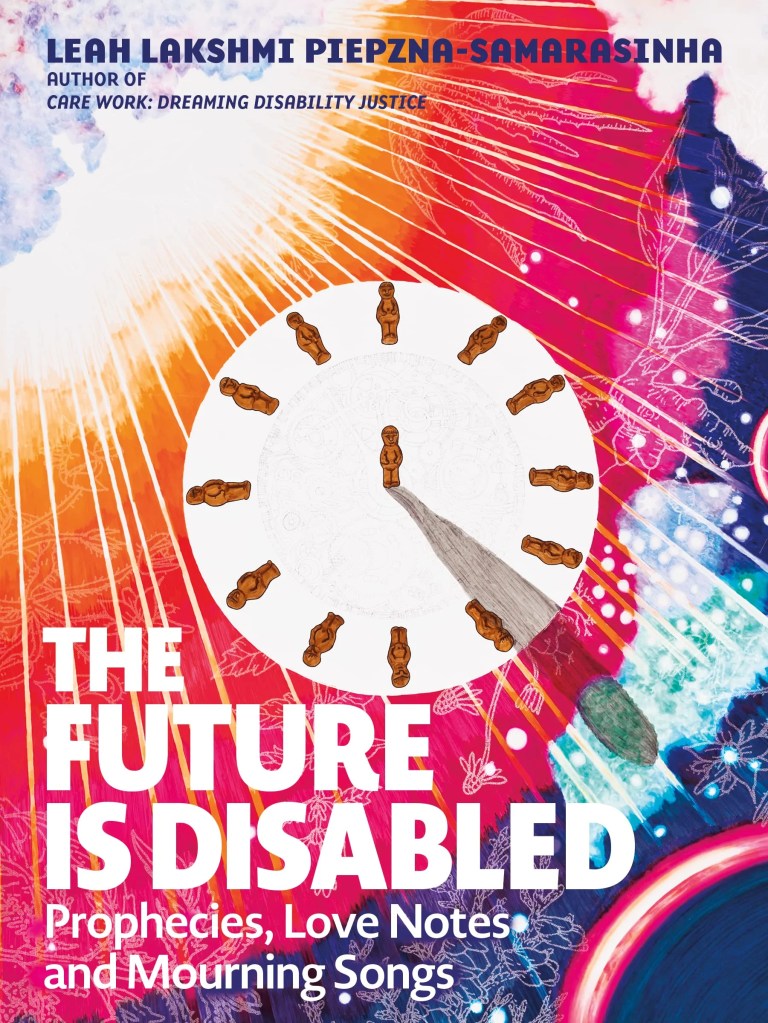
Living with chronic illnesses and disabilities often means to balance feelings of “more of the same” and “wow, not another drastic change”. It means ongoing adaptation. It means grieving a version of yourself which you will never be (again)–often not only once, but again and again and again. Dealing with it in the middle of a global pandemic often is  more heartbreaking than usual as everything we know to be true about our ableist societies seems even more acute, dangerous, and damning. And while books are not the only source to disabled knowledge–and books and longer written texts are not accessible for everyone—they are one important source. Picking up non-fiction books by disabled and chronically ill authors allows us to feel connected, allows us to dream up better futures and to find some tools which help to manifest such a future. In October, Leah Lakshmi Piepzna‑Samarasinha’s latest book will be published. It is aptly titled The Future Is Disabled: Prophecies, Love Notes and Mourning Songs and I, for one, cannot wait to take another step towards a new world which includes us all.


When CHARLOTT SCHÖNWETTER was ill as a child, her parents always gifted her reading material. Now as a chronically ill/ disabled adult she feels she always has the perfect excuse to get herself new books. Her writing on pop culture and literature has been published mostly in German language publications such as an.schläge, ak analyse&kritik and WASD – Bookazine für Gameskultur. In English, she shares her thoughts on books, culture, and politics regularly on Instagram (@half_book_and_co) and less frequently but more in depth in her literary newsletter Have You Read…? (https://tinyletter.com/haveyouread).

The Groundskeeper and His Seven Lawn Mowers

The Groundskeeper—name Mr. Lenard Lentin—was found in the midst of the July heat by his estranged daughter, Mae Dean Wilde, neighbors said, “alive, afghan-covered, sitting up in the middle of his living room with nothing ‘cept his clothes: a short-sleeved shirt and a pair of jeans.” The living room was 41 degrees; the lights had been turned off. The Groundskeeper’s hands were blue; he wasn’t dead, but the carpet he was sitting on seemed to be so.

Neighbors in Greenbrooke started calling Mae Dean a month back, after the Groundskeeper began using their garages, without permission, to store the junk he had procured from the garage sales he frequented each Saturday and Sunday. Each neighbor said lots of things about the Groundskeeper, as neighbors do.

“Began buying tools at first: shovels and rakes, clippers and trimmers. Then came measuring things: measuring tape, rulers, measuring cups, a pedometer, a T-square.”

“The Groundskeeper was constantly getting things ready without readying anything at all.”

“Bought all kinds of hangers, too, without anything to hang them on.”

“His mowers (he had at least seven) he kept in top condition, often spending more time with them than he did tending his own grass or his house or his second wife, Martha Minnie, which must have pissed her off awful.”

“One mower or another was always upended on the sidewalk. Later it’d turn up parked in one of our garages.”

The Groundskeeper used to layer the grass back and forth with a sequence of mowers—using different mowers for different parts of the lawn, overlapping sections, and then pulling out the old silent push mower for the final touches. He sculpted to perfection, lining the edges, trimming the bushes and pruning the trees. He snarled at errant footballs, whose misplaced bounces found their way onto lawns, turned up his nose at beer cans or paper scraps that blew in, got down on his knees like he was praying and picked them all up.

“Don’t get me started on the cursing he called the leaves.”

“For just a hair’s breadth, after he’d finished a job, the patch of grass was near perfect as it could be. There was no room in that moment for any kind of disappointment at all.”

Then, in early July, Martha Minnie died, and the verdant world he made of his life turned brown overnight. Neighborhood lawns soon followed and faded to yellow—strange curled and busted patches fell up in swirls, clover and dandelions grew like kudzu.

The neighbors rapped on his front and back door—tried to peek inside; doubted he was there but knew he was there; walked around his house and kicked up great moments of dust they later found would not shake away.

Some thought the Groundskeeper gave up when Martha Minnie died. Others whispered through their teeth the word ‘breakdown,’ but, most waited for the Groundskeeper to reappear, for the dead circles to give up their ghostly swirls, for the grass to snap back.

“We rummaged through our garages, hoping to catch a glimpse of him. Instead we found shovels and rakes, measuring tools and empty hangers.”

“We searched through the bags of seed and empty water cans while our grass continued to brown and fall away all together.”

“We wished the Groundskeeper would tend to our lawns again.”

One night in July, neighbors thought they heard him walking around on their roofs, cleaning out their gutters so rain water wouldn’t pour off onto their patios and find its way into their basements or flood their garages. They heard the sounds of wet leaves hitting the ground like bombs. Then, Mae Dean found him huddled in the afghan Martha Minnie had made from patches of discarded yarn she had forever collected. The Groundskeeper sat in the middle of the carpet, which had turned to thatch.

In September, all but a few neighbors called the big lawn maintenance companies. They watched from their windows as men came in trucks and rode riding mowers and plugged in electric trimmers and stood around scratching their heads over brown spots. The men suggested turf, which came in large rolls that they spread out like green carpets.  

“We heard the sounds of landscapers’ machinery—the shrill buzz of distant electric clippers and riding mowers but wished for the distant hum of a single lawn mower. And, during the late afternoons, the silence was deafening when we realized the garage sale leavings—the measuring cups, the weedwhackers, the shovels, the rakes, the empty hangers, the water cans, the seed, and the seven lawn mowers, even the silent push mower—were for us.”


J. BRADLEY MINNICK is a writer, public radio host and producer, and an Associate Professor of English at the University of Arkansas at Little Rock. Minnick has written, edited, and produced the one-minute spot “Facts About Fiction,” which celebrates influential authors and novelists with unique facts from their lives. These spots air weekly on UA Little Rock Public Radio and its affiliated stations. In 2014, Minnick began work on artsandlettersradio.org, a show celebrating modern humanities with a concentration on Arkansas cultural and intellectual work. He has produced over 100 episodes, and this work has been acknowledged by the 2016 national PRNDI 1st Place award for Long Documentary for “Sundays with TJ,” and a 2020 SPJ Arkansas Diamond Award for Long Documentary/Investigative Reporting for the two-part “They Liked My Phras’n: The Life and Music of Rose Marie McCoy. He has published numerous journal articles and fiction.

The Demigod

I first saw the word ‘severe’ chiselled into the lines arranged on Baba’s face. Until then, all I had wanted to see, was ‘here’ or ‘fire’, maybe ‘revere’ instead of ‘mere’. What I received after ten years, just as I was getting to know myself, was rejection. I had never stared at a blank grey slate of wall— like I had nothing better to do, like the drool slowly leaking out of my mouth’s corner was welcome. Nobody actually adopts this vegetative state of their own accord. Isn’t it always thrust upon you? The arrangement of ‘severe’ was on his face but it severed me. So many things became clear then. The world was nothing as I had imagined. Baba taught me this lesson thoroughly. Guileless as I was, his words became both the holy word of the Veda and the sentence that incarcerated me. Aai’s odhni fluttered in his hands, the material so tender and transparent that I wanted to risk snatching it back.  Baba had returned home before I could remove Aai’s odhni and ‘nausea’ crawled over his face at my appearance. In that moment, it fought the lines of ‘severe’, before emerging victorious. I could not decide which word was worse. My mouth burned with the red stain of lipstick. Long clumps of twisted hair, which some people called luxurious, shivered on my shoulder, a drooping rose still stuck somewhere in it, one twist hanging along my left eye. I wanted to find it annoying but couldn’t. My ankles hurt in their raised position inside the awkward shapes of outsized heels. Aai’s metallic belt which she only wore for her Bharatnatyam performances (an expensive borrowed item), pressed diagonally across my chest. Some loose thread from holes in my vest caught the sharp edges of metal. I was afraid to remove it. Would his nauseous disgust not turn into uncontrollable rage?

Before that day, I’d had an indifferent relationship with my body. It existed and as long as I could do whatever I liked, I couldn’t care less about this subjective object. It was just a thing I was born with, like our surname. Upon hearing it, people turned their heads to the side and spat (Aai said it was the ‘jaat’ – our centuries-old meaningless burden. I thought it was all the same). I haven’t bothered to know when the definition of this relationship between the object and the self began to change. Maybe it was always there or it started years back. The lines on Baba’s face said none of that mattered. Did I matter? I suppose not. Is this the lesson he wanted to teach? Either way, this is what I will take with me as long as I live. Decades have passed and the cement of this lesson grows like a living thing, indifferent that it might be killing another living being – the one it resides in, on it’s metaphorical rise. I thought I knew then, what ‘severe’ meant but now I can write a Master’s thesis on it. You are surprised I know what that is. Isn’t it common knowledge – a thesis? If ‘ordinary’ people like you know it, so do ‘others’  like us. You never asked. But then, in my experience, ‘ordinary’ people think they are the only ones making up the world. I would call them naive instead of my ten-year-old self. Have I changed my surname? You ask. I did, years ago but there’s no shame in admitting it. Your mouth presses like you can’t decide your opinion about it. But I know that these small shreds of self I share in my tiny square-metered room, demand a certain toeing of line from you. My silences, the set of my brows, the line of my mouth, the twitch of my tongue and palm, the movement of breath in my chest, all demand it. I don’t get to act out this luxury – negotiate my worth – very often. I won’t admit this to you though. As it is, I never have the upper hand except in these minutes between seven and eight on the clock’s face. Sometimes, when you don’t want to give in, you look around the recently painted blue walls which appear gloomy and gagging. An easy lone bulb hangs in the center, always still because the single-hand-sized window hardly brings a breeze to sway it. In your ‘generous’ moments, you say I am like this stationery filament in glass. I can tell now when you will say this. The first time it was an enormous struggle to hide my hurt. Now, I cover it like pulling up a sheet before sleep.

I keep secrets from you as well. One day, I walked barefoot to the Elephant-headed God’s temple. I complained of the blisters as I stood in front of the idol adorned with gold and sweets. I whispered a wish that my troubles would melt like cotton candy instead of lingering like rotten pigeon droppings or the water that refuses to drain from streets during the monsoon. I pleaded in the cold silver ear of the still mouse whose eyes had glazed after hearing so many wishes and cavils. And then I left my faith at the temple’s doorstep.

Once, I brazenly walked inside a mall, with the privilege of the word ‘ordinary’, past a conflicted security guard and snatched ordinariness for myself. I tucked the belt of my purse delicately, my limbs flirted with delicacy in your absence. I marvelled at my figure reflected in each ceiling-length mirror that passed. I entered a store branded with a neon-pink sign and the person floating about in this perfumed place demanded all my attention. Their lips were violently purple, eyelids violet and glistening, cheeks moister than mine on a sweaty day, and smart black heels matched with a lacy, ruffly skirt! I think I fell in love! Not with the person but… their presentation? Their air? Their naturally upturned cheeks? They were a person from some dream I had never dreamed, a dream I had but forgot. I go there as a treat. I went there the day I heard Aai, my solace, had passed away. I went there once just because. I don’t think I like ‘that’ world more than ‘this’ world. Maybe because we live the same everywhere. I remember many people before you admitting reluctantly that I had special powers. That I could read what they thought. You laughed when I confided this but I have caught your uncertainty flitting from brow to chin. It doesn’t matter. Baba’s lesson taught me much more than he intended. It granted me my power, or maybe it only awakened the power’s nerve. This power courses in my vein when I give sincere blessings to strangers on streets in exchange for money even as they tumble out insults or rejection gruffly. It surges when I am waiting in a queue for my turn in some degraded role at a village Tamasha, yearning that the audience has come to watch me perform. It percolates underneath the layers of my skin when I swallow the insults borne by the man inside me, seconds ago. It cowers when I see children directed by their families to recoil at my presence, women desperate to become pregnant gingerly placing money over my palm. They stare and stare some more. How did I become so soft and plump, they wonder. Am I not supposed to have hardness all over me? The Goddess knows I have enough in my heart.

Baba’s face in the shape of ‘Severe’, should have cut everything from me, even all forms of love. I had believed this until you daintily held my pinky. You still do at the beginning, middle or the end of our meetings. You declared I was Bahuchari Devi in earthly dimensions, a child in her reflection. The ten-year-old self in me awoke from slumber then. Sometimes I wonder how or why it is that the things they shrink away from, you touch and taste and explore. How do you do it? Can you show them how to do it? Would it make an easier world for me? Would I no longer need the sword or trident? You touch the hoops around my ears in reverence. I remind myself that I am a being of one gender attracted to another being of a different gender. I permit myself to place the lines. Over my face, yours, our bodies. The glistening freshly harvested grapes that are our skins. Thick matte hair curling up, where I please. You caress the marks on my skin made by ‘severe’, which blend into scars left after my skin stretched. You say you can’t understand beauty, but this is something close. I know what it cost, so I think it is. The shock of parts which ought to be there, absent in reality, this surprise of yours recedes with every meeting. You are still trying to understand me, but I want to scream “take me as I am!”. I wonder if you have the courage. I dare not ask. I’m damned to this shrunken state no matter how much ordinariness I have stolen- that is my greatest fear.

My more slender counterparts get away with metal tinkling at their ankles, necks and ears. They receive stares when they move in numbers. Chitra who lives beside me in the same narrow smothering box, has frequent call-ins from different men on different dates and hours of night. I get insecure when I see her carefree smile. That long flowing hair and delicate frame of bones is very attractive nowadays. Her face isn’t heavily set in gloom or cursed like mine. I know she, like everyone, must have their share of sorrows. Until I see it, I can’t feel sorry for her. But Chitra gives me strength. On days when my body refuses to get out of the tangled sheet, I listen to her coming and going out of her room. I stare at the long lengths of my fingernails. Sharp little swords. Sometimes red, other times pink. Currently chipped, uneven. It takes a lot to maintain their length. In times like these, the power unique to me, vanishes altogether, but I know I have only to call on it. I wonder what would make it stay permanently. It doesn’t act upon me or dare to surge when I look at how ‘affection’ falls on your nose. It only comes when I am alone. Is that a good or a bad thing?

Today, I am back to Baba’s lines spelling ‘severe’. Baba, the people from the chawl I grew up in say, has become obsessed with the lethal white powder that he deals people. I imagine Aai’s horror-struck body rustling. Her grey ashes adulterated by wood, have long since absorbed into soil, cloud and ocean. Someone politely alleged that I have a mental illness. A week ago, this white collar man nervously brushed his moustache and called me an animal roaming on his streets. Ex-lovers hang under my lone window and instead of ever singing a song of pining or yearning, their words lash and whip my back- ‘Hijada Whore’- Eunuch Slut. In all these decades, I haven’t gotten used to this. I can’t pull up a sheet like I do before sleep.

Now anger drives fatigue out. My powers might be stronger. I want to yell and fight with Baba’s face spelling ‘severe’. A chromosome gave me the body I have. Neither Aai nor Baba asked what I felt like. ‘Ordinary’ people change their bodies on a whim. This body isn’t my body until I claim it. If my self can’t unfurl and fill every crevice, is it really mine? Baba shouted that the world will laugh at me. I want to scream right back at him- why did you work, vote for and make a world that will mock me?

A journalist has asked to take my photos and when I meet them, they enquire about my real self and this way of life. They ask if they might be present when I make love to you. They hastily assure me they will pay me for it, but I feel apprehensive, hesitant. They gently murmur that I wouldn’t be the only one, they would ask Chitra for consent as well. ‘Consent’, suddenly I hold the word and turn it over like a treasured coin. That is how you treat me differently, how I have unwittingly reclaimed the oldest self of my past. I take the tiny relief and freedom and tell myself to make do with what remains of living. I comfort myself that the ten-year-old had always been right because a world that doesn’t let people discover and assert who they are, becomes an unlovable hell. I wrap saris, tighten petticoats and blouses, slide over kurtas and salwars, draw bindis, weave flowers and wear thin anklets, slip into peeling heels that fit better- each act in defiance of Baba and ‘his’ world that is just ‘a’ world. I sit on the Goddess’s rooster as another incarnation, hair flowing, limbs swinging. I whisper to the figment of Baba that the lesson he wanted me to learn was never learnt, lost and buried in that memory. I have seen the shape of ‘severe’ but now I cut and pierce the meaning. The power flows and speaks more clearly than ever. I make words mine.

For you. My lover, it is ‘I’. For the world, it must be ‘she’ and ‘her’ but they only see ‘he’ and ‘him’. Baba wanted me to sacrifice myself so he placed a word that meant it-‘Samarpan’ – over me. I scratched the first name out and wrote ‘Sumaiyya’- pure, high, exalted. I sacrifice to no one but myself. This is the legacy I create for myself and ‘my’ world, so that Baba’s patrimony eats itself, erodes with the acid borne of my reclaimed body, and vanishes out of existence- like it was never there.


SAMRUDDHI is a bibliophile and manga otaku since twelve and knew she wanted to become a writer when her teacher said her school essays were too outré. She writes short stories and literary reviews and is currently working to publish her first novel. Her literary review has been published in the ‘Verse of Silence’ literary magazine. She practices Japanese Calligraphy for inner peace and loves dogs.