Editor’s Note

Dear readers,

The ninth issue of Inklette comes at the right albeit tragic time. In my own country of India, songs, poetry and history is being revived by students and protestors on the streets. I always used to believe that literature and art is my private source of hope. However, it’s now become a public source of hope, of revival and of transformation. Publishing and putting out literature and art for the world to see, therefore, seems important, seems almost as positive as lending a balm so wounds can heal.

I would like to thank all our submitters, contributors and editors who submitted their work to us. Each issue of Inklette breathes different, breathes new, and with each issue, our expectations of what strikes us as unexpected, change. Our fortnightly blog shall continue as usual, thanks to the selfless cooperation of so many writers, artists and organizations. We shall also be accepting staff applications soon for the positions of prose editor and visual arts editor.

With this, I end this short editor’s note. We look forward to many submissions that rip us apart and bring us to the light in new ways. We look forward to individuals who shall be joining our team soon. And more importantly, we hope you heal as you read.

Love and peace,

Devanshi Khetarpal
 

Five Pieces

This slideshow requires JavaScript.


ALEXIS CORTEZ, or who is more often known by the name “LUNA” is a 22 year old Visual Artist born out of Southern California. Luna hopes to captivate her viewers through the figurative expression of the human body and the subtle connotations of her own personal connections as both an artist, a LGBTQ+ woman, and as well as her journey of dealing with Bipolar disorder.

Us

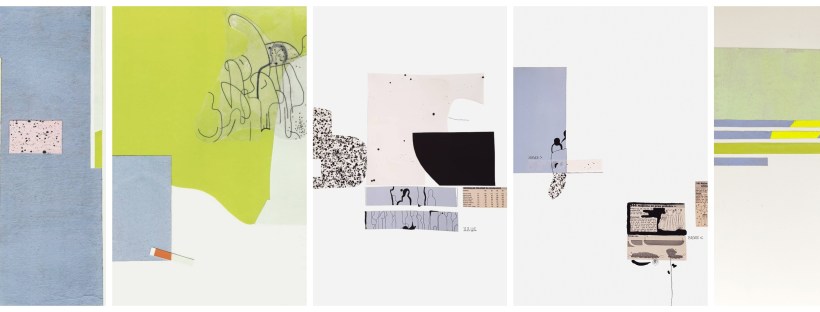
Artist Statement: The collages are a part of a larger body of works on a concept named Us. The inexhaustible theme of the relationship between human nature with its social constitution is displayed through juxtaposition and duality in the materialization of the concept. The visual approach to the problem of the individual-society, man-woman, human-nature-social norm is interpreted in layers, in parts, gradually removing redundant information in order to provide insight on the uniqueness of existence.


This slideshow requires JavaScript.


ANA JOVANOVSKA received her M.A. in Printmaking from the Faculty of Fine Arts – University Ss. Cyril and Methodius, Skopje, Macedonia (2016). Upon receiving a scholarship she spent time studying abroad attending École supérieure d’arts & médias de Caen/Cherbourg in France (2013-2014). Ana had 10 independent and more than 100 group exhibitions in Macedonia and abroad in countries such as: Serbia, Montenegro, Greece, Bulgaria, Bosnia and Herzegovina, Slovenia, Romania, Czech Republic, Poland, Russia, Italy, France, Germany, Spain, Portugal, Mexico, Argentina, Colombia, USA, UK and so on.

Upon the Anniversary of Our Divorce

Fifteen years ago, we were like this:


We held hands slowly on our way to the sunken movie theater

and I watched you through fractions of light, 

thinking there is nothing more our patch of love could teach us now.

We were inseparable, bound likes veins under the skin.


The undoing comes quietly: the handholding ebbs,

we bounce like endless particles without a solution.

And we go round and round, until a child

spins our fragments into a perfect rose-gold circle.

Yet, the deep wounds are waiting to speak misery.


Now, we seal our regret into long-knotted memories.

You sit at the kitchen table for two

and I honk the horn from the side of the road,

waiting for our son to appear.

I imagine letting go of the familiar things,

collecting the missing pieces which have been found.


DORSÍA SMITH SILVA is a Professor of English at the University of Puerto Rico, Río Piedras. Her poetry has been published in several journals and magazines in the United States and the Caribbean, including New Reader Magazine, Portland Review, Rock & Sling, Heartwood Literary Review, Stoneboat, Misfit Magazine, Nassau Review, Shot Glass, Moko Magazine, and POUI: Cave Hill Journal of Creative Writing. She is also the editor of Latina/Chicana Mothering and the co-editor of six books.

Emily and Sappho


I exist far too often in public

to make you proud.


One of you is more fantasy

than ash and no one knows who.


You persist through my favorite words,

yellowed stationary and collapsing ink.


I do not know

if you ever existed.


How your feet padded across the cold stone

whether flowers bloomed in your window.


Your parchment feels like some ancient owl

with no nest left behind.


Where did your attic go and

how did it crumble?


I hope it went as you may have lived—

wooden beams, then a passing sigh.


Heard like air moving

sometimes a whistle, but mostly

not there at all.


AVA SERRA is a queer woman who strives to highlight underrepresented identities in her art. Aside from her writing projects, she recently completed her degree in Environmental Science at Northwestern University. Since her introduction to poetry in 2016, her work has been featured in Nailed, Northwestern University’s French & Italian publication Rosa La Rose, POSTSCRIPT (2018 & 2019), Sonder Midwest Review, and Lavender Review. She has also received an honorable mention and performed as a finalist in the 2018 and 2019 Gwendolyn Brooks Open Mic Awards in Chicago, where she dwells and frequently performs. More information about Ava and her work can be found via her website (avaserra.com) or her Facebook page (@avajserra).

Nothing ethical has a barcode

#1 

Nothing ethical has a

barcode. 


Bruised fruits beg

empathy under ripe fruits

beg inquiry. 


My consumption = ignorance

of 


the drought that never touched

me the fire that never

swallowed me the smog that

never choked me. 


No excuses; no exemptions.

Nothing ethical has a

barcode.


When you start

thinking in

ecology you

forget how to

speak bullshit. 


and even if

you never

watch the

news 


you can still

notice that the

goldenrod

blooms earlier

each year. 


and even if you don’t

reuse your ziplocks 


you can still wonder

everyday: “Does the Earth

forgive me?” 


and even if you

didn’t vote

green 


you can still ask the wild

grasses what is their wealth?

and why don’t you seem to

have it? 


and even if

you take

baths ride

planes eat

pork and wear

plastic 


you can still

explore the

possibility of

leaving the world

more nourished

than you found it 


because

even if 

you belong to a

system you didn’t

create 


you can still be

seduced by an affair

with spontaneity. 


and even if you profit from

your place on a ladder

that you were forced to

climb you can still

remember what it is to be

a part of everything and a

master of nothing.


MARY LOEHR is an undergraduate student living in Colorado. Her greatest passions are creative writing, nature-based education, and local food systems. She finds the deepest happiness in life to be walking in the forest with her dog. She has been published in The Social Justice Review and several local zine publications.

[i like my mind when it is with your]

after E. E. Cummings’s “[i like my body when it is with your]”


i like my mind when it is with your

mind. it is so quite a new thing.

ideas better and imagination more.

i like your neocortex. i like how it thinks,

i like its hmms. i like to follow the twists

of your thought and its tangents, and the reflective

-self-aware ness and which I will

again and again and again

consider, i like considering this and that of your brain,

i like, slowly probing the, shocking synapses

of your electric neurons, and what-is-it comes

over parting hemispheres…And amygdalae big love-crumbs,


and possibly i like the thrill

of with me you quite so smart


FLOYD CHEUNG is author of the chapbook Jazz at Manzanar (Finishing Line Press, 2014). His poems have appeared in qarrtsiluni, Rhino, and other journals. He teaches in the Department of English and American Studies Program at Smith College in Northampton, Massachusetts.