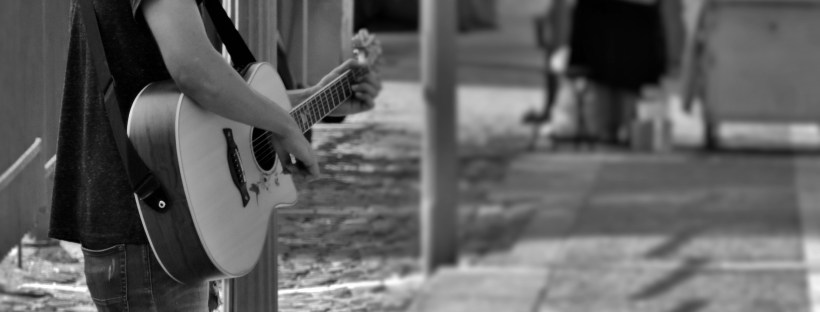
Leonidas Plays the Guitar: Athens, Greece by Chaun Ballard
Photography Ι 3672 X 4896 Ι 2014
CHAUN BALLARD is a poet and photographer who was raised in both Missouri and California. For six years now, he and his wife have been teaching in the Middle East and West Africa. He is a graduate student in the University of Alaska, Anchorage’s MFA Program. His poems have been published or are forthcoming in The Caribbean Writer, Grist: The Journal for Writers, Sukoon, Orbis: Quarterly International Literary Journal, Apogee, Off the Coast, and other literary magazines. His photographs can be seen in the latest issues of Gravel and The Silk Road Review.
It had been a pleasant day till then. The people I met had been hospitable. The day’s climate had soaked my skin, lulling away my state of fatigue and weariness. As the day dropped down to a still, silent winter night, with the numbness of air established in the ambience of my room, I laid on my bed, wrapped up inside a thick blanket that reached up to my shoulders. A cupful of caffeine had proved efficacious in drawing my consciousness out of some much needed sleep.
As I turned my head to my right, I breathed out some air that froze to visible fog. It retreated unto my face after rummaging the silky surface of the cover of the cushion that lied adjacent to my head. Startled by the abrupt, momentary cold of my own breath, my eyes opened with a meek flutter of my lashes. I felt an old and odd vacuum stepping back sneakily into the vicinity of my blurred vision. Stepping out gradually from my blank thoughts stained with unwanted reverie, I realized the smidgen of winter winds entering my room through the casement had a rasping influence on the Brahms lullaby that I had played to assist myself in sleeping.
Irked by the grating of the sound, I sat up, though with utmost disinterest in getting out of bed. I splayed my arms in the empty air around, shifting on the bed-sheet that had gotten dragged a little to my side.
I stepped down on the wooden floor, bare-foot, and began to move towards the casement. It unexpectedly seemed totally different as I reached there. The air. It was a baffling mixture of awe and serenity, laced with a few whiffs of forgotten love. The whispers of my steps, moulded into unheard voids, had already whidded into thin air. Varying ebbs of the peculiar aura overwhelmed my calm. It was one of those times when you feel something tickling your mind, sending you into spasms of weird pleasure, the reason of which you’re unsure of, or maybe you know; something compelling, something ethereal, something unimaginably real.
I shut the window. The wind was gone now. Its chilling claws were rendered half-dead. But, the wind had left its traces. I could still smell the ambrosial aroma of the odourless wind that wafted through the air around me. I was doubtful, though, regarding my assumption that they were the traces of wind.
It wasn’t the wind; I was sure now. A moment I couldn’t decipher in the simplicity of words. I didn’t see it occurring. Nor did I hear any creak. I walked in haste to find out. I hurriedly stepped out of my room. For almost a minute, I fumbled in the murk of my house.
It was in the dining space. My feet were still bare against the cold pulses the wooden floor offered. All the eeriness racked my spine, creeping over my nerves at a steady pace. My gaze was fixed at a settee that had its front left leg cracked. It provided to me an uncanny mélange of tranquility and delirium that cocooned the compass of my thoughts. It radiated familiar ripples of memories; memories that I had vowed to bury, but was always eager to embrace. She loved sitting on that settee, reading a book, or just losing herself to a slumber, with her left hand resting on the rough patina of the settee’s right arm as her left foot rested lightly on her right upper-thigh. The very remembrance held me frozen, my mind befogged from all other imaginative constructs.
I was adeptly hauled back from the reminiscence by an uncanny creak as someone walked behind me. It left me addled and wondering. It sounded like a dagger chiming against a metallic bangle dangling on a woman’s wrist before cutting and piercing, slowly, grotesquely, but painlessly, into her wrist. It sounded much like a cacophony disguised as a melody. I turned back to realize it was a silhouette of a lady. I couldn’t see anything except the beautiful outline of it that certainly appeared categorically intimate to my eyes. I hadn’t seen a scene as such before. It appeared like a beautiful diadem made of prosaic, crushed crystals, or maybe like a flickering candle. A flickering, black candle: disgusting, and treacherous, burning off fumes of irrational apprehension. A few moments of rambling through the possibilities inside my head and I knew it was her. There wasn’t even an iota of suspicion regarding this. It was a labyrinth, paradoxically both pleasant and ghastly. I had turned cold and numb. But, proximity to her aura solaced my senses down to warm, visceral sensations of love that swirled inside each of my organs. Her mere presence caressed subtly the contour of my face like her angelic, sorcerous hands used to.
I was supposed to be struck with astonishment, with jitters crushing my conscience to nothingness, and my skin turning to shades of pastel. But instead, I was transfixed, with eccentric idyll churning inside my guts, and my eyes evaded the fear, looking at her with the old, dormant love.
But, this time, it was different. I didn’t want to get inside the confines of her breath, grasp her wrist, knead her hair with my shuddering right hand, or massage her arched back gently. All I yearned for was to stay there, look at her, and delve into the divinity of her realm just by gazing at her dark outline. I was intrigued by this alteration in my emotions. However, I didn’t want to comprehend the situation, or my love, because staying intrigued is solitarily central to the art of loving someone unattainable. And she was unattainable. After all, that’s what real love is—free from the desire of being requited, free from the wild cravings of touching the flesh. It’s like the warble of a musical note. It enthralls your sensibility without the existence of any physical aspect.
When I was somewhere lost between my own thoughts, she vanished. She was gone, again. Everything receded back to normalcy. The warmth inside me dissolved into the cold pulses of the floor. The redolent aroma diffused. The air was more nipping, but less benumbing. My insides provoked me to lament over her departure. But then, I realized that was what she was destined to do. In the semi-dark house, she had to depart with all her insidious essence. She had to vanish. Because that’s what dead souls do. They vanish.
SWAPNIL is an 18-year-old high school science student who loves to write. He has deep love for poetry as well. He loves to sing and listen to soul-soothing music at his leisure. This is his first publication.
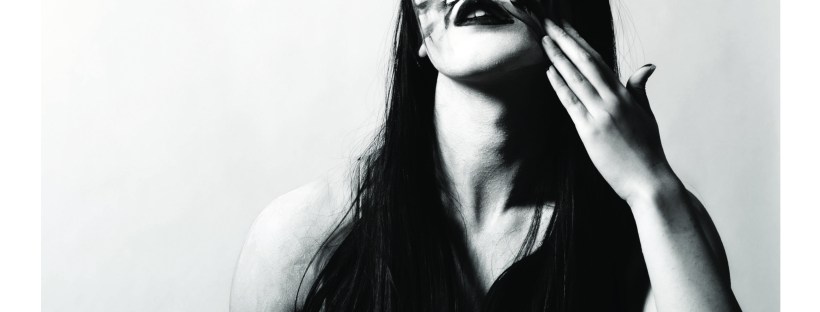
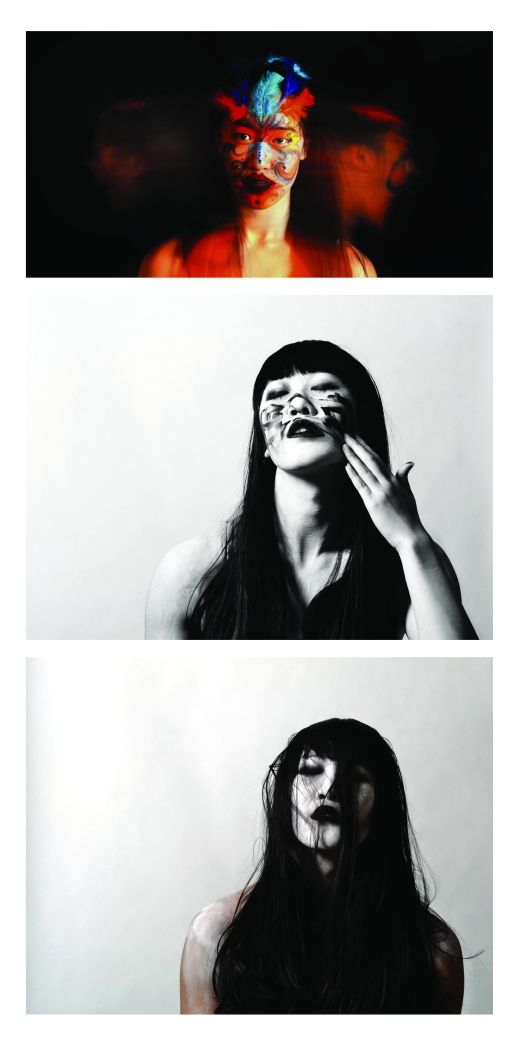
Artist Statement: “This series of 3 self-portraits represents the effects and consequences of LSD on one’s perception of the world. The photographs are inspired by an experiment done by reddit user, whatafinethrowaway, where she asked her artist friend to draw self-portraits while given LSD. The series demonstrates both the vivid imagery and colors seen during one’s high, as well as the negative and nightmarish after shocks that take over during drug use.”
Lucy In The Sky With Diamonds by Stacey Lin
Photography Ι 16″X8″, 14″X10″, 14″X10″ Ι 2013
STACEY LIN is an industrial design student from Ottawa, Canada currently attending Carleton University. She’s an aspiring designer, winning the Lillian Rapport Arts Memorial Scholarship in 2014 as well as the Carleton University, School of Industrial Design Award of Excellence in 2015.
Woman, 52, medium-build, brown hair, seeks man (N/S, GSOH) for dinners out, walking, friendship +
Dee wrinkled her nose and poured herself another glass of Rioja. The only interesting bit was the plus, but she wasn’t even sure if she dared include it.
“But it matters! It matters almost as much as the friendship,” she murmured, staring at the page. Plus encompassed a whole gallery of dreams, moons, rainbows, candlelit caviar, weekends in Paris and fabulously naked bodies writhing under the bedclothes…stuff that at fifty-two you weren’t supposed to feel that bothered about. But bothered was exactly how she felt. She grabbed the biro and scrawled ten more plusses all over the page.
If only Alan could see her now!
She frowned. How were you supposed to make yourself sound desirable without either boasting or lying? The ads in the magazine by her elbow were peppered with words such as ‘attractive’ and ‘slim’. But could she in all honesty describe herself as either of those?
She forced herself into the hall and inspected her reflection in the long mirror from every angle; close-up, distant, directly under the glare of the light-bulb, a little back from it, stomach sucked in, stomach released into habitual paunch. It wasn’t good news.
There must be something about her that could kindle a spark of interest in the male psyche. Men had, after all, shown interest in the past. Alan had anyway. But interest was a slippery issue that came in many shapes and sizes. She would need to mull it over for a while.
The evening sun was filtering through the spots and smears of the kitchen window which she should have cleaned months ago. She downed her Rioja and went outside. The garden always helped when inspiration was called for. She noticed a couple of foxglove plants pushing up through the cracks between the paving stones. They would be better off in the border; they could fill up that bald patch of earth she disliked so much. She transplanted them tenderly one by one. Digging was always a therapy, the quiet rhythm of it, the warm, private feel of the soil.
Half an hour later she laid down the trowel with a sigh and took up the secateurs. Brambles – they were her job now, like so many things.
“You need me, Dee,” Alan had said. “You need me and I need you. We’ll be together forever.”
Forever! She grunted and tore at a bramble. It tore back at her through her gardening gloves. She winced. Her tolerance levels were not what they used to be. It was all to do with hormonal changes she believed.
A chill hung in the air and dew was beginning to form on the grass. Dee went back inside, looked at the wine bottle and got a pot of tea instead. She allowed herself just one chocolate hobnob. The brambles had pierced through her sleeves in several places and scratched long, red lines that criss-crossed the other wounds on her arms.
Back to business.
Woman, 52, very passionate, a dreamer, chestnut hair and eyes to match, likes foxgloves, dislikes brambles. Seeks N/S man to share Rioja and friendship +
She liked that better. Yes, perhaps the secret was in being specific. Maybe she should be more specific about him, too:
…seeks man not in the least bit like my ex-hubby, Alan.
Now she was being ridiculous. Did any such creature exist? Her mind zizzed round in circles a few times and refused to focus. She’d have to sleep on it.
Alan came to her in her sleep. He sometimes did that these days. This time he was walking towards her with a pair of shears, slicing them open and shut in slow motion. She did not run or scream, just stood there, interested to see how far he would go.
She was relieved when she woke up. The dream had not been very real – shears would not have been his style – but it made her shudder all the same.
She missed him, in spite of everything. She was not used to being alone.
Woman seeks man. Desperate. Please love me!
They strolled around the lawn together, their shadows growing long. It was a compromise, of course. Matthew was not everything she had ever dreamed of, but he would do. She had pitched her wording just right in the end, keeping the ‘passionate’ and the ‘dreamer’ and mentioning her love of gardening – that bit had obviously registered. Matthew was courteous if a little full of himself, could not exactly be described as handsome but had nice dimples when he smiled, and he had bought her a pink camellia for the border (pink was a kind, gentle colour, she thought). Matthew worked in a bank, so money would not be a problem. And he liked food and travel, which boded well. It was even quite romantic, the speed of it all. He was moving in with her next week. He had wanted it to be the other way round but she’d insisted. She would never sell her house, her garden. Not now.
They’d already toasted their future and were a little tipsy. Soon would come the fabulously naked bit. But now, as they meandered, the talk was of the camellia.
“Where will you plant it?” he asked, hand linked in hers.
“Oh, there, I think, next to the foxgloves.” She’d been so busy with the border recently there was only one little space left.
“Lovely!” he said.
She smiled. She’d have to be careful not to dig too deeply. But it was nice to think of the camellia growing there right over Alan, drawing up new life from his pitiful remains. An image of herself baking his weed-killer pie flitted through her mind, but she quickly banished it.
That was in the past. Now she had friendship plus, and that was all that mattered.
HAZEL PRIOR has written many stories for both adults and children and has won several national writing competitions. She is currently working on her second novel. In between writing, she teaches English as a foreign language, sings a lot and enjoys being a freelance harpist. She lives in Exmoor with her husband and two cats.
The video was too cheerful: “If you’re a boater, like me, then the locks at Bonneville Dam…” But Charles didn’t own a boat, and the one time he had been on one, he found the instability on top of the water discouraging. Today he was just a visitor to the dam. The drive on Interstate 5, beautiful, windy, and prompting a sense of desolation, demanded he stop. The river, which had been his companion for most of his journey, kept going, but Charles pulled the car into the crowded parking lot.
As he pushed his body from the driver’s seat, he grunted. Thus continued his war of attrition with gravity. But it is a constant, and will win in the end. Age marks itself strategically, in heavy cheeks, a drooping neckline and a descending chest. Even the heart drops.
He felt old. Not a nice round number kind of old, which his age belied, but old nonetheless.
Admission was free; he needed only to let a guard look in his trunk, which was empty now. He’d dropped off his last child at college; his wife had beaten him to the grave; he was alone.
“You never let me win at anything,” his wife had joked after the doctor told her the cancer was terminal and had given her an estimate. The number of months she might live was like a payment plan for a small appliance.
It was true that during game nights, especially when they were younger, the children always said, “I’m on daddy’s team.” And he had won a lot. Only when his son had started listing boys won and girlslose in a litany of childhood facts did Charles try to lose more often. No point in giving the world another misogynist.
Still, after Delia was gone he found himself loving her and hating her in intervals. What right did she have to take death’s offer first? They had only settled into the first years of middle age when she went.
Now, alone and peering at the rush of water on the top part of the fish ladder, Charles struggled to accept her absence. On another morning he would have stopped somewhere on the highway and set up his easel, painting the changes of light, losing the sounds of traffic with each brushstroke. But not today, not when his solitude was confirmed so completely.
Before she had gone, Delia tried to find something new for him to do.
“Something different than painting. Not just a way to spend your time,” she said. “I don’t like to think of myself as that. But really, something useful.” It was a reminder that he still had to be present for the children, to serve as a role model.
She talked him into buying a book to help him learn Latin.
“You speak Spanish, so it should be simple.”
It wasn’t. While he recalled Spanish vocabulary, declensions in Latin felt like another reason to despise Delia. Still, he stuck with it because the book helped him remember her, even if he forgot ablative forms and how to feel in Latin when the text closed.
He spent a long time reading the signage in the visitor center, learning how locks worked. It felt like such a natural exchange: water either filled or drained so a boat could reach the level of the river; it was how Charles felt, needing to match up to the world. He wasn’t sure he wanted to take the tour, but they started every hour, and it was early in the day—he had been driving since five—so he delayed.
On the lowest level, visitors could watch fish climb the ladder or navigate the twisted path to their next stage of life, and learn how to identify the types of fish passing by. Some job, he thought, to numb workers with counting fish, sometimes more than two thousand in a day.
Still, without the pressure of numbers, the fish hypnotized him. Occasionally they were thrown back by the surge of water in the maze engineers had created, but usually the fish appeared suddenly and pushed on, disappearing again, unconcerned with being tracked.
“Here come some,” he said, his face a few inches from the window. Although he’d already watched fish glide by for fifteen minutes, he still spoke with a touch of surprise.
He became so absorbed in this study that when a voice over the public address system announced, “A tour of the dam will begin in five minutes,” he jumped, as though he were encased in glass, the victim of a sudden, incessant tapping.
A small group gathered for the tour, which began with a more technical video and a presentation by the ranger. Then, at last, they were moving, no longer held by the unseen force of the ranger’s green jacket or the authority of that voice.
The group took a short walk down to the powerhouse. An osprey had made its nest on one of the towers and Charles wondered how many fish it prevented from returning to spawn. Once inside, he marveled at the size of the turbines.
“That’s modern engineering for you,” a man next to him said.
“Yes, they’re so clean,” Charles admitted. This answer apparently failed to meet the man’s expectations and he wandered away. Charles stared. A line on the wall marked how high the water was outside the dam, and suggested, playfully, that visitors consider where they stood. If they were outside the powerhouse, they would be underwater. Charles envisioned the rush of noise and life around him.
The tour ended and parties moved back leisurely to the visitor center. A few moved singly, but more often they came in pairs or families.
Charles felt the day turning, time itself victim to the force and whirls of thought. He crossed the parking lot and retrieved a travel set of paints. In Delia’s absence, and with all his children at college, he always kept the paints in his car. You never knew when… he didn’t finish the thought. If you didn’t have the tools, you had only dark spots on the imagination.
The bathrooms in the visitor center were on the top floor. Charles picked his way up slowly, confident that no obstacle would be insurmountable. He almost laughed, looking in the mirror—how serious his face had been.
Besides Halloween, he seldom used mirrors for painting. The first curved lines took the longest, because he was at his most cautious. Soon though, his hand moved quickly; both the process of his flapping arm and the result seemed perfectly natural. He studied his new reflection. Yes, his face looked as though it were covered in scales. He’d become a fish.
Exiting the bathroom, he held one arm over his head. Now he moved swiftly, unable to contain his excitement, a journey near its conclusion. He took the stairs, knowing most visitors opted for the elevators, and that it was more appropriate to the moment.
When he reached the lowest level, a few heads turned, registering surprise first, then interest. Charles ignored their gaping and walked to the viewing windows. He sat against the glass in one corner and stared back at the people who came to watch.
After all, he wasn’t a boater, and not everyone needed locks to get through the dam. With fish patrolling behind him, he would stand, eyes unblinking and lips parted, in the basement of the visitor center, until they closed.
MATT KOLBET teaches and writes near Portland, Oregon. Besides stories and poetry, he is the author of the novel, The Futility of Nicknames.
The blades of the ceiling fan rotate lazily above her and she stares right at them, her thoughts sluggish, matching the pace of the fan. She is in the room again, the four walls of enclosed space which she never could relate to as ‘hers.’ It is stripped bare of any sharp objects- even her toothbrush is taken away after her supervised shower time twice a day. It was painted a muted shade of white and has just an iron bed, a white bookstand, a white night shelf and a white cupboard. A few belongings lay around, memories of a life, long outlived. There are a few books around, but she feels no interest in them. Papercuts barely hurt and she needed to feel a lot more pain than just a few drops of blood a tiny piece of slivered skin.
The fan casts shadows over her as the sun goes further down the horizon. She hears the call of birds as they return to their homestead for the night. She had once wondered how flying would feel. The notion of weightlessness as she roared through the air for just a split second, before gravity would blessedly pull her towards the earth had put a brief smile on her face. She had wondered how her blood would pattern the sidewalk, pondered about the angles which her broken limbs will be bent into, speculated about just how long would she be alive to feel the blissful pain. She had dreamed about all of this, that fateful day at the hospital. As soon as all the formalities were complete and she was free to go, she had gone up to her neighbour’s terrace.
She had ascended the water tanker at the top, something she never had the courage to do in The Before. She vividly recalled the gentle breeze which had caressed her naked face. She was awarded with a view of the city, which lay peacefully like a patchwork quilt before her eyes. She had widened her legs and had taken the stance. But before she could leap, her neighbour had pulled her down. Everything went blank from there and the next thing she remembered, was being brought into the hospital again. The nice doctor later told her that she was hysterical and they had had to tranquilize her.
The sun goes lower and it is now time for the bars on the windows to play the shadow game. Seeing them, it evoked another memory of how a bird had once gotten trapped in her classroom. This was of course, in The Before. She no longer goes to college and she no longer cares. The bird had gotten in through the open door and couldn’t get out since all the windows in that room had bars as well. The bird had valiantly tried to find a way out, completely forgetting the way it had gotten inside. Those bars in that classroom were supposed to keep evil outside and they ended up trapping an innocent life. What are these bars for? Are they for keeping the evil inside of her to ever get out?
The bird incident was in fact, very close to the beginning of The After. It was actually just a couple of days before The Event. It was slightly funny how she would sometimes be struck with crippling recollections of the most mundane things which happened in The Before. The most burning of it all was The Event, for obvious reasons. She could picture the entire day, as if it had happened just yesterday.
The wide open door of her house.
The merriment of her entire extended family and friends.
The smiles on the faces of her parents, as bright and as constant as the sun.
The huge white cake, in the shape of her graduation cap.
The black robes she had laughingly insisted on wearing the whole day.
The copy of her admission letter in the most prestigious institution for her chosen Masters.
All these memories have a happy tinge to them. The joy of that day is still painfully tangible to her. She could taste the vanilla cake and she could feel the warmth of the champagne as it slipped down her throat. Her mind was still imprinted with the photograph of her and her friends in their black gowns, throwing their caps into the air. She was sort of glad that she no longer had the actual picture. Everything was lost in The Event, both literally and figuratively.
Her recollection then takes on a slightly black haze, as she remembered the shaking of the floor under her 4 inch black pumps. In a flash, she was back in the brightly lit living room, with the neon balloons and the floaty streamers. Her eyes took in the oft repeated scene in front of her.
Ducking under the heavy, wooden dining table out of instinct.
Watching in mute horror as the entire roof fell on all of her beloved.
Concrete covering up the sides of the table and she could no longer see.
Praying in the dark, using up every molecule of oxygen, her lungs burning for more air, her organs slowly beginning to shut down.
She could still conjure up the haunted dreams that her slowly dying brain presented her. They say that when one is close to death, they usually walk in a long, dark tunnel which leads up to the famed light. But, all she could hear were wailing noises and see bright, flashing lights. In retrospect, that really should have been the sign that she was, unfortunately, alive. Her next memory was waking up in a bright, white hospital room, very similar to this one. Turning to her side, she wonders why all the medical rooms, in what seemed like the entire world, were designed in the same manner. In The Before, it might have led to a hilarious discussion with her friends. Right now, she did not have the will to laugh.
She had seen the headlines in the news channels later on, from the hospital. The earthquake was, by everybody else’s accounts, a small one. Everywhere else, no lives were lost. Only a few walls had fallen down and the city was mostly praised for its effective disaster management. Only the epicentre had reported causalities. 47 dead, 1 survivor. A tagline she would have to always live with. She wishes that she could tell them that there were no survivors that day. She is a victim.
She now knows how almost dead felt like. She had come very close to it the day she had jumped into the sea. It was right after she had left the hospital for the second time. She had been declared mentally fit 4 months after she had tried to jump. She had gone to her newly rebuilt home and had eaten a lunch of dry bread and jam, before going over to the docks.
She recalled with relish, the feeling of floating under the water’s surface, watching the blue sky get farther and farther away, the water feeling silky to her skin. She had forced herself to not breathe in the water as long as she could, but her gag reflex had finally won that particular battle. As soon as she had opened her mouth, water rushed in and burned her lungs. Everything slowly started to shut down.
The dark tunnel with the light at the end of it? She can now say with proof that it is all true. Before she could reach the light and beyond that, her beloved, she was pulled out and sent to this place. She is now on Constant Suicide Watch which involves being locked up in this white room during all times, except when it is time to talk to the psychiatrist. Survivor’s guilt, with major suicidal tendencies. That’s her identity now, in the midst of the rest of the crazy folk.
The sun has now completely gone down and the last vestiges of light tinge the sky a lovely shade of pink. She suddenly feels a little breathless, though she is lying flat on the bed. Struggling to take deep breaths, her mind wanders to something she had once read for her Philosophy class. “The life of the dead is placed in the memory of the living.” The memories were so vivid, that she could almost feel them surrounding her. The love in her parents eyes, the warmth emanating from her friends, the tight hugs from her aunts, the proud pats from her uncles, the stories from her grandparents and the laughter of her cousins. They crowded around her, suffocating her, squeezing her chest.
She gasped and rolled on her bed, unexpectedly falling out of it to the floor, onto her back. Tears ran down her cheeks as she took stock of all the symptoms wracking her body. Tightness in her chest, shooting pains traversing through her arms, her stomach rolling with nausea, her struggle to take a breath.
Heart attack.
The finality of her self-diagnosis calms her down and she relaxes into the pain, occasionally flinching. She struggles to paint on a smile, at the irony of it all. A broken heart could do what trying to drown, jump and cut couldn’t do. Her life flashes in front of her eyes like a movie reel; giving her a short glimpse of all the labels she had been given.
Daughter
Granddaughter
Niece
Cousin
Friend
Student
Patient
Survivor
Suicidal
As she takes in another breath of her very limited ones, her eyes finally close, no longer able to be propped open. Her dying brain echoes with the calls of her loved ones and her failing heart lifts a little at the thought of being with them again. Her last coherent thought is whether they would finally change the headline. 48 dead, no survivors.
SNEHA RATAKONDA, 20, currently lives in Hyderabad, India and is a lover of all kinds of fiction. A Chartered Accountancy student who is currently stewing over the books at home, she writes when ideas strike her or when the world frustrates her.
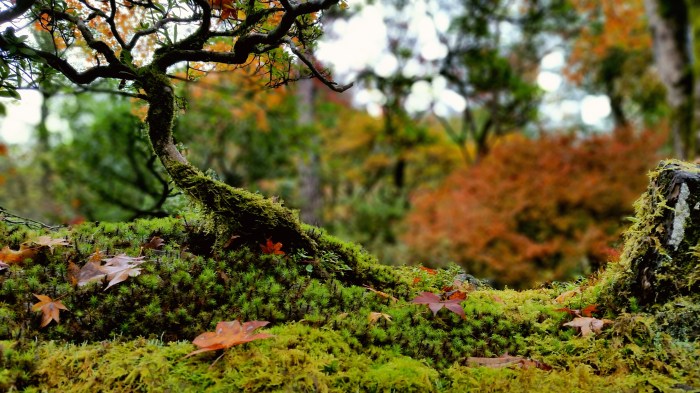
Artist Statement: “This photograph was taken at the Ginkakuji Temple in Japan. It was named Big Aspirations with the hope of representing how the pursuit of greatness can be rendered obsolete when a new perspective is adopted.”
Big Aspirations by Santiago Villar
Photography Ι 5312 X 2988 Ι 2015
SANTIAGO VILLARis a young student from Mexico City who enjoys photography as a hobby. His works have won second place in the American School Foundation’s Photography Contest in 2015. Since the contest, he has continued to take photographs of his travels in hopes of creating pieces that will inspire other young students.


 Inklette Magazine