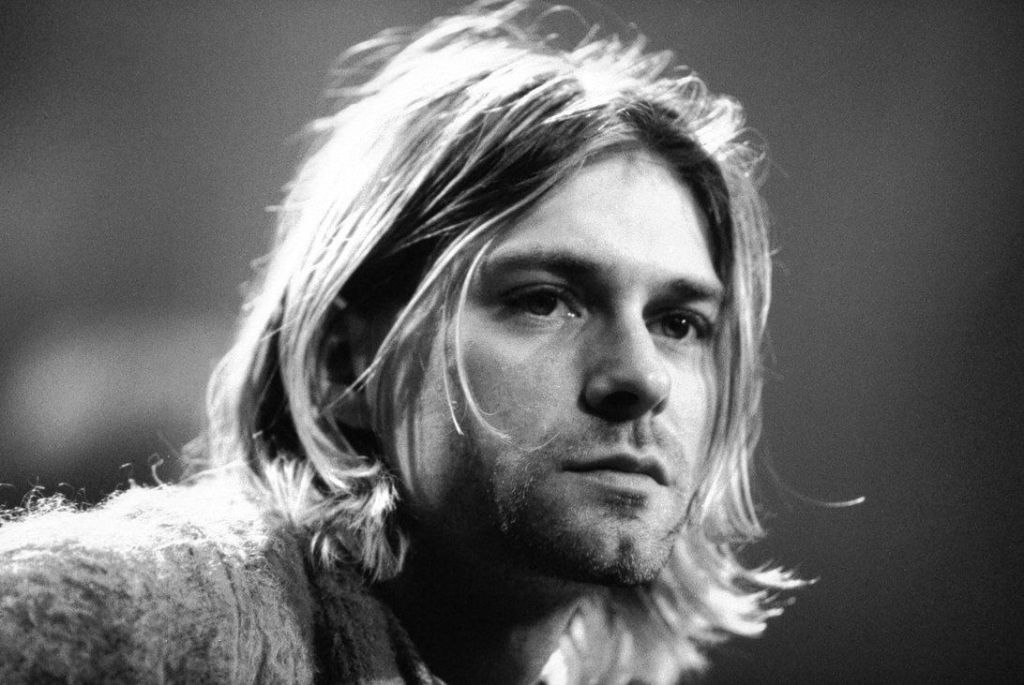
A Conversation with Sergio Troncoso

I wrote my first short story only a few months ago. It concerns the truth of someone I know. It was told to my mother in confidence, but she decided to spill it to me anyway as most innocent mothers do. I wasn’t shocked by the truth when I first heard it, but it has stayed with me and assumed its own shape and form in my mind over the past few years. It is strange to say this, but I can almost feel it constantly shifting and being punctured in my mind and body in ways that have perhaps made that truth mine now. When I decided it was time to write it down and give it some form, I realized I couldn’t do it through poetry. It had to be done through prose; I had to write a short story. It needed a different body. But I felt odd being nearly paralyzed by the idea of writing something down as a poem. I had never written a short story. Where should I begin? How? How do I get my mind to think in sentences without line breaks? How much should I meditate on language and isolate words? How do I write with a poet’s mind? I never thought there was something I couldn’t say through poetry, but this instance felt different as though the real challenge was not the story itself, but the way to tell it. And so I finished writing the short story and wrote one after the next, and soon enough, I realized I had embarked on a novel. I haven’t written any poetry since and decided sometime in April that I wanted to attend a fiction workshop in the summer.

I came across the Yale Writers’ Workshop and spent a week with other writers on the beautiful Yale campus trying to find ways to write and revise our stories. There, I was struck by something that Sergio Troncoso, one of the faculty members, said at the faculty reading. He pointed out that it’s the challenges related to craft that he wants to explore in his writing now, as opposed to challenging themes or subjects alone. I thought he had spoken to what I’d recently experienced: the truth of the story didn’t challenge me as much as the idea of writing in a short story form did. So I decided to get in touch with Sergio and talk to him more about this idea.

We decided to meet one afternoon at a French-style cafe on the Upper West Side. I like going to a different neighborhood than mine, or meeting people in theirs. Each neighborhood carries a different personhood and conversations in different areas, too, perhaps are imbued with the identity of that place. I composed myself before meeting Sergio. I always feel like I am entering a different world, a different dimension when I exit the subway and it takes a while for me to reorient myself. Sergio was waiting for a couple of minutes. We decided to sit inside because we thought it would be too noisy outside. We ordered coffee and our conversation, of course, began with talking about New York. If I could have it my way, every conversation of mine would begin with the city.

Sergio thought I look acclimated to New York. “For better or for worse,” he added. And he went on to tell me how he misses Texas, where he was born and raised in the city of El Paso. He misses connecting with people the most. “They can be rude and rough in New York,” he said. But he went on to add that the diversity of the city is unmatched, that one can meet fascinating people from various backgrounds doing all kinds of creative, interesting stuff. And then we got down to it. Sergio asked me to shoot my questions and I told him, then, that I was interested in talking to him about the idea of being challenged by some aspect of craft. He immediately said that he knew how to tell a good story, but that he wants to feel constantly challenged as a writer. He wants to do something difficult or something he wants to learn more about. I liked that approach. Sergio was stepping into the territory I like asking writers the most about: What do you not know about writing yet? What continues to scare or challenge you about writing?

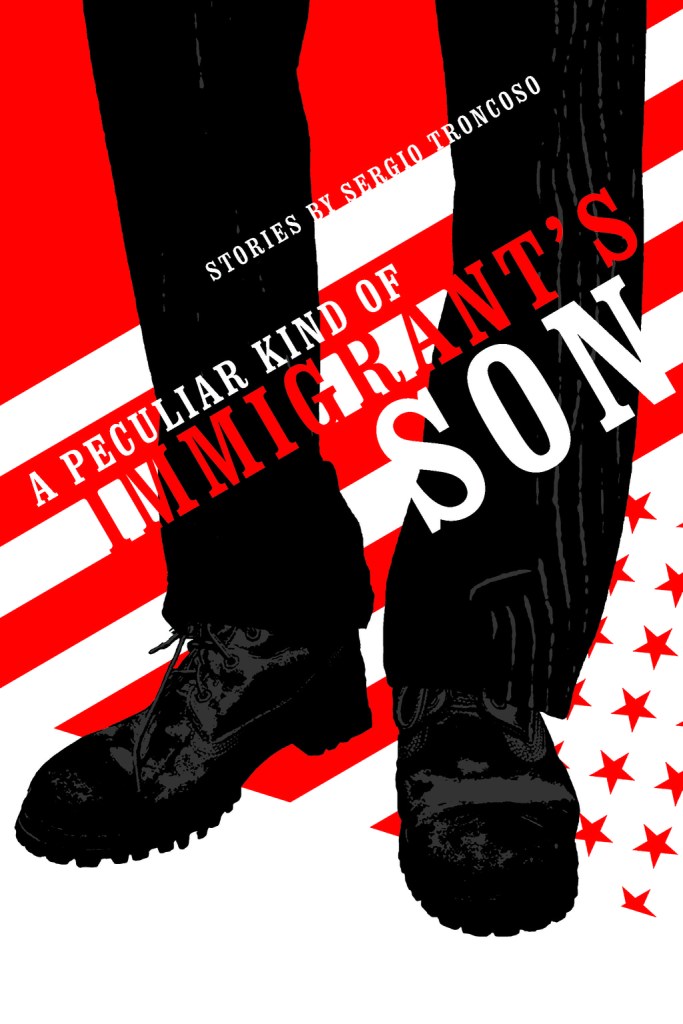
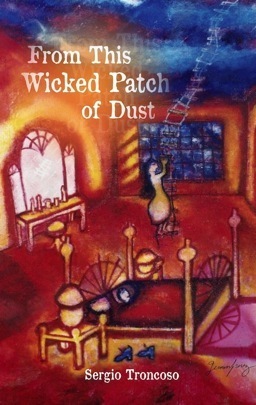
And Sergio’s new novel, Nobody’s Pilgrims, is what he had in mind as his “adventure novel.” It’s his attempt at something new, something he hasn’t done before. He wanted to write something suspenseful, but also something about immigration, poverty and the working class. His other books, such as A Peculiar Kind of Immigrant’s Son (Lee and Low, 2019) and From This Wicked Patch of Dust (University of Arizona Press, 2011) deal with similar themes, albeit in different ways. Nobody’s Pilgrims, however, is interestingly described as “a cross between The Adventures of Huckleberry Finn and No Country for Old Men.” Sergio wanted to write about people who don’t belong, and his novel follows three runaway teenagers— Turi, Molly and Arnulfo— racing across the country in a stolen truck. “One of the things writers are supposed to do,” he said, “is entertain readers.” He laughed and added, as if suddenly conscious of what he had said, “I know it sounds ‘sucky,’ but it is true.”

But one of Troncoso’s main challenges related to craft in Nobody’s Pilgrims was to write short, fast-paced chapters and a novel in which all the protagonists are teenagers. The book, unlike his other works, was not what he calls “pre-arranged.” His other novels were laid out and he mostly stuck to the maps he had drawn. He said, “I wouldn’t call it an outline. It was more like a map of a lot of paragraphs… and I sort of followed it with a few adjustments.” But with Nobody’s Pilgrims, he only knew where to start and where to go, but he wanted to allow a chance of discovery.

I went on to ask him at that point, whether he ever conceptualized his book a YA novel even though it is adult fiction. His publisher, Lee and Low, after all, mostly publishes children’s books although they have started to make forays into the adult fiction and nonfiction markets. Troncoso stated that the presence of three teenage protagonists doesn’t necessarily make it a young adult fiction. I agreed with Sergio and he asked for my opinion as a reader. I told him how I was reminded of reading Salman Rushdie’s books, Luka and the Fire of Life and Haroun and the Sea of Stories. I read those titles only a few years ago as an undergraduate, and my experience of reading them was not from the perspective of children’s literature or YA fiction. The same, I believe, is the case for Elena Ferrante’s books, I told Sergio. Her latest fiction, The Lying Life of Adults, is told from the perspective of a teenager and although the narrator of her Neapolitan novel, Lenù narrates her childhood and adolescence in retrospect maintaining a touch of her childhood and adolescent voice, they are not books for children or teenagers alone.

But what also interested me about Sergio’s new novel was his attempt to explore the psychology of teenage characters in the present and insert his own self into them. In his new novel, he goes through just a few weeks in their life as opposed to a long stretch of time. One of his characters, Arnulfo, is like a version of himself, he said. And Molly is the kind of character Sergio knew while he was teaching in Independence, Missouri. Most Mollys, he said, were from white, working-class families who are “poor, blonde and blue-eyed,” but who perhaps saw Sergio as an elite, Ivy-league educated man— he graduated from Harvard before receiving two degrees in international relations and philosophy from Yale, and was a Fulbright scholar. And Turi, on the other hand, is as an orphan who doesn’t have a family to fall back on and is trying to escape the border from a bad family. “The more you educate yourself and spend time away from your family or origin, the more you can’t explain to them where you are and what you’re doing. And I have felt that acutely.” The reason Sergio started to write was because he felt he couldn’t talk to anybody, not about the works of Plato and Aristotle, or about what he had managed to do with his life.

But Sergio maintains that growing up in poverty never really leaves one and there’s always an imposter’s voice inside him that speaks at times. “I’ve always felt a sense of fear. Maybe I haven’t done enough, maybe I don’t understand enough. Maybe Yale and Harvard made a mistake.” And it is these apprehensions that he tries to write into his characters. Sergio started learning the craft on the fly. He learnt it on his own, he says, and he admits that it’s a lonelier path to take, but the payoff, he thinks, is that it has made his voice all the more unique.

But Sergio is always working on something new. He was working on research for another historical novel set in Juárez about a young, seventeen-year old woman who led a protest during the Mexican revolution, but has largely disappeared from history. Based on his research, he has reason to believe that she was probably killed but the more he dug into her life, he realized he would have to create her end to make her life meaningful. He wrote a little bit about her in his linked short story collection, but he said the fervor is gone now, he said. “The Yale Writers’ Workshop and a few other things,” he said, “interrupted it.” He did a lot of research, but he’s just not so sure of continuing with it. Sergio often advises his students to write something that really excites them, even if they don’t know everything about it. “If you’re not excited, you should put it aside and do something else,” Sergio declared, ” and that’s the other thing about craft. You should enjoy it.” Sergio is very serious about writing but he emphasizes on having fun with it, not a purposeless kind of fun, not a fun that isn’t ambitious. But the kind of fun that makes you feel more engaged with the task at hand. Craft is time-consuming and any lack of energy, Sergio believes, is reason enough to drop it and switch to something else.

He said to me, “You are your best experience. You dig deep into yourselves, you see many different selves and many different versions of people in you. I always see myself as an experiment, a vehicle.” And Sergio is always experimenting with versions of himself. But as he were talking, I was interested in his idea of discovery— it is something I think of as a translator. You’re not just translating words from one language to another, you’re also aiming to translate their discovery and suprises and how you replicate your discoveries as a reader, that delicious suspenseful feeling before the discovery, is crucial to your task.

But Sergio cared about it being a conversation, and asked me a few questions about my own writing project and obsession with Ferrante. I told him how the novel I am working on is an auto-fiction and before I could pick his brain about inserting oneself into one’s story, Sergio immediately acknowledged that creating a fiction of yourself and putting yourself in a story is also about “putting yourself through a lot.” When he was writing Nobody’s Pilgrims, it was a departure from From This Wicked Patch of Dust, which was about a loving, poor family who could get to the United States primarily because of the love that existed among them in the midst of their poverty. But Nobody’s Pilgrims is different and focuses more on the idea of violence haunting innocence. It was born out of focusing on the reversal of some ideals, out of Troncoso’s own inability to speak to everyone. I was certain many writers can connect to that— so many of us write when we fail to speak. It sounds ironic, but it’s true.

“I feel like a turtle. My home is on my back, it’s wherever I am,” he said. Sergio is accustomed now to working by himself, to the loneliness of a writer’s life that only occasionally crosses paths with others. But he is a firm believer in the freedom that loneliness affords, the one to follow one’s mind and delve deeper into oneself that emerges within its sad but liberating confines. One of Troncoso’s early stories, he recounted, was about a twenty-year old man, Victor, who goes out with a Mexican woman he met in El Paso who is a decade older to him. That relationship made his character wonder about whether he’s Mexican or American. The very first scenes describe them in a moment of passion and Troncoso’s father, upon reading the story, said, “Sergio, what are you doing? Are you writing pornography?” We laughed and Sergio talked briefly about not censoring oneself, or not writing because of the fear of people around us. There’s often a pull to write the “right characters,” he said, but Sergio tries to resist linear or perfectly moral characters, not the “right” kind of immigrants or women for instance.

“A deep freedom of consciousness,” Sergio says, “is what writing is about.” “Damn even yourself,” he says and advises writers not to fall for their own proclivities, judgements and tendencies. He wants to ask the toughest questions of himself, as much as he asks them of others around them and that’s why he loves writing. He said, “Let me be blunt. I don’t even think I know myself.” It’s a huge admission to come from a writer, and it is difficult to do what Sergio wants writers to do: to turn the lens onto our own selves as we do towards others. In many ways, my first short story felt like a test of my ethics, I told him. I wrote that story because I was uncomfortable harboring the truth. It wasn’t a lens turned towards that person’s secret, but a lens turned towards my own self. Should I tell the story that belongs to someone else and how? How do I capture the ways in which their truth is as difficult for me to harbor as it is for them? How do I write a secret and still keep it?

But I asked Sergio about teaching writing which is, in my eyes, a difficult terrain that forces one to test one’s ethics and morality. And, of course, since I know him through the Yale Writers’ Workshop Sergio laughed and asked me to talk to his students. He calls himself a “tough” teacher. He pushes them a lot, he gives them exercises each day. He has his students doing exercises three weeks before the start of the workshop. “I believe if you work hard, you should enjoy yourself.” He wants to help his students realize their vision instead of forcing his own on them. His workshop, he says, operates like a group effort in service of writing before anything else.

And I wondered if he had other advice for writers. “You should be reading three books a week as a writer,” he said. “That’s normal pace for a writer, and frankly, you should be reading a lot more than that.” I think of the beautiful Urdu word, riyaaz. For writers, one of the most important forms of riyaaz is reading, and to make it less solitary, one should perhaps espouse Sergio’s definition of teaching: an effort to create a community. He tries to run the kind of workshop he wish he could have been part of. At Yale, he mentions how he meets students over breakfast and dinner and talks shop. His workshop outside the workshop too, and while it exists for the sake of creating beautiful work and working on each individual’s weak spots, he is also equally motivated to helping his students get a contract, get published in the best literary journals and prepare a serious piece of work to be shared with the world, .

When I asked him if there’s anything else he’s working on, or what’s going on in general in his reading and writing life, he revealed to me that he works a lot with his dreams and frequently dreams about his characters. At the moment, he’s thinking of a short story based on this one character who appeared in his dream, but he also wants to work on some essays. An editor, he told me, has requested a sequel to Nobody’s Pilgrims and around the time we met, he was reading Gogol’s Dead Souls and Chekhov’s short stories as a way of “replenishing” himself while “getting lost.” He loves writing by some Russian and German writers, and feels very connected to them and the time they lived in. He thinks of American literature as something “flimsy.” He thinks of George Saunders, for instance, as a great writer, but very few American writers, he believes, can stand the test of time. He mentioned Elena Ferrante as a truly great writer (which obviously brought a smile to my face) and he struck a nerve when he mentioned how he had to leave everything he learnt about academic writing behind as a creative writer. The mechanics of the two are rather different and it requires one to switch one’s brain, he mentioned.

Finally, towards the end of our conversation, he said “writers don’t talk about money, but they should.” Despite growing up poor, Troncoso told me he is adept at managing money. And writers, according to him, should learn how to manage money in ways that helps them build a life in which they can write and explore freely. “Writing a story needs a great deal of meandering until one gets it right,” he said, and money is an entity through which one can afford that luxury so the writing doesn’t suffer. In the last recorded sentence of our conversation, Troncoso said, “You don’t have to be lonely.” It is a reassuring thing to hear from another writer, particularly when, as Michele Filgate writers, writers are the loneliest artists of all. As we got up to leave, I told Sergio I could walk down a few blocks with him to the 79th Street subway station. People, I saw suddenly with Sergio’s words still on my mind, were everywhere. There were people coming out or walking into the subway, going into the stores that lined the streets. Nobody was truly alone, nobody had to be.


SERGIO TRONCOSO is the author of eight books: Nobody’s Pilgrims, A Peculiar Kind of Immigrant’s SonThe Last Tortilla and Other StoriesCrossing Borders: Personal EssaysThe Nature of Truth and From This Wicked Patch of Dust; and as editor, Nepantla Familias: An Anthology of Mexican American Literature on Families in between Worlds and Our Lost Border: Essays on Life amid the Narco-Violence.

Troncoso teaches fiction and nonfiction at the Yale Writers’ Workshop in New Haven, Connecticut. A past president of the Texas Institute of Letters, he has also served as a judge for the PEN/Faulkner Award for Fiction and the New Letters Literary Awards in the Essay category. His recent work has appeared in the Texas HighwaysHouston ChronicleCNN OpinionNew LettersYale ReviewMichigan Quarterly Review, and Texas Monthly Magazine.

Website: https://www.sergiotroncoso.com/

Don’t Stop Because You’ve Hit a Block: Unconventional Techniques to Spark Writing Inspiration

by Stephanie Gemmell

While all writers struggle to find inspiration from time to time, grappling with bouts of writers’ block can seriously shake your confidence as a writer. Many writers tend to think of their craft as an aspect of their identity, so facing writers’ block for an extended period of time can easily seep into other facets of life, causing self-doubt or artistic insecurity.

Gathered based on experience and other writers’ recommendations, these 15 techniques include suggestions for how to make authentic progress in your creative process and ultimately overcome writers’ block. While no individual writing approach or activity offers a universal remedy, these methods offer a variety of options to address possible root causes of writers’ block and foster inspiration.


Use the “Cut-Up Technique”

Popularized by William S. Borroughs and subsequently used by artists like David Bowie, this technique can provide writers with a hands-on, creative approach to finding inspiration. By cutting up an existing piece of writing and rearranging words and phrases to create something new, you may be able to spark unique and unorthodox ideas to use in your writing. The physical elements of practicing this technique can also enable your mind to naturally wander, further aiding the creative process.

Try a Guided Writing Journal

Guided journals can be useful to ensure that you dedicate some time to your craft each day, but they can also contribute to ideas for larger projects or creative endeavors. Trying a guided journal that focuses on your home genre or different genres that you want to experiment with can bring some form and structure into the writing process, helping you find a sense of direction as you explore new artistic territory. Another writer recommended Noor Unnahar’s Find Your Voice: A Guided Poetry Journal for Your Heart and Your Art, and it has been a simple, valuable resource to try new approaches in my writing.

Visit a New Place that Stimulates Your Senses

Traveling to new places, even within your local area, can be an incredibly valuable source of inspiration. Encountering new environments provides opportunities for descriptive writing involving all of the senses, and experiencing a place for the first time brings your mind into a greater awareness of your surroundings.

Change Your Daily Routine

Try changing your routine in the morning or evening and see how these shifts impact your mindset throughout the day. If you have a morning commute, consider changing your route or method of transportation for a day and see how this difference in your movement might differently inform your awareness of spaces around you.

Change Your Writing Routine or Environment

Having a consistent, familiar process and environment for writing can feel comfortable and reassuring, especially when embarking on a new creative project. But when you find yourself struggling with writers’ block or grasping for new sources of inspiration, writing in the same environment each day can seem to make your creative mentality stagnate as well. Writing in a coffee shop, outside in a park, or even in your backyard or balcony might open your mind to different ways of thinking and writing. Trying to write at a different time of day than you usually do could also trigger a rewarding shift in your artistic mindset.

Create Blackout Poetry

Similar to the cut-up method, erasure techniques allow you to seek external inspiration in other writers’ words. Blackout poetry can stand alone as an art form, but the process of creating erasure poetry can also be a source of inspiration for other genres of writing or art. In particular, if you don’t consider yourself to be a writer of poetry, this technique can showcase your own capacity to create in a new genre or provide you with distinctive phrases to carry into your other work.

Read Part of a Book You Wouldn’t Normally Choose

Visit a library or bookstore and choose a book off of the shelf that you have little or no interest in. Reading a chapter or even just a few pages could pique your interest, teach you something new, or introduce you to a topic or subculture that you had never considered exploring previously.

Write an Ekphrastic Poem or Narrative

Visual art can hold a powerful capacity to awaken latent creativity by engaging writers’ senses and imaginations. Writing a piece based on a work of visual art could provide you with a new way of approaching your work or introduce you to ideas to explore further in longform writing. Writing based on abstract art in particular can pose a unique challenge to open your mind to idiosyncratic ideas and unconventional ways of thinking.

Write to a Rhythm (Or Don’t)

Songwriters and poets who prefer to write in form often approach their writing with an acute awareness of prosody and the rhythm of language. But being attentive to rhythm in prose can also valuably alter the way writers engage with their work on the sentence level, offering an opportunity to uniquely engage the reader, sharpen dialogue, or diversify your writing style. As Truman Capote explained, “the greatest pleasure of writing is not what it’s about, but the music the words make.”

Conversely, if you frequently write using rhythm as a formal device, consider subverting your usual rhythmic techniques to write freely or bring greater acoustic complexity into your writing.

Force Yourself (Allow Yourself) to Free Write

Being a common exercise in workshops and classroom settings, free writing may be intimidating or uncomfortable for some writers. But seeking to write in an uninhibited way can directly demonstrate the power of vulnerability in your writing. Writing down your fleeting thoughts and ideas can enable you to more clearly see both their rawness and their value, allowing you to more effectively assess what ideas you want to expand and explore moving forward. If you already find yourself actively working on a project but feel stuck, free writing could enable you to get “words on the page” to revise and refine later.

Create Visual Art (Even if You’re the Only One Who Ever Sees It)

If you write and create visual art as well, these two artistic processes can overlap or naturally contribute to each other. But if you consider writing to be your exclusive creative pursuit, trying your hand at drawing or painting could serve as a source of inspiration that enables you to approach your writing from a different perspective.

Change Writing Formats or Mediums

Similar to creating in a brand new visual medium, experimenting with a new genre or format of writing could engage your creative mind in different ways. You could try writing descriptive poetry to incorporate into your fiction, or experiment with writing prose to later refine into poetry. If you write fiction that includes dialogue, try formatting conversations in a script or screenplay style to shift your perspective of the interplay between your characters’ voices.

Make a Collage

Collaging can be a relaxing method to open your mind to visual sources or inspiration—and an affordable way to create distinctive, personalized decor. Being attentive to the colors, textures, and words or phrases that speak to you can provide you with a greater awareness of your mental landscape or state of mind. Creating a collage can also be a useful way to create a hands-on representation of physical settings or emotional undertones that you want your writing to convey.

Seek out the Stories of Your Family and Friends

Talking to relatives and friends often opens new possibilities for both nonfiction and fiction writing. Older relatives in particular may have valuable stories to share about their past experiences, and these can provide you with inspiration while also offering an opportunity to document family history. Giving your friends an opportunity to share their stories or talk about their interests or goals can provide them with a platform for their voice and allow you to get to know each other better. If you plan to use these discussions to inform your writing in a direct way, it is always vital to be upfront about how you would like to utilize the content of your conversations.

Give Yourself (and Your Writing) Some Space

If you find yourself feeling uninspired or feel especially depleted in your writing, taking a break from writing for a few days could be what you really need to get back on track. While giving yourself some space from writing may feel unproductive, it could actually be what your mind needs to come up with new ideas in an organic, unforced way. You may return to your writing feeling renewed and naturally inspired, or you could be able to approach a different technique with greater mental openness. Either way, providing yourself with an opportunity to decompress creatively can jumpstart your artistic process in the long run and allow your writing to flow more freely.


STEPHANIE GEMMELL is a writer and composer currently living in Pennsylvania. Her writing has been featured in Just Place ChapbookCapitol LettersThe Ekphrastic ReviewThe Rival GW, and in the poetry anthology Falling Leaves published by Day Eight. She also attended the 2021 Glen Workshop as a poetry and songwriting fellow. She recently graduated summa cum laude from George Washington University with a BA in Religious Studies and minors in Journalism and Psychology. Her work is motivated by the unique power of art to ask meaningful questions and inspire authenticity.

Madness and the Inadequacy of Language in Swadesh Deepak’s ‘I Have Not Seen Mandu’

by Abheet Srivastav

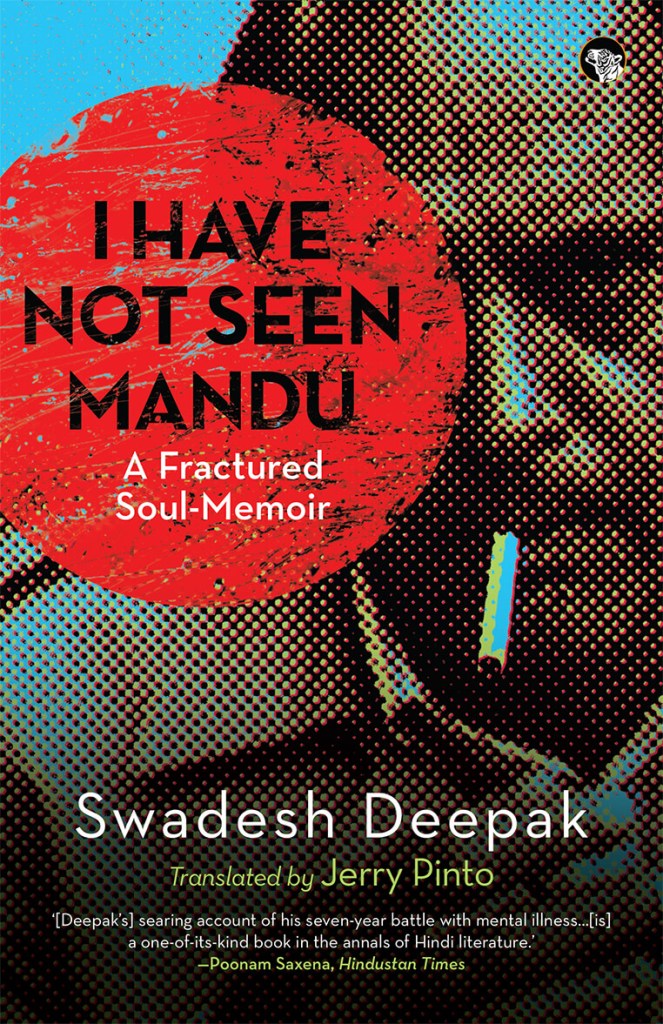
‘I Have Not Seen Mandu: A Fractured Soul-Memoir’ by Swadesh Deepak, trans. Jerry Pinto (Speaking Tiger Books, 2021)

“The rest is silence.”
-William Shakespeare

In the beginning of summer, when I read I Have Not Seen Mandu, I thought of this line from Shakespeare that Swadesh Deepak quotes in his book. Mandu is a book of loud silences. I wonder if this is one of the few books that chronicles the life of an individual with bipolar disorder in India, written by the individual themselves. Deepak is telling us that there is no language to communicate his experience. Beyond all that is written on page, the rest is silence. His is an attempt to breach the silence, an attempt to leave us with more of it.

In 2006, Swadesh Deepak went out for a walk in his hometown Ambala and never returned. This was the last book he wrote where he tried to present a collage of his seven years of mental illness. Jerry Pinto has translated the title from मैने मांडू नही देखा: खंडित जीवन का कोलाज, into I Have Not Seen Mandu: A Fractured Soul-Memoir. The second half of the title is not a literal translation, but it sums up an important aspect of the book by highlighting that this is a broken memoir of the soul. The body, which Deepak tried to abandon three times, does not have memories. It is the soul which transcends time, which remembers the dream that the body inhabited for seven long years, which felt the memories that are relayed in this memoir. Deepak himself puts it thus: “Memory lives in the soul and therefore the soul is immortal.” It was, and still remains, the assertion of that immortal soul. 

The question worth pondering, for me, was how do I begin to understand this fractured memoir? How do I inhabit this language, which is borne out of a lack, a madness whose central theme is its failure to be articulated? At the beginning of the book, Jerry Pinto, puts a caveat for the reader, “Where you think fit, add the word ‘perhaps’. For some unsettled memories are fractured.” Hence, we begin with mistrust, or maybe a warning of the fantastical events that will subsequently transpire. Against Swadesh Deepak’s gun with which we hunted his characters, all we have is a ‘perhaps’, rendering the space between language and truth infertile. 

The reader is presented with an interesting choice from the get go, which is absent in the original Hindi version. They are  provided with the ability to approach the book with suspended faith, as a clinical examiner would, adding ‘perhaps’ wherever necessary and thus staying within the bounds of sanity, separating the mad from the lucid, the dreams from reality and, in an extended metaphysical way, the realm of Swadesh Deepak’s body from his soul. This ‘perhaps’ supplied to us by Jerry Pinto adds an entire dimension which not just questions or saves us, but also opens up a whole new world for us–to interpret something that we don’t understand yet, to add a hint of indecision and remind us to not be too certain about our realities, to say that just like Swadesh Deepak, as we try to understand these fractured memories, we can add the word ‘perhaps’ where we see fit.

In a Hamlet inspired sentence, Swadesh Deepak writes, “There is no method in this madness.” As I begin to delve into this fractured memoir, the paradoxical need to understand the absurdity of the structure becomes the central tenet. Despite the lack of method, we need a spatial and temporal “method” to understand both internal and external events. Events which are fractured in time jump forth as isolated memories strung together with a thin thread. They offer the reader the challenge to allocate them in neatly defined temporal slots in order to make sense of it all. 

Spatially, the terrain of the narrative itself jumps between reality and dream. The lines between internal and external drama are often blurred. We move from the internal chaos to an external stasis. The temporal and the spatial tie into each other, as we jump between time and space, or are stuck in an elongated moment that refuses to pass. Often time flows linearly, with him stuck in his hospital bed. People keep arriving and leaving. While, at other times, time abruptly stops in the middle of a sentence and we are transported to different places and different realities. As we search for a “method”, this narrative style offers an insight into both the fractures in thought, and often thought itself.  It gives us, not an objective truth but an attempt to retrospectively reconstruct the thought process of a particular time. 

The other challenge in developing a method to understand this memoir lay in building a shared narrative with Deepak. In an intensely personal work, we share the truth offered to us. However, in a memoir of his meandering thoughts, we are not privy to all the details of the paths we tread with him. The reality we build around him is formless. He sits at a party and wanders off into his dreamland. The parking lot gives way to a fever dream of a stranger prophesying his death. Symbols present themselves in disjointed realities, with varying meanings. It hints at a broader theme, where Deepak is a reader of his own experience. 

While he tries to write a memoir true to his fragmented thoughts, he has to build within it a method with which it can be understood, not just by the reader but by himself. When he writes “But there, I was back from my frightening dreamworld. From dreams, in which I change form, change form endlessly, dreams which do not end or break or fracture until someone drops the curtain…” there is a need to drop the curtain to extend beyond this frightening dream world. The only method that we develop is to approach the fragmented reality on its own terms and when the curtains drop, to introspect about the frightening dream world that he has offered to us.

We are invited to take part in this fragmented reality, which is not just fragmented at a singular level of identity, but at multiple levels, which does not necessarily form a hierarchical structure or move in a fixed direction from outwards to inwards or vice versa. They form a chaotic jarring state that Swadesh Deepak is able to bring out through an honest account of his words. The fragmentation is visible at the outset with his body being a shared inhabitant of both the Psychiatric and Burns Wards. It enters into a linguistic relativity with him being torn between Hindi and English–the two languages he switches between, his multitudinal feelings for the Seductress who visits him constantly, and him dangling between life and death. His dreams are formless and his identity takes various forms in them. Sometimes he is a tiger, sometimes a hunter, sometimes the hunted, sometimes a bird in a cage, sometimes a wolf, and in certain moments of lucidity, a patient tied to his bed robbed of time.

The language of this fragmentation, of this divide that Swadesh Deepak feels within himself, is a space to meditate on the symbology of his language and to form a bridge to the internal psychological state of a person which is both limited and enabled by this language. Throughout the book, we get glimpses into the strained relationship of a writer with his own language and words. He calls English the language of lies, and yet in his most vulnerable moments of breakthrough, he switches to English. There is a threatening quality to English offered throughout the memoir. The language offers alienation and disdain, and yet demands reverence. It is when Deepak switches to English that everyone cowers down and listens to him and yet everyone, from the boy next to his hospital bed to his wife Gita, asks him to never use the damned language. Deepak himself reprimands his children when they show a disregard for Hindi and use English, and yet goes on to quote English authors to transmit some of his most honest emotions. 

The constant tussle between the two languages is present even in his play, Court Martial, where English is given an aristocratic, alien quality, that implies a disregard for the lived reality of the people of the country and yet some of the most sublime moments in the play is when English itself is employed against the colonial and aristocratic heritage it defends. 

Deepak complains of having lost his words and how his illness has not just taken them but his hands with which he held his pen. His break from reality, and its relationship with language comes forth: “When it is an incurable disease, we generally forget even the mother tongue, for one lives in a land of forbidden memories. That’s when we withdraw to a foreign dream world.” In this foreign dream world, the tether to one’s own language is broken. One has to inhabit a foreign language to emote and communicate. The untethered desires and memories need to be translated into a foreign language–the “language of the mad”, as he calls it–to be transmitted to the world. The manifestation of the disease, the Seductress, does not exist in Hindi. “Hindi has no seductress. The only way to talk about Mayavini is in English.” In this confusing relationship with the two languages, I wonder if the disease of alienation from oneself drew him to English more and, at the same time, made him hate it. The use of language by a writer could be a statement in itself, a way to communicate how it feels to be stuck in a self that feels untethered.Yet, we cannot be sure if this is the exchange of one language for another or a hatred of the limited nature of language itself. All language eludes him. He confesses to Giridhar Rathi, when asked to write about his illness, “I don’t want to write about my illness. I don’t remember the events in any order.” Lost in time, there is no language for the spaces he inhabits: “We are international citizens. We have no language.” His distance and unease with literature is also filled with duality. He talks about writers and artists extensively, and then goes on to lambast them. He quotes everyone from Plath, Shakespeare and Eliott to Nirmal Verma, Soumitra Mohan and Faiz, and then writes, “Now I will not sin by reading. Wisdom destroys.” Perhaps, in one of his lucid moments, when asked to talk about his illness, he acutely sums it up: “What do I say? What do I tell you? Words have become enemies. They punish me.” With dreams that cannot be translated, he has to rely on the words of others and a foreign language.

In the foreign dreamland, there are ominous signs of an impending disease. This dream reality carries meaning. Symbology of his dreams comes forth in various forms. He is always looking for signs. Just like the reader’s attempt to establish a method to this madness, these disparate symbols are also an attempt to emote something of value to us. He is enraptured by a Seductress, who he first finds after the premiere of his play Court Martial, in Calcutta. She asks him if he would come to Mandu with him, and he insults her in return. Thus starts the fall, the revenge of the Seductress on Swadesh Deepak. The Seductress appears with three parrots. 

When he meets Arun Kamal at an art exhibition and watches the paintings, he recounts looking at a particular painting. “When I asked Arun Kamal about it, he said: Swadesh, I don’t know much about painting. In our folk tales and fairy tales, we always have parrots. They are never female. For the epitome of beauty is always masculine, never feminine; and a female character always wants to bring a beautiful male character into her control. And if she can’t find a man then at least a symbol, the parrot in a cage, will do.” I wonder if each of those parrots is a life offered to Deepak. Having tried to kill himself thrice, he tries to fly away but is captured again and again.

 It is often difficult to decipher if the Seductress is a metaphor for his bipolar disorder or if he was literally haunted by a seductress. I carry both interpretations in parallel as they both together offer a richer view into his inner life than either in isolation. The Seductress becomes a common recurring symbol, which prompts us to ask various questions. Why is the Seductress a woman? Why is the Seductress intermixed with symbology of animals, with birds and leopards? What is the relationship of the Seductress with his impending death? What is the significance of Mandu? When we approach the text, with all these questions in our mind, several symbols jump forth. With most of Swadesh Deepak’s literature filled with violent, male-dominated, testosterone-filled characters, the presence of a woman as both an object of disdain and desire, offers us an avenue to investigate this dialectical relationship. 

In his conversations with the Seductress, he alludes to the trope of the femme fatale, recounting the tale of Helen of Troy and Draupadi. He is misogynistic, and yet finds himself surrendering and belonging to the seductress. He often gives into his lust for the seductress, and finds books on tantric sex in her bookshelves. He is often torn between his immense desire and hatred for the same thing, where he both longs for her to arrive and yet knows that her arrival means his demise. His lust for her often rises to a spiritual sense of oneness and yet shows a lack of religiosity in his life. In his conversations with Nirmal Verma and his repeated allusions to disenchanted Gods, I wonder, if in all his disillusion, he did search for a broader faith that he could hold on to rather than this dangling, constantly oscillating desire. 

It makes sense, even when I extend this to a metaphor for mental illness, where mental illness manifests itself as a mystical being—a being he could not make sense of properly and yet he engaged with it in an integral and complex relationship which lies beyond words. The seductress, at the same time, also occupies the complex terrain between life and death in which Swadesh Deepak finds himself. On some days, the seductress wears a white sari and sings a dirge in his name, whereas on other days, she appears as a three-breasted deity, which might be an allusion to Meenakshi, the three-breasted goddess of fertility. She plots revenge on him and then cradles him in her arms and offers the only tether to belong in this world. 

The symbology of the seductress also hints at the fragility of the machismo he inhabits. This space between life and death is not just inhabited by the seductress, but also premonitions and prophecies. Most premonitions offer a feminine character to the impending doom. When he meets Faiz, he is told, “You will suffer at the hands of women. But why fear? Mirza too suffered much. May Allah protect you. But you are fated to suffer.”, while Amritlal Nagarji tells him, “Swadesh, beauty can often be dangerous….you will be destroyed. Be careful. Be watchful.” In yet another conversation when he travels to Madhya Pradesh, Malay diagnoses his illness as a fear of his machismo being shattered by the non-Hindi speaking audiences of Calcutta, at the first screening of his play Court Martial. In most of his plays, the characters are violent and loud. He is touted to chase his characters with a gun. In the language of his illness, those characters return, seeking revenge for their death. There are limited moments of tenderness, in a disease that has an immense requirement of it. Rather, all tenderness is suspicious. The moments of tenderness are also displayed as distant, acts of sympathy or through self absorption. 

I am never sure if the misogyny and the fragile masculinity is a quality of Deepak himself, or a disease that negates all classically feminine traits, until they arise from the disease itself. However, it does hint at the deeper malaise of the ingrained machismo and the inability to ask for help when brought up in a deeply patriarchal setting. This violent machismo also appears in his description of the Seductress, where he oscillates between conquering her or being destroyed by her. It is in his moments when his machismo falters, that he lets her cradle him and ask him to come with her. And yet, later, in his moments of rage he detests his supposed weakness. In a lot of ways, it opens up a conversation about mental illness in men, and how patriarchy can make it an incredibly violent struggle, both physically and psychologically.

However, the symbology extends beyond the seductress, where premonitions and prophecies abound. A strange man meets him on a lonely night, and tells him first in English, and then in Hindi, that he will die. The wind knocks against his window and whispers to him. He moves in pictures, and the pictures talk to him. The sparrows and the Jungle Babbler, arrive in groups of seven to narrate his death to him. He is warned by the likes of Faiz, Amritlal Nagarji, Ranjit Kapoor and Abrahim Elkazi about his future. Death is represented in all his dreams. He travels to the space between life and death, where tigers abound and recite the poetry of Nirala, and W.B. Yeats makes friends with him in heaven. Leopards arrive along with the Seductress, and he chases them in his dreams, and is chased by them. He is both the hunter and the hunted. He sees horsemen in his dreams, which might be an allusion to the Four Horsemen of the Apocalypse.

In chaos that exists in his mind, there are still moments of lucidity. There are moments when Swadesh Deepak, the English professor, the radical playwright with his sharp critique on social issues, and the gifted writer is on display. He talks to his son Sukant and opens up to him about his mental illness. There are moments where he realises his own lack of power with his debilitating condition. The subject of the societal treatment of the mentally ill, though scarcely addressed, also presents itself in a conversation with his doctor who talks about how no one understands the illness properly and there is no language to talk about it in India. In another instance as Deepak sits in his home, an unemployed man working on his next book, we are shown his existence as a non-entity. It is a depiction of the resources and the respect that the mentally ill lack in our society.  Perhaps, that is why he could not find the right words, the right metaphors, in his own mother tongue to talk about his state. Maybe our mother tongue still lacks the accurate vocabulary to talk of mental illness, to discuss it with our close ones. That is why his attempt to create literature out of his experience becomes even more significant. 

I am reminded of a line of Soumitra Mohan he quotes, “भाग्य कहीं थमा हुआ है। (My destiny is stuck somewhere).” Swadesh Deepak offers us an insight into the complex life of an equally complex man. All I have is to offer theories and methods to understand a part of his experience but beyond all these analyses, all the literature he left behind for us, he teaches us empathy. He leaves us with an intensely human experience, creating a place where we can suspend our belief and exist in contradictions. A place where we can try to open conversation not just about mental illness but the nature of reality in itself and how the imagery processed by the human mind can create such a unique piece of work.


ABHEET SRIVASTAV is an analyst working in the field of Artificial Intelligence, and an avid reader. Always curious, he likes to learn about everything ranging from philosophy to science, and is always tinkering with both ideas and products to create something of value. His work has appeared in The Medley, an anthology of short stories, and various online platforms.  His writings can be found on his Instagram account @abheet_srivastav, and also his monthly Substack newsletter Figuring.

Book Review: Streaming Now by Laurie Stone

By Stephanie Gemmell


Postcards fulfill an impulse to share our experiences, concisely capturing moments in time and carrying brief messages to people in distant places. Now, postcards also tend to represent a sense of nostalgia, conveying some appreciation for an apparently simpler time.

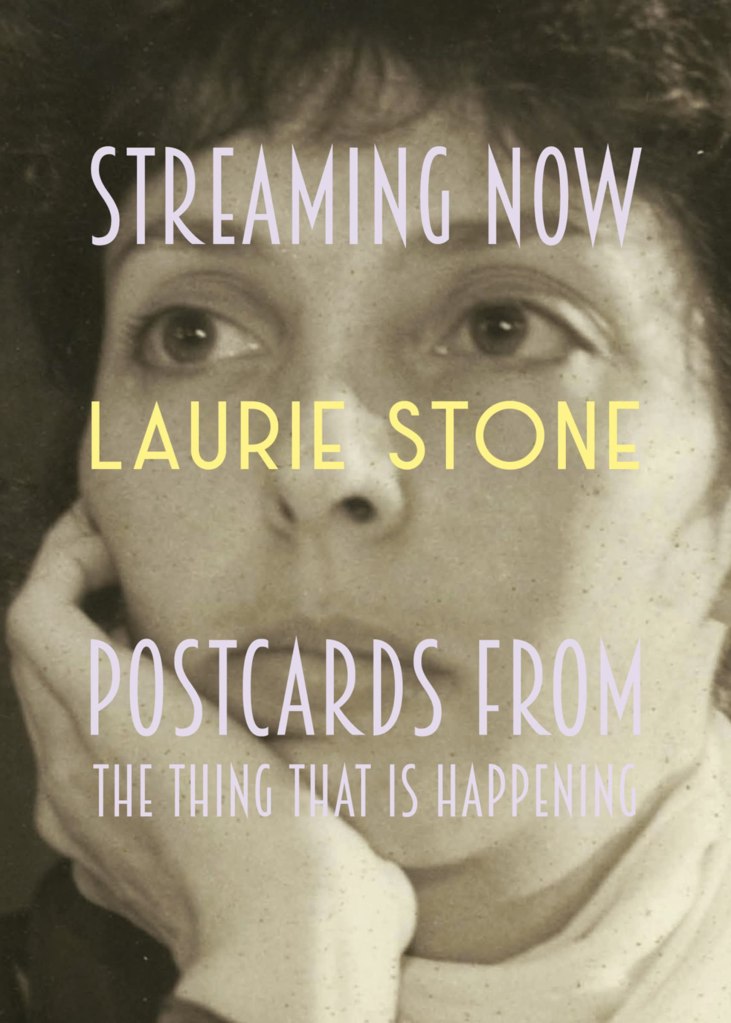
In Streaming Now: Postcards from the Thing that is Happening, Laurie Stone’s writing reflects both a motivation to share her ideas and an appreciation for the past. Stone documents her experiences, thoughts, and seemingly random musings from the pandemic, along with some particular memories of her life before its descent.

The “postcards” that make up the book sound and feel like fleeting thoughts grasped just long enough to be put on paper. Many of Stone’s dispatches come from a place she calls “Pandemica,” viewed unsympathetically from her vantage point in Hudson, New York. She addresses a wide variety of topics, in no particular order, realistically capturing a steady stream of thoughts and ideas.

Stone recounts in detail the films and shows she watched throughout the worst of the pandemic. She unabashedly expresses her views on the value and necessity of feminism in frank personal terms. She candidly addresses loss: the death of her sister, the experience of caring for her dying dog. She questions the role of abstract language in the pursuit of social change. She describes her impressions of her early writing career and recounts the details of some gigs she worked as a caterer.

Some of Stone’s paragraphs flow seamlessly through intertwined topics. Others abruptly traverse chasms between disparate subjects. This unpredictability in structure conveys a pervasive sense of movement that evolves throughout the book. While this organizational element of Stone’s approach to the book can prompt confusion or unease in some places, even these reactions seem to support Stone’s intent. Stone shifts topics from sentence to sentence in some places, resulting in a stream of consciousness narration that feels authentic and artfully unedited.

The strength of Laurie Stone’s writing lies in her capacity to integrate evocative description with striking frankness and concision. Even the shortest paragraphs in this book embody Stone’s literary vitality and her palpable resistance to the weight of the pandemic. Her specific yet relatable narratives about mundane activities—buying plants for her garden, partaking in Zoom events, accidentally eating too much of a marijuana gummy—become increasingly engaging based on their apparent randomness and sheer number.

Stone’s writing in Streaming Now bluntly captures the complexity of life, as she details events ranging from the unremarkable to the life-altering. Based on what she includes, Stone’s forthrightness in this book serves less as a literary device than an effort to build real trust with the reader. 

Stone’s writing reflects the value of taking the time to freely capture thoughts as they come, honestly and without inhibition. As a whole, Streaming Now implicitly challenges readers to draw up vivid mental postcards of their own experiences and memories.


STEPHANIE GEMMELL is a writer and composer currently living in Pennsylvania. Her writing has been featured in Just Place ChapbookCapitol LettersThe Ekphrastic ReviewThe Rival GW, and in the poetry anthology Falling Leaves published by Day Eight. She also attended the 2021 Glen Workshop as a poetry and songwriting fellow. She recently graduated summa cum laude from George Washington University with a BA in Religious Studies and minors in Journalism and Psychology. Her work is motivated by the unique power of art to ask meaningful questions and inspire authenticity.

Book Review: The Lustre of a Burning Corpse by Anureet Watta

by Priyanka Chakrabarty


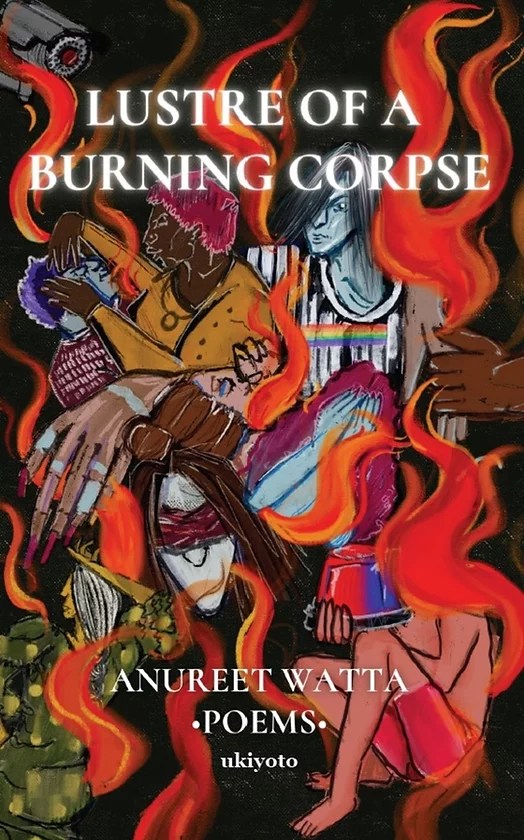
Queerness is a lesson in knowing that survival is both an act of violence and a form of self-love. In Sexualness by akshay khanna queer lives are described as “bare life of bodies” where they emphasize the untranslabitlity of being human and its fragile condition. Anureet Watta’s debut poetry collection The Lustre of a Burning Corpse, examines these bare lives of bodies that are subjected to the violence of existing, carrying grief and hope simultaneously. 

Audre Lorde, in her seminal essay, “Eye to Eye: Black Women, Hatred and Anger,” distinguishes suffering from pain. Suffering is unscrutinized pain that festers like a wound. Pain is recognizing the festering wound of suffering and providing it with language. In the poem, “Where do you put down the scream?” Watta names pain as “holy agony” and asks, “What would/I be when I do not have this holy/agony to keep me company?” because “It keeps me company, the way a pebble/in a shoe, an itch you cannot reach/does.” There is an intimacy with the “holy agony” of knowing pain and carrying it like a scream. Pain often looks like anger, like a scream. After all, it is much easier to be angry than to be hurting.

The agony further stems from violence that is both personal and political. Watta writes, in “The Government has it Under Control”: “the postcard I write to my lover,/the prime minister licks the stamps for me,/the home minister checks for grammar”. These lines keenly emphasize the discomfort of being aware of the voyeuristic gaze of the state. The power vested in it is so deep that its presence is felt in the innermost sanctum of our love and the language we use to communicate. They further write, “Who wore it better, lets find out:/The prime minister’s sherwani/threaded with blood,/or the home minister’s boot,/caked with graveyard mud?” in the ironically titled, “Country of Non-Violence.” Watta’s poetry stems from the acute awareness of autocratic power and the violence it wields. The imagery presented is vivid, driving home a brutal point about the relationship of despotic power with bloodshed.

The collection is a roadmap of violence in its various grotesque and benign forms. There is the unending violence of the state masquerading as security, obsessed with safeguarding honour and mitigating shame. There is the violence of constantly finding oneself erased and invisibilized. How do we then survive, live, and bear witness to our lived experiences? In “We Swallow the Sun to keep from Stuttering” Watta writes,

“You have never longed to be understood

just acknowledged, 

under kinder skies and with undoubtful eyes 

but until then, 

I’m here, and I’m not really a hug person, 

but I think we can both use one.”

There is also a quiet form of violence that queer people reserve for themselves, like an arsenal for emergency use, in case they momentarily forget the normalized threshold of violence that constitutes their lives. It is discernible in the lines, “You have never longed to be understood/ just acknowledged.” To be understood and acknowledged is to belong so here is an attempt to belong in the face of the intrinsic violence of erasure. 

Poetry carries the crucial burden of witnessing. It carries the weight of testimony. The act of witnessing is fraught with the power dynamics of the one who suffers and the one who witnesses. This act is exploitative at its core when suffering is performed for the benefit of the observer. It becomes sacred when there is surrender and the binary of the witness and the witnessed collapses. As Watta says, “We are, after all,/ the truest reporters of ourselves.” The self they behold is always on the verge of being consumed and at the brink of this annihilation is the voice of their poetry. 

Watta stands witness to the lives they have lived as a queer person as well as the lives they couldn’t live or weren’t allowed to, holding themselves, all their selves, with tenderness and mercy. In “Poet as a Tragedy,” Watta pens one of the most powerful lines in this collection, “I learn the necessity of consuming yourself,/in exchange for an allegory.” They further say, “Mostly, I write, in fleeting moments of power I do not kill/myself/Mostly, I self-sabotage and wait for the poem./This must be how it works.” Poetry has always remained the domain of cis-het white men who are still taught in classrooms as canons. Poetry is fraught with romanticisation of tragedy, usually accompanied by the image of a brooding poet, taking long walks. This element of tragedy is rarely a lived experience. “Poet as a Tragedy” is a masterful subversion of this imagery where tragedy is not a convenient trope but rather varying shades of lived experience guised as a poem. Poetry then is a barter with life, which arrives in moments of self-sabotage, an attempt to live where moments of power are rare and fleeting. 

Watta’s poetry brings to us the redemptive power of language. In “Body Without a Border,” Watta writes, “To commit something to memory is to protect it from the/filth of touch.” The private shrine of memory is sacred. Watta tests language to measure queerness and mocks its inadequacy to map the terrains of desire and intimacy etched in memory and shrouded in silence. “Our imaginations are so revolutionary,/I refuse to sell then to authenticity,” they write in “Cinematic Imagination.” Language as a tool belongs to the powerful who determine the narrative that dominates public imagination. Queer lives, in this power structure, are written about as subjects of interrogation and curiosity. Our lived experiences constitute educational awareness material meant to convince people of our existence. Watta supplants this usage of language from a patriarchal, heteronomative gaze which showcases “realities.” Dry witted, they write, “No, I do not want to know about the part where/the lesbian commits suicide,/I was there when she did it.” They directly challenge the gaze that curates queer realities for an audience where valorisation of death is the only option. The narrative where queer lives are reduced to a shadow, and eventually a dead body, is an old misguided, even malicious, trope that long lost its charm. Instead, Watta draws our attention to queer joy and the horizons of imagination that contain possibilities of revolution. 
Carmen Maria Machado in In the Dream House writes, “When the historian of queer experience attempts to document a queer past, there is often a gatekeeper, representing a straight present.” In Watta’s poetry I meet that historian who is documenting a queer past, living a queer present, and imagining queer futures. This documentation is unlike the history of victories and conquests. It is a meticulous collection of intimacies, with one’s self as well as with lovers and beloveds. I often witness the gatekeeper and the straight present, it lingers in this collection too, but Watta grazes against it in anger and humour. The voice of a poet drives poetry. It is what remains like a resounding echo long after the words have been read. After the last page is turned, Watta’s voice lingers in all its anger and tenderness.


PRIYANKA CHAKRABARTY is a neuroqueer person and law student based in Bangalore. She aspires to be a human rights lawyer and is an avid reader of fiction, non-fiction, and poetry. She has been writing in the genre of creative non-fiction and is a literary contributor with The Chakkar. Her works have been published with Phosphene MagazineInklette Magazine and The Chakkar. She is a bookstgrammer and regularly documents her reading journey on Instagram: @exisitingquietly.

Book Review: ‘Dominant Genes’ by SJ Sindu

by Akilah White

Dominant Genes by SJ Sindu (Black Lawrence Press, 2022)

I was born by the ocean an island child

the core of me salt water and seagulls howling

As an island child who imagined conifer trees by an oily harbour in my hollowed core when I lived in a foreign mainland, those lines from the poem ‘Gods in the Surf’ were a recognisable code. Growing up in a tourist town bore out an affinity for writers who situated beaches within the locals’ quotidian patterns, the water-borne histories that often connect island states to colonialism and imperialism, rather than the popular image of idyllic pleasure sites. In Dominant Genes, a hybrid collection of poetry and nonfiction, SJ Sindu, a Tamil diaspora author in Canada, reconfigures dominant concepts about place, family, love, gender and sexuality, religion, and herself. She restories how they can be, how they are, and how she is in the world, considered through an exploration of familial and cultural inheritance.

This latest release made me mentally kick myself for letting my copy of Sindu’s debut novel Marriage of a Thousand Lies (2017) languish in the cloud unread. Readers who have followed her writing since then will be familiar with the bright thematic threads spun into the present: How do queer Sri Lankans navigate relationships with themselves, their matriarchal families and community marriage market? What is British colonialism’s impact on indigenous ontology and understandings of Hinduism that obscure its visiblly queer gender and sexual narratives?

The “I” appears often in what Sindu acknowledged to be a directly autobiographical work but the “I” does not stagnate in a limited individualism. To give the work a genetic framing necessitates a focus on self in relation to others. The “I” shifts to “we” in critical thematic pieces in which spatial, temporal, and spiritual boundaries are permeable pathways to consider inheritance: what legacies are within the writer’s power to claim, to reject? Recognising an ancient epic’s unique mutability in its hold over collective consciousness, Sindu restories mythic figures to pose potent questions about epigenetic endowments like anger and violence which are not easy to avow or disavow. 

In the poem ‘Sun God’, Sindu imagines herself in tandem with Karna through framings that implicate her Tamil identity. He is not the chosen one and “…his real story is one of self-destruction” where he ends up on “the wrong side of a holy war”. The speaker sets one of her childhood memories alongside an imagined “little Karna”, asking “bad questions” about identity. His is about perceived godhood, hers about perceived righteousness. 

Whether obliquely or directly addressed, the Sri Lankan civil war that started in 1983, four years before Sindu was born, underpins much of who and what she explores in this collection. Heritage—cultural practices and intangible ideas embodied in offspring across generations—becomes that much more of a contested territory for a displaced people driven out by targeted violence. 

if one man’s freedom fighter

is another man’s terrorist

then are we on the wrong side of this war

But a soldier with a weapon in hand is not the first figure to mete out violence on the page —it is the author’s mother, threaded needle in hand, in ‘The Birth Story’.

My mother, out of love, stitches up my heart, pulling the thread tight to make sure it won’t rupture again at the same spot. My heart is defenseless, ready to come undone at the next crisis. While she’s at it, my mother stitches up my mouth, too, and turns her needle and thread to my brain.

The author is disembodied, represented only as cavity and viscera, vulnerable, in a “birth” that recalls Dr. Frankenstein and his creature. In ‘Dominant Genes’, the last poem, there is a memory of Sindu as a child unknowingly taking advantage of her mother’s ophidiophobia to terrify her—a “favourite pastime” because it placed the mother within the child’s power. The two poems frame the power struggles in a fraught relationship that straddles the entire collection. The glimpses offered into their personal history encompass a mother who denies her gender queerness through the policing of her clothes in ‘Draupadi Walks Alone at Night’, dismisses her love for a woman as a “phase” in ‘Mother’, rediagnoses her depression as “weakness of character, stress, overwork” in ‘Parental Love’. The lens expands to include the aunties, active stockbrokers in a now globalised marriage market conducted online as well as in person. For to be perceived as a single young woman is to ceaselessly exist on an auction block under their commodifying, dissecting gaze – “My worth measured in pigments and strands.” 

Raj Chakrapani, a poet, filmmaker, and professor, in conversation with Sindu for The Rumpus in 2017, probed at the deeper reasons for Sri Lankan parents “obsession with marriage” beyond the typical assumptions, especially those who were war refugees. Sindu answered: 

“I think marriage for many South Asian parents becomes the embodiment of tradition and of maintaining that cultural link back to the homeland. […] The other part, specific to Sri Lankan parents, is that marriage and family are signifiers of security and support. And as people who have experienced war, they know how important the security and support of family can be to survival. When the world turns dangerous, who can you trust? Who can you rely on to protect you? A nuclear family is a great solution to that problem. And at the center of that is a happy marriage, according to traditional views of family.”

Yet, in this collection, Sindu never entertains the notion that her feminism and queerness renders her as other in relation to her culture. With the evocatively titled “Draupadi Walks Alone at Night”, the longest of the mini-essays, Sindu pins Draupadi’s story at the centre of the Mahābhārata to map and sequence the patriarchal norms embedded in its narrative code, and how it connects and reinforces the objectification of and violence against femmes, whether cis or genderqueer, detailed in varying degrees throughout the collection.

‘To all My Suitors and the Aunties Who Send Them My Way’ the family’s treatment of Sindu as a child creates an image that recalls divinity. “…my aunts and uncles took turns fanning the [chicken pox] sores with bundles of curry leaves so I wouldn’t be tempted to scratch”. That touch of the divine appears in Draupadi’s story, her birth a prayer granted to Drupada, her father, to aid in his revenge plans. To help grant his desire, she participates in his plan to make an advantageous alliance via marriage. At no point is the reader given the impression that Sindu felt any true desire to do the same, there was a period during which she met with “potential suitors” from the belief that her parents’ mental health depended on her performing conformity, however limited. Draupadi ends up in a polyamorous marriage to five brothers not by choice but through her mother-in-law’s mistake. Yet not even five husbands could protect her from abuse and public humiliation—indeed others cite it as the reason she deserves it—and so she has fallen from a created feminine virtue. As an example of the most extreme practices to uphold this ideal, in an earlier section the reader learns that women are forced to marry their rapists in parts of rural India.

Through this and poems like “Sun God”—about Karna, who called Draupadi a “whore”—Dominant Genes becomes a part of a centuries-long previously mentioned tradition of reinterpreting the ancient Sanskrit epics to sustain its relevance to the ever changing times. At the end of the essay, after detailing the extent to which Draupadi and so many like her are wronged, Sindu names what she desires for them all: anger. Not just the intergenerational trait “folded up in the pleats of sarees”, sucked through breast milk, as mentioned at the beginning—the anger she tries to exorcise through haircuts, the anger her mother tries to quiet through prayer. She wants a transformative anger that can destabilise and rebuild worlds. She morphs the thread imagery in ‘The Birth Story’ from her mother’s oppressive, confining intent to one that rage cuts through to unleash its creative generative possibilities. Sindu herself can spin it into her own protective boundaries, reconciling not only the differences between her mother and the writer-offspring, but also the different selves within the writer.

Is it fair to say that hybrid collections such as this are trending in the literary marketplace? True or not, they are my new favourites, especially ones like this where the combination of two writing genres, poetry and nonfiction, reflect the theme of twoness in the collection as coexistence and conflict. On average a little over a page long, the essays’ brevity and internal associative logic forced me to break their hold to remind myself which ones were the poems. It may not sync with the author’s categorisation but a more traditional or relaxed adherence to writing conventions proved the easiest tells. The poems feature a very limited use of capitalizations, except for proper nouns in most instances, and a few commas or colons for specific clarity. This sharpened meaning in poems like ‘Gods in the Surf’ that revolve around the different locations—“America”, the “Gulf” ocean—and the different meanings they hold, and in the silence of the landmass that is not named except in geographical terms. It also offered Sindu the freedom to play with how language creates meaning. With little punctuation, reading the poems aloud encouraged a sensitivity to rhythm and proximity to discern meaning. A stanza could be a complete statement on its own or it could be split, a part of it easily read and understood as belonging to the next. From ‘How to Survive a Pandemic’:

these were the happy days

before the plague

and then after

it was out of necessity

is what we tell ourselves

giving up our skin

was the only way we knew

how to stay inside

and still be human


In the title poem, Sindu traces her “serpent-tongue” through her “foggy ancestral memory” to her snake worshipping ancestors. She names it both a “gift” and a “liability”, the latter word weighted with its own ambiguity in this context. Who or what does it put at a disadvantage? Is that a bad thing? Her mother’s instruction to “write nice stories” is received as a move to cage her tongue, a negative image. Yet Dominant Genes shows Sindu’s awareness of the risk that comes with any kind of destructive power. Book marketing language can enervate overused words but I hope some of mine conveyed what courage, what rebellious love lives in this text. May it be a literary heirloom to families born, found, and yet to come.


AKILAH WHITE is a Jamaican freelance book reviewer and sensitivity reader living in the shark’s mouth. Her writing has appeared in The Book Slut, Rebel Women Lit Magazine, and Intersect‘s Caribbean Queer Feminist Stories Vol 1 amongst other venues. When not doom scrolling on Twitter she bookstagrams at @ifthisisparadise

Discover poet-lyricists: Artists embodying the relationship between words and music

By Stephanie Gemmell

As distinct art forms, poetry and lyrics remain inherently intertwined. While many artists focus their energies on one or the other, some poets and musicians naturally express themselves through both mediums. For these artists, the different facets of the creative process seem to energize one another, supporting the development of new creative approaches and enabling writers to cultivate their most open and authentic voices throughout their work.

To highlight songwriters whose work traverses and transcends the boundaries between lyrics and poetry, I chose 10 artists whose work reflects different musical genres, poetic themes, and personal perspectives. Organized in no particular order, these artists vary widely in terms of their creative career trajectories and their development as musicians. Many of these writers have powerfully influenced my creative process as a writer and composer, and I feel confident that the same is true for many others as well.

Despite their differences, all of these artists palpably demonstrate authenticity, honesty, and openness throughout their work, making their artistic contributions especially valuable. These creators also display courage through cultivating their own unique voices, reflected in the distinctive nature of their words and music. More than half of these artists have also produced visual art in a variety of formats, further embodying intersections across creative mediums.


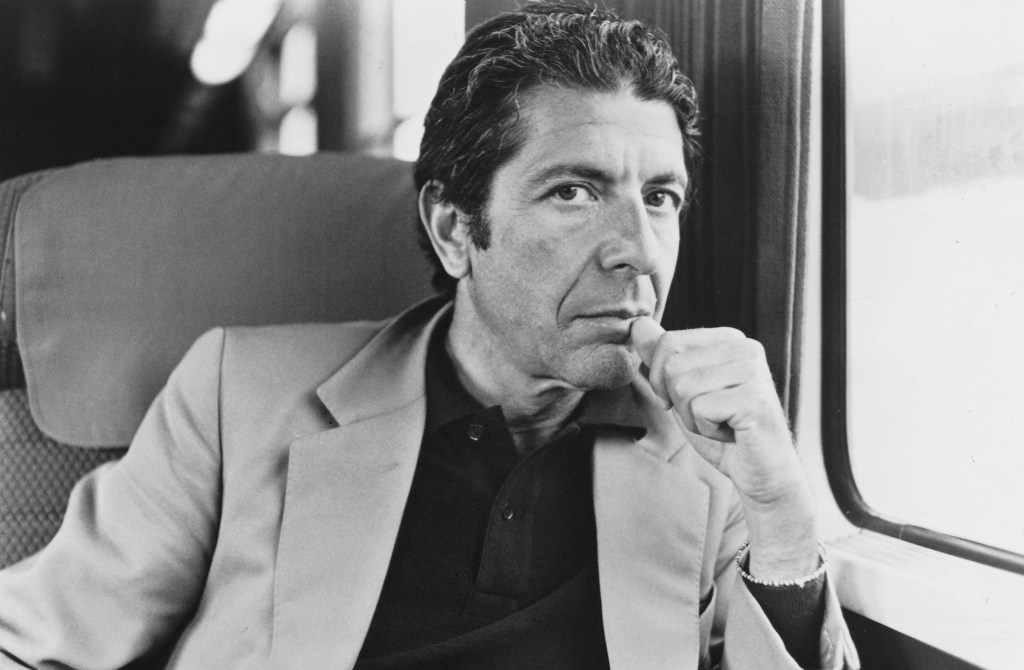
Leonard Cohen

Leonard Cohen famously embarked on a musical career at the age of 33, having already published poetry collections and two novels. Despite his relatively late start in the music industry—or perhaps partly because of it—Cohen became an eminent singer-songwriter, releasing 14 studio albums between 1967 and 2016. Cohen’s fifteenth album, Thanks for the Dance, was also released posthumously in 2019.

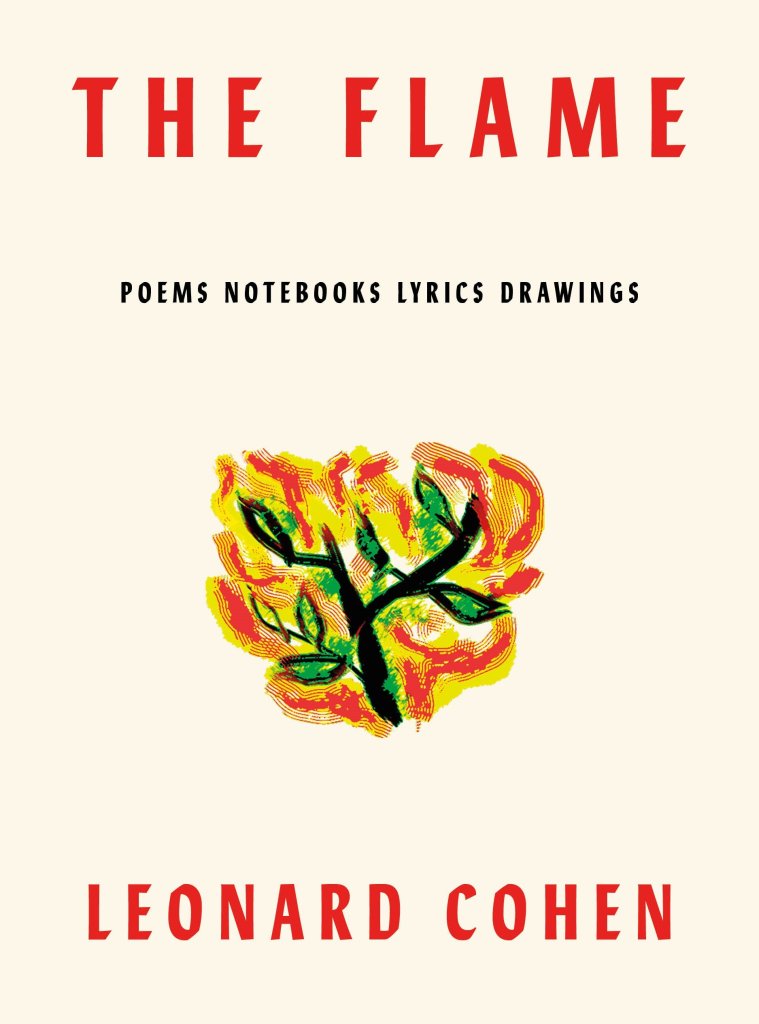
The distinctive literary voice that Cohen cultivated throughout his life echoes through both his lyrics and his poetry, contributing to a powerful catalog of music as well as multiple poetry collections. Most recently, Cohen published Book of Longing in 2006, and it included his first published poetry since the publication of his collection Book of Mercy in 1984. Following Cohen’s death in 2016, The Flame, a collection of poems, drawings, and journal entries, was published in 2018.

In discussing his creative process, Cohen tended to emphasize the length of time he spent drafting and revising individual songs. “The only thing I can say is, a song will yield if you stick with it long enough,” Cohen explained in an interview. “Usually, I take a long, long time – partly because of an addiction to perfection, partly just sheer laziness.” Despite his self-effacing remarks about his unconventional creative process, it remains clear that Cohen’s writing approach worked for him, enabling him to bring meaningful and memorable songs and poems into being.


Cohen’s poetry and lyrics throughout his career frequently addressed existential and religious questions, reflecting Cohen’s personal thoughts and questions. Cohen’s song “You Want it Darker,” released in 2016, explores notions related to religious belief, struggle, and justice from Cohen’s perspective near the end of his life. Much of Cohen’s posthumously-published writing included in The Flame also involves these themes. In the foreword to his father’s last book, Adam Cohen writes that the book “was what [Leonard Cohen] was staying alive to do, his sole breathing purpose at the end.” Adam Cohen also notes, “my father, before he was anything else, was a poet,” and this reality remains evident in the varied writing that follows. Many of Cohen’s poems employ rhythmic rhyme schemes, but in the poem “My Career,” Cohen concisely writes, “So little to say / So urgent / to say it.” Similarly addressing themes related to his work and legacy, Cohen concludes another poem, “If I Took a Pill,” with the lines, “I am trying to finish / My shabby career / With a little truth / In the now and here.”


Alicia Keys

When Alicia Keys entered the music industry at the young age of 13, she quickly faced demeaning power differentials and struggled to maintain control over her work and creative process. However, Keys embodied artistic tenacity from a young age, retaining power and ownership over her music and her public persona. Following the release of her debut album Songs in A Minor in 2001, Keys has continued to write, perform, and produce music that reflects her own unique R&B sound.

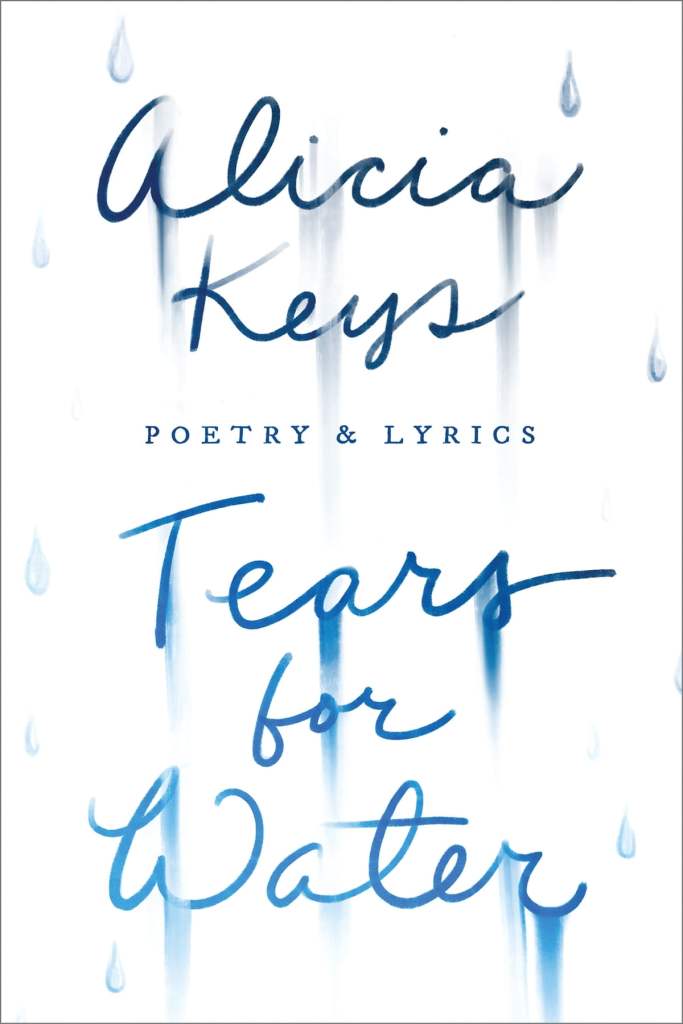
Following the release of her sophomore studio album, The Diary of Alicia Keys, Keys published Tears for Water: Poetry and Lyrics in 2004. Like her music, the collection offers insights into her mindset and perspective, as well as her own personal creative process. In her introduction, Keys writes, “I know that any creative expression is destined to be subject to criticism, but this book is for me and all those who are on the search for freedom.” The poems that follow embody an authentic vulnerability and sincerity, honestly reflecting specific moments and revelations in Keys’ early career. Along with Keys’ poetry, Tears for Water also includes explanations of the poems’ origins and what they originally meant to her. 


In the poem “golden child” Keys writes, “Girl, you be smart / look in your heart and see what shines in you.” In her commentary, Keys explains how the poem reflects a shift in her internal mindset, writing, “I was forced to believe in myself and not in what others thought of me,” describing the moment captured in the poem as a turning point in her life. Directly addressing themes of self-doubt, uncertainty, and burgeoning artistic confidence, the poems included in this collection exhibit the creative courage that Keys has continued to cultivate over the past two decades. In addition to her poetry collection, the fifteen-time Grammy winner also released a memoir, More Myself: A Journey, in 2020.


Lana Del Rey

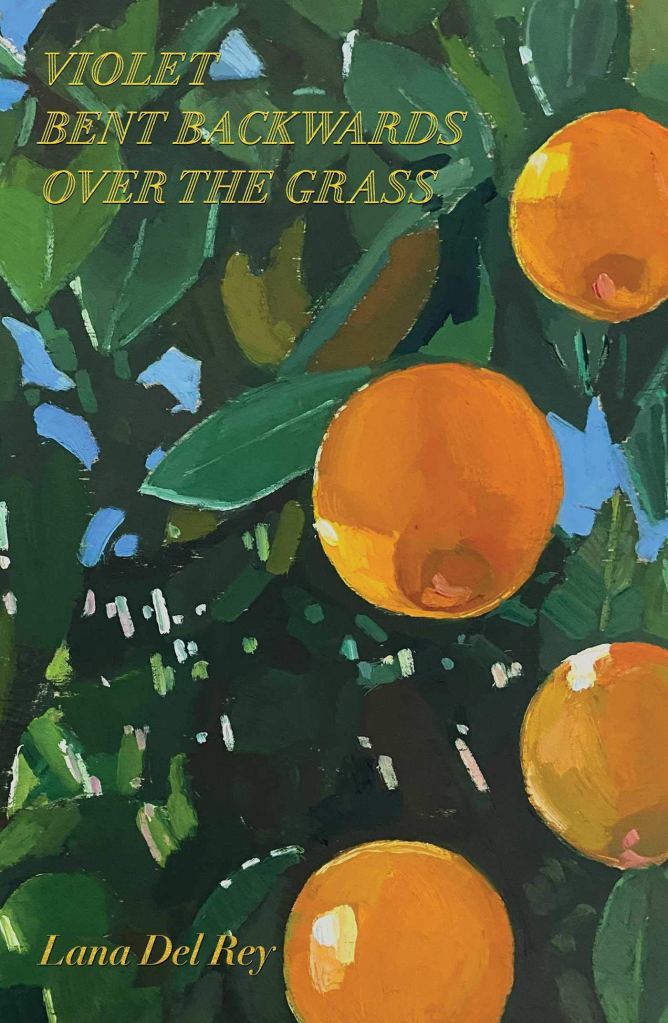
In an early interview, Lana Del Rey described that she selected her stage name as something that would guide the trajectory of her musical and creative process. Following the release of her breakthrough sophomore album Born to Die in 2012 at the age of 27, she has continued to create unique, authentic work that remains true to her voice. She released eight studio albums between 2010 and 2021, and her debut poetry collection, Violet Bent Backwards Over the Grass, was published in 2020.


In contrast to the rhythmic structure and rhyme scheme used in her music, the poetry in Del Rey’s collection tends to employ a free, stream of consciousness narrative approach. In the poem “SportCruiser,” Del Rey describes taking flight classes and sailing lessons, concluding, “All of this circumnavigating the earth / was to get back to my life / 6 trips to the moon for poetry to arise / I’m not a captain / I’m not a pilot / I write / I write.” 


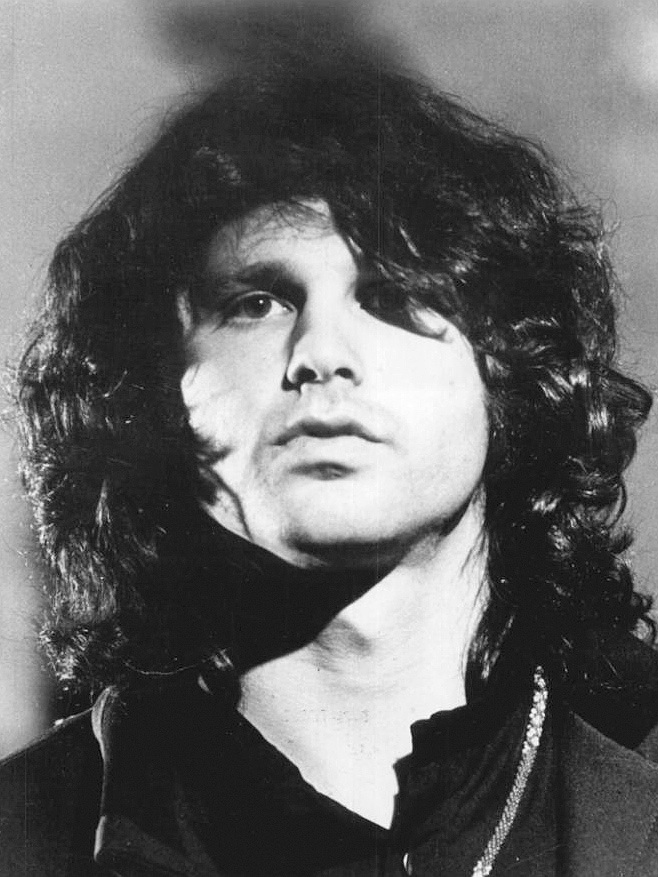
Jim Morrison

After rapidly rising to fame as the frontman of The Doors in the late 1960s, Jim Morrison developed a reputation for his distinctive onstage theatrics and the descriptive, philosophical nature of his lyrics. After cofounding The Doors with keyboardist Ray Manzarek in 1965, Morrison recorded six studio albums with the band between 1967 and 1971. Morrison’s unique vocal style and offbeat lyrics gave life to songs ranging from “Riders on the Storm” and “When the Music’s Over” to “Moonlight Drive,” “Roadhouse Blues,” and “L.A. Woman.”

Following his sudden death in Paris in 1971 at the age of 27, Morrison remained a seminal figure in psychedelic rock, being inducted into the Rock and Roll Hall of Fame in 1993 along with his bandmates from The Doors. But Morrison conceived of himself as a poet first and foremost, with his lyrics stemming from his original dedication to the craft of writing poetry.


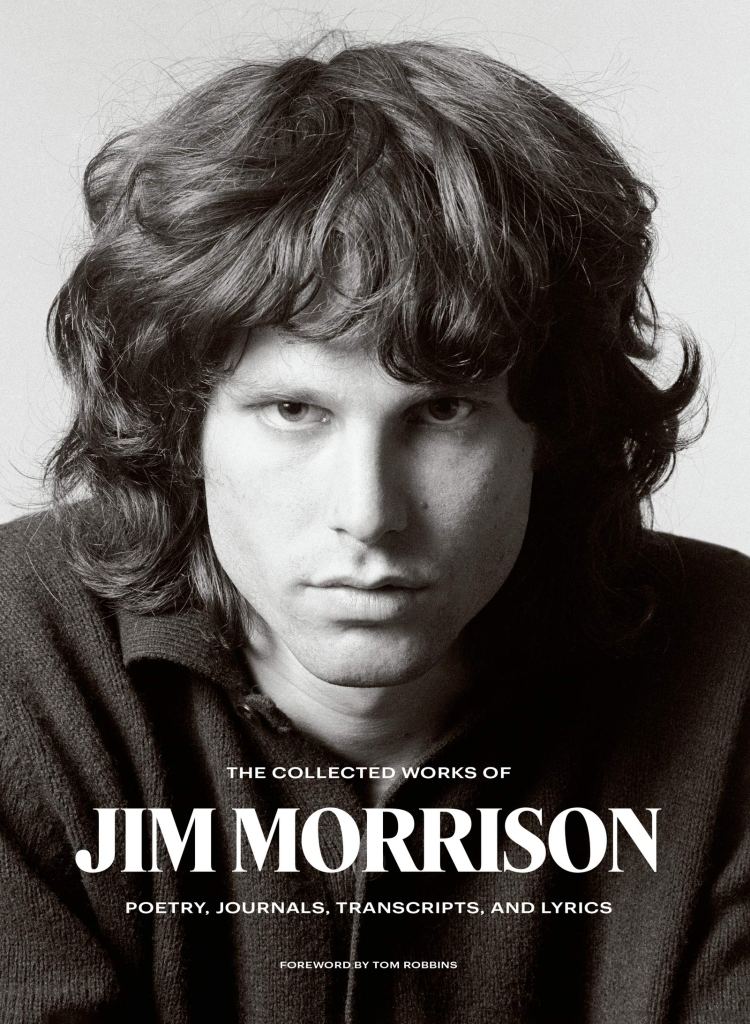
Morrison wrote poetry and lyrics synchronously as a member of The Doors. He self-published two collections of poetry in 1969, later compiled in The Lords and the New Creatures. Many of Morrison’s poems, drafts, and journal entries have been published in posthumous collections, including Wilderness in 1988 and The American Night in 1990. Most recently, The Collected Works of Jim Morrison, published in 2021, contains nearly 600 pages of both published and previously unpublished work from throughout Morrison’s life, reflecting his development as an artist and individual.

The collection demonstrates the breadth of Morrison’s interests beyond the sides of him commonly known in pop culture, including vividly descriptive imagery, metaphysical concepts, and narrative poetry. The book also provides pictures from Morrison’s notebooks with poems in his own handwriting, showing elements of his drafting and revision process. Morrison’s poem “The Universe” reflects recurring themes of metaphysics and reptile imagery. Morrison writes, “The Universe, one line, is a / long snake, & we each are / facets on its jeweled skin.” 


Florence Welch

As the vocalist and primary songwriter for her band Florence + The Machine, Florence Welch found her breakthrough success in the music industry with the band’s debut album Lungs in 2009. Since then, Welch has released four more albums with the band in addition to collaborating with other musicians as a featured artist. Many of Welch’s original lyrics incorporate existential and religious themes from varying perspectives, and her poetry collection, Useless Magic, reflects similar concepts.


Published in 2018, Useless Magic includes lyrics from Welch’s first four albums, followed by poetry. In her preface, Welch explains, “I don’t know what makes a song a song and a poem a poem: they have started to bleed into each other at this stage.” In the poem “Monarch Butterflies,” Welch paradoxically writes, “I am afraid of things being written down / Confined to the page so permanent / There is an impermanence to song / It is fleeting and of the moment / Words grow wings.” 


John Lennon

As one of the preeminent songwriters of the twentieth century, John Lennon left a lasting musical and cultural legacy, impacting generations of musicians and creatives. It would be difficult to overstate Lennon’s influence as the founder of the Beatles, a solo singer-songwriter, and a prominent peace activist. But in addition to his well-known accomplishments and artistic pursuits, Lennon also published two successful books early in his career.


In His Own Write, published in 1964, includes poetry, short stories, and illustrations. The book has generally been classified as nonsense literature, featuring wordplay and anti-authority sentiments. Lennon published another book, A Spaniard in the Works, using a similar format of drawings and nonsensical short stories in 1965. Skywriting by Word of Mouth, published posthumously in 1986, includes more of Lennon’s miscellaneous writings, drawings, and cartoons. All three books reflect elements of Lennon’s background in visual art, including simple cartoons paired with his writing, stemming from his experiences and interests he originally developed as a young student.


Keaton Henson

Songwriter, composer, and visual artist Keaton Henson has paradoxically gained greater attention and recognition through his quietness. As a singer-songwriter, Henson scarcely performs due to anxiety, and themes related to mental health figure prominently in both his lyrics and instrumental scores. Henson’s vulnerable, deeply personal songwriting reveals an understated yet formidable artistic courage that finds expression throughout all of his work.

Henson launched his creative career as an illustrator and visual artist, designing album art for other musicians. Henson released his first music in 2010, after beginning to record original songs in his apartment without originally intending to release his music publicly. Since then, Henson has continued to consistently produce and release new music, sporadically performing his work live in concert. Henson also composed Six Lethargies, a 70-minute work for string orchestra, and the piece debuted in 2018.


Henson’s songwriting style reflects a poetic sensitivity to language, and he published a poetry collection, Idiot Verse, in 2015. The book illustrates Henson’s background both as a writer and visual artist, including poetry and sketches. Henson’s publisher describes the collection as drawing on “the tradition of Leonard Cohen and John Lennon,” and similarities in style and creative approach are present throughout the collection. In the final stanza of the book’s opening poem, Henson states, “I’ll write it out just as I see it / and just as it sounds in my heart / and pay no mind to those wasting their time / in confusing confusion with art.” 


Mike Posner

After releasing his debut album 31 Minutes to Takeoff in 2010 at the age of 22, Mike Posner quickly became known in pop culture for his singles “Cooler Than Me” and “Please Don’t Go.” Following his first album’s international success, Posner grappled with the pressures of fame and struggled with depression, leading him to focus on writing and producing for other artists rather than releasing new solo work.


In 2015, Posner released the original acoustic version of his song “I Took a Pill in Ibiza,” which was later remixed by SeeB into a chart-topping tropical house song. His 2016 album, At Night, Alone, included both versions of “I Took a Pill in Ibiza,” along with “Be As You Are.” Both songs’ lyrics reflect a shift in artistic perspective, openness, and creative maturity that found similar expression in Posner’s 2017 poetry collection Tear Drops and Balloons. Posner has subsequently released two more albums and completed a walk across the United States in 2019, successfully walking more than 3,000 miles across the country after surviving a dangerous rattlesnake bite.


Joni Mitchell

Revered as a multidimensional songwriter whose extensive catalog of music transcends genres, Joni Mitchell has received nine Grammy Awards for her work and was inducted into the Rock and Roll Hall of Fame in 1997. Mitchell’s songwriting demonstrates a profound sensitivity and attentiveness to the power of language interconnected with rhythm. The poetry she has published throughout her career similarly reflects her talent for descriptive storytelling and her awareness of the interplay between sound and meaning in language.


Published in 1997,  Joni Mitchell: The Complete Poems and Lyrics, reflects the breadth of her writing up to that point in her career. More recently, Mitchell published Morning Glory on the Vine: Early Songs and Drawings in 2019, representing a reproduction of a book she originally gave to friends as a gift in 1971. The book contains her original lyrics along with paintings and drawings, offering authentic representations of her creative process and mindset in the early stages of her musical career. In “Woodstock,” Mitchell writes, “We are stardust / We are golden / And we’ve got to get ourselves / Back to the garden.” Mitchell’s poetry tends to reflect her attention to both rhythm and the inherent music of language. In“Cactus Tree,” she writes, “Now she rallies her defenses / For she fears that one will ask her / For eternity / And she’s too busy / Being free.”


Kurt Cobain

Known as the frontman, guitarist, and primary songwriter of Nirvana, Kurt Cobain left an indelible impression on the music industry and uniquely affected the development of alternative rock. Cobain released three studio albums with Nirvana, finding major commercial success through the release of the band’s sophomore album Nevermind in 1991, followed by In Utero in 1993. After Cobain’s tragic death by suicide at the age of 27 in 1994, his artistry has continued to powerfully impact other artists and musicians. Cobain was posthumously inducted into the Rock and Roll Hall of Fame in 2014 along with his Nirvana bandmates.


Many fans and admirers of Cobain would be unlikely to characterize him as a poet in the traditional sense, and he did not publish any poetry during his lifetime. But Kurt Cobain’s Journals, published posthumously in 2002, includes poetry he drafted, along with other lyrics and drawings from his personal notebooks. The unedited nature of the writing provides a clear glimpse into Cobian’s thought process and creative perspective.  In one entry, Cobain writes “I am threatened by ridicule… My emotions are affected by music. Punk rock means freedom. I use bits and pieces of others’ personalities to form my own.”


STEPHANIE GEMMELL is a writer and composer currently living in Pennsylvania. Her writing has been featured in Just Place ChapbookCapitol LettersThe Ekphrastic ReviewThe Rival GW, and in the poetry anthology Falling Leaves published by Day Eight. She also attended the 2021 Glen Workshop as a poetry and songwriting fellow. She recently graduated summa cum laude from George Washington University with a BA in Religious Studies and minors in Journalism and Psychology. Her work is motivated by the unique power of art to ask meaningful questions and inspire authenticity.