Sleep On, Sleep Off

Good Morning II.jpg

Photography by Brad Garber

The mattress is hard against my back, as if I am strapped in and held against it. A train crashes by, rattling the glass on my nightstand, the clear liquid sluicing with the aftershocks. I hope no one is on the tracks. I bring the brim to my lips and spit a mist of vodka.

My brother used to say that you shouldn’t drink water at bedtime. Before he was taken away.

The pharmacy sign blinks from the windows. Somewhere across the canyons of neon, he’s harnessed into a hospital bed, shouting and lashing in a Seroquel slumber. Tomorrow he’ll wake up, eyes roving around the room for a rope or a razor. Always the worst in the morning. He may try to rip his restraints—teeth slicing into zip ties. The nurse for the understaffed, under-cleaned, underfunded psych ward will put an end to his escape attempt. I hope she won’t have to put him under.

My stomach throbs. I stand, stagger to the bathroom, and kneel over the bowl. I vomit. One of his toothbrushes dangles above my head, the bristles taunting me. Jittery and drunk as ever, I return to bed.

I will sleep on it, or sleep it off. Either way, I cannot stay awake much longer. Tomorrow I have work to do, groceries to buy, laundry to fold, and a brother to visit. I need the sleep.

Over the past few nights, I’ve tried everything. Reading, leaving the lights on, slow breathing, counting sheep, now alcohol. Nothing works. A birdcall splits the silence; the magpies are already up.


HENRY HIETALA is a recent graduate of Macalester College with a degree in Creative Writing. His work has been published in Medusa’s Laugh Press, Chanter, and The Spark. He was a finalist for the Nick Adams Short Story Contest.

BRAD GARBER has shown his drawings, photographs, mixed media and paintings since 1997, in the Portland and Lake Oswego, Oregon area. His art and photographs have made it onto the front covers of Vine Leaves 2014 Anthology and N Magazine, and in Gravel Magazine, Cargo Literary, Jokes Literary, The Tishman Review, Shuf Poetry, Meat for Tea, Mud Season Review, Third Wednesday, Foliate Oak and many other literary publications.

White for Mourning

His eyes only ever looked that color when he was lying or when she was on speed. He told her that she was sober when it last happened, he swears. Lie.

He’d rub her knuckles when the earth scorched and cracked into dust — whisper something into her ear that made the corners of her mouth lift until her stomach ached. When the moon no longer glowed in technicolor and their pupils contracted, he felt her palms and told her that nothing about this routine screamed “destructive.” The corners of her mouth would lift again and she’d throw her hair onto his shoulder. Lie.

Her mother couldn’t know enough about her if she ever had to identify her daughter on the table at the morgue. She never had to. A shock. Her daughter’s features were always shifting, broadening, elongating. It was a shame that she came out looking more like her father because how was she supposed to recognize a face that she forgot so often to remember.

When he finally broke it off with her, he promised that he, too, would never cross paths with her mother’s habits and forget her. His eyes glassed over. The drugs.

When her pottu¹ was nothing more than a smear, all the women of the temple shaved their heads and lit an incense to mourn the loss of her innocence. White robes are for death, for the rebirth and renaissance of a wilted soul². White skin is a prize, a reimbursement free of the tallies of sin and covet.

 Her dinner was simple: peas, rice, a dialect, lentils. Ragi roti. Potatoes. White is for innocence, white robes are for death.

Her dinner was pink chicken, juice, cheese. Crunchy rice. Black is for death. Black is for funeral. They asked her, “What did you even see in that boy?” with oiled tongues. They should have asked, “Was it worth all this?” because that would have given the same answer.

They opened his casket, his face sallow and sunken until the hollows of his cheeks were plastic. She covered her mauve lips with her brown hand and was hit in her brown stomach with a blue sleeve and a white arm when she tried to leap across the burgundy rope into the black casket and hug the boy in the navy suit with purple veins and gray skin. Maybe if he had some color in his cheeks he would breathe again.

They prayed for her “death” just like his. It was only fair, as the balance tipped in greater favor of her tragedy over his. Her mother used up all seven of the prayers she had prided herself in memorizing into asking for her daughter’s forgiveness, but all her daughter wanted was for her to pray that she could forgive him.

She pandered to his parents by baking more White sweets and entering their White house without a dot between her feathery eyebrows and saying her own name with two syllables instead of three. And his mother sobbed and dabbed her eyes and yet could only ask her about things she found exotic. Some leopard or iguana dated her deceased son and was sitting in her living room, thick hair messy for her own rebellion. How did it know so much? Did it have time to read something of weight and matter in its garden that it called a house, or did it only learn how to cook with clove and ginger? How did it speak so well? Was it allowed to speak so much? Did it really want to speak so little? How much dirt did it remove from its clothes before slipping under its sticky covers at night? Did it really breathe? What was it doing dating her son? Did it give her a thrill?

Her mother was a botanist. She lectured yuppie young adults about fauna and its properties and came home to adorn her daughter’s hair with leaves. There. Don’t cry. She bawled louder. Did crying mark the end of adolescence into adulthood? Fuck his mother. What did she know. She sprinted up the stairs, plowing through the barricade her small mother tried to make with her arms, stumbling over the last crooked step, locking herself into the bathroom, and reaching for the sharp end of the scissors in the cup with such a speed that it left a scar on her palm. But it didn’t hurt at all. Not as much as seeing petals and strands of black hair drop around her in a ring. There. She stared at a her jagged creation in the mirror for less than a minute before dropping to the floor on a pile of hair and wet stems.

She was never serious throughout the drama, when he stopped their relationship with more of his fallacies nor when he stopped his heart with drugs. She had stretched her lips into a smile so thin that they were White and had forgotten how to pronounce “regret” in her mother language. She had drank the bitter and drank milk in reconciliation in the face of worship. She had cracked her lips and curdled her stomach and bleached her skin and dried her eyes until she had no more left to she give.

Fuck him. Fuck his mother. Fuck what he’d made her do. Fuck what he’d done to her.

She pulled on molten rattlesnake skin. She opened her mouth and watched her tongue fork like a lizard. Her skin grew mahogany; her skin grew fur and her eyes spun until they were slanted like a goats and under her scalp she could feel with her scarred palm the base of her horns. Smooth, smooth over. She could measure her menses in gallons and her heart would no longer murmur when she was screaming. She drew further from the questions and their beholders because her ancestry drew answers, and she fed from them, she clung to them so. And after she lost eight of her nine lives she promised herself that she was still human, that the bumps under her hair weren’t the sign of the devil and that she would live to see the next morning and the next morning and the next mourning.


¹Pottu – a word in South Indian languages to mean a forehead dot/bindi

²In many South Asian cultures and even religious practices, women wear white instead of black after a death.


VRIDDHI VINAY is a writer and social activist born in 2000 and living in Pennsylvania. A South Indian femme, they write fiction, nonfiction, and poetry surrounding topics of feminism, LGBTQIP, mental illness, leftism, and the Asian-American identity. They are also a staff writer for Affinity Magazine and has been featured in publications like Rookie Magazine. More of their work can be found at vriddhivinay.wordpress.com for published writing, and feel free to follow any of their social media accounts: Twitter (@scaryammu), Instagram (@scaryammu), and personal Tumblr (@criesincurry.tumblr.com). https://medium.com/@Vriddhi.Vinay. Want Vriddhi to write for you? Contact them via their email: vriddhi.vinay@gmail.com!

Let’s Talk About Fan Fiction

BY MICHELLE WOSINSKI

Let’s talk about fan fiction:

It’s an uncomfortable topic when it comes to literature— because it’s not really considered as such. When anyone can publish anything online, using pre-existing characters for what most likely will be a short cliche romance story, it isn’t considered very impressive. Why should it be when most of it is eleven year old girls’ One Direction unedited slash fiction anyway?

But, consider this— it has existed as long as fiction has existed. Here’s some background for today’s fan fiction as we know it!

The term ‘fan fiction’ was coined in 1939, though the practice existed long before this. In 1967, Spockanalia the first Star Trek fanzine ever featured fan written works, and these were written by and for adults and sold at various science fiction conventions. It is also important to add that 80-90% of Star Trek’s fanbase was made up of women— because the series was aired during the day, when housewives would be home and thus expanded from there— contradicting the common stigma that sci-fi is made for and enjoyed by men. Fan fiction has always been a female-dominated community and there is a lot to be taken away from this fact, especially since Star Trek arguably was the first large fandom to exist that made fan fiction a more mainstream phenomenon.

Skip ahead to the internet, which transformed how people shared and consumed their fan works. Previously, small groups of people would mail each other their stories and pieces of art via post, never before fully open for the public. This changed everything!

Teenage girls are well known to be stereotyped as obsessive or fanatic when it comes to media— an obvious example being boy bands. This passion, especially if for tv-shows, books, or movies, can easily be put into creating fan works. If you really love the characters of a TV show and want to see more, why not create more yourself? You have complete control and can conjure scenes that you probably won’t see on screen because perhaps it doesn’t fit the genre or the significant plot being followed. Now with access to an online community of like-minded fans you can share your passion and works easily!

This can actually be a very helpful exercise for young writers, because they have the freedom to explore worlds without having to worry about building character first and get right to the plot or development or whatever they choose to focus on. However, this stereotype of young girls also presents them as irrational and very naive— they are belittled for enjoying things and thus the things they enjoy are considered ‘silly’ and immaterial, or not intellectual. Fan fiction is a good example of this.

This can be partially attributed to its reputation of being badly written sickly sweet slash fiction and not worth any real attention— to read it is even considered embarrassing, much less to write it!

Don’t get me wrong, some fan fiction is badly written. Some fics are 900 words of self-indulgent bad dialogue, and some are 120,000 words of messy and confusing plot lines. However, that is not the point. I could go on and on about how some works are genuinely well written and explore interesting themes and have amazing  character interaction and so much more, but I’m not going to. Because, more importantly, it should not matter if the content is good or not. Many of these writers are young— their creativity should be encouraged and they should be allowed to develop as writers.

Fan works are not like books, in that literally anyone can publish anything online. However, like books their quality also ranges. There is the notion that because something is published as a book it is inherently better compared to, for example, a fan fiction. “It has original characters and plot and was taken up by a publishing house!” I’ve read too many awful books to even consider this a reality anymore.

Also, think about this: 50 Shades of Grey was a Twilight fan fiction. Now after changing the names to Anastasia and Christian, it has multiple sequels and movies, and you know what? I don’t want to show too much bias here, but it’s a trash, terrible, horribly written book. What do I take away from this? Nothing means anything when it comes to fan fiction vs published books. Fan fiction can be bad, books can be bad, and bad fan fiction can become best-selling books/blockbuster movies.

Most of all, everything is up to reader’s interpretation and their taste.

You know what fan fiction has that books and other media don’t have, though? LGBT+ representation, and an abundance of it.

I’m not going to go down the rabbit hole of female fetishization of gay male pairings, that’s a discussion for another day. I’m going to focus on the the actual positive representation of gay relationships written by and for queer people— fan fiction is not only dominated by women, but queer women especially.

Growing up gay is a hard gig, I can tell you that. Even worse, though, is growing up being a gay bookworm. Media has little to nothing to offer outside of the few sad™ coming out books which get tiring very quickly. Fan fiction fills a hole that popular media refuses to. None of these books or TV shows you like have openly gay characters? Make. Them. Gay. You have the power to do that. Many people before you have, trust me. If you don’t want to write it, that’s fine, google it and you will find there probably is already lot of content out there, whatever you’re looking for.

You know what, I’ll admit it, I actually like sickly sweet slash fiction. I hate romantic comedy movies, always have, but it took me a long time to realize it wasn’t because I hate romance. It’s because I’m sick of seeing relationships I can’t and don’t relate to! I’m sick of seeing the same A-List straight actors fall in love. Fan fiction is the gay rom com I’ll never get to see and I love it. I like being able to get on AO3 and find the exact kind of domestic fluff I need at 1am on a Tuesday night, it’s not even a guilty pleasure. You shouldn’t have to be ashamed of the things you like!

I don’t want to give the impression that all fan fiction is soft romance, though. Just like books, there are different genres and you can pick and choose what you want to read— whether it’s mystery, horror, sci-fi, romance, angst, or literally anything else you can think of.

This is really just the tip of the ice-berg when it comes to this topic, there is so much to discuss, but the thing I think I would most like you to take away from all of this is: fan fiction is fun! Don’t take it too seriously, but don’t dismiss it either. Write what makes you happy, read what makes you happy, and don’t worry about the rest.


149894693398805.gif

MICHELLE WOSINSKI is an alumnus of the University of Virginia Young Writer’s Workshop. She was a member of the program’s fist class of Graphic Fiction and Nonfiction, which was also the first workshop of its kind in the country. In the fall, she will begin her further education at Loughborough University, for a foundation in Art and Design.


Letter from Art

BY SUDHANSHU CHOPRA

In Midnight in Paris, when Gil Pender, a present-day, successful but creatively unfulfilled Hollywood screenwriter, travels back to the 1920’s for the first time to a party for Jean Cocteau, I’m amused by the presence of Zelda and Scott Fitzgerald: my dear authors speaking as if they are writing: Zelda, “missing the bathtub gin,” is high on adjectives, and Scott, well he never misses out on a chance to say “old sport.”In the background, Cole Porter sings a Cole Porter song. Everyone looks neat and shiny; cigarette puffs punctuate sophisticated sips of wine. The person I’m looking for is not there.

Another scene, another bar, though plain and quieter, Gil meets Hemingway: unkempt hair and fairly under-dressed as compared to the people in the situation earlier described. I get hopeful. But later in the movie he, too, is shown getting drunk at what seems to be an invite-only party. He is also associated with a woman—a stunning fashion model conveniently out of an ordinary man’s reach (unless the man is an anti-hero, whose lack of sweeping ability only makes him all the more attractive, and who, of course, is not fictional.) With these steps, Hemingway bluntly walks out of the shadow I had initially thought he might be sitting comfortably in. He, too, turns out to be part of yet another literary circle: the circles capable of only producing revolution, and failing to open up to freedom and diversity (whichthey apparently advocate), mostly because of their closeness, their circularity.

I wonder if all this was being watched from a dark corner by someone like the anonymous master who wrote the very fine Sir Gawain and the Green Knight.Also, a ballad singer comes to mind, one having no idea of the privilege he could have achieved by asserting his ownership over the invaluable lyrics he so nonchalantly scattered at curbs going around towns. Maybe if by wearing a certain sort of trinket he had shone like radium, people would have thought of him as a finer man. He would have inspired awe—in place of homeliness—amongst his ragged listeners who would have spotted him from a distance, thus in a way bringing him closer to them than his words ever could.

I, Art, have always been the field of the elite. The part of me that has not been so is unknown, mainly because it could not fit the social construct of popularity.And I do not speak just of kings and nobles, but of every era that has been doing the same: a handful of erudite gathering in groups, leaving out millions whose stake in me is no lesser. A bird’s eye view would show separate, distant dots—formless on the body of time—rather than a uniform veneer that covers all nakedness.

Since my inception, perhaps even before—when my idea was being conceived in black holes—I was meant to be imbibed, not made. I had smooth, flexible ends, not the stiffness of unwritten rules and tacit protocols which were forced upon me by every movement no matter how much liberal and anti-establishment it called itself to be. And these limitations have not been so much in the works than in the interaction of people producing those works, because wherever humans are involved there is always preference and dislike, clash of thought, and intervention of ego.On these factors is decided what and who deserves tobe in the group—who is capable of being an artist. Therefore, every age has had its artists, and the commonplace folks—the ones who can’t comprehend me.

At this point, I’m inclined to wonder if I’ve always been just another societal norm, away from the universality I stand for. Sometimes they try to adapt, the non-artists— they spend evenings watching intense theatre, or standing in front of confusing brush strokes on canvas, and after getting home, try to convince themselves of the beauty of what they just witnessed.They are ready to change, rather than contribute with their originality. Would I ever be able to purge myself of promoting this pretence?

How would I know? I’m too old and fraught now to pine for a perfect past. I can only ask you to write prose poetry or poetry prose, or any third form that you can conjure, maybe even go directly to a fifth, or simply come back to the classic iambic pentameter couplet if that is your dark corner where you can sit secluded from ideology and relationship to the external, offering your blank mind to my once free, independent and all-pervading body.

It is then that I hope to find you, my elusive person. And I hope to find you before Liam Neeson does.

Best,
Art


149738016536773SUDHANSHU CHOPRA hails from India. He draws inspiration to write from observation, memories, subconscious, books he reads, movies he watches, and music he listens to. Sometimes a phrase or simply a word is enough. Some of his poetry has been published in In Between Hangovers, Anti Heroin Chic, Calamus Journal, Wordweavers, FIVE:2:ONE, and Right Hand Pointing. Some more of his poems/thoughts could be found on his blog, The Bard.

Jump

Illustration by Priyanka Paul

Illustration by Priyanka Paul

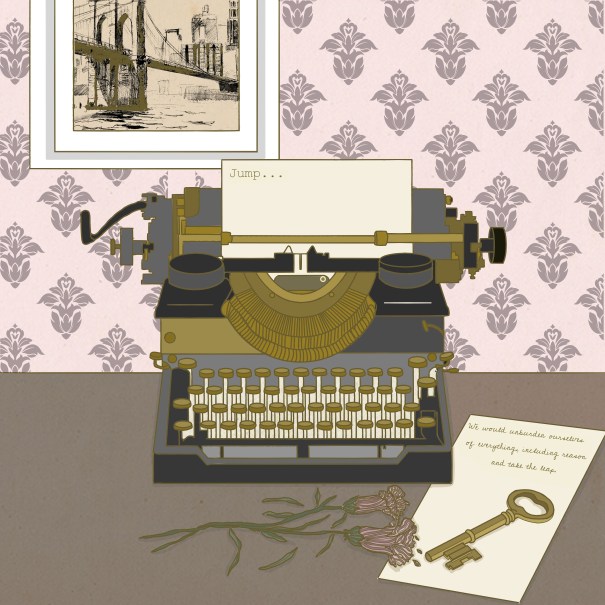
A set of keys, a typewriter with a letter in it and a photo collage; a forced elongation of happiness. Symbols that commemorate a state of consciousness that could never be accurately reproduced. We didn’t buy gifts to each other that year, the shared experience of jumping off a bridge into the Corinth canal was enough. We would unburden ourselves of everything, including reason, and take the leap. What would take a few more weeks to acknowledge is that we plunged into nothingness alone. Before the ropes broke our fall we felt free, alone. When they signaled me I wasn’t ready to be pulled up for I’d lose that which made me dive, head first, into the unknown. The keys adorn the coffee table, the ring has been removed. The letter has been folded and stored inside a book whose words have swallowed it whole. But as I write these words on the old typewriter, my eyes drawn to the empty frame on the wall, I know we did ourselves proud; we let ourselves jump, despite the fall.


ELENI CHELIOTI was awarded her PhD in English Literature hours before she received her stethoscope, as a doctor should. She is currently living and working in Athens, Greece. She’s only ever written about the things she cannot utter. Her short stories ‘Stealing Time’ and ‘Only Lust’ were recently published in The Rusty Nail and Heart & Mind Zine respectively. She also has a blog:  http://darkcaffeinematter.blogspot.com


PRIYANKA PAUL is a humanities student at St. Xavier’s College, Mumbai. She’s a self taught artist and loves to experiment with different mediums. She also writes and most of her written work is accompanied by her illustrations. Her art is highly influenced by social issues, gender studies and a basic liberal outlook of the world.

Into The Night

The wooden slats of the timeworn, dilapidated porch groaned underneath my feet as I stepped to the edge and looked up into the vastness. The Georgia night sky was as dark as I’d ever seen it. With heavy eyes I contemplated the black, hypnotized by the millions of miniscule specks that danced and flickered against the velvet backdrop. “I don’t remember there ever being so many,” I whispered into the cool air, knowing there was no one there to hear me. Grief ripping through my heart, I closed my eyes against the pain and began to sway, allowing the breeze to swirl around and wrap me in its tranquil embrace. Instinctively, I reached up and rubbed my palms against my bare shoulders to fend off the chill causing the soft hairs on my arms to rise.  The gust continued its twirling path down and around my body, ruffling the bottom of my loose, black dress. Filling with a sense of contentment, I sighed and thanked the night for its attempt at consoling.

 I opened my eyes and breathed in, pulling the air through my nose and allowing it to expand into my lungs until they were tight with pressure. The sweet smell of magnolias embedded in the breeze triggered my senses to come alive, sending my mind reeling back to a time of pure innocence. Wrapping my arms around myself, I stared into the shadows and allowed the memories come flooding into my consciousness.

“Watch Momma!” I shouted from the middle of an overgrown field with my arms outstretched to the sky above me, my tiny hand clutching tight a glass Mason jar. My five-year-old self was running and jumping into the air causing my long dark curls to trail in my wake.  Dusk was setting in and the sky layered on its bedtime ensemble. Deep blue folds pressed down from above causing the brilliance of the sun to succumb to its power. As the yellow melted into the earth, it hissed its flames into the dark only to be extinguished by the inevitably swelling black.

“I see you baby! You be careful now.” Momma stood watching from our old but sturdy farmhouse. The once white, two-story structure sat in the middle of a forty-acre farm worked by my father from dawn to dark. The expansive wrap around porch provided the house a look of refinement though many of the railing spindles were loose or altogether missing. The wood slats of the floor were always swept and clean and a two person swing hung at the far end, just past the front door.

Hearing my mother’s voice, I turned to see her leaning on the support post, hip resting against the railing. In the fading light of day, I could just make out the expression on her face. A soft smile rested on her lips as she looked at me with adoration. Her dress, though simple and plain, fell flatteringly over her slim figure and accentuated the curves of her waist. Her Italian heritage had gifted her with smooth, olive-colored skin that radiated vibrancy and youth. We shared the same dark, flowing curls though hers were kept shorter with the coils lightly dusting her shoulders. I thought her to be the most beautiful woman in the world.

“Momma!” I cried out again. “I got four of ‘em. See!” I held up the jar with my hand now pressed over the opening. Inside, four insects flitted about, lighting up in unsynchronized choreography. I ran towards the porch as graceful as my little legs could carry me, grinning with absolute pride and satisfaction. I dashed up the steps and rounded the corner to show off my prize. “Look Momma,” I said in between gasps of breath. “Look how pretty they are.” I stood on tiptoes, pushing the thick glass up as close to her face as I could so she might gaze upon my treasure.

“Yes, they certainly are beautiful.”

“I want to keep ‘em inside by my bed so I can look at ‘em every night,” I whispered to her as we both watched the glowing lights with fascination.

“If you do that honey, they’re gonna die.  You don’t want that now do you?”  She smiled down at me and ran a loving hand over my head, smoothing my tousled curls.

“I don’t wanna let ‘em go.” Large drops filled my eyes and my voice caught as I started to cry. “But I don’t want ‘em to die neither.” I looked up at my mother, searching for an answer in her face. She knelt down bringing our eyes level and reached out a hand to wipe away the tears streaming down my cheeks.

“Sweetheart,” she began in her gentle Georgian lilt that always managed to calm even my most heart wrenching moments. “You should let ‘em go. I know you wanna keep ‘em but you should set ‘em free so they can fly off and light up the sky for everyone, not just us. You want other people to see how pretty they are, don’t you?”

“Ye…eh Mom…ma,” I choked out, my sobs hampering my ability to speak clearly.

“Shhhh baby. Don’t cry,” she soothed, pulling me into her warm embrace. Craving the comfort of her love, I pulled my hand from atop the jar and threw my arms around her neck to bury my face in her hair. The light smells of jasmine and lavender swirled around my nose, filling me with the solace I was seeking. She pulled back to place a gentle kiss on the tip of my nose, making me laugh.

“I think they’re gonna fly back to their families now, Momma,” I said focusing back on the jar in my hand. The bugs had climbed their way to the top but sat just inside the rim, not making any attempt to escape. “See Momma. They don’t wanna leave. They wanna stay with us.”

“No, baby.  They’re just waitin’ for you to say good-bye.”

Sniffling, I ran my forearm across my nose and took a deep breath. Taking hold of the jar with both hands, I pulled it in close to my body so I could peer down into it. The anxious insects paced along the ridges of the glass lip but still did not take flight. “Okay,” I whispered quietly to the bugs. “It’s time for you to go on home now.” The bugs halted their movement as if they were listening. “Go on now,” I said again, giving the jar a gentle shake. In unity, they flew out and circled my head. Their tiny bodies illuminated the darkness and danced in the air between my mother and me. I squealed with delight as I watched them rise higher into the sky until they were out of sight. That night I dreamed of fireflies and ballerinas.

That had been my first lesson in saying good-bye. The childhood memory didn’t diminish this new, still raw pain, but it did ease the ache. As I dragged my consciousness back to where I remained rooted, standing on that very same porch, I looked out onto the open field to see hundreds of fireflies dancing in the darkness. My heart yearned for things to be as easy as they had been back then, when it was all so simple and everyone was full of love and happiness.

Another sigh escaped my lips as the breeze took a sudden, bitter turn and snapped an icy switch across my bare legs. The sharp gusts whipped my long curls with violent thrashes and my body released an involuntary shiver causing me to wrap my arms tighter around my shoulders. I hadn’t felt this cold since…since the day I revealed the truth and watched as my mother’s heart froze over right before my very eyes. Though a reaction had been expected, one so severe had been like a slicing slap across an already tender cheek. Her adamant refusal to speak with me, to discuss further what had taken me so long to divulge, caused a piece of me to wither and die the instant I had seen the rejection in her eyes. As the flashes jabbed at my tender soul, once again my mind went plunging back.

“Momma, please,” I had begged. I remembered that fateful afternoon from so long ago as though it was only yesterday. “Please let me explain.”

“No,” she spat. “I won’t hear of this. You will not come into this house and say these things to me and expect me to understand.” Her dark eyes hardened and her lips drew pencil thin.  My heart screamed out to beg her forgiveness, but I knew she would grant no such relief. “Be glad your daddy isn’t here to watch you throw your life away!” She had always known how to drive the knife straight into the heart, though never before had I been on the receiving end. With my father’s passing just a few years prior, I still hadn’t quite adjusted to his absence. She had known this and used the barb to wound me as she knew of no other way to redirect the anguish she was feeling.

I walked away from her that day with the hope that time would soften her resolve, open her heart to me, and forgive what she believed to be my indiscretions. That time never came. For ten years I waited. For ten years I fought back the tears and the anger, yearning and hoping she could again see me as that five-year-old catching lightning bugs in the summer night air.

Now, a decade later, I had received the phone call deep in the night. It was one I had known would come sooner or later. My brother was on the line, pleading for me to come, assuring me I needed to be there. So I conceded, and drove the distance to a house I no longer called home.  Upon my arrival, I had climbed the wooden steps, sadness stinging me as I noticed how they were now covered with layers of dirt and dehydrated leaves. I passed through the doorway and into the kitchen, lit by only the dim yellow bulb over the stove. The air was tranquil and stale yet still held the faint smell of Momma’s secret recipe pasta sauce. Was I supposed to be sad? Relieved? Angry? Was it possible for me to feel them all at once? Finally, it was sorrow that won out as I passed through the hall and into my parents’ bedroom.

Not taking my eyes from the far corner of the room, I inched my way towards the quiet hum of medical equipment. I reached my destination of the old, sunken rocker sitting next to the queen size bed. I eased into it with a quiet whoosh, doing all I could not to pierce the awkward stillness. The figure that lay in the center, under the blankets, was barely recognizable to me.  Gone were the wisps of shiny dark curls and unblemished, tanned skin. They had been replaced with dry, grey stands of worn out yarn and thin, pallor skin that made my fingertips tingle at the thought of touching it. A haggard, raspy sound escaped from her lips, then rattled away. I shot a look across the bed to where my brother stood, his arm curled tightly around his wife. “I didn’t know she was this bad.  Why didn’t you tell me?” I said with an edge.

“She made me promise not to,” he said, his eyes shifting to the ground in shame. Tears ran across his face and dripped from the tip of his nose. “I thought we’d have more time,” came in a whisper from his hoarse throat.

I shook my head in disappointment and returned my gaze to the woman dying before me.  “Does she know we’re here?” I asked, not looking back at my brother.

“Doctor says no. The morphine is keeping her under, but he says she’d probably be unconscious anyway by now.”

“God, Momma,” I whispered. I took hold of her frail hand and wrapped my fingers carefully around hers.  It was the first time I had touched her in years. For an instant, I felt light from the connection. I leaned over and pressed my lips to the bony knuckles and held them there as the grief swelled inside my chest, threatening to burst through and shatter my ribs. The breaths that seeped from her dry, cracked lips were garbled and it became obvious she didn’t have many more left.

A vice began tightening against my lungs and my heart echoed in my ears with a thud so resounding I could no longer piece together a coherent thought. I knew I couldn’t stay, couldn’t remain until the end. I hadn’t the strength. I eased my way to standing, keeping the gnarled fingers still intertwined with mine. Using my free hand I smoothed the top of her unruly hair and bent to place a kiss on her temple. I rested my forehead against her clammy brow and searched for the last words I would ever say to her. A thickness formed in the back of my throat as I struggled to keep the tears at bay. A strangled sound emerged from my lips when I tried to speak. I paused, and then began again, driving down the building anger and regret. “I can forgive,” fell from my lips in a hush so low I barely heard it myself. Large drops now streamed freely down my cheeks. I made no attempt to wipe them away as I bent closer to whisper in her ear.  “Go dance with the fireflies, Momma.”  I gave her hand one final squeeze and let the gnarled fingers float back towards the sheet.  Stifling the cry forcing its way through my lips, I covered my trembling mouth and rushed from the room.

Three days had passed since that night and today we lowered the casket into the ground to remain there for eternity.  Still standing in the night air, I blinked away the tears and inhaled with a quiet gasp as I realized time had slipped away from me while I had tumbled through painful memories all the while remaining fixed to the old porch of my childhood home. The winds had all but ceased and my dress now hung limply, occasionally brushing back and forth across the tops of my knees. The sounds of the crickets had disappeared as the cool of the night swept in and silenced the remnants of evening. The quiet enveloped me as I continued to sway ever so slightly. Everything seemed surreal and I could feel the loneliness start to edge its way into me.  It nibbled at my fingertips and crawled its way up my arms, seeping into my chest in an attempt to smother my heart.

I was about to relent and let it consume me when the creak, smack of the wooden screen door sounded behind me.  Light footsteps sauntered up and a slight smile flickered across my lips.  Long, warm arms wrapped around me from behind, pulling me close to the body to which they belonged.

“How are you?” a quiet voice whispered into my right ear.

“I’m not sure.  Still trying to believe she’s really gone.” Though the loneliness had fled at the sound of the door, the dull ache still radiated through me.

“Is there anything I can do?” Warm, sweet breath danced across my cheek.

“No, love.  You being here is enough.” I smiled and ran my hands along the arms encircling my waist. My fingertips skimmed across tender flesh to the long slender fingers interlocked in front of me. I pulled the hands apart so I could turn. My heart flooded with emotion when I stared back into eyes of bright blue reflecting the love I had known for ten years.  I reached up to float my touch along the soft curves of a face filled with devotion, across full lips that smirked back at me, and up into long, silky hair that shimmered between my fingers. The smirk melted into a smile as she tilted her head down to kiss me.


CHRIS EVANS currently resides in Lebanon, Ohio with her wife and three children. She works full time as a supply chain planner for a large plastics company. Chris holds a Bachelors of Arts degree in English from Southern New Hampshire University and is currently pursing her graduate degree in English-Creative Writing with an emphasis in fiction.
Everyone Has Sad Stories

EveryoneHasSadStories_12x9_grayscale_310_dpi_web.jpg

Illustration by Allen Forrest


A doctor explains to you in very large words the effect of trauma, of traumatization. You want to tell him you don’t know what he means by that, what he means by “Those who have experienced trauma.” Doesn’t that mean everyone? You want to ask. Isn’t the world just one big scar? But you don’t ask him that, it might only be more evidence of your traumatized mind.

“We define trauma,” he says, “as an experience that impairs the person’s proper functioning of their stress-response system, making it more reactive or sensitive.” He also says, “An infant who is neglected or abused develops a different neural framework. They might begin to dissociate and withdraw from everyday life. Because they are outwardly quiet and compliant they are often seen as okay and ignored…” You wonder why he says “they” when what he really means is “you.”

This whole thing happened because of one “triggering event.” You’d been quietly managing through everyday life. Wake up. Bed check. Try to get the last of the Fruit Loops. Walk to school. Sit in school. Walk around. Back to the group house. Eat. Bed check. Sleep. Sure, sometimes you lost whole days, sometimes it turned out to be Friday when it was supposed to be Wednesday, but didn’t that happen to everyone? Teachers ignored you, students (mostly) ignored you, you never caused problems. While the other kids at the group home smashed things and got in fights and stole alcohol or pills, you just sat there. So why are you here?

They say they found you in the middle of the street, they say you were trying to kill yourself, but it didn’t happen that way. You just happened to stop walking, to stop, to stay still, like they were always telling you to do, be a good little girl, don’t make noise. You didn’t make noise, you were silent, still. So what’s the problem? You closed your eyes, and felt the wind of the cars fly by you. And then there was the screeching of tires, and horns and yelling. You covered your ears with your hands, because it was too much noise. You heard the sirens, but there were often sirens. Later you felt the air of someone speaking to you, close to your face, but you didn’t open your eyes. He started to shake you but you kept your hands up against your ears, kept your eyes closed. They must have pulled you away, must have put you in handcuffs (for your safety), must have covered your head as they pushed you, gently, into the back of the car.

In a room at the station it was quiet, so you opened your eyes. There was a woman sitting there. “Why’d you try to kill yourself?” she asked. You didn’t answer because she wasn’t talking to you. She got frustrated, you saw it in her face, and closed your eyes again.

Eventually, they brought you back to the group home but they didn’t make you go to school the next day. And then finally someone brought you here, to this man with the gray beard and glasses, and corduroy pants. He is sitting on the ground, which seems very strange for a grown-up to do, but you try not to think about it because you don’t like strange.

He’s still talking. “People who have experienced trauma, especially children, need to be able to control how and when they tell their stories. Only the child knows what the proper time and method of revisiting trauma is.” You think he’s talking about you again but he’s using all the wrong words. He calls you a child, but you figure you probably haven’t been a child for fifteen years. Although you also know they’ll call you that for the next three, when you turn from “child” to “no one.” He also tells you, “You can control when and how to tell your story,” but what he really means is “tell me now.” And he waits.

You know what he wants you to say. You know he’s read your chart, he knows your story, and he is almost whispering the words, willing you to say them because that will prove that he is right and you are “traumatized” but he can and will fix you. Triumph. He wants you to say it so bad and you don’t want to disappoint him so you begin to speak.

“Dawn Almarez died during childbirth. She was only 14 and didn’t go to the hospital. Her mother lived with a boyfriend, he bred pitbulls to fight. The grandmother was 30 years old. She was addicted to methamphetamines. The grandmother’s boyfriend was arrested for abusing his dogs in public. They found drugs on him. They raided the house and found a two year old infant in a dog kennel in an empty room. They took the infant to CPS and it was placed in a foster home.”

You stop speaking because the man is looking at you in a strange way.

He speaks. “You were the infant.” You feel guilty, like he’s caught you in some way, like you told the story all wrong, and he’s disappointed anyway.

Obediently you say, “Yes, I was the infant.” You feel your heart begin to race you don’t want to be in this room anymore.

“You weren’t even crying,” he says. “But that’s not unusual. You had evidence of abuse. Infants can not fight or flee from a perceived threat. Their impulse is to cry for an adult. However, most likely whenever you cried for an adult, you were abused. So you stopped crying.”

He is proud of this understanding, and you nod because you don’t want to take that from him.

That was the story he wants you to tell, so you tell it, you have it memorized, but none of it is from your memory. It is only words on a page, a history that may or may not have existed. Everyone has sad stories.

“What about growing up?” he asks you.

You don’t answer him, even though you want to, because you don’t know what he means. Growing up. You did grow, up- once you were small, now you are five feet two inches. You wonder if that’s what he means, if he wants you to tell your height but you doubt that he does. And the doctors tell you you’re too small anyway, only 95 pounds they say, always disappointed, so you don’t want to bring that up, he’s already disappointed in you.

“Foster care? The group homes?” He is trying to prompt you, like you’ve forgotten your lines and he wants you to remember.

You remember being five years old and climbing onto the kitchen counter in the middle of the night. You remember finding a can of tuna and stabbing it with scissors until it opened enough to eat it. They had forgotten to feed you again. When the teacher asked about the cuts on your hands, you just shrugged, you’d never noticed them before.

You wondered if that’s the kind of story he’d like to hear, but you don’t have the energy to tell it.

You stay silent and he continues to watch you, waiting. Your heart beats faster and you begin to sweat. It’s hard to breathe.

He looks away. He sighs. “A traumatized child can recover. But it takes time. And patience. The most important thing is to get the child connected to something- family, community, friends, school….” You want to ask him how you can connect to something you don’t have.

He smiles and puts a hand on your shoulder that feels like it’s a million pounds and burns like fire. You close your eyes and tell yourself not to flinch, you tell your lungs not to close.

As he says goodbye to you in the doorway, he gives a smile like he is full of hope for you. You want to cry, because you know he’s wrong, and there is no hope for you. But you don’t cry, because good little girls don’t cry.

So you turn from the door although turning feels like it takes all of the energy you have. You tell your feet to move.

You walk into the street.


KRISTEN POITRAS is a graduate of San Francisco State University with a BA in Creative Writing. She has had a lifelong love of writing and working with/helping others. She currently lives in the Napa Valley in Northern California enjoying the grapes and working as an education coordinator at an alternative middle and high school. She previously worked for two years as a high school English teacher at a traditional school combining her love of literature and working with youth. She plans to attend graduate school for a Masters in School Psychology Counseling and Education. In the future, she will continue writing while also devoting her time and effort to youth in need.

ALLEN FORREST has created cover art and illustrations for literary publications and books, is the winner of the Leslie Jacoby Honor for Art at San Jose State University’s Reed Magazine and his Bel Red painting series is part of the Bellevue College Foundation’s permanent art collection. Forrest’s expressive drawing and painting style is a mix of avant-garde expressionism and post-Impressionist elements, creating emotion on canvas.