While we are accepting submissions for the post of Blog Editor, we thought it would be great to ask our staff what they like most about the Inklette blog and talk about some of their favorite blogs. Here are a few perspectives.
I love helping to manage the Inklette blog because I believe our posts complement the artistic context — stories, poems, and visual art — in our issues. Specifically, they allow the personal voices of artists and readers to be heard along with the works of art themselves. Our blog also allows our magazine to have a life — to keep learning and growing — in between our issues, which I feel helps all involved stay immersed in the world of art. Moving forward, I look forward to using the Inklette blog to both connect with new readers and further cultivate relationships with long-term readers worldwide.
–Joanna Cleary, Blog Editor
For me, picking out a favorite blog post is incredibly difficult, and part of it is likely due to the wide variety of topics we’ve covered. But to echo Joanna’s statement that the Inklette blog allows personal voices to be heard, I think my favorite would have to be the recent “Experiments with Reading/Writing” from August 30. Not only was this post a collaborative one that showcased the different voices of the staff, it also pulled from outside sources to answer questions about what we write, why, how, and etc.In the end, the final product struck me with its intermingling of voices: the Inklette staff’s, the authors’, and the different speakers’ and characters’.
–Sarah Lao, Social Media Manager
I loved the special blog feature we did with Cow Tipping Press. When our prose editor, John, proposed the idea we immediately wanted to do it. Not only was it different, but it was also encompassed a great deal of people involved with the press– teachers, writers, and volunteers. It was the opportunity to highlight their work and the work of an entire organization that is built around inclusivity, something important although lacking in the field of writing today, that excited us about what went into the making or writing of the blog as much as the blog itself.
–Devanshi Khetarpal, Editor-in-Chief
To learn more about our staff, visit our Masthead page here. To apply for the position of Blog Editor, visit this page to know more.
The start of school comes with many perks to look forward to: a change in routine, seeing old friends who were away during the summer, making new friends, and so on. However, it is undeniable that it also comes with a plethora of homework, one that ebbs and wanes until the end of the term. How does one find time to write in the chaos of academia?
The Inklette team was asking the same question, and compiled a list of tips to help student writers find time to write during school terms:
Set a specific time in your weekly schedule to write. Don’t give it up even when the term gets busy. Think of it as a reward for all of your early morning classes, much like a session of binge-watching TV or eating a full bag of chips.
However, don’t be afraid to write at odd moments. Stuck in the waiting room at the dentist’s? Arrived at class a few minutes early? Woke up a half hour before your alarm was set to go off? Use that time to write!
Carry around a notebook so, when inspiration strikes, you’re well prepared.
Don’t be afraid to write a messy first draft. Writing is rewriting.
Write even when you feel as though you have nothing to say. Inspiration is not as important as commitment.
You know what you could be doing instead of mindlessly scrolling through Instagram and hate-liking everyone’s study abroad pictures? Windsurfing! Or, you know, writing.
Write in subway cars, trams, taxis, trains, flights. “I am commuting” is not an excuse for not writing.
List writing as one of your daily tasks on Google tasks. Obsessively set alarms and calendar alerts and schedule reminders so you write. Treat it like another part of your daily routine, as a morning cup of coffee, as your daily meals, as a shower perhaps.
Keep a notebook under your pillow. Write a sentence just as you are about to fall asleep. If you wake up in the middle of the night, write a sentence. Write a sentence as soon as you wake up instead of checking your phone or doing something else. This is a great way to record your different states of mind.
To learn more about the Inklette staff, visit our Masthead page here.
Following up last week’s blog, our Blog Editors are back with a conversation on questions about who they write for, what they write about, how they write, when and where they write and, lastly, why they write. Read on for more provocative insights.
Maria Prudente: Hi Joanna! I know we are both busy gearing up to begin our fall semester, but it seems there is no time better than now to go back to basics and discuss who, what, when, where and why we write. For whom do you write?
Joanna Cleary: Hmm… that’s a difficult question. I’ve written for teachers, mentors, friends, ex-friends, unrequited love interests, and complete strangers, but I think first and foremost I write for myself. I’m sure you can relate to the fact that students often don’t have a lot of spare time and those interested in writing have to really, truly want to write in order to make time for it. There have been times I’ve stayed up to 3:00 AM writing when I really shouldn’t have, usually because I only have time to write at odd hours of the day (or night) when on school terms, but I’ve never regretted it the next day. Writing is a joy I give to myself; it reminds me that I’m human, that I feel pleasure and pain, happiness and despair, and all of those more complex emotions in between the aforementioned binary opposites. I write to understand who I am, and I hope what I write occasionally helps those who stumble across it do the same for themselves. What about you – for whom do you write?
MP: A Turkish writer, Orhan Pamuk, wrote this excellent op-ed for the New York Timeswhere he attempted to answer this great question. He said, “[w]riters, write for their ideal reader, for their loved ones, for themselves or no one. All this is true. But it is also true that today’s literary writers also write for those who read them.” I would agree with all of this. I think we create people to write for and other times we answer directly to people we know will read our work. I find that affects how I write. My writing frees up when I write for a dreamed-up “who” as opposed to an audience of a particular publication but, because our culture demands content quickly it can be tricky and, in Pamuk’s words, perhaps stifle our writerly “desire to be authentic.”
What do you write?
JC: I like how Pamuk acknowledges that all people for whom writers write are valid, as I think the wish to write is too nuanced to be defined in simple terms. I strive to cover a multitude of different topics when I write — from feminism to the body to the landscape around me — in order to continually challenge myself as a writer. In order to do this, I need to write for a variety of people. In terms of tangible projects, however, I want to eventually write a collection of poetry. I find the idea of bringing individual poems together so they can make meaning as a single microcosm fascinating and would love the opportunity to delve extensively into a particular topic or poetic style. And you?
MP: What I strive for is to write about what it means to be human. My non-fiction and playwriting seem to have this shared obsessive quality in exploring the young female living a creative and precarious life.
The content of what I write significantly affects my approach. If what I require the kind of research I can’t pull from my own experience, I find that writing within an outline is beneficial. How do you write?
JC: I pull up a blank Word document, stare at it for awhile, type a bit, get distracted, type a bit, get distracted, edit what I have, and eventually (hopefully) have a rush of creativity that leads me to produce something of substance. I’ve learned about various ways of combating writer’s block over the years, such as writing stream-of-conscious without stopping, but I also think that writers should recognize when to let their ideas come slowly. Often, I quite literally need to lie down in bed and do nothing but think for a solid fifteen minutes in order to make sense of what I want to write. However, I’m always trying to try new techniques, which is why I’m curious as to the ways in which you write.
MP: Whether I think an idea is good or not, if it’s pulling me toward the page, then I write it down; anything is writable. Inspiration doesn’t strike as frequently as I’d like, but when it does, if I can, I will drop when I’m doing, sit down and, write. I’m a firm believer in staying in the pocket and not coming up for air until there’s nothing left to put onto paper. For me, writing requires a particular kind of silence that I can only find at my home. When and where do you write?
JC: I’m actually quite the opposite at times, even though, like I said, sometimes I stay up until 3:00 AM because of a burst of creativity (usually at home, though once in the library on campus during exam season). I find that sometimes it works best for me to leave an idea partially unrealized so I have something tangible to work on when I return. Doing this also motivates me to come back to a project instead of abandoning it for something new, as so much of writing is editing. Reminding myself that I always have material to add to a project helps me remember why I’m passionate about it. Speaking of which, why do you write?
MP: I think of this Henry Miller quote often: “[d]evelop an interest in life as you see it; the people, things, literature, music – the world is so rich, simply throbbing with rich treasures, beautiful souls and interesting people. Forget yourself.” Unless what I’m writing is a memoir piece, I try to use that as my compass. The why of my writing rests in my desire to make connections and arrive at some truth. I write because I need to. Why do you write?
JC: I write because it feels right. I imagine writing, for me, feels like how hitting a home run, or cooking a perfect fillet mignon, or re-organizing a messy room feels for others — it takes a lot (and I mean A LOT) of work, but I couldn’t imagine feeling as fulfilled doing anything else. Like you, I suppose I need to write. I feel as though people can contribute most to the world by making meaning in the ways they are most passionate about, and for us, that’s through the written word.
That said, hopefully we’ll each have time to do activities besides writing essays and reports in this upcoming term. I wish you all the best as we head into another semester, and I’m excited for the conversations we’ll surely have before 2020 arrives!
To know more about our blog editors, visit our Masthead page here.
The idea of finding oneself as a writer in what one reads is an attractive notion. And as difficult as it is to answer larger questions about what we write and why or how, our readership and experiences or experiments with reading can help us find answers, however changeable they may be, to some of those questions. The Inklette team tried answering some of these questions by flipping through the pages of books we are currently reading or books near us, kept an inch away from our grasp, and copying sentences or two that answer the questions of who we write for, what we write about, why we write, when we write and where. We hope you enjoy this blog, not only as a potential reading list to kick off the fall but also as an experiment in reading ourselves in what we read.
Silence, swift memories of another life, a sweeter life, nothing else.
Why do you write?
Much like the previous evening in Chiaia, although it wasn’t yet the same hour, here, too, there was a great commotion, a feeling of extraordinary excitement, as if something had happened– a murder, a wedding, a victory, two horses breaking loose, a vision– but then drawing nearer I saw it was nothing.
When do you write?
On the evening of June 19 (evening in a manner of speaking, since the sky was bright and the sun was still high over the sea, its glare intense), I boarded the #3 tram, which runs along the Riviera di Chiaia to Mergellina.
Where do you write?
This cafe is at the intersection of Piazza Trieste e Trento and the tortuous Via Chiaia.
I am a collector of stories, a connoisseur of character, so for the most part I love the random way that traveling strangers enter and exit people’s lives.
Why do you write?
I can still work in my underwear, but I hardly ever eat soup right out of the pot anymore.
When do you write?
Was it when all the cute rock-climber girls went back to school and the rednecks didn’t?
Where do you write?
Like I said, I love Amsterdam.
For staff bios, please refer to our Masthead page here. Amazon links to purchase books can be accessed by clicking the titles.
Having celebrated Canada Day and the 4th of July earlier this month, many people in North America may be feeling more patriotic than usual. However, it is of utmost importance during these days of national celebration to acknowledge and pay respect to the voices of those who rightfully claim first ownership of these lands. Here are some provocative, humourous, heartbreaking, and, above all, relevant works by Indigenous writers that you should definitely put on your summer reading list!
If you speak and write in English, or Spanish, or Chinese, or any other language, then only a certain percentage of human beings will get your meaning.
But when you draw a picture, everybody can understand it.
If I draw a cartoon of a flower, then every man, woman, and child in the world can look at it and say, “That’s a flower.”
So I draw because I want to talk to the world. And I want the world to pay attention to me. I feel important with a pen in my hand. I feel like I might grow up to be somebody important. An artist. Maybe a famous artist. Maybe a rich artist.
That’s the only way I can become rich and famous.”
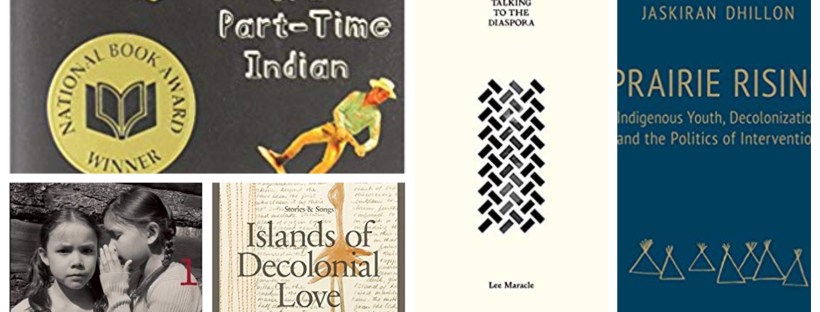
Junior, an aspiring cartoonist, has mixed feelings about growing up on the Spokane Indian Reservation. As he decides to take his future into his own hands, Junior leaves his school on the rez to attend an all-white farm town high school, one where the only other Indigenous presence is the school mascot.
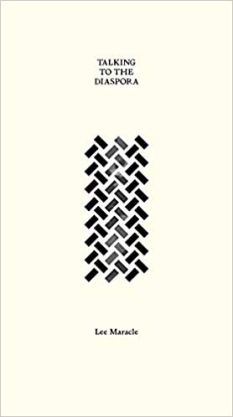
The second collection of poetry by one of Canada’s most prominent contemporary authors features a look at diaspora and identity that is both intimate and larger than the individual experience.
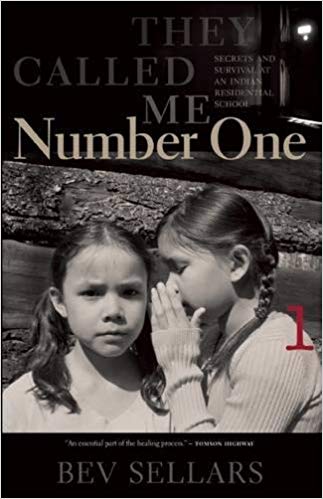
“I read somewhere that everyone is born with the potential for success, and it is only through life’s experiences that we develop or destroy that potential. For many Aboriginal people, our most vulnerable and impressionable years, our childhood years, were spent at residential schools. Our mental, emotional and spiritual growth was extremely stunted because of the way we were treated there. You have to tell our story like it is, don’t hold back or make it seem like it wasn’t as bad as it actually was. People have to know and believe what happened to us.”
A defining part of Xatsu’ll chief Bev Sellars’ childhood was spent as a student in a church-run residential school. This honest and evocative memoir details her time at St. Joseph’s Mission, as well as how it has affected her and her family over generations. As Sellars discusses trauma, diapora, and healing, she makes it apparent that it is only through knowing the truth about these past injustices can we, as a society, can begin to properly address them.
“bringing up trauma from my life made therapy-lady cry, especially if it was “aboriginal” themed. she said “aboriginal” a lot, and i knew she was trying to be respectful so i planned on letting it slide until the breaking point and then i was going to let her have it in one spiralling long manifesto. therapy-lady liked to compare my life to refugees from war-torn countries who hid their kids in closets when airplanes flew over their houses. this was her limit of understanding on colonized intimacy. she wasn’t completely wrong, and while she tried to convince me none of us had to hide our kids anymore, we both knew that wasn’t exactly true. i knew what every ndn knows: that vulnerability, forgiveness and acceptance were privileges. she made the assumption of a white person: they were readily available to all like the fresh produce at the grocery store.”
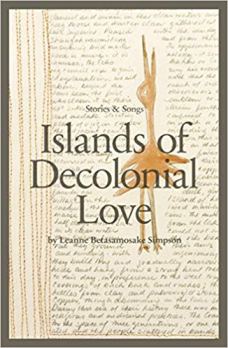
Simpson’s debut collection of short stories explores the lives of contemporary Indigenous peoples and communities, especially those of her own Nishnaabeg nation.
Heartbreaking, absurd, and real, these stories aim to capture all aspects of what it means to be Indigenous in a world that has been taken from Indigenous people.
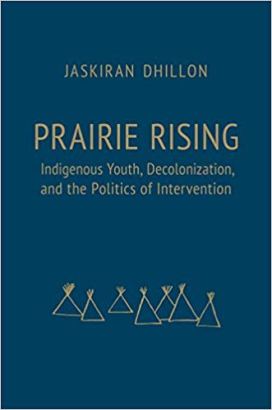
“The persistent sensation of being hunted, of monitored movement, of freedom being truncated through institutional caging is central to the daily reality of being an Indigenous youth in Saskatoon. It is not an anomaly. It is not the fictitious creation of a youthful imagination on overdrive. Through their existence as Indigenous youth, these young people constitute a direct threat to an already existing settler social order.”
Dhillon’s ethnography sharply examines the indigenous-state government of Saskatoon, Canada’s strategy of dispossession and the state’s failure to uphold human and political rights of the indigenous community. We learn that indigenous alliances meant to help indigenous women, lack representation for whom they are advocating: indigenous women. Dhillon, who grew up on Treaty Six Cree Territory in Saskatchewan, details the state’s refusal to look for missing indigenous women and its failure to include indigenous participation in what they deem to be a community in need of reform. Are Canada’s state advocacy organizations merely visible tokens for what they consider invisible problems in their own country?
To read staff bios, please visit our Masthead page here.
Joanna Cleary: Thanks so much for your willingness to have a conversation about your writing with us and congratulations on the publication of your most recent collection of poems: The Sea that Beckoned. According to the book’s description, these poems are “an exploration of all those places we’ve sought to call home.” Could you elaborate on that?
Angela Gabrielle Fabunan: I’ve always yearned for a home. My childhood spent in the Philippines did not feel like home because my mom and dad were always abroad; my mom came home every six months, stayed for six months, then left for six months. Even now, I live in Manila, while my mom lives in Olongapo City, Zambales, which are two different places in the Philippines. I travel for 3-4 hours every weekend to see her.
Place is very different from home. There are many places I mentioned in The Sea That Beckoned, and yet, I feel I am always searching for home, which is why it is an exploration. My home is a place, but not just a place, it is a place of comfort, where my loved ones are. Home is difficult to articulate, for me. So I thought this search for home might lead somewhere, and it did, to The Sea That Beckoned. Each place I’ve been in is ridden with memory and emotion, and I thought it might be interesting for me and for others, if I were to write it down.
Maria Prudente: At the end of your poem, “Midway,” you land on this beautiful line: “I am the mango heart left beating in your hands.” How do you approach imagery in your work? Where do you find your inspiration?
AGBF: I am a bit of a mystic when it comes to poems. I believe that the poem itself will lead me to where it wants to go. Once I have the first line, or the first image, or the first rhyme, it will take me on a journey. I have been schooled in the technical aspects of poetry, and can tell what form or meter I should use, but I wouldn’t want to manipulate the poem into what I want. I want what it wants. So the deeper into my schooling about poetry that I get, it seems the more faith I have in the mysticism of poetry. There are times, however, in revision, where I have to tweak, and I suppose that’s where my formal training comes in. But for a poem such as “Midway,” it came fairly easily, without much manipulation. The images of the foreigner is interwoven within, as are my longing to come “home” to the Philippines. I was in New York then, in 2017, and I was torn between a love and a place. I loved New York, but I had already built what I call a home in the Philippines, with my loved ones. And I thought there might be a poem there.
That image of the mango heart seems like generic Philippine imagery, and indeed the mango has been used many times in folklore or even in contemporary literature. But there’s a bit of background with that—my mom owns a mango farm in Balasiw, Zambales, and that’s where I often visited and ate delicious mangoes. I recently sold some mangoes to friends in Manila this past harvest, and they couldn’t help quoting that quote that you mentioned while I was giving them their mangoes.
I think the most artful images are those that have a back story that you don’t necessarily have to mention. I didn’t mention that my mom had a mango farm in the poem, but the remnants of the emotion I feel when it comes to my mango heart is felt because of that background. So I guess write images of what inspires you, even if it’s something as mundane as mangoes on your kitchen table.
JC: My favourite stanza from “migration story,” a poem in this collection and also published in Eastlit is:
laying down my back to the bamboo
i would count the leaves
above my head, dreaming
of snow, and my dad was bright and alive
then, there in the hot, humid december,
decades ago before he would die
in a frigid hospital while the snow fell.
In this poem, as in your other poems, you mix such intimate details of individual life with universal images of searching, longing, and home. Can you speak to the parts of The Sea that Beckoned that you found the most personally difficult, and/or personally rewarding, to write about?
AGBF: I believe that poems crafted from the heart are those most difficult to write, because it comes from a synergy of the heart and the mind, of the intricate connections between emotions and intellect. You sort of have to find a way to be able to mix the two gently. The silly love poems in the latter half of the book were, personally, because the trauma of love for me is still ongoing. The love poems such as “Murasaki,” and “To the Man Who Claimed Me” and “Visit” did not come to me as effortlessly as did the poems of place, such as “Midway” and “Abò,” perhaps because I am always thinking of place, of home, and of my tender regard for these places.
The poem you mentioned, “migration story” is an ode to my dad, and although he’s been gone for more than 10 years, every time I revisit the story of his life, it’s both difficult and rewarding. It’s the epitome of the synergy I was talking about earlier and of plumbing through loss.
MP: What advice do you have for writers interested in publishing their collection of work? What was your process for The Sea That Beckoned?
AGBF: My advice for young writers is just to read, read, read and write, write, write. One of my poetry professors always told me never to rush the poem. I always take it to wherever it leads me, and some poems take minutes and some poems take years. The poem always has a mind of its own (a muse, maybe?) and thus it can tell you if it needs to be a sonnet and a pantoum, if it needs to be in rhyme or meter, if it needs to be published now or later.
As for publishing, I have the same advice: submit submit submit. Never be afraid of rejection, because it will give you the strength to work harder to be accepted. I submitted through the regular submission cycles at Platypus Press, and the editors Michelle Tudor and Peter Barnfather were kind enough to choose my work amongst many others. If I had been afraid of submitting then, The Sea That Beckoned would never have been published.
MP: We cannot wait to read more from you! Can you tell us what you are currently working on?
AGBF: I’m working on a second manuscript, for the moment called As Memento, As Imagen, As Woman. It’s a work inspired by mythology and feminism alike, and inspired by the works of Carol Ann Duffy and Louise Glück. In these poems, I give voice to women of myth, from Greco-Roman to Philippine mythology, such as Medusa and Bakunawa, bending these myths along the way to reflect the context of the modern-day Filipina. It still needs a lot of work, but it’s getting there. Thank you for your questions and this interview! 🙂
To buy Angela Gabrielle Fabunan’s book, The Sea That Beckoned, click on the link here.
Art by Rayji de Guia
ANGELA GABRIELLE FABUNAN was born in the Philippines and raised in New York City. She graduated from Bowdoin College and attends the University of the Philippines MA Creative Writing Program. In 2016, she was awarded the Carlos Palanca Memorial Foundation Awards for Poetry. Her work has appeared in or is forthcoming from Cordite Poetry Review, Asymptote Journal, Cha: An Asian Literary Journal, Eastlit Magazine, and New Asian Writing, among others. She is one of the current poetry editors at Inklette Magazine. Her first book of poetry, The Sea That Beckoned, is available from Platypus Press.
Although the spirit of queer pride should last 365 days a year, today marks the last Friday of Pride month 2019. Here are the top picks of LGBTQ+ literature or works of literature written by LGBTQ+ writers to last you all until June 2020.
Links to buy books mentioned below through Amazon can be accessed by clicking on the titles.
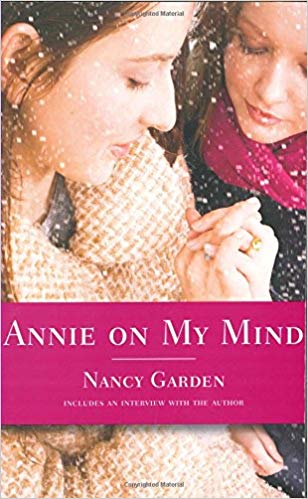
I found this book at a time when I was just beginning to come to terms with my queerness and it helped normalize being gay for me. While this love story between two girls takes place in the 1980s, the nuanced character development and intricacies of the love explored helped me realize that being all forms of love deserve to exist not solely defined by their political status.
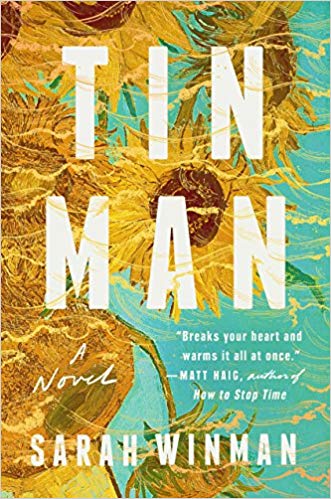
I read Tin Man on the recommendation of a friend, unaware of the storyline or the synopsis. The story I encountered was perhaps one of the most emotionally poignant ones I had read. Tin Man depicts love and sexuality beyond the cardboard boxes we put them in and touches upon art, friendship, and desire by freeing these from their socially gendered labels. It’s a warm, gradual narrative on sadness and nostalgia, and the transformative potential of love.
While the poems in this collection often deal with the conflicts of history, politics, culture, and family, hope and beauty win out for the view of the future. Her poems cross boundaries into the vulnerable to reveal how loving someone can help you love the world.It’s published by Artoi Books, which is an imprint of Red Hen Press (Arktoi Books publishes literary poetry by lesbian writers).
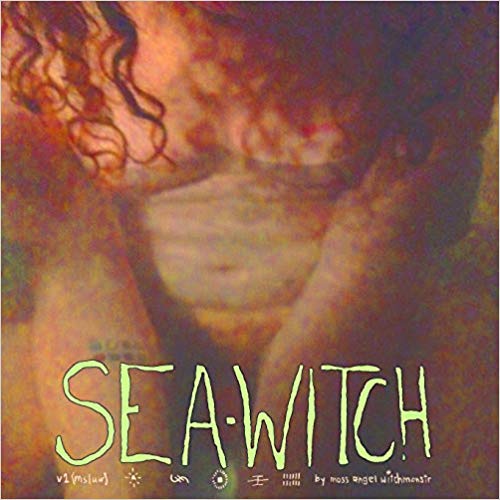
I think Sea-Witch was revolutionary for me: a work centered around transsexuality, a genre-fluid/genre-defying and literature-altering book, Never Angeline Nørth’s book is about a girl monster, a witch-god, about their origin stories and journeys and narratives. I don’t know how to summarize this book but I do know that this book will change the way you look at and critique texts, and I believe it is a great introduction, both in terms of form and content (as much as I despise considering those as the two components of a text), to what the category of LGBTQ+ literature is and can be. Sea-Witch helped me come to terms with my still-developing notion of what my own sexuality is and what it means to me. The book sounds tumultuous but that is the beauty, that is its defiance, and that is what motivates me to make peace with my tumultuous sexuality.
Christopher Isherwood was one of the first queer authors I came across during my English studies, and his stories opened up new perspectives to regard the world I’d grown up in. In my private Isherwood collection, A Single Man still stands out most remarkably. An artistically crafted story about seclusion and otherness, it tells the tragic end of a curtained love in a homophobic society that grants no (public) closure for the bereaved. But more powerfully, Isherwood’s insight into a single day of a grieving man revealed to me the beauty of two men in love – physically and emotionally. Reading A Single Man, you’ll certainly be touched by the despair that travels from the first to the last page. But I also hope that you’ll be ignited – to make reality better.
Look Garth Greenwell up on Youtube and listen to him read aloud from his work before you read this novel. He was trained as poet before turning to prose, and his history shows in his work: every sentence has a rhythm that demands to be read aloud. That isn’t to say that the ideas of his work don’t matter, but auditory beauty is a nice way to ease yourself into the story that is ultimately devastating. The story follows an American professor teaching in Bulgaria, who pays a young man named Mitko for sex and comes back to him again and again. The driving question of the novel is whether Mitko really has a connection with the narrator, or if it’s all just loneliness making infatuation feel like love. I’m not gay, I’ve never been to Bulgaria, and the world of illicit sexuality described in the book is something I’ve never experienced. Which might have been part of why I liked it so much: much of the power of fiction is to show you what you’ve never known or seen. But even more powerful is the universality of the book. Wondering if your love is real or not is something that every romantically-inclined person has felt, no matter who you are or who you love.
– John S. Osler III, Prose Editor
To view staff bios and learn more about our staff, check out our Masthead page here.




 Inklette Magazine