GABE HALES is an 18-year-old high schooler based out of Okemos, Michigan who has always loved creating and capturing with a lens. He’s worked with major corporate companies such as Context Summits on photography and videography of their events in the past and has a few jobs lined up in the future as well. Ever since he was a kid he’s loved looking at the world through a lens.
MARK AIZENBERG is a self-taught photographer located at Wynnewood, PA. Mark combines his background as a neuroscientist with his photography, creating impactful, award-winning images. If asked to describe in one word his art, this word would be “simplicity”. In Mark’s opinion, basic shapes, lines and curves, complimentary color schemes can have a deep emotional impact by stimulating the viewer’s active role in experiencing the photograph. Despite using a DSLR and iPhone to create images, he often strive to blur the line between photography and painting by reducing number of details.
Mark’s work has been accepted into numerous juried exhibits distributed in the Philadelphia metropolis. In addition to his fine art, Mark offers a wide array of photography services including portraiture and events. Mark invites everyone to get familiar with his work on his website: markaizenbergphoto.com
Artist Statement: “This image is part of Robert G Alexander‘s current series, consisting of close-up studies of eyes. This series was initially inspired by his research on visual cognition and psychophysics. Knowing that when we look at other people, we mostly look at their eyes, he wondered if he could transform that typical view in a meaningful way. By taking our most commonly seen features—our eyes—and approaching that subject with awe and reverence, Alexander works to find new meaning, new depths, and new emotions in each drawing. Alexander lives, works, and creates in New York, where his daughters are a source of inexhaustible inspiration and meaning in his life. He works mostly in graphite and charcoal because he feels that the immediacy and freedom in those materials allows him to best capture the sense of empowerment that he hopes to convey in his art.”
‘Looking To The Light,’ Graphite on Paper, 2016
“Many of us struggle with our self-image. Every day, society bombards us with harmful messages. I believe that I have a special responsibility to challenge those ideas, using creative, loving compassion to celebrate feminine grace and strength. I fight back as a visual artist by honoring the positive aspects of body image and by working to break down our emphasis on physical beauty. Everyone deserves to feel beautiful and strong. Our bodies are sacred; our only means to act in this world; to share love and joy. This perspective has led me to engage in dialogue with communities of women who dislike the way they look—including many who have (or are recovering from) eating disorders. Through portraying the strength in these women, and portraying their successes, I advocate for social change: More than ever, we need to recognize our strengths and celebrate the beauty that exists in each other.”—- ROBERT ALEXANDER
Artist Statement: “A fundamental part of our daily experiences, the sense of touch is a means of gathering information and establishing trust and bonds with other people and environments. In our current society, however, we are “connected” through so many digital channels that our physical connections are becoming lost.
These magnetic body sculptures turn the unseeable sense of touch into a magnified motion; enhancing the sense. The material construction of the knitted sculptures allows wearers to physically connect themselves to other people and environments around them through the integration of magnetic materials. Utilising the properties of the magnetic knitted structures, these garments can also change shape and form on the body, depending on how they are connected.”
‘Touch is the sense that makes us human,’ Mixed Media, 2016
SOPHIE HORROCKS is a British knitted textile designer currently living and working in Hong Kong. Sophie is a keen experimenter who uses materials, structure, and form to explore and understand the immaterial elements of our bodies and environments. As a curious designer, Sophie believes there are no boundaries to what we can classify as a textile, drawing inspiration from all aspects of life; in particular sociological theories, nature and the human anatomy. Previous collaborations have included biomaterial engineers and computer scientists; these have aided her quest to investigate the potentials of materials.
NYRI A. BAKKALIAN is a queer Armenian-American and adopted Pittsburgher. A military historian by training, she’s an artist and writer whose work has appeared on Inatri, Metropolis Japan, Gutsy Broads, and Queer PGH. She has a soft spot for local history and unknown stories, preferably uncovered during road trips. When not hunting for unknown history, Nyri can most often be found sketching while enjoying a good cup of Turkish coffee. Check out her blog at sparrowdreams.com, and come say hello on Twitter at @riversidewings.
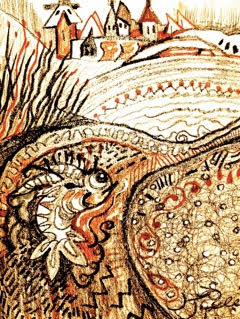
The way to our house takes you past the river where it bends around Beaver Island, flowing toward the dam. In June, boys toss their lines with calm restraint. Their eyes have become clouds, faces serene as statues from a land of sun-bleached stone. They wave as you pass, three hands or four, and maybe the wind ruffles their hair, and somewhere strange fish rise toward the surface with their ancient gills and their blood. And the road leads down into a valley of golden trees, where sky changes color beneath the scarlet sun. You may hear women singing in the flower-sprinkled grass, or you may feel the breath of their tongues as words roll across the yard. There is a word for anger, and one for spite, and quite another to describe the hot scent of bread, or the way to connect two bodies with a little bridge of flesh.
Illustration by Rebecca Pyle
The House No One Remembers
Here in the north it sits abandoned,
hunched in the wind, a silent place
with a hundred mouths and broken
tongues. Seven hothouse lilies stood
in a clear glass vase, seven cats curled
gray bodies around the hearth, as smoke
braided above the chimney, while cold
sun stared down on juniper and pine.
A sister lived there with seven brothers
who flew into the sky as their black
wings dripped blood onto new fallen
snow. Seven years without laughter
or a single word to disturb the silence
she has come to love, or the rhythm
of her hands weaving brightly colored
tapestries of change. Clean floors, clean
linens, bread and cheese, a table rubbed
with lemon and oil. Water drawn from a
clear well. No boots thumping, no snores
or snapping towels, no coarse hairs
in the sink, just her visions growing like a slow
flame, consuming her day by day without pain.
STEVE KLEPETAR’s work has appeared widely and has received several nominations for Best of the Net and the Pushcart Prize, including four in 2016. His most recent collections are Family Reunion, A Landscape in Hell, and How Fascism Comes to America.
REBECCA PYLE, now living above a hundred-foot rock garden near the Great Salt Lake in Utah, has artwork that will appear or is forthcoming in Hawai’i Review, New England Review, and the art / lit publication Raven Chronicles, out of Seattle. See a collection of her artwork at rebeccapyleartist.com. She is also a writer, a member of the writers’ group The King’s English, and recent work by her can be found in The Healing Muse, Stoneboat and (later this year) the Wisconsin Review.
A story: I volunteer to write a blog piece for Inklette on a hazy Wednesday evening and an idea appears, as they often do for me, seemingly out of nowhere. I want to write about the female body. No, a voice within me interjects. That’s too political. The voice is correct; bodies are political. This inner resistance is not a result of me wanting to shy away from my political beliefs, however, but more a result of me not wanting to be yelled at for being politically incorrect in a world, particularly a virtual world, where it is impossible to be politically correct to everyone.
I continue to stare at a blank Word document in hopes that another idea comes to me. Slowly, my gaze slides from my computer screen to my forearms, resting beside the keyboard of my laptop. They inexplicably appear stubborn, resistant. They seem to want to say something, but, being forearms, they can’t. I look at my hands next. Get typing, the voice inside my head says, having changed its (my?) mind. I do.
Being a Poetry Editor for Inklette, I spend an embarrassing amount of time writing and reading poetry. Here is a list of poems about the female body that each emotionally resonate with me. I acknowledge that there are as many different female bodies as there as females and that these differences can stem from life experiences, gender identity, ability, race, ethnicity, culture, and so on. This list does not attempt to capture all the complexities of the female body, as that would be impossible, but is rather the product of the nights I spend staying up reading poetry I haven’t read before instead of going to bed.
Enjoy. Read them in order. Pick one at random. Recite your favourite at a poetry slam. Write a response poem. Write a comparative essay and show it to your English teacher. I decided not to write any commentary concerning the poems themselves so that each one will come as a surprise. As you read, I have one request: remember to feel the poetry. We too often forget, or choose not to acknowledge, how things make us feel.
Go ahead. Be political. We don’t have a choice about that, for better or for worse. All bodies can be powerful and perhaps that power deserves to be used. I developed a rather complex formula when I was collecting poems for this article: meaning = feeling = power = politics = change/advocacy = progress. For good reason, progress is often seen as an illusion. I agree that it is, unfortunately, too often illusive, but I also believe it exists in some form. I see potential for progress to come about through these poems and the reading of them. So, read. See the power in the female body.
JOANNA CLEARY has been part of the Inklette team since 2015 and is pathetically in love with poetry. Her work has previously appeared in Cicada Magazine, Inklette Magazine, Glass Kite Anthology, Parallel Ink, Phosphene Literary Journal, HIV Here and Now, and On the Rusk. She is the 2017 recipient of the 2017 University of Waterloo Creative Writing Society Award for Poetry




 Inklette Magazine