Abuse of the Body

13479947_10208220749589642_1085720231_n

Illustration by Ashwin Pandya

Abuse of the body comes as no surprise. I know this. It’s Friday night and I’m at the regular keg, in the empty lot behind the warehouse, and soon the fighting will start. I know this. It’s hard not to when I’m here, already reaching for my second cup and then a third. In Elk Horn, Iowa, this is Friday night. A bonfire. A keg. Thirty or so of us huddled together, waiting for something to happen.

The boys all wear what you’d expect them to; varsity jackets and steel-toed work boots.The girls are in their uniforms–tight  jeans, blue eyeshadow, foundation caking their cheeks. I’m an outlier in my loose clothing, my short hair, and like this I stay invisible. I look around for Sarah but don’t see her. To my right a gaggle of girls are all laughing. They sound like hyenas in my ear and Jenna’s red cup is tilted dangerously close to spilling on my sneakers, but I don’t say anything. Sarah is the only one I talk to.

The fighting comes naturally, like moving through water. A pack of boys in the steaming slick of the night–of course there’s violence. Of course. It only sounds strange because nobody wants to look at it that way. A pack of boys with nothing better to do, with trucks and beer and fists.

Think about where we were born from–that kind of carnage. Scrawny boy-chests flat and unmuscled as dead earth. The edge of town and how it goes barren, colorless dirt. Think about our fathers and reclining sofas, about ice tires, about Fox News and algebra II and complacency. It makes sense, the boys with fists.

I’m the only girl who fights. We crowd around the keg and I drink fast, thinking of the twenty I slipped the Fareway cashier for a case because he doesn’t ID, long as he can keep the change. In the cold my body begins to feel edgeless, skin blurring into night. I fight the boys because because it’s the only option. When you fight, they stop spitting at your feet. When you fight, they leave you alone. When you fight, there are no post-it notes stuck to your backside, no roadkill shoved inside your locker, and they don’t make fun of your short hair.

Tonight, Andrew swings the first punch, this time at Billy. The party backs up, makes a circle. Billy punches Andrew back, red Solo cup sailing out of his hand and clattering to the concrete. So it begins.

The boys fight like dogs, their breathing loud, heavy. Andrew’s smaller, so the crowd thinks he’s done for, but I know it doesn’t matter, that his body is a steel plate dipped into life, that his knuckles could crack your teeth into dust. Billy swings but Andrew’s too fast. He ducks beneath his aim, laughing.  He strikes Billy’s cheekbone. I can hear the sound, the collision of flesh on flesh. Billy’s jaw drops and before he can hide it, shock washes over his face in a wave. In that half second, Andrew punches him square in the stomach. He doubles over, a wail escaping him. Andrew not stopping until Bobby is on the ground. No longer the big one. Not anymore.

Andrew, out of breath, takes Billy’s limp hand from his side and raises it in his, signaling the end. Steam rises off his face and neck in the cold, and he grins with all of his teeth showing. The audience cheers drunk and enraptured, made delirious by the violence. It’s only now that my presence is noticed. People around me look out from the corner of their eyes, trying to see if I’m watching. I am. Under my sweater, my heart beats full and heavy, and even in the cold I can feel my hot breath, my wet lips. I’m waiting and imagining my hands as fists, the fight inside a drunken circle. Its own breed of church. Where the anger in me prays, gets reborn staticky and new.

Andrew’s still now, steam rising off his neck, making him look like a stallion. He comes toward me, nostrils flared, gripping my shoulder in the damp curve of his palm, and I nod, stepping forward. The crowd shifts so that we are now in the center. Andrew stands still, hands by his side. He gives a slight nod and this is my cue to swing, hard, right hook aimed at his jaw but he’s faster than me, ducks. He swings straight forward and hits me square in the stomach. I should be doubled over now, but instead I feel electric, I feel like a live wire, and I just smile. Andrew pauses, and in that second I punch his shoulder. He steps back, stunned, and then I’m going for his gut, his face, his hands plastered over his eyes because he knows I’m not stopping. I don’t mean to knee him in the groin because I don’t like to fight dirty, but I do it without thinking. Andrew is on the ground. He reaches up his palms in surrender. I help Andrew up and we re-enter the crowd.

Roy steps into the empty circle now. His varsity jacket looks waxy in the dark and the blockish jut of his forehead and wide nose are the only discernible features on his face. Roy’s the most brutish of the boys, so I don’t volunteer to fight him, despite sidelong glances from the crowd around me. I don’t mind getting beat up, but I’m not trying to die.

This moment of pause is when I notice Sarah for the first time all night. I see her lanky figure from afar, tight jeans and long blonde hair, hear her high-pitched laugh. From the way she is standing, one hip jutting out, hand gripping a beer, I can tell how drunk she is. It doesn’t take much for Sarah to get wasted but that doesn’t stop her. In her cowgirl boots and blue eyeshadow, she looks, for a moment, like a statue in the cold. My best friend. Not that she knows this. Sarah and I have lived on the same street for fifteen years. We hang out on weekdays, textbooks spread across my living room table. I help her study and she tells me about her life, the boys who wait outside her door to take her on dates, her parents’ arguing, where she hopes she’ll wind up. I never have anything to say back so I just listen, study the blonde highlights in her hair, her perfect nose. She’s my best friend but I’m more like a bookmark, something holding her in place.

“Roy!” Sarah shouts. “Roy!” And then she’s stepping into the circle’s center, the crowd suspended in silence. “Roy! Fight me!” she laughs, although there’s an edge to her voice. “Do it!” Billy shouts. One of the boys starts yelling, “Fight, fight, fight!” Sarah’s stands there grinning, like an idiot, until Roy winds up his right arm and hits her. Hard.

Something swells in my throat and my jaw drops. At first Sarah was laughing in Roy’s face, her teeth bared. But then he hits  her, a slap across the face that sounds like a loud crack in the night. It’s horrible to watch,the way her neck jerks from the impact of his strength. Her baby blue eyeshadow almost luminescent in the dark. My best friend.

I want to stop him, but I’m gridlocked by bodies and paralyzed by fear, knowing Roy could unhinge my jaw like snapping a toothpick.

I remember, now, algebra class second period. How they once sat together. How Roy’s hand drifted to Sarah’s knee in a way he thought was subtle. I remember her giggling at his bad jokes and then I remember them not speaking. I remember a week later Sarah holding hands with Roger McCormick. Not Roy.

He stands face-to-face with Sarah, and everything is silent. She’s breathing heavily. He rears back to hit her again, but last minute she ducks and takes off, breaking through the parting throng of people, running, running into the dark.

I sprint after her, my eyes fixed on her moving figure ahead of me, her swinging arms. I don’t know how far she goes but finally she rounds the corner on a barn along the edge of the road, leans against its wall, catches her breath.

My breath makes little puffs of fog in the cold but my heart’s still beating like crazy. Part of it’s the running but it’s also something else, the ugliness I watched, how something dark and sickly was born from within the circle, from the force of Roy’s fists.

The December air starts biting into us now that we’re suddenly so sober, and we find the barn door from its outline in the dark, its door hanging half-open on a crooked hinge.

Inside, we lean against a wall, sliding down until we’re sitting on the concrete floor. It’s dark and empty, no animals inside, no hay lining stalls or farm tools hanging from the wall. Through the rafters I can see slivers of moonlight shining in. Surrounded by all this empty, our breathing echoes back at us, amplified in the soft dark.

I look at Sarah, really look at her, and assess her face. She has a welt in the shape of a hand, a bloody nose. She’s ghost-pale. I wrap my arm around her and she presses her face into my shoulder, her breath soft against my neck. We sit and I think about Roy Normally, I can handle the violence. Enjoy it, even. But tonight was something much darker, a corrosive rage, ripping through me.

Sarah doesn’t make any noise when she starts to cry. I feel a wetness against my neck and I just know, so I stroke her hair, like spun gold between my fingers.

Sarah’s laugh from inside the circle rings in my ears. The image of her like a statue, like a saint, out in the cold. We didn’t deserve any of this. She didn’t, anyway. Me, I know I can take it. That’s why I do.

Sarah lifts her head and her eyes meet mine, wide and glassy.

“Why did I do that?” she asks in a whisper, and I kiss the top of her head, without thinking. I love her, so much. “You’re my best friend and you don’t even know it,” I want to say. But I don’t. I stroke her hair. I say, “I don’t know, Sarah. You know I’m the only girl who fights.”


GRETA WILENSKY was the 2015 runner-up in prose for the first annual Winter Tangerine Review Prizes and the 2016 runner-up for So to Speak’s annual fiction competition. Her fiction and poetry is published or forthcoming in the Best Teen Writing Anthology of 2015, Souvenir Lit Journal, Alexandria Quarterly, Blueshift Journal, the James Franco Review, Bartleby Snopes, Duende, Gone Lawn and So to Speak. Her work has been displayed at MoMA PS1 in NYC and in the Department of Education building in Washington, D.C. She lives in Lowell, MA.

ASHWIN PANDYA is a sketch-artist and illustrator, whose work has graced many book-covers. Acknowledged for his digital art as well as musical compositions, Ashwin Pandya can sketch given any situation, description or character. You can visit his website here.

Editors’ Note

It is strange enough that as we start to look back, the first thing we notice is time. We remember, today, what has or has not changed since May 1, when we started reading submissions.

As we bring to you our third issue, we distill this space, this moment for some time. Here we are, standing while everything slips from our feet, after having waited on them awhile.

***

We think of how young children fill flasks with rainwater to drink on their way back home from school. We know how water always comes to the edge and hits the ground, gently.

With change, with new forms of arrival, we rise and fall. Sometimes we don’t make a sound.

Our lives, too, like the life of this space we so lovingly belong to, have unveiled unexpectedly. Perhaps, why everything in this issue answers something we don’t know. The answers we know are distant, hazed. And yet, it is a mystery as to how we find refuge in them, how we step out of ourselves into language that never does everything.

Carson Sawyer’s poems bring us back to the place we all belong. We wait, right here where we are, to know the answers after reading Dexter Gore’s short story. We believe the deepest mysteries after looking at the photograph taken by Aayushi Deshpande. 

***

Special thanks to Alexandria Heather, Nilesh Mondal, Brynne Rebele-Henry, and Michael H. Broder for being a part of Inklette’s featured section. Your work and charm never cease to amaze us.

This is the third time we are publishing Lisa Stice, a reader we all cherish and feel thankful for.

We would like to acknowledge Ashwin Pandya and Priyanka Paul for their wonderful illustrations that accompany a few pieces in this issue.

Through months of hard work and new beginnings, the staff at Inklette Magazine has, again, maintained their undying friendship, commitment and sheer brilliance to bring this issue to you. As always, we are thankful for the rare and beautiful human beings and colleagues that they are.

Lastly, both of us are grateful we share this space together— such a rare and beautiful space, just like our friendship.

Here we are with the windows open. And here we will stay for you, always.

Thank you so much!

Trivarna Hariharan and Devanshi Khetarpal

Editors-in-Chief

Inklette Magazine 

Orange Day

coded controversy was the sparkly spoon born into shamed silent mouths, shielded in rust

hidden from sun and scars, we (almost) unite. this is gay pride, this is stand by me, or,

more to the point, the baby-sitters’ club, the fuzzy femme speakeasy we dreamed

when first we tugged our cautionary sweaters over the rainbow patch on our

pants. lustful cheers, hugging mirrors, outraged objection, ointment

fly intervention are communal glue, a babel fish easing dangers,

intro for strangers.  until the journey to the cliff is waxed off

at the end, thirteen hours past your window, dregs a

shortened solo voyage back down the mountain,

like a compelling book you recited in

transnational unison but can

only reread

alone.


DEB JANNERSON is a New Orleans-based poet and author of bildungsroman fiction, queer romance, and children’s horror and sci-fi. Her book of poetry, Rabbit Rabbit, was published by Finishing Line Press in 2016. She has stories in Best Lesbian Erotica 2015, My Gay New Orleans, and the forthcoming collection Best Lesbian Erotica of the Year, Volume 1. Her new adult novella, Further, was shortlisted for the 2015 William Faulkner – Wisdom Award. Her work has been featured in over a dozen magazines, including Bitch, E·ratio, and Women’s Review of Books. Learn more on her website here and Facebook page here.

Sylvia

Artist Statement: “Even though I prefer photography as a medium to capture happier emotions, I turn to my camera when writing my heart out isn’t enough. This self-portrait serves as testimony to my undying love for Sylvia Plath, and to a semester that almost brought me to ruins, and to survival.”


Aayushi_Deshpande-Sylvia_Ink (1).JPG

Sylvia by Aayushi Deshpande
Photography Ι 3740 X 2494 Ι 2016

AAYUSHI writes poetry for the lack of prose-ac. She loves quizzing and Tumblr, and her choice of weapon is her Canon 400D. She believes that art as an agent and expression of empathy has the capacity to transform individuals and make a difference in this world. She has a recessive musical gene, and her spirit song is ‘Vienna’ by Billy Joel.

Burgundy

We were in a garden, in a mall. A garden of crimson and fuchsia bullets. Bullets spread neatly over the shelves of counters, under the label of LIPSTICK TESTERS.  I hovered over the bullets, taking my pick while Ann went to the bronzer counter. The salesgirl had judged us to be too rich, thanks to the accent we pulled off and my cold command to the staff, asking for a French moisturiser that was not available in the country. The coast was clear.

By then I had picked my shade. A deep cool toned wine color with a matte finish. Finalizing my choice, I signalled the salesgirl. She left the preteens she was watching over and approached me with a placid face.

“I need an an eyeshadow to go with this color,” I said, showing her a tangerine lipstick that was far too warm toned for pale face to handle.

“Sure ma’am,” she said with the mechanised promptness of a vending machine.

She turned. I scanned the store with a sweeping gaze, picked up my beautiful burgundy and slid it in the right pocket of my jeans.

I stood there, waiting for the feeling to dawn upon me like a landing plane. Nope, nothing. My conscience stayed true to its pledge of silence.

She returned with some baked, coral eye shadow that I obviously had to dismiss. I would have bought it if I hadn’t shoplifted.

I called Ann out, whose pockets and bra must have been brimming with highlighters and mascaras.  She then proceeded to play last move – buying a hot pink lip balm that tasted of strawberry.

Ann had a whole drawer full of strawberry lip balms back home.

Her polishing touch to remove any traces of suspicion. Or guilt.

We sat and ate Crimson rolls in the food court; the distinct aroma of freshly brewed coffee seeping through the still air conditioning with the ease of the infusion of a steeping teabag. She drank her hazelnut frappuccino with a straw, I chugged my Caffe misto.

The barista rolled his eyes at the high schoolers who were evidently here only for the free wifi; their eyes transfixed on their iPhones.

“We can’t do it here,” Ann pointed out, after taking in the surroundings.

“The bar’s always there.” I said dryly.

We went to the bar and gushed into the smoking zone with the urgency of a fever. Two boys stood there, with glass red eyes, one wearing a black pink Floyd T-shirt, the other wearing a cloth poster of Jim Morrison. Ann was always really put off by stoners, but I harboured a great love for their playlists.

We cornered a corner and sat down on the cold ground, leaning our heads against the glass walls, panting more out of thrill than exhaustion. Ann started the ceremony.

One steal at a time, we laid out our shoplifted jewels on the floor, neatly in a line. An avocado moisturiser, a Dior lip-gloss, double ended mascara, a pale baby pink highlighter and a burgundy lipstick.

We divided the treasure in a neat fifty – fifty, with alternating turns at the mascara.

“Ann,” I said, looking at her angular face that was carved out for a high fashion shoot.

“I don’t feel guilty,” my voice now gaunt  .

She smiled a wry smile, eyes still lit up. “That’s all right”.


MEHAR HALEEM is a seventeen year old student who writes for the editorial board of her school. She has previously won several creative writing competitions. This is her first publication. She currently lives in New Delhi, India.

Sacrifice

I was a lesbian when he met me

but I hadn’t made love to any girls yet


—didn’t know I wanted to

make love to any girls yet—


because I’d been told that that love

would make me burn in hell


and I was a good girl

—loved my Jesus—


so a good girl like me,

so good at sacrifice,


couldn’t possibly be in love with those

side-swept, black-brown bangs,


irreverent freckles and earphones

jammed above perfect lobes—


I just admired her.

And even Jesus would approve


of how much attention

I paid to that pageboy haircut,


that witty retort, the newspaper ink on

her fingers,


how angry I was that

her boyfriend wasn’t good enough for her,


how in a moment of weakness I thought

that I could do a better job.


A Georgia native, ABIGAIL PATTERSON has been an active participant in the Athens poetry scene, reading at local venues and for the University of Georgia’s radio station WUOG. She received her MA in Professional Writing from Kennesaw State University and lives in Fort Collins, Colorado with her husband and daughter.

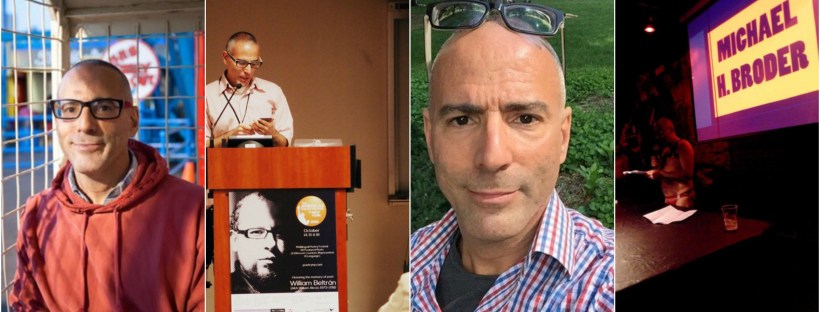
Featuring Michael Broder & The HIV Here and Now Project

The HIV Here and Now Project uses poetry and other arts to advocate for a world without HIV or AIDS. It is a project of Indolent Books and is directed by Michael Broder. The project grew out of an idea for an anthology of poems, still in development, touching on HIV in the 21st century. On June 5, 2015, an online poem-a-day countdown to 35 years of AIDS on June 5, 2016 began. With the online countdown behind them, the print anthology is currently being edited. The site has been lively with blog posts by contributing editors and guest bloggers, many of whom contributed poems to the online countdown and will be represented in the print anthology. Blog posts address long-term survival, recent infection, racialization of HIV, criminalization of HIV, globalization of HIV, and living with HIV risk, among other topics.


BroderPic_CROPPED

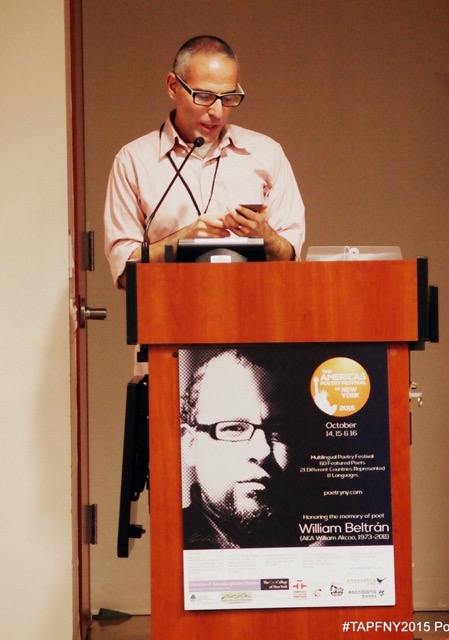
Michael Reading at the Americas Poetry Festival

New York, 2015


THREE poems by michael h. broder


 These poems were part of the Tupelo 30/30 Project in December 2015. 


ESTEEM 


I have a shit list

I love my shit list

I want to roll around like a pig in the ordure of my shit list.

My husband hates my shit list, hates that I have a shit list,

not so much that I harbor ill will or that there is a list—

no, he’s an old hand at nursing old grudges

—but rather that it’s a SHIT list,

because it’s not hatred, anger, or resentment that he dislikes

so much as scatology

Let’s just sit with that wonderful word for a moment…

scatology

which is funny because my husband

loves Kristeva and her abject

Bakhtin and his bodily grotesque

Bersani and the charnel (or should I say Golgothic) rectum,

but only as ideas—

How he suffered, my husband, reading and writing about Hogg

for his dissertation on the molested boy in the postwar American gay novel,

how he wretches at the sight or even thought of the prolapsed

male anus, associated with fisting and other extreme sex acts

But anyway, getting back to my shit list

my mother had a shit list and I am very like her,

my mother who made frequent use of the Yiddish expressions

Gai kakhen afenyam (Go shit in the ocean) and, my favorite,

Hob dir in drerd, which is literally a rather mild “I hold you in the earth,”

but in force is more like “Go to hell” and which

when spat from my mother’s angry, wounded, despiteful mouth

especially that last word, drerd, uvulated and gutteralized

with all the suffering she had suffered in her battered and banished life,

sounded much more like you are on my shit list.


WHAT WOULD SYLVIA HAVE DONE? 


Daddy, you can fuck me up the ass,

but don’t expect me to lick your balls after.

How many poems can I write about the penetrated male anus?

One for each sphincter, maybe—

Two anal sphincters, the external, which is voluntary,

and the internal, which is involuntary,

controlling the exit of feces from the body;

also the entrance of fingers, fists, penises, dildos, butt plugs

and nozzles for anal douching. But there are other sphincters—

pupillary sphincter (in the iris of the eye);

sphincter orbicularis oculi (muscle around the eye);

upper and lower esophageal sphincters

(and…we’re back to fucking);

cardiac sphincter, atop the stomach,

keeping gastric acid from out of your throat;

pyloric sphincter (bottom of the stomach);

ileocecal sphincter (where small intestine meets large intestine,

liminal space between digestion and poop);

Oddi’s sphincter, named for Ruggero Oddi (1864–1913), Italian,

also know as Glisson’s sphincter,

named for Francis Glisson (1599–1677), British physician,
keeping bile and gall in their proper places;

sphincter urethrae, which keeps you from pissing your pants

(and also capable of being fucked, a kink known as “sounding”);

precapillary sphincters, wee microscopic bloodgates;

and finally the preputial sphincter of the foreskin

(may its memory be for a blessing).

I like to think that any sphincter can be fucked; in some

cases, maybe we just haven’t figured out how—yet.


prayer for healing 


May the one who blessed our ancestors, Abraham, Isaac and Jacob, Sarah, Rebecca, Rachel and Leah, bless and heal those who are ill.

—Traditional Jewish prayer for healing


May all who need healing be cauterized, ectomized, frozen

may your healing leave a scar and your scar trace a map,

the map of your scarred wound lead you to a spot marked x

your branded body conceal treasures of love and light

and may god reveal them all, splitting open your wound again,

so that rivers of truth run from your torn body,

may you be grateful for your suffering and learn from your pain

may the shattered parts heal stronger, your torture make you better

may your battered body, beautiful, bring comfort to others


BRODER_Radicals_Reading

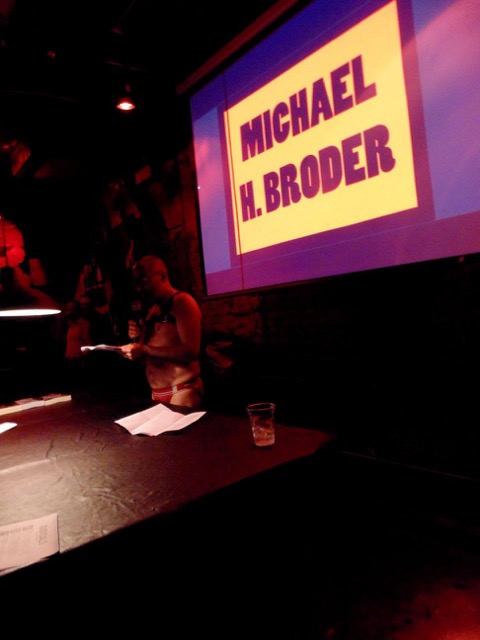
Michael reading in a jock strap and harness at the Radicals Reading at The Eagle

New York, 2015


An INTERVIEW WITH MICHAEL H. BRODER

Inklette:  How do you think poetry and identity should be related? In other words, does it ever bother you to be defined by some as “a gay poet,” or do you think understanding your sexuality, and other things you identify as, is crucial to understanding your poetry?

Michael: My gayness is central to my poetry. That does not mean every poem I write is about gay relationships or gay identity. But I remain gay no matter what kind of poems I write. I’m not sure if I think readers need to understand my identity to understand my poetry. I’m not sure that’s the goal. Maybe I want my poems to expand a reader’s awareness about gayness. This could apply even to gay readers. To paraphrase Tolstoy (sort of), not all gay people are gay in the same way.

Inklette: How do you capture the individual struggles of your sociopolitical identity and turn them into a universally provocative narrative for those who might not identify with your situation? 

Michael: How do I make my gayness relevant to readers who might not relate to it? I don’t really know if I do. I don’t really know if I can. I don’t really think it matters. I used to worry about that. I did not want to be thought of exclusively or even predominantly as a gay poet because I wanted a mainstream audience. But that did not work out very well for me. So now I write whatever I want and I do not worry about who my audience will be. Either I will have an audience or I won’t. Probably I will, if I really want one. But it may be small. But that’s okay too. I think I just need to tell the truth, or my version of the truth or my understanding of the truth. The rest will take care of itself, one way or another.

Inklette: Poetry, in the last few years, has emerged as a platform for young and queer writers to express their identities which are often stifled by society. Do you think poetry often helps us to come to terms with ourselves as people of varied identities?

Michael: Poetry can be a place where the poet can explore the terms of their identity. I’m not sure if that’s the same as coming to terms with one’s identity, but maybe it’s another way of saying the same thing. So, if I write a poem about casual anonymous gay sex, or getting an STD from gay sex, which are two things I’ve written about, it’s not so much that I am coming to terms with my gayness as it is about exploring the semantic field of my gayness— what my gayness includes in terms of thoughts, feelings, ideas, and experiences.

Inklette: Can you tell us about how poetry can inspire people to action? While we know there exist realms of thought that do so, what is that spark which can start revolutions? Shall we believe in poetry to change things?

Michael: Generally speaking, I do not believe poetry can inspire action in the way that songs can, in the way that songs can become anthems that rouse the passions of a generation to fight for freedom or protest a war. Maybe today it is memes that do that as much as songs. I’m much too old to really understand what memes are or how they work, but I get the idea that memes can have that kind of power to incite people to act for change. I believe, again, speaking generally, that the power of poetry is more subtle than music or memes. I believe that poetry shapes or reshapes consciousness incrementally and cumulatively, bit by bit, over time. Poetry can shape how and what people think, feel, and believe, and move people into a state of mind where they may want change and work for change. Poetry can change poetry—I mean, a radical new poetic vision can reshape what poetry is and what poetry can be—as Emily Dickinson did, or Walt Whitman, or Gertrude Stein, or the confessional poets, or the beat poets, or very recently, the hip-hop poets. Same applies to music, theater, dance, and the visual arts. But I think only people can change and reshape society, because society is the sum total of people and their thoughts, feelings, beliefs, opinions, and actions. I guess I’m going way back to the Marxian notion of base and superstructure. Only that’s a simplistic idea that has been deepened, widened, and enriched over time by cultural materialists like Raymond Williams and Alan Sinfield. They give culture a much more instrumental rather than merely an ornamental role in society and history. But in the end, people need to march in the streets, assume roles in government, make new laws, and create new norms for society. People must create conditions for justice to flourish. Poetry can help shape the social imaginary that undergirds political action. But poetry is not the same as political action.


Photo Shape Editor: https://www.tuxpi.com/photo-effects/shape-toolMICHAEL BRODER is the author of Drug and Disease Free (Indolent Books, 2016) and This Life Now (A Midsummer Night’s Press, 2014), a finalist for the 2015 Lambda Literary Award for Gay Poetry. His poems have appeared in American Poetry ReviewAssaracusBLOOMColumbia Poetry ReviewCourt Green, OCHO, Painted Bride Quarterly, and other journals, as well as in the anthologies This New Breed: Gents, Bad Boys and Barbarians 2 (Windstorm Creative, 2004), edited by Rudy Kikel; My Diva: 65 Gay Men on the Women Who Inspire Them(Terrace Books, 2009), edited by Michael Montlack; Spaces Between Us: Poetry, Prose and Art on HIV/AIDS (Third World Press, 2010), edited by Kelly Norman Ellis and ML Hunter; Divining Divas: 50 Gay Men on Their Muses (Lethe Press, 2012), edited by Michael Montlack, and Multilingual Anthology: The Americas Poetry Festival of New York 2015 (Artepoética Press, 2015), edited by Carlos Aguasaco and Yrene Santos. Michael is the founding publisher of  Indolent Books and the founding editor of The HIV Here and Now Project. He lives in Brooklyn with his husband, the poet Jason Schneiderman, and a backyard colony of stray and feral cats.