Editors’ Note

It is strange enough that as we start to look back, the first thing we notice is time. We remember, today, what has or has not changed since May 1, when we started reading submissions.

As we bring to you our third issue, we distill this space, this moment for some time. Here we are, standing while everything slips from our feet, after having waited on them awhile.

***

We think of how young children fill flasks with rainwater to drink on their way back home from school. We know how water always comes to the edge and hits the ground, gently.

With change, with new forms of arrival, we rise and fall. Sometimes we don’t make a sound.

Our lives, too, like the life of this space we so lovingly belong to, have unveiled unexpectedly. Perhaps, why everything in this issue answers something we don’t know. The answers we know are distant, hazed. And yet, it is a mystery as to how we find refuge in them, how we step out of ourselves into language that never does everything.

Carson Sawyer’s poems bring us back to the place we all belong. We wait, right here where we are, to know the answers after reading Dexter Gore’s short story. We believe the deepest mysteries after looking at the photograph taken by Aayushi Deshpande. 

***

Special thanks to Alexandria Heather, Nilesh Mondal, Brynne Rebele-Henry, and Michael H. Broder for being a part of Inklette’s featured section. Your work and charm never cease to amaze us.

This is the third time we are publishing Lisa Stice, a reader we all cherish and feel thankful for.

We would like to acknowledge Ashwin Pandya and Priyanka Paul for their wonderful illustrations that accompany a few pieces in this issue.

Through months of hard work and new beginnings, the staff at Inklette Magazine has, again, maintained their undying friendship, commitment and sheer brilliance to bring this issue to you. As always, we are thankful for the rare and beautiful human beings and colleagues that they are.

Lastly, both of us are grateful we share this space together— such a rare and beautiful space, just like our friendship.

Here we are with the windows open. And here we will stay for you, always.

Thank you so much!

Trivarna Hariharan and Devanshi Khetarpal

Editors-in-Chief

Inklette Magazine 

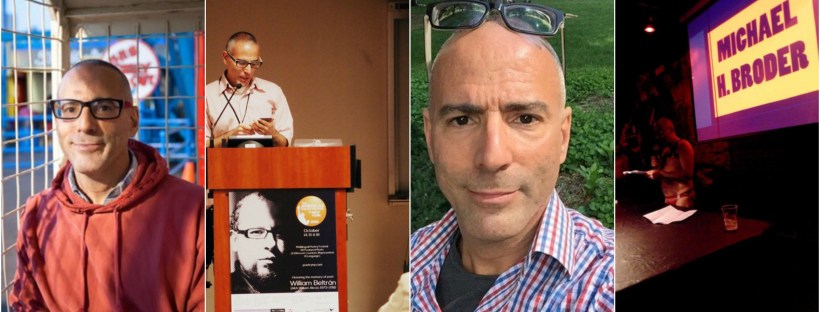
Featuring Michael Broder & The HIV Here and Now Project

The HIV Here and Now Project uses poetry and other arts to advocate for a world without HIV or AIDS. It is a project of Indolent Books and is directed by Michael Broder. The project grew out of an idea for an anthology of poems, still in development, touching on HIV in the 21st century. On June 5, 2015, an online poem-a-day countdown to 35 years of AIDS on June 5, 2016 began. With the online countdown behind them, the print anthology is currently being edited. The site has been lively with blog posts by contributing editors and guest bloggers, many of whom contributed poems to the online countdown and will be represented in the print anthology. Blog posts address long-term survival, recent infection, racialization of HIV, criminalization of HIV, globalization of HIV, and living with HIV risk, among other topics.
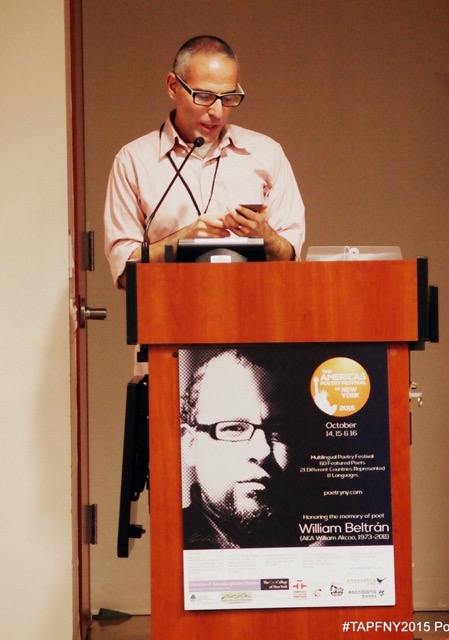

BroderPic_CROPPED

Michael Reading at the Americas Poetry Festival

New York, 2015


THREE poems by michael h. broder


 These poems were part of the Tupelo 30/30 Project in December 2015. 


ESTEEM 


I have a shit list

I love my shit list

I want to roll around like a pig in the ordure of my shit list.

My husband hates my shit list, hates that I have a shit list,

not so much that I harbor ill will or that there is a list—

no, he’s an old hand at nursing old grudges

—but rather that it’s a SHIT list,

because it’s not hatred, anger, or resentment that he dislikes

so much as scatology

Let’s just sit with that wonderful word for a moment…

scatology

which is funny because my husband

loves Kristeva and her abject

Bakhtin and his bodily grotesque

Bersani and the charnel (or should I say Golgothic) rectum,

but only as ideas—

How he suffered, my husband, reading and writing about Hogg

for his dissertation on the molested boy in the postwar American gay novel,

how he wretches at the sight or even thought of the prolapsed

male anus, associated with fisting and other extreme sex acts

But anyway, getting back to my shit list

my mother had a shit list and I am very like her,

my mother who made frequent use of the Yiddish expressions

Gai kakhen afenyam (Go shit in the ocean) and, my favorite,

Hob dir in drerd, which is literally a rather mild “I hold you in the earth,”

but in force is more like “Go to hell” and which

when spat from my mother’s angry, wounded, despiteful mouth

especially that last word, drerd, uvulated and gutteralized

with all the suffering she had suffered in her battered and banished life,

sounded much more like you are on my shit list.


WHAT WOULD SYLVIA HAVE DONE? 


Daddy, you can fuck me up the ass,

but don’t expect me to lick your balls after.

How many poems can I write about the penetrated male anus?

One for each sphincter, maybe—

Two anal sphincters, the external, which is voluntary,

and the internal, which is involuntary,

controlling the exit of feces from the body;

also the entrance of fingers, fists, penises, dildos, butt plugs

and nozzles for anal douching. But there are other sphincters—

pupillary sphincter (in the iris of the eye);

sphincter orbicularis oculi (muscle around the eye);

upper and lower esophageal sphincters

(and…we’re back to fucking);

cardiac sphincter, atop the stomach,

keeping gastric acid from out of your throat;

pyloric sphincter (bottom of the stomach);

ileocecal sphincter (where small intestine meets large intestine,

liminal space between digestion and poop);

Oddi’s sphincter, named for Ruggero Oddi (1864–1913), Italian,

also know as Glisson’s sphincter,

named for Francis Glisson (1599–1677), British physician,
keeping bile and gall in their proper places;

sphincter urethrae, which keeps you from pissing your pants

(and also capable of being fucked, a kink known as “sounding”);

precapillary sphincters, wee microscopic bloodgates;

and finally the preputial sphincter of the foreskin

(may its memory be for a blessing).

I like to think that any sphincter can be fucked; in some

cases, maybe we just haven’t figured out how—yet.


prayer for healing 


May the one who blessed our ancestors, Abraham, Isaac and Jacob, Sarah, Rebecca, Rachel and Leah, bless and heal those who are ill.

—Traditional Jewish prayer for healing


May all who need healing be cauterized, ectomized, frozen

may your healing leave a scar and your scar trace a map,

the map of your scarred wound lead you to a spot marked x

your branded body conceal treasures of love and light

and may god reveal them all, splitting open your wound again,

so that rivers of truth run from your torn body,

may you be grateful for your suffering and learn from your pain

may the shattered parts heal stronger, your torture make you better

may your battered body, beautiful, bring comfort to others
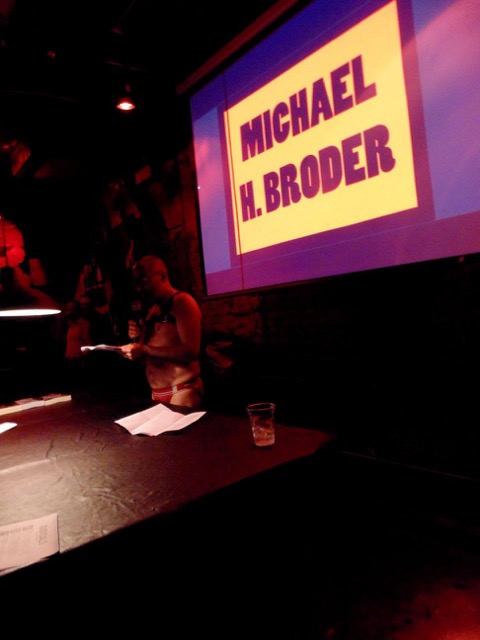


BRODER_Radicals_Reading

Michael reading in a jock strap and harness at the Radicals Reading at The Eagle

New York, 2015


An INTERVIEW WITH MICHAEL H. BRODER

Inklette:  How do you think poetry and identity should be related? In other words, does it ever bother you to be defined by some as “a gay poet,” or do you think understanding your sexuality, and other things you identify as, is crucial to understanding your poetry?

Michael: My gayness is central to my poetry. That does not mean every poem I write is about gay relationships or gay identity. But I remain gay no matter what kind of poems I write. I’m not sure if I think readers need to understand my identity to understand my poetry. I’m not sure that’s the goal. Maybe I want my poems to expand a reader’s awareness about gayness. This could apply even to gay readers. To paraphrase Tolstoy (sort of), not all gay people are gay in the same way.

Inklette: How do you capture the individual struggles of your sociopolitical identity and turn them into a universally provocative narrative for those who might not identify with your situation? 

Michael: How do I make my gayness relevant to readers who might not relate to it? I don’t really know if I do. I don’t really know if I can. I don’t really think it matters. I used to worry about that. I did not want to be thought of exclusively or even predominantly as a gay poet because I wanted a mainstream audience. But that did not work out very well for me. So now I write whatever I want and I do not worry about who my audience will be. Either I will have an audience or I won’t. Probably I will, if I really want one. But it may be small. But that’s okay too. I think I just need to tell the truth, or my version of the truth or my understanding of the truth. The rest will take care of itself, one way or another.

Inklette: Poetry, in the last few years, has emerged as a platform for young and queer writers to express their identities which are often stifled by society. Do you think poetry often helps us to come to terms with ourselves as people of varied identities?

Michael: Poetry can be a place where the poet can explore the terms of their identity. I’m not sure if that’s the same as coming to terms with one’s identity, but maybe it’s another way of saying the same thing. So, if I write a poem about casual anonymous gay sex, or getting an STD from gay sex, which are two things I’ve written about, it’s not so much that I am coming to terms with my gayness as it is about exploring the semantic field of my gayness— what my gayness includes in terms of thoughts, feelings, ideas, and experiences.

Inklette: Can you tell us about how poetry can inspire people to action? While we know there exist realms of thought that do so, what is that spark which can start revolutions? Shall we believe in poetry to change things?

Michael: Generally speaking, I do not believe poetry can inspire action in the way that songs can, in the way that songs can become anthems that rouse the passions of a generation to fight for freedom or protest a war. Maybe today it is memes that do that as much as songs. I’m much too old to really understand what memes are or how they work, but I get the idea that memes can have that kind of power to incite people to act for change. I believe, again, speaking generally, that the power of poetry is more subtle than music or memes. I believe that poetry shapes or reshapes consciousness incrementally and cumulatively, bit by bit, over time. Poetry can shape how and what people think, feel, and believe, and move people into a state of mind where they may want change and work for change. Poetry can change poetry—I mean, a radical new poetic vision can reshape what poetry is and what poetry can be—as Emily Dickinson did, or Walt Whitman, or Gertrude Stein, or the confessional poets, or the beat poets, or very recently, the hip-hop poets. Same applies to music, theater, dance, and the visual arts. But I think only people can change and reshape society, because society is the sum total of people and their thoughts, feelings, beliefs, opinions, and actions. I guess I’m going way back to the Marxian notion of base and superstructure. Only that’s a simplistic idea that has been deepened, widened, and enriched over time by cultural materialists like Raymond Williams and Alan Sinfield. They give culture a much more instrumental rather than merely an ornamental role in society and history. But in the end, people need to march in the streets, assume roles in government, make new laws, and create new norms for society. People must create conditions for justice to flourish. Poetry can help shape the social imaginary that undergirds political action. But poetry is not the same as political action.


Photo Shape Editor: https://www.tuxpi.com/photo-effects/shape-toolMICHAEL BRODER is the author of Drug and Disease Free (Indolent Books, 2016) and This Life Now (A Midsummer Night’s Press, 2014), a finalist for the 2015 Lambda Literary Award for Gay Poetry. His poems have appeared in American Poetry ReviewAssaracusBLOOMColumbia Poetry ReviewCourt Green, OCHO, Painted Bride Quarterly, and other journals, as well as in the anthologies This New Breed: Gents, Bad Boys and Barbarians 2 (Windstorm Creative, 2004), edited by Rudy Kikel; My Diva: 65 Gay Men on the Women Who Inspire Them(Terrace Books, 2009), edited by Michael Montlack; Spaces Between Us: Poetry, Prose and Art on HIV/AIDS (Third World Press, 2010), edited by Kelly Norman Ellis and ML Hunter; Divining Divas: 50 Gay Men on Their Muses (Lethe Press, 2012), edited by Michael Montlack, and Multilingual Anthology: The Americas Poetry Festival of New York 2015 (Artepoética Press, 2015), edited by Carlos Aguasaco and Yrene Santos. Michael is the founding publisher of  Indolent Books and the founding editor of The HIV Here and Now Project. He lives in Brooklyn with his husband, the poet Jason Schneiderman, and a backyard colony of stray and feral cats.

What It Means to Be An Editor

BY TRIVARNA HARIHARAN

Up until I joined Inklette, I was alien to the idea of editorship. I hardly understood what went behind creating literary magazines or how crucial an editorial team was to the process preceding it.

After an year of serving as the Co-Editor-in-Chief at a vibrant community of young artists, I have realised that taking on an editorial position has been one of the best decisions I’ve made.

It has opened my eyes up to not just the technical side of operating a magazine, but also to various kinds of art whose existences I was previously oblivious to.

It has changed the way that I gauge the importance of an editorial process. I no longer belittle or undermine the relevance of one, for I know what goes into it. I no longer look at it as a position of “excessive privilege or power”, for it is certainly not one.

While it is true that editors are entrusted with the responsibility of selecting pieces for publication (and in the process filtering out some), this by no means empowers them to do as they wish. It is a job, after all. Editors work within frameworks and paradigms fenced by rules which are adhered to. This disallows them from being biased or coloured by factors other than the ones assigned to the working of the magazine.

Of course there may be instances of other factors playing in, but those are very few in number. Eventually, pieces will find themselves in places where they truly belong.

An editorial process is an extensive one – and needless to say, it’s a demanding job. But being an editor has its own perks – the opportunity to learn being the most prominent of them.

Editorship allows one the space to explore a plethora of arts, each different from each other in its texture, tonality and narrative. It allows one to discover an eclectic range of pieces, and exposes one to varied perspectives, contexts and stories.

It helps understand different kinds of art, and what goes behind making them. It gives one a place to belong to.  “It made a group of strangers a family”, as my friend, the Founder and Co-Editor-in-Chief, Devanshi Khetarpal rightly puts it. It made us realise the necessity of understanding each other’s strengths and weaknesses, opening us up to varied ways of working on similar pieces. It facilitated an exchange of perspectives – culturally, socially, and intellectually.

It nurtured us into better artists and human beings and made us more receptive to art. It has been a huge lesson in patience, co-operation and perseverance, and what it means to work in unison.

An editorial job may be intricate, time consuming, and extensive, but it is most definitely worth it.


title951409746

TRIVARNA HARIHARAN is an ardent lover of poetry, prose, film, music and everything artistic. She often wonders what the world would have been like without Gabriel Garcia Marquez, J.M. Coetzee and Ruskin Bond. Besides reading and writing, she loves to play the keyboard, and listen to tunes that sound like “neighbours from another world.”

In Response to ‘The Sacred Androgen: The Transgender Debate’ by Daniel Harris

BY HALEY ZILBERBERG


This blog is in response to the article, ‘The Sacred Androgen: The Transgender Debate’ by Daniel Harris published in The Antioch Review here. 


There is no debate. There is no right or wrong in gender or gender expression. Transgender people are not “TGs” or “transgenders” or any other term that takes away the humanity from a group of people who are people before they are anything else. Cisgender people are in a position of power and have privileges that transgender people do not. Writers have the wonderful and beautiful tool of language and the ability to employ rhetoric to make readers see things differently. In the case of Daniel Harris’s “The Transgender Debate,” his writing was not that of beauty, but of destruction.

Transgender people are people. There is no delusion. There is no grand sacrifice. There is no repression. I find it hard to believe, let alone ponder, the idea that people would make their lives so much harder in order to go through a painful experience of transitioning, both emotionally and physically. I cannot conceive that anyone would ever want to go through that hardship on top of the bigotry and lethal actions provided by society. Even someone who is part of a group of people who faces hardships has served a neatly packaged essay with vicious accusations by Daniel Harris. We, at Inklette, will not stand for the unkind words and discrimination towards people with varying gender identities and expressions. We will not let voices of hatred overpower the voices of those who struggle.

There are people, like Daniel Harris, who may struggle with trying to understand that people should not be condemned for simply being themselves. We are growing and evolving as a society every day, and there is room to continuously improve and adapt the views we have towards cultures, peoples, and practices that we do not understand. There is no shame in not knowing everything immediately, but there is shame in belittling minority groups for wanting to be happy. This push against Equal Rights is counterintuitive. When we repress those who strive to live benign and gentle lives being who they are, we are asking these people who are trying to climb the ladder of success to prove they are able to get to the top while throwing boulders on them so they keep falling down.

No institution or organization should use its power on the basis of “freedom of expression” to further oppress people. If you are going to start a war on something wrong with the world, stop targeting people who do nothing destructive and start fighting against the destruction being caused. Being notable in the public eye as a person or an organization makes your words and messages amplified to mass amounts of people. This kind of power should be used to create positive change. There is absolutely nothing constructive about Daniel Harris’s words claiming himself as a ‘supporter’ of Transgender Rights and then tearing down the transgender population. If that is support, I do not want to know what hate is.

People who are transgender are everywhere, and a lot of times, we might not even notice. And that’s how it should be. Society should not be on a hunt to try to pinpoint and pick apart everything about transgender people. There is no room for criticism and scrutiny over things that are personal to others, that are challenging enough without the idiocy of condemning people for wanting to be happy and wanting to be themselves. There is no Transgender Debate that needs to be looked at. There is only the need for people who cannot wrap their heads around something that they do not experience and understand to resolve their own cognitive dissonance. Being transgender does not and will not ever make someone less of a person, but hatred can.


145688373036873 (1)

HALEY ZILBERBERG is pursuing a Bachelor’s in Social Work with a Creative Writing minor. She writes about many topics, often surrounding disabilities and social justice. Haley has been published in Inklette and Loud Zoo (Issue 5).

Insight: Akhil Katyal

AKHIL KATYAL‘s poetry has one of the most eclectic audiences one can find—and a majority of it is virtual. If you trace the ‘shares’ on his posts on social media, you’ll find college professors, students, and often, the students’ parents too. His work evokes a sentiment of immense solidarity. The comments section reads like a classroom discussion, straddling observations, discourse, and impromptu collaborations. Fitting, one could say, considering his official role as an assistant professor at Shiv Nadar University. Indeed, Katyal’s work shadows his ability to teach. He never tells, but merely shows, highlighting subtexts and contexts that leave you wanting to explore more.

Harnidh Kaur, Poetry Editor


When Farida Khanum

sings now,

she does not hide the age
in her voice,


instead
she wraps it in paisleys,
and for a moment
holds it in both of her hands, before

she drowns it in our sky.When she sings now,
she knows

that at the end of that note
when her voice breaks
like a wishbone,

he will stay.


When I die

bury me

only in your eyes.


For someone who’ll read this

500 years from now

How are you?
I am sure a lot has changed

between my time and yours,
but we’re not very different,

you have only one thing on me –
hindsight.

I have all these questions for you:
Do cars fly now?

Is Mumbai still standing by the sea?
How do you folks manage without ozone?

Have the aliens come yet?
Who from my century is still remembered?

How long did India and Pakistan last?
When did Kashmir become free?

It must be surprising for you
looking at our time,

our things must seem so strange to you,
our wars so little,

our toilets for ‘men’ and ‘women’
must make you laugh

our cutting down of trees
would be listed in your ‘Early Causes’

our poetry in which the moon is still
a thing far away

must make you wonder, both for that moon
and for the poetry.

You must be baffled,
that we couldn’t even imagine

the things you now take for granted.
But let that be,

would you do me a favour,
for ‘old time’s sake’?

Would you go to the Humayun’s Tomb
in what used to be Delhi

and just as you’re climbing the front staircase,
near the fourth rung, I have cut into

the stone wall to your left –
‘Akhil loves Rohit’

Will you go and see it?
Just that, go see it.


जेनेरल साहब – Bertolt Brecht
tr. Bertolt Brecht’s ‘General, Dein Tank ist ein starker Wagen’

जेनेरल साहब,
आपका ये टैंक बड़ा ही शक्तिशाली है,
जंगलों को रौंद देता है
सौ-सौ आदमियों को कुचल देता है,
पर इसमें एक दोष है –
इसे एक ड्राइवर की जरूरत पड़ती है

जेनेरल साहब,
आपका ये बॉम्बर बड़ा ही शक्तिशाली है,
हाथी जितना बोझ लिए भी तूफ़ान से तेज़ उड़ता है,
पर इसमें भी एक दोष है –
इसे एक मैकैनिक की जरूरत पड़ती है

जेनेरल साहब,
इंसान बहुत काम की चीज़ है,
वो उड़ सकता है, वो मार भी सकता है,
पर उसमें एक दोष है –
वो सोच भी सकता है


This slideshow requires JavaScript.


Aligarh

Dr. Siras,
In those nights,
you must have felt loneliness like a drip.

The walls of your room
would’ve been held apart only by a faint song,

and memory must have sat by you all night
combing the hours.

In your Marathi poem, Dr. Siras, the one about the ‘beloved moon,’
the one in which you somehow eke dawn from the dark sky,
I read it last night on the terrace,
it held me, it held my hands,
it let grass grow under my feet.

In this house that I have lived in for three years in Delhi, Dr. Siras,
the windows open onto a Palash tree.

I was 27 when I had rented it,
and at 27, the landlord had not spent too much time on the word ‘bachelor’
he had only asked if I had ‘too many parties’,
I didn’t, and I had got the house.

But next time, Dr. Siras, when I will try and look for a place in this city,
I will be older and they will pause at “but marriage?”
and I will try to eke out respect from a right surname,
from saying ‘Teacher’
from telling my birth-place,
and will try and hide my feeling small under my feet.

What had you said, Dr. Siras,
when you looked for that house in Durga Wadi?
What had you said for the neighbourhood, ‘Teacher’, ‘Professor’,
‘Poet’?

What gives us this respect, Dr. Siras, this contract with water?

In those nights,
weighing this word in your hands,
you must have felt weak, like the sun at dusk,
you must have closed the window to keep out the evening,
you must have looked back, and hung the song in the air
between refusal and letting go.

(Thanks to Apurva M. Asrani and Ishani Bannerjee)


That night in Mumbai when Brandt asked ‘Are you good with speed?’ and I said ‘Yes’


it was as if
I pillion rode the moon
on the Western Express Highway,

and every mile we raced on his bike
we reclaimed from the sea,

the Goregaon high-rises passed us by
like longing measured on a Richter scale,

and the sky, window-lit at Malad, tripped
onto us,

at Kandivali, the fortieth floors spun out
into the night till the sky was only staircases,

and when he dropped me
by those black mountains of Borivali,
I realized I had held onto my seat
like the black holds onto basalt,
like the skin holds onto bones,
like Mumbai holds onto sea.


इंसान की कीमत कितनी कम लगाई जाती है – रोहित वेमुला
 

इंसान की कीमत
कितनी कम लगाई जाती है

बस एक छोटी सी पहचान दी जाती है
फिर जिसका जितना काम निकल आये –
कभी एक वोट,
कभी एक आंकड़ा,
कभी एक खोखली सी चीज़

कभी माना ही नहीं जाता कि इंसान
आखिर एक जीवंत मन है

एक अद्भुत सी चीज़ है
जिसे तारों की धूल से गढ़ा गया है

चाहे किताबों में देख लो, चाहे सड़कों पर,
चाहे उसे लड़ते हुए देख लो,
चाहे जीते-मरते हुए देख लो


चाहने से क्या नहीं मिलता

आकाश दो तिहाई ‘काश’ है
आसमां आधा ‘आस’ है


Q-A WITH AKHIL KATYAL

Inklette: What does the experience of being a contemporary Indian writer mean to you? What is it like to occupy this space?

Akhil: These are very, very strange times. Professor Gopal Guru who opened the lecture series on Nationalism recently at JNU, after the terrible sedition row, said the “benign, egalitarian state” has gone missing. Imagining it back into being seems such an uphill task. Think of this – a small university event on 9th February whose very name was the name of a poetry book, ‘The Country Without a Post-Office’, an event which raised legitimate concerns about the miscarriage of justice at the highest levels, an event which brought Kashmir – which has never known India as either ‘benign’ or ‘egalitarian’ – shattering back into the mainstream Delhi imagination, that one event, could kick-start a most unfortunate series of events which landed up three university students in jail and hundreds others finding themselves demonised in their own city. A false bogey of ‘anti-nationalism’ was raised to scuttle deep and searching questions this country needs to ask, that its writers and artists, its teachers and students are asking.  

Speaking on these series of events, in the same lecture series, journalist P. Sainath said to JNU students – ‘Welcome to the rest of India’. You’re only experiencing, he told them, what non-Delhi has been experiencing for decades, the repression, the arrests, the elusive bails, what Bastar or Jagatsinghpur feel in their marrows every day. What Kashmir could give all of us masterclasses in. Look at Hyderabad. Look at what is happening in the university, to its students and teachers, who are, against all odds, carrying out a most strident struggle for all of us. Look at the utter casteist and MHRD-backed forces at work against them.

It is important, and inspiring, to note that at the centre of both these rows, in JNU or HCU, is a boundless literary imagination, one that has shown the way to wed that which is ‘political’ with that which is ‘imaginative’ – there is no other way, there can be no other way. Rohith Vemula’s reaching for the stars in that gut-wrenching last letter which has become the fable of our times, and Agha Shahid Ali’s searing and sorrow-laden transcription of the horrors in 90s Kashmir in his book ‘The Country without a Post-Office’ are what we have at the centre of these debates. These documents anchor these debates, fuel them, and keep them alive. It tries to keep at bay a government that is afraid of its artists, teachers and poets – that pushed Vemula to his death, that was flummoxed by Ali’s metaphors. To be an Indian writer today is to recognize such power in the literary, in such urgent and poignant voices such as Vemula’s and Ali’s. To appreciate what conversations it can create, what old, rigid forces it can upset. To be a writer today is also to recognize the differences between literary folks working in different settings – of language, of caste position, of location. The anti-caste songs of the musicians and poets of the Kabir Kala Manch in Maharashtra landed them up in jail, whereas I largely write from the relative safety of Delhi, of a job, of a caste-position that shelters me, of cultural capital that has so far ensured nothing untoward happens.

At a recent event in Delhi University, where some of us were called to read poems on the occasion of Women’s Day, there was a threat that the BJP student wing ABVP would interrupt the event and cause trouble if any anti-Sangh sentiment was expressed at the event. They had done it in the past on many, many occasions. We noticed some of them were hovering around. This is our times. The space of the literary finds itself surrounded, sometimes vulnerable and sometimes strident, in this BJP-backed anti-intellectual, anti-artistic climate that is systematically being built one arrest after another, one denied bail after another, one sedition row after another. But my contemporaries – in and outside Delhi, writing in Hindi, in Marathi, or in Telugu – continue to write in situations million times more vitiated than mine. So what excuse do I have. I draw inspiration from them and get on and write.    

Inklette: We’ve heard you’re learning Urdu these days. Could you talk more about it? Also, as a translator, what is your relationship with language?

Akhil: You know it is incredible. One of my students, Abdur, is teaching me. He is walking me through a language that had always felt so intimate but never looked it. Now each letter is being caressed out of incomprehension. And brought into meaning. You know I learnt to write ‘dil’, ‘ab’, ‘aarzu’, ‘suno’ and other such short words in the last class. It was quite overwhelming when I could recognize the ‘gulon’ of Faiz’s ‘gulon mein rang bhare, baad-e-nau-bahaar chale’. As a translator, what do you want – you what to know how a language breathes, sits, dreams, gasps, orgasms. You want to make the dreams of one language be realized in another, you want one language touch the viscerality of another. Learning the Nastaliq at this late stage – I am 30 – not as someone who is learning it by rote but as one for whom each curve and nuktah is a thing of beauty, is a thing of surprise, I cannot thank Abdur enough who is helping me in this. He is opening the door and letting me enter a language. I am looking forward to the day – hopefully not too far – when I would write a letter, all right to left, all curves and dots, that would express the appreciation I feel. Also, to a translator, a third script means your world has just exploded open. New texts, new authors, new loves, new noise, new worlds to inhabit.

Inklette: You’ve written and spoken about sexuality on various platforms and occasions. Poetry has a body, a form, through which language flows. How would you compare this experience of poetry with the experience that is shared between the body and sexuality, at large?

Akhil: I know there are nights when to be able to write a poem is also to be able to sleep that night. That the poem produces that very visceral, that very physical response – of calm, of rest wrenched out of restlessness. Of the place which the body reaches with that ability to transcribe in words that precise thing which is happening inside and around you. I know that there is something somatic about what the poem does – when you write it, when you read it to yourself, when you share it with others. You know that feeling, when you’re reading something on stage, when you’re reading it among hundreds of listeners, you hurl your body into the audience as much as you hurl your words. Think of Habib Jalib reciting ‘Aise dastoor ko, subah be-noor ko, main nahin maanta, main nahin jaanta.’ Think of his body trembling at each word, think of each word finding a limb. That’s my ideal, I wish I was able to write and sing like that. For the very specific of your question, as far as the ‘body’ of the poem is concerned, its ‘form’ which allows language to flow through it and find meaning in it, and the connection of this with our own sexualness, I guess there is a quirky allegory there somewhere but I don’t know what it is.   

Inklette: Finally, we come to the toughest question: do you have any favourite poets or writers?

Akhil: It is not tough at all. Agha Shahid Ali for his searing embrace of sorrow, Dorothy Parker for her pathos and self-deprecation, Mangalesh Dabral for his gentle inventiveness and bringing alive mountains for me, Uday Prakash for his hope in the darkest of times and insight, Rene Sharanya Verma for her joy and resistance, Aditi Rao for her vulnerability, Anannya Dasgupta for letting pain know rhyme, Vikramaditya Sahai for wrapping words around heartbreak, Dushyant Kumar for letting me know what places of love Hindi can find, Gorakh Pandey for his imagism that is possible only in the welter of the political, Parveen Shakir, for letting me stake a claim on Urdu, and finally, Faiz Ahmed Faiz, for telling me that there is a vocabulary in which one’s desires can speak to the desires of one’s time.


AKHIL KATYAL is a writer and translator based in Delhi. His first book of poems Night Charge Extra was shortlisted for the Muse India Satish Verma Young Writers Award – 2015. In 2014, he was selected among the five best emerging writers in India by The Caravan Magazine and The Columbia University Global Centre in France. He translates widely between Hindi and English, including the works of Langston Hughes, Mangalesh Dabral, Amrita Pritam and Dorothy Parker.


Behind the Scenes: Vikram Kushwah

VIKRAM KUSHWAH’s photos reflect a longing for childhood dreams and fantasies, and for a world unsullied by modernity and the mundane; a simpler life, when ‘miracles were taken for granted’, as Vikram puts it. Similarly, through his corpus of work, Vikram strives to ‘challenge reality’ and rebel against the modern world through celebrating the romanticism and innocence of the ‘pure self’ of the child. The poignant symbols and images featured in his surreal and magical photos are a manifestation of this celebration and yearning.


‘OFELEA’

This slideshow requires JavaScript.


In addition to being inspired by his childhood memories and his notions of romanticism, Vikram’s artistic influences are vast. While through his work one can see a direct link to childhood classics such as Alice in Wonderland and Peter Pan, Vikram also cites the works of Sigmund Freud and the photographer Guy Bourdin as having left a profound impression on him. As well, while pursuing his Master’s, he was particularly drawn to the work of the Surrealists, the Romantics, and the Pre-Raphaelites.


‘THE TWINS & THE GREEN CAR’

This slideshow requires JavaScript.


‘WHAT IF THESE WERE LEGS’

This slideshow requires JavaScript.


Q & A WITH VIKRAM KUSHWAH

Inklette: The world that you create in your work is an individual, personal space. Yet, do you like to be defined by it or are you simply a part of the whole?

Vikram: I’m certainly a part of the whole as I am in that kind of space – at least in my head—even when I’m not producing work. It follows me. I follow it. So in that sense you could also say that I’m defined by it. Also because, while flipping through a magazine, people tend to recognise or distinguish my work from the rest. It’s some kind of a paradox.

Inklette: At the end of every project, how do you think you change from within?

Vikram: I don’t think I change from within at all. I have and always will be a daydreamer. I have always seen my work as a sort of rebellion against the modern times where violent acts of destruction are commonplace. That will not change. A friend recently wrote this after seeing one of my recent series, “Quite honestly I ‘d rather just look at some beautiful things than think about all the horrific stuff and quality of humans floating around in the universe!” That’s one of the ways I’d like to impact people.

Inklette: You’ve stated that you have been influenced by Surrealism and Romanticism. How do you converge that narrative into your own, as a contemporary photographer?

Vikram: I don’t take Surrealism and Romanticism as necessarily belonging to the art periods of the past. I think they’re states of the mind. Therefore past and contemporary do not apply. I dream of a simpler world, a place without rigid social rules – and that’s where the magic comes in my pictures. My daydreamer self lends itself to the surrealism of my work. Of course, I’ve studied the historical art periods and have taken inspiration from those as well.

Inklette: So, you teach high school students photography in the summer through the OxBridge Academic Programs. What do you hope they take away as artists and people?

Vikram: I hope they take away photography as an art form and not merely as a technical medium because art enables people, it elates and it excites – and more so with young minds. I hope they can be dreamers at some level.

Inklette: The elements in your work are characterized by a mix of wondrous synchronization and a gnawing sense of dream-like disintegration. Where does the origin of such inspiration lie, according to you?

Vikram: The inspiration at the very core, at the very heart is triggered by the imagination. With an imagination, anything can become inspirational, even the everyday and the seemingly mundane. The imagination helps perceive things differently and then conceive an idea. It’s the same with me—anything I see, hear, taste, smell can inspire or trigger an idea but it’s the imagination (read: daydreaming) that really helps construct it.

Inklette: In your work, there is a striking dimension where each event takes place in an unconscious space. Surprisingly, in your photographs, that dimension is more perceivable and tangible than distant. How would you explain this or how do you manage to do this?

Vikram: I can only think of one explanation. What you see in my pictures is what really happens when I press the button.


In 2010, VIKRAM KUSHWAH completed his masters in photography at University for the Creative Arts, Rochester. He has since been practicing his art in Britain and India, working for reputed publications such as Vogue and Harper’s Bazaar and showing his work in galleries in the UK, Europe and the USA. His collector base spans Europe, America and Asia. Vogue Italia featured him in their ‘New Talents’ section in 2012. The following year his work won a bronze at Cannes for an advertising campaign shot for a Singapore based agency.He currently lives in London. You can visit his website here.

Staff Tales

The Inklette team comprising entirely of youngsters in high school or college has been busy curating submissions and adding the final touches to the magazine’s second issue, due to be released in early April. But in addition to editorial duties and preparing for finals, the multi-talented members have been involved in a host of other creative and profitable activities as well, whether it’s being published in literary journals, winning competitions or even graduating from high school an entire semester early!

Read on to find out what your favourite Inklettes have been upto in the months of January and February: 


Inklette’s Co-Founder and Editor-in-ChiefDevanshi Khetarpal, has recently joined the staff of the upcoming Moledro Magazine as a Poetry Editor. Moreover, her latest poems have been accepted at Souvenir Literary Journal and The Corner Club Press Magazine. One of her poems received an Honorable Mention from the Nancy Thorp Poetry Contest by Hollins University. Along with comrade, Trivarna Hariharan, Co-Founder and Editor-in-Chief, the duo have also been interviewed by LitBridge. In addition to this, Trivarna’s poetry has also been featured in HIV Here and Now, On The Rusk and Random Sample Review and also joined the staff of Moledro Magazine as a Poetry Editor and Director of Social Media.

Meanwhile, the Prose Editors have been upto some serious creative writing. Liana Fu recently won two regional gold keys in Scholastic Art and Writing awards for personal essay/memoir. John Osler III had a short story published in Moledro Magazine and launched the latest issue of The Southern View, an underground satirical newspaper that he runs. But Nathalia Baum has definitely been industrious – she graduated from high school a semester early! She says, “I had to really load up my schedule to meet all the graduation requirements but I’m really proud of myself and am using my time to take classes at a nearby college and write.”

Poetry Reader, Smriti Verma too has been taking her creative writing seriously with her work being featured in B O D Y and Crashtest. Inklette is also immensely proud that Poetry Editor, Harnidh Kaur and Prose Reader, Rohit Chakraborty have been featured in the Campus Diaries’ list of “Top 25 Under 25” change-makers in the ‘writing’ category. While Harnidh has been recently published in the American Mustard, Rohit’s reviews and fiction pieces have appeared in Kindle magazine. Meanwhile Prose Reader, Umang Kalra has made it to Trinity College Dublin, Class of 2020!

Moreover, Inklette’s mischievous Illustrator/Designer, Aditi Chandra, has been busy developing her website/blog: http://www.aditichandra.wordpress.com, which is almost ready to be launched. She is also delighted to have been published in ArtRefurbishAlexandria QuarterlyCargo Literary and Moledro Magazine.
On the other hand,  the Interns have been participating in a variety of extra-curricular activities. Haley Zilberberg’s latest volunteer activities include being the Vice President of a club called ‘Access at UCF Now’ and she even received a Scholarship for the School of Social Work at the University of Central Florida! Plus, she also has her writing forthcoming on the site, ‘Everyone is gay.’ Archita Mittra has been recently published in Culture Cult, Quail Bell Magazine and Eye Art Collective. She also won the second prize in the Eriata Oribhabor International Food Poetry Competition 2015. Finally, wordsmith Paige Ariella Robinson has been working on her novella as well as writing for her school newspaper and play-writing class.
Way to go, Inklettes!

Blog Credits: Archita Mittra (Intern)


145789737574684ARCHITA MITTRA is a freshman, majoring in English, at Jadavpur University. A student journalist for Voices, the Thursday supplement to The Statesman, she is a regular contributor to Glo Mag and Quail Bell Magazine. Her work has been recognized by The Statesman, The Albert Barrow Creative Writing Competition and TATA Literature Live! To know more about Archita, visit her website here.